 Add to Chrome
 Add to Firefox
 Add to Edge
DeltaMIL: Gated Memory Integration for Efficient and Discriminative Whole Slide Image Analysis
Dec 22, 2025
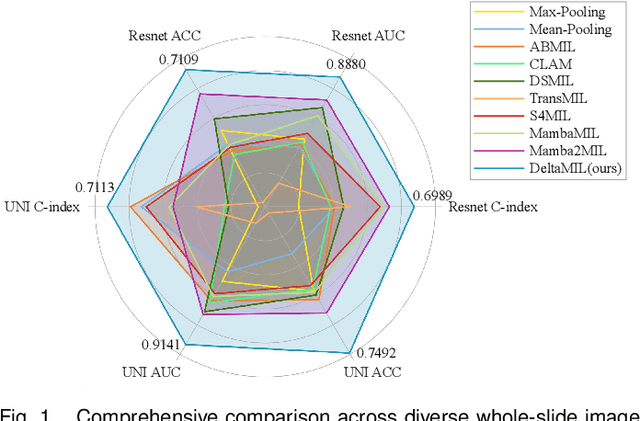
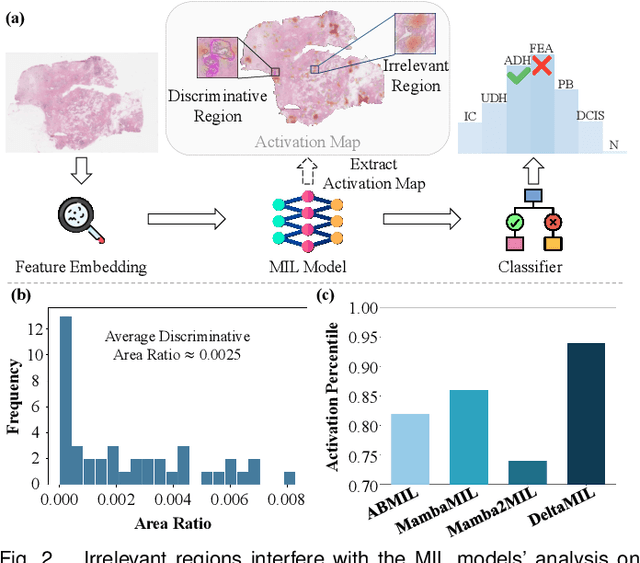

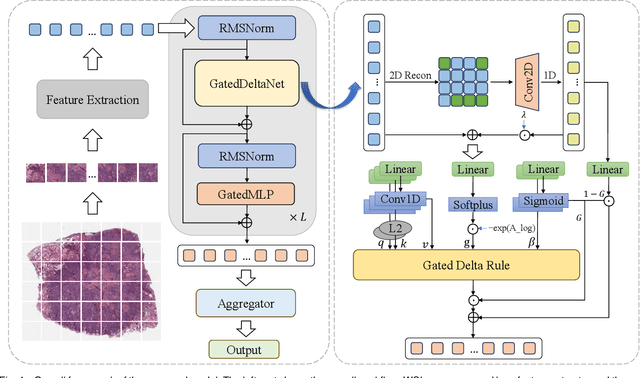
Whole Slide Images (WSIs) are typically analyzed using multiple instance learning (MIL) methods. However, the scale and heterogeneity of WSIs generate highly redundant and dispersed information, making it difficult to identify and integrate discriminative signals. Existing MIL methods either fail to discard uninformative cues effectively or have limited ability to consolidate relevant features from multiple patches, which restricts their performance on large and heterogeneous WSIs. To address this issue, we propose DeltaMIL, a novel MIL framework that explicitly selects semantically relevant regions and integrates the discriminative information from WSIs. Our method leverages the gated delta rule to efficiently filter and integrate information through a block combining forgetting and memory mechanisms. The delta mechanism dynamically updates the memory by removing old values and inserting new ones according to their correlation with the current patch. The gating mechanism further enables rapid forgetting of irrelevant signals. Additionally, DeltaMIL integrates a complementary local pattern mixing mechanism to retain fine-grained pathological locality. Our design enhances the extraction of meaningful cues and suppresses redundant or noisy information, which improves the model's robustness and discriminative power. Experiments demonstrate that DeltaMIL achieves state-of-the-art performance. Specifically, for survival prediction, DeltaMIL improves performance by 3.69\% using ResNet-50 features and 2.36\% using UNI features. For slide-level classification, it increases accuracy by 3.09\% with ResNet-50 features and 3.75\% with UNI features. These results demonstrate the strong and consistent performance of DeltaMIL across diverse WSI tasks.

SuperCLIP: CLIP with Simple Classification Supervision
Dec 16, 2025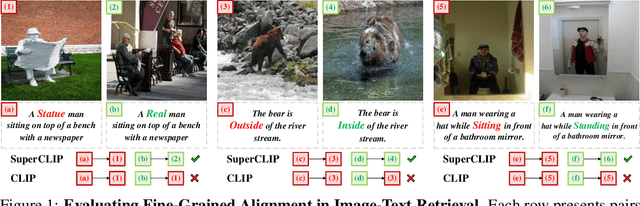

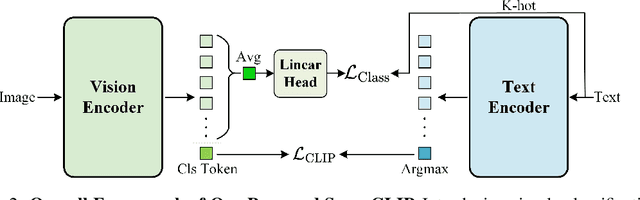
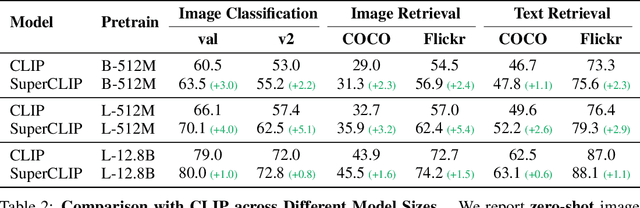
Contrastive Language-Image Pretraining (CLIP) achieves strong generalization in vision-language tasks by aligning images and texts in a shared embedding space. However, recent findings show that CLIP-like models still underutilize fine-grained semantic signals in text, and this issue becomes even more pronounced when dealing with long and detailed captions. This stems from CLIP's training objective, which optimizes only global image-text similarity and overlooks token-level supervision - limiting its ability to achieve fine-grained visual-text alignment. To address this, we propose SuperCLIP, a simple yet effective framework that augments contrastive learning with classification-based supervision. By adding only a lightweight linear layer to the vision encoder, SuperCLIP leverages token-level cues to enhance visual-textual alignment - with just a 0.077% increase in total FLOPs, and no need for additional annotated data. Experiments show that SuperCLIP consistently improves zero-shot classification, image-text retrieval, and purely visual tasks. These gains hold regardless of whether the model is trained on original web data or rich re-captioned data, demonstrating SuperCLIP's ability to recover textual supervision in both cases. Furthermore, SuperCLIP alleviates CLIP's small-batch performance drop through classification-based supervision that avoids reliance on large batch sizes. Code and models will be made open source.
Towards Scalable Pre-training of Visual Tokenizers for Generation
Dec 15, 2025The quality of the latent space in visual tokenizers (e.g., VAEs) is crucial for modern generative models. However, the standard reconstruction-based training paradigm produces a latent space that is biased towards low-level information, leading to a foundation flaw: better pixel-level accuracy does not lead to higher-quality generation. This implies that pouring extensive compute into visual tokenizer pre-training translates poorly to improved performance in generation. We identify this as the ``pre-training scaling problem`` and suggest a necessary shift: to be effective for generation, a latent space must concisely represent high-level semantics. We present VTP, a unified visual tokenizer pre-training framework, pioneering the joint optimization of image-text contrastive, self-supervised, and reconstruction losses. Our large-scale study reveals two principal findings: (1) understanding is a key driver of generation, and (2) much better scaling properties, where generative performance scales effectively with compute, parameters, and data allocated to the pretraining of the visual tokenizer. After large-scale pre-training, our tokenizer delivers a competitive profile (78.2 zero-shot accuracy and 0.36 rFID on ImageNet) and 4.1 times faster convergence on generation compared to advanced distillation methods. More importantly, it scales effectively: without modifying standard DiT training specs, solely investing more FLOPS in pretraining VTP achieves 65.8\% FID improvement in downstream generation, while conventional autoencoder stagnates very early at 1/10 FLOPS. Our pre-trained models are available at https://github.com/MiniMax-AI/VTP.
InfiniteVL: Synergizing Linear and Sparse Attention for Highly-Efficient, Unlimited-Input Vision-Language Models
Dec 09, 2025Window attention and linear attention represent two principal strategies for mitigating the quadratic complexity and ever-growing KV cache in Vision-Language Models (VLMs). However, we observe that window-based VLMs suffer performance degradation when sequence length exceeds the window size, while linear attention underperforms on information-intensive tasks such as OCR and document understanding. To overcome these limitations, we propose InfiniteVL, a linear-complexity VLM architecture that synergizes sliding window attention (SWA) with Gated DeltaNet. For achieving competitive multimodal performance under constrained resources, we design a three-stage training strategy comprising distillation pretraining, instruction tuning, and long-sequence SFT. Remarkably, using less than 2\% of the training data required by leading VLMs, InfiniteVL not only substantially outperforms previous linear-complexity VLMs but also matches the performance of leading Transformer-based VLMs, while demonstrating effective long-term memory retention. Compared to similar-sized Transformer-based VLMs accelerated by FlashAttention-2, InfiniteVL achieves over 3.6\times inference speedup while maintaining constant latency and memory footprint. In streaming video understanding scenarios, it sustains a stable 24 FPS real-time prefill speed while preserving long-term memory cache. Code and models are available at https://github.com/hustvl/InfiniteVL.
DiffusionDriveV2: Reinforcement Learning-Constrained Truncated Diffusion Modeling in End-to-End Autonomous Driving
Dec 08, 2025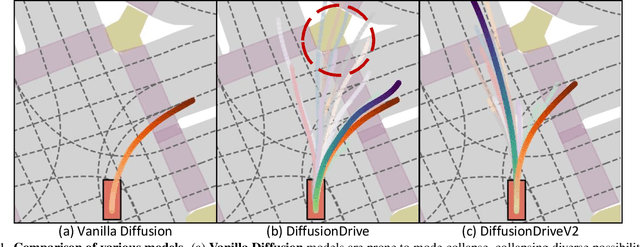
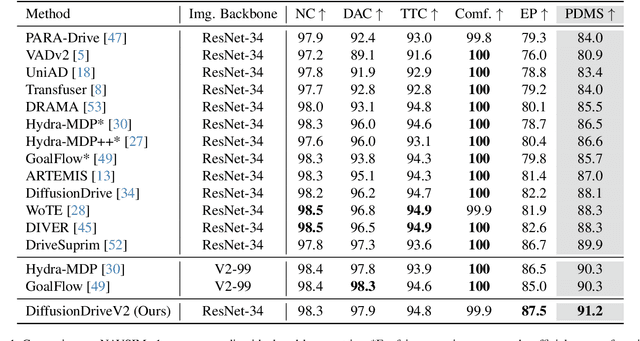
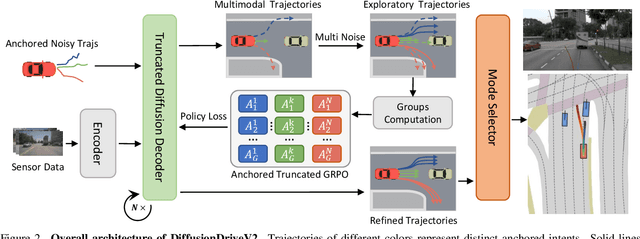
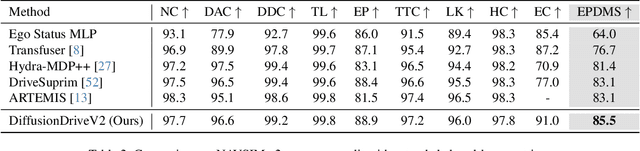
Generative diffusion models for end-to-end autonomous driving often suffer from mode collapse, tending to generate conservative and homogeneous behaviors. While DiffusionDrive employs predefined anchors representing different driving intentions to partition the action space and generate diverse trajectories, its reliance on imitation learning lacks sufficient constraints, resulting in a dilemma between diversity and consistent high quality. In this work, we propose DiffusionDriveV2, which leverages reinforcement learning to both constrain low-quality modes and explore for superior trajectories. This significantly enhances the overall output quality while preserving the inherent multimodality of its core Gaussian Mixture Model. First, we use scale-adaptive multiplicative noise, ideal for trajectory planning, to promote broad exploration. Second, we employ intra-anchor GRPO to manage advantage estimation among samples generated from a single anchor, and inter-anchor truncated GRPO to incorporate a global perspective across different anchors, preventing improper advantage comparisons between distinct intentions (e.g., turning vs. going straight), which can lead to further mode collapse. DiffusionDriveV2 achieves 91.2 PDMS on the NAVSIM v1 dataset and 85.5 EPDMS on the NAVSIM v2 dataset in closed-loop evaluation with an aligned ResNet-34 backbone, setting a new record. Further experiments validate that our approach resolves the dilemma between diversity and consistent high quality for truncated diffusion models, achieving the best trade-off. Code and model will be available at https://github.com/hustvl/DiffusionDriveV2
Phys-Liquid: A Physics-Informed Dataset for Estimating 3D Geometry and Volume of Transparent Deformable Liquids
Nov 14, 2025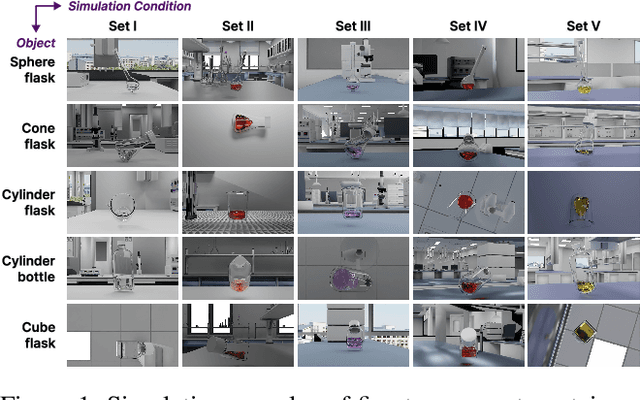
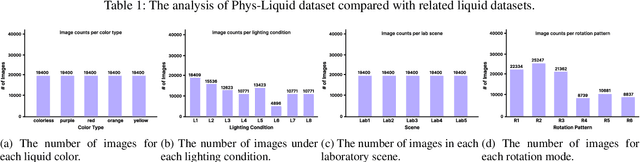
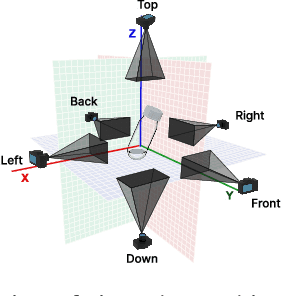

Estimating the geometric and volumetric properties of transparent deformable liquids is challenging due to optical complexities and dynamic surface deformations induced by container movements. Autonomous robots performing precise liquid manipulation tasks, such as dispensing, aspiration, and mixing, must handle containers in ways that inevitably induce these deformations, complicating accurate liquid state assessment. Current datasets lack comprehensive physics-informed simulation data representing realistic liquid behaviors under diverse dynamic scenarios. To bridge this gap, we introduce Phys-Liquid, a physics-informed dataset comprising 97,200 simulation images and corresponding 3D meshes, capturing liquid dynamics across multiple laboratory scenes, lighting conditions, liquid colors, and container rotations. To validate the realism and effectiveness of Phys-Liquid, we propose a four-stage reconstruction and estimation pipeline involving liquid segmentation, multi-view mask generation, 3D mesh reconstruction, and real-world scaling. Experimental results demonstrate improved accuracy and consistency in reconstructing liquid geometry and volume, outperforming existing benchmarks. The dataset and associated validation methods facilitate future advancements in transparent liquid perception tasks. The dataset and code are available at https://dualtransparency.github.io/Phys-Liquid/.
Gait Recognition via Collaborating Discriminative and Generative Diffusion Models
Nov 09, 2025Gait recognition offers a non-intrusive biometric solution by identifying individuals through their walking patterns. Although discriminative models have achieved notable success in this domain, the full potential of generative models remains largely underexplored. In this paper, we introduce \textbf{CoD$^2$}, a novel framework that combines the data distribution modeling capabilities of diffusion models with the semantic representation learning strengths of discriminative models to extract robust gait features. We propose a Multi-level Conditional Control strategy that incorporates both high-level identity-aware semantic conditions and low-level visual details. Specifically, the high-level condition, extracted by the discriminative extractor, guides the generation of identity-consistent gait sequences, whereas low-level visual details, such as appearance and motion, are preserved to enhance consistency. Furthermore, the generated sequences facilitate the discriminative extractor's learning, enabling it to capture more comprehensive high-level semantic features. Extensive experiments on four datasets (SUSTech1K, CCPG, GREW, and Gait3D) demonstrate that CoD$^2$ achieves state-of-the-art performance and can be seamlessly integrated with existing discriminative methods, yielding consistent improvements.
Few-step Flow for 3D Generation via Marginal-Data Transport Distillation
Sep 04, 2025Flow-based 3D generation models typically require dozens of sampling steps during inference. Though few-step distillation methods, particularly Consistency Models (CMs), have achieved substantial advancements in accelerating 2D diffusion models, they remain under-explored for more complex 3D generation tasks. In this study, we propose a novel framework, MDT-dist, for few-step 3D flow distillation. Our approach is built upon a primary objective: distilling the pretrained model to learn the Marginal-Data Transport. Directly learning this objective needs to integrate the velocity fields, while this integral is intractable to be implemented. Therefore, we propose two optimizable objectives, Velocity Matching (VM) and Velocity Distillation (VD), to equivalently convert the optimization target from the transport level to the velocity and the distribution level respectively. Velocity Matching (VM) learns to stably match the velocity fields between the student and the teacher, but inevitably provides biased gradient estimates. Velocity Distillation (VD) further enhances the optimization process by leveraging the learned velocity fields to perform probability density distillation. When evaluated on the pioneer 3D generation framework TRELLIS, our method reduces sampling steps of each flow transformer from 25 to 1 or 2, achieving 0.68s (1 step x 2) and 0.94s (2 steps x 2) latency with 9.0x and 6.5x speedup on A800, while preserving high visual and geometric fidelity. Extensive experiments demonstrate that our method significantly outperforms existing CM distillation methods, and enables TRELLIS to achieve superior performance in few-step 3D generation.
TransLight: Image-Guided Customized Lighting Control with Generative Decoupling
Aug 20, 2025Most existing illumination-editing approaches fail to simultaneously provide customized control of light effects and preserve content integrity. This makes them less effective for practical lighting stylization requirements, especially in the challenging task of transferring complex light effects from a reference image to a user-specified target image. To address this problem, we propose TransLight, a novel framework that enables high-fidelity and high-freedom transfer of light effects. Extracting the light effect from the reference image is the most critical and challenging step in our method. The difficulty lies in the complex geometric structure features embedded in light effects that are highly coupled with content in real-world scenarios. To achieve this, we first present Generative Decoupling, where two fine-tuned diffusion models are used to accurately separate image content and light effects, generating a newly curated, million-scale dataset of image-content-light triplets. Then, we employ IC-Light as the generative model and train our model with our triplets, injecting the reference lighting image as an additional conditioning signal. The resulting TransLight model enables customized and natural transfer of diverse light effects. Notably, by thoroughly disentangling light effects from reference images, our generative decoupling strategy endows TransLight with highly flexible illumination control. Experimental results establish TransLight as the first method to successfully transfer light effects across disparate images, delivering more customized illumination control than existing techniques and charting new directions for research in illumination harmonization and editing.
Snap-Snap: Taking Two Images to Reconstruct 3D Human Gaussians in Milliseconds
Aug 20, 2025Reconstructing 3D human bodies from sparse views has been an appealing topic, which is crucial to broader the related applications. In this paper, we propose a quite challenging but valuable task to reconstruct the human body from only two images, i.e., the front and back view, which can largely lower the barrier for users to create their own 3D digital humans. The main challenges lie in the difficulty of building 3D consistency and recovering missing information from the highly sparse input. We redesign a geometry reconstruction model based on foundation reconstruction models to predict consistent point clouds even input images have scarce overlaps with extensive human data training. Furthermore, an enhancement algorithm is applied to supplement the missing color information, and then the complete human point clouds with colors can be obtained, which are directly transformed into 3D Gaussians for better rendering quality. Experiments show that our method can reconstruct the entire human in 190 ms on a single NVIDIA RTX 4090, with two images at a resolution of 1024x1024, demonstrating state-of-the-art performance on the THuman2.0 and cross-domain datasets. Additionally, our method can complete human reconstruction even with images captured by low-cost mobile devices, reducing the requirements for data collection. Demos and code are available at https://hustvl.github.io/Snap-Snap/.