 Add to Chrome
 Add to Firefox
 Add to Edge
Detail Matters: Mamba-Inspired Joint Unfolding Network for Snapshot Spectral Compressive Imaging
Jan 02, 2025
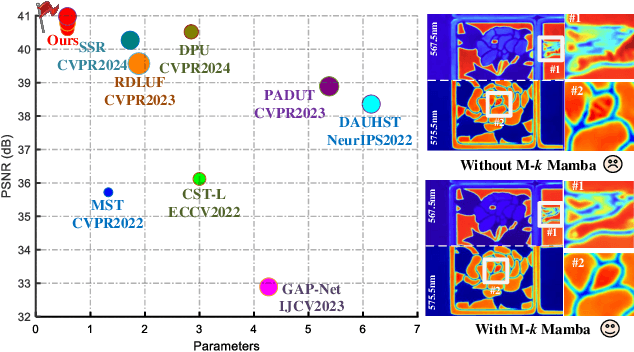
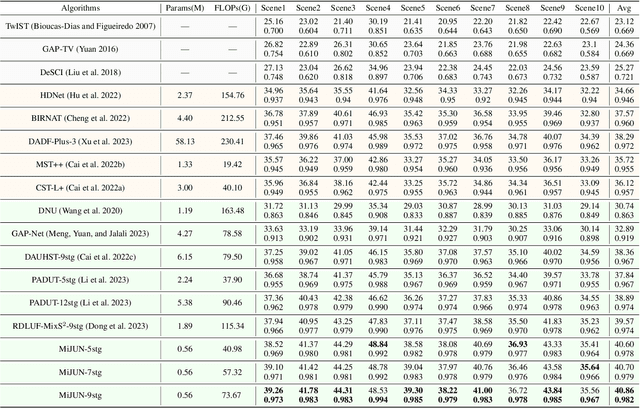

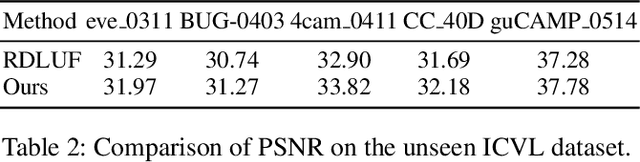
In the coded aperture snapshot spectral imaging system, Deep Unfolding Networks (DUNs) have made impressive progress in recovering 3D hyperspectral images (HSIs) from a single 2D measurement. However, the inherent nonlinear and ill-posed characteristics of HSI reconstruction still pose challenges to existing methods in terms of accuracy and stability. To address this issue, we propose a Mamba-inspired Joint Unfolding Network (MiJUN), which integrates physics-embedded DUNs with learning-based HSI imaging. Firstly, leveraging the concept of trapezoid discretization to expand the representation space of unfolding networks, we introduce an accelerated unfolding network scheme. This approach can be interpreted as a generalized accelerated half-quadratic splitting with a second-order differential equation, which reduces the reliance on initial optimization stages and addresses challenges related to long-range interactions. Crucially, within the Mamba framework, we restructure the Mamba-inspired global-to-local attention mechanism by incorporating a selective state space model and an attention mechanism. This effectively reinterprets Mamba as a variant of the Transformer} architecture, improving its adaptability and efficiency. Furthermore, we refine the scanning strategy with Mamba by integrating the tensor mode-$k$ unfolding into the Mamba network. This approach emphasizes the low-rank properties of tensors along various modes, while conveniently facilitating 12 scanning directions. Numerical and visual comparisons on both simulation and real datasets demonstrate the superiority of our proposed MiJUN, and achieving overwhelming detail representation.

Learning Radiance Fields from a Single Snapshot Compressive Image
Dec 27, 2024In this paper, we explore the potential of Snapshot Compressive Imaging (SCI) technique for recovering the underlying 3D scene structure from a single temporal compressed image. SCI is a cost-effective method that enables the recording of high-dimensional data, such as hyperspectral or temporal information, into a single image using low-cost 2D imaging sensors. To achieve this, a series of specially designed 2D masks are usually employed, reducing storage and transmission requirements and offering potential privacy protection. Inspired by this, we take one step further to recover the encoded 3D scene information leveraging powerful 3D scene representation capabilities of neural radiance fields (NeRF). Specifically, we propose SCINeRF, in which we formulate the physical imaging process of SCI as part of the training of NeRF, allowing us to exploit its impressive performance in capturing complex scene structures. In addition, we further integrate the popular 3D Gaussian Splatting (3DGS) framework and propose SCISplat to improve 3D scene reconstruction quality and training/rendering speed by explicitly optimizing point clouds into 3D Gaussian representations. To assess the effectiveness of our method, we conduct extensive evaluations using both synthetic data and real data captured by our SCI system. Experimental results demonstrate that our proposed approach surpasses the state-of-the-art methods in terms of image reconstruction and novel view synthesis. Moreover, our method also exhibits the ability to render high frame-rate multi-view consistent images in real time by leveraging SCI and the rendering capabilities of 3DGS. Codes will be available at: https://github.com/WU- CVGL/SCISplat.
SGIA: Enhancing Fine-Grained Visual Classification with Sequence Generative Image Augmentation
Dec 09, 2024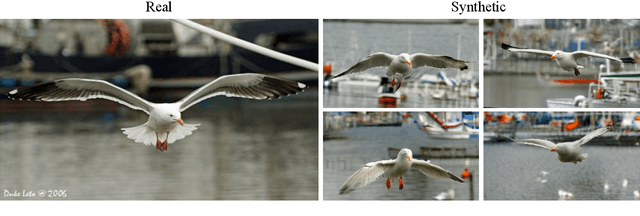
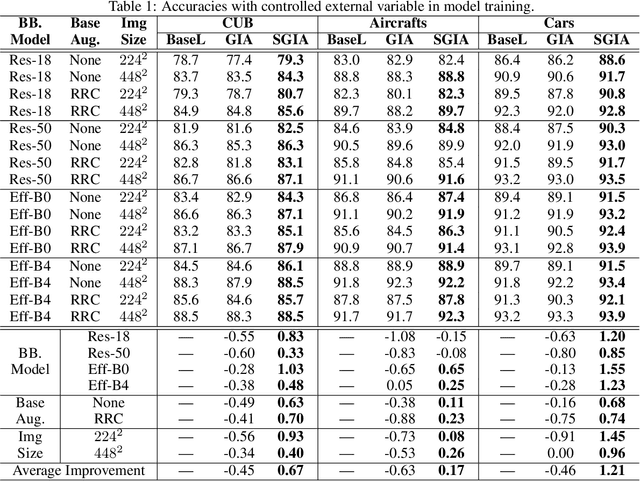
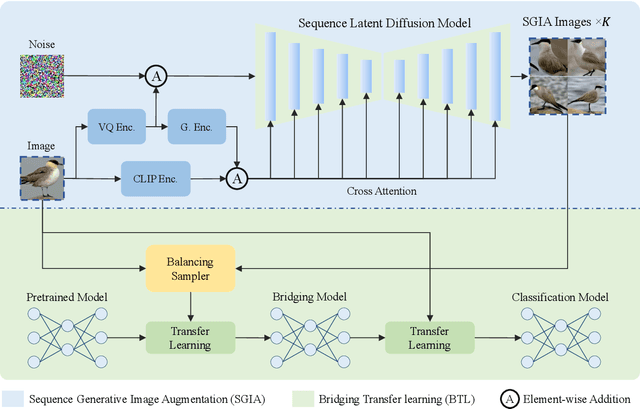
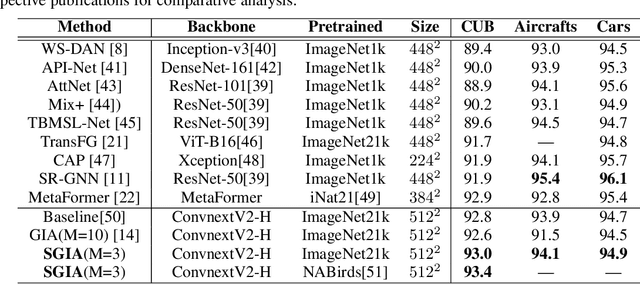
In Fine-Grained Visual Classification (FGVC), distinguishing highly similar subcategories remains a formidable challenge, often necessitating datasets with extensive variability. The acquisition and annotation of such FGVC datasets are notably difficult and costly, demanding specialized knowledge to identify subtle distinctions among closely related categories. Our study introduces a novel approach employing the Sequence Latent Diffusion Model (SLDM) for augmenting FGVC datasets, called Sequence Generative Image Augmentation (SGIA). Our method features a unique Bridging Transfer Learning (BTL) process, designed to minimize the domain gap between real and synthetically augmented data. This approach notably surpasses existing methods in generating more realistic image samples, providing a diverse range of pose transformations that extend beyond the traditional rigid transformations and style changes in generative augmentation. We demonstrate the effectiveness of our augmented dataset with substantial improvements in FGVC tasks on various datasets, models, and training strategies, especially in few-shot learning scenarios. Our method outperforms conventional image augmentation techniques in benchmark tests on three FGVC datasets, showcasing superior realism, variability, and representational quality. Our work sets a new benchmark and outperforms the previous state-of-the-art models in classification accuracy by 0.5% for the CUB-200-2011 dataset and advances the application of generative models in FGVC data augmentation.
Mix-Modality Person Re-Identification: A New and Practical Paradigm
Dec 06, 2024Current visible-infrared cross-modality person re-identification research has only focused on exploring the bi-modality mutual retrieval paradigm, and we propose a new and more practical mix-modality retrieval paradigm. Existing Visible-Infrared person re-identification (VI-ReID) methods have achieved some results in the bi-modality mutual retrieval paradigm by learning the correspondence between visible and infrared modalities. However, significant performance degradation occurs due to the modality confusion problem when these methods are applied to the new mix-modality paradigm. Therefore, this paper proposes a Mix-Modality person re-identification (MM-ReID) task, explores the influence of modality mixing ratio on performance, and constructs mix-modality test sets for existing datasets according to the new mix-modality testing paradigm. To solve the modality confusion problem in MM-ReID, we propose a Cross-Identity Discrimination Harmonization Loss (CIDHL) adjusting the distribution of samples in the hyperspherical feature space, pulling the centers of samples with the same identity closer, and pushing away the centers of samples with different identities while aggregating samples with the same modality and the same identity. Furthermore, we propose a Modality Bridge Similarity Optimization Strategy (MBSOS) to optimize the cross-modality similarity between the query and queried samples with the help of the similar bridge sample in the gallery. Extensive experiments demonstrate that compared to the original performance of existing cross-modality methods on MM-ReID, the addition of our CIDHL and MBSOS demonstrates a general improvement.
Grounding-IQA: Multimodal Language Grounding Model for Image Quality Assessment
Nov 26, 2024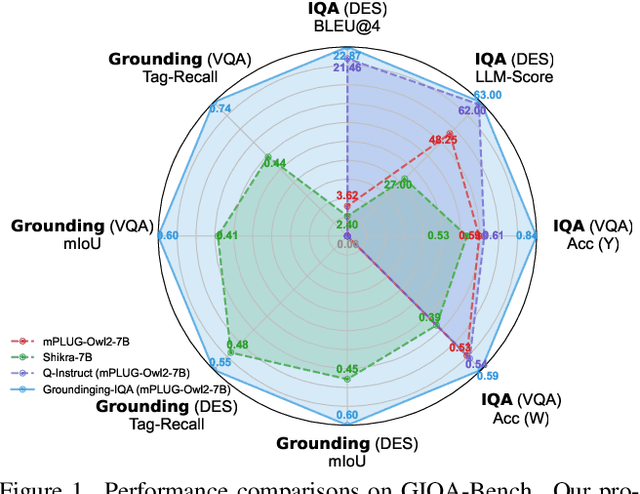
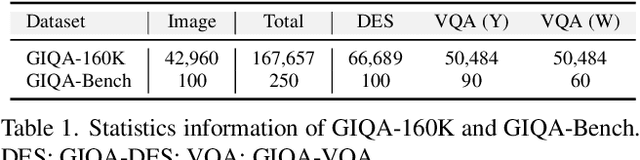
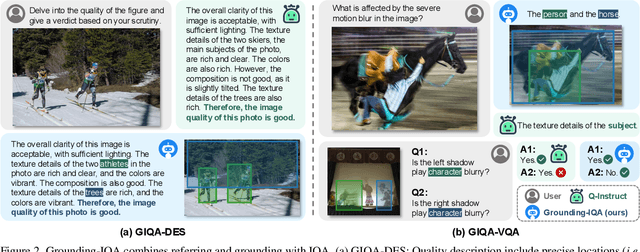
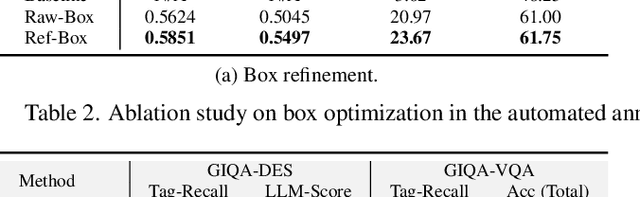
The development of multimodal large language models (MLLMs) enables the evaluation of image quality through natural language descriptions. This advancement allows for more detailed assessments. However, these MLLM-based IQA methods primarily rely on general contextual descriptions, sometimes limiting fine-grained quality assessment. To address this limitation, we introduce a new image quality assessment (IQA) task paradigm, grounding-IQA. This paradigm integrates multimodal referring and grounding with IQA to realize more fine-grained quality perception. Specifically, grounding-IQA comprises two subtasks: grounding-IQA-description (GIQA-DES) and visual question answering (GIQA-VQA). GIQA-DES involves detailed descriptions with precise locations (e.g., bounding boxes), while GIQA-VQA focuses on quality QA for local regions. To realize grounding-IQA, we construct a corresponding dataset, GIQA-160K, through our proposed automated annotation pipeline. Furthermore, we develop a well-designed benchmark, GIQA-Bench. The benchmark comprehensively evaluates the model grounding-IQA performance from three perspectives: description quality, VQA accuracy, and grounding precision. Experiments demonstrate that our proposed task paradigm, dataset, and benchmark facilitate the more fine-grained IQA application. Code: https://github.com/zhengchen1999/Grounding-IQA.
Transfer Learning in Vocal Education: Technical Evaluation of Limited Samples Describing Mezzo-soprano
Oct 30, 2024


Vocal education in the music field is difficult to quantify due to the individual differences in singers' voices and the different quantitative criteria of singing techniques. Deep learning has great potential to be applied in music education due to its efficiency to handle complex data and perform quantitative analysis. However, accurate evaluations with limited samples over rare vocal types, such as Mezzo-soprano, requires extensive well-annotated data support using deep learning models. In order to attain the objective, we perform transfer learning by employing deep learning models pre-trained on the ImageNet and Urbansound8k datasets for the improvement on the precision of vocal technique evaluation. Furthermore, we tackle the problem of the lack of samples by constructing a dedicated dataset, the Mezzo-soprano Vocal Set (MVS), for vocal technique assessment. Our experimental results indicate that transfer learning increases the overall accuracy (OAcc) of all models by an average of 8.3%, with the highest accuracy at 94.2%. We not only provide a novel approach to evaluating Mezzo-soprano vocal techniques but also introduce a new quantitative assessment method for music education.
Paths-over-Graph: Knowledge Graph Empowered Large Language Model Reasoning
Oct 21, 2024


Large Language Models (LLMs) have achieved impressive results in various tasks but struggle with hallucination problems and lack of relevant knowledge, especially in deep complex reasoning and knowledge-intensive tasks. Knowledge Graphs (KGs), which capture vast amounts of facts in a structured format, offer a reliable source of knowledge for reasoning. However, existing KG-based LLM reasoning methods face challenges like handling multi-hop reasoning, multi-entity questions, and effectively utilizing graph structures. To address these issues, we propose Paths-over-Graph (PoG), a novel method that enhances LLM reasoning by integrating knowledge reasoning paths from KGs, improving the interpretability and faithfulness of LLM outputs. PoG tackles multi-hop and multi-entity questions through a three-phase dynamic multi-hop path exploration, which combines the inherent knowledge of LLMs with factual knowledge from KGs. In order to improve the efficiency, PoG prunes irrelevant information from the graph exploration first and introduces efficient three-step pruning techniques that incorporate graph structures, LLM prompting, and a pre-trained language model (e.g., SBERT) to effectively narrow down the explored candidate paths. This ensures all reasoning paths contain highly relevant information captured from KGs, making the reasoning faithful and interpretable in problem-solving. PoG innovatively utilizes graph structure to prune the irrelevant noise and represents the first method to implement multi-entity deep path detection on KGs for LLM reasoning tasks. Comprehensive experiments on five benchmark KGQA datasets demonstrate PoG outperforms the state-of-the-art method ToG across GPT-3.5-Turbo and GPT-4, achieving an average accuracy improvement of 18.9%. Notably, PoG with GPT-3.5-Turbo surpasses ToG with GPT-4 by up to 23.9%.
Distillation-Free One-Step Diffusion for Real-World Image Super-Resolution
Oct 05, 2024Diffusion models have been achieving excellent performance for real-world image super-resolution (Real-ISR) with considerable computational costs. Current approaches are trying to derive one-step diffusion models from multi-step counterparts through knowledge distillation. However, these methods incur substantial training costs and may constrain the performance of the student model by the teacher's limitations. To tackle these issues, we propose DFOSD, a Distillation-Free One-Step Diffusion model. Specifically, we propose a noise-aware discriminator (NAD) to participate in adversarial training, further enhancing the authenticity of the generated content. Additionally, we improve the perceptual loss with edge-aware DISTS (EA-DISTS) to enhance the model's ability to generate fine details. Our experiments demonstrate that, compared with previous diffusion-based methods requiring dozens or even hundreds of steps, our DFOSD attains comparable or even superior results in both quantitative metrics and qualitative evaluations. Our DFOSD also abtains higher performance and efficiency compared with other one-step diffusion methods. We will release code and models at \url{https://github.com/JianzeLi-114/DFOSD}.
A Novel Framework of Horizontal-Vertical Hybrid Federated Learning for EdgeIoT
Oct 02, 2024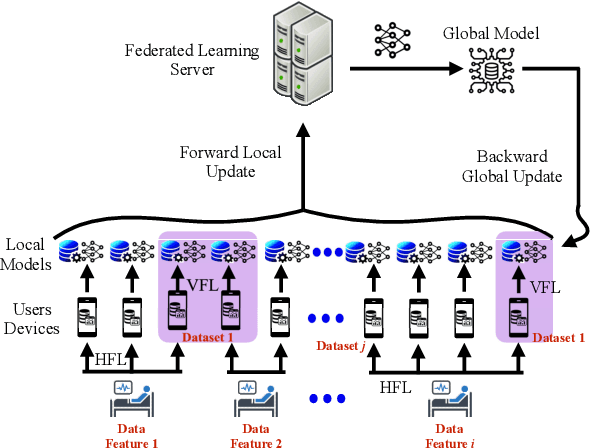
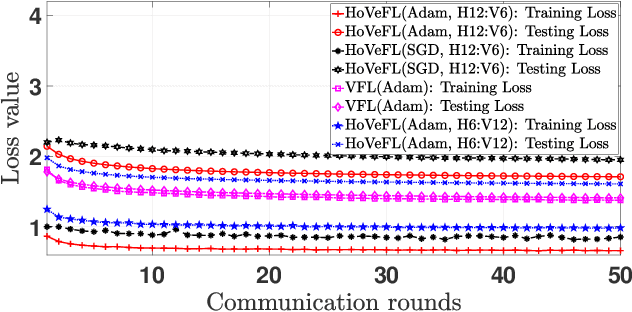
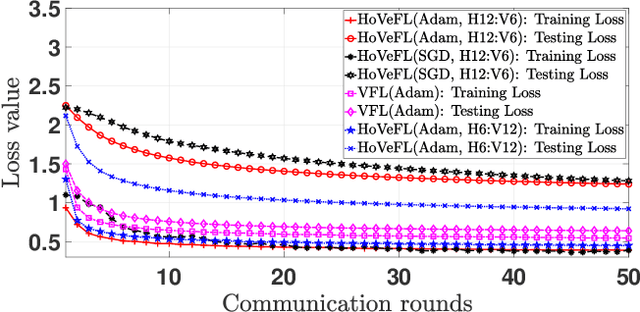
This letter puts forth a new hybrid horizontal-vertical federated learning (HoVeFL) for mobile edge computing-enabled Internet of Things (EdgeIoT). In this framework, certain EdgeIoT devices train local models using the same data samples but analyze disparate data features, while the others focus on the same features using non-independent and identically distributed (non-IID) data samples. Thus, even though the data features are consistent, the data samples vary across devices. The proposed HoVeFL formulates the training of local and global models to minimize the global loss function. Performance evaluations on CIFAR-10 and SVHN datasets reveal that the testing loss of HoVeFL with 12 horizontal FL devices and six vertical FL devices is 5.5% and 25.2% higher, respectively, compared to a setup with six horizontal FL devices and 12 vertical FL devices.
A QoE-Aware Split Inference Accelerating Algorithm for NOMA-based Edge Intelligence
Sep 25, 2024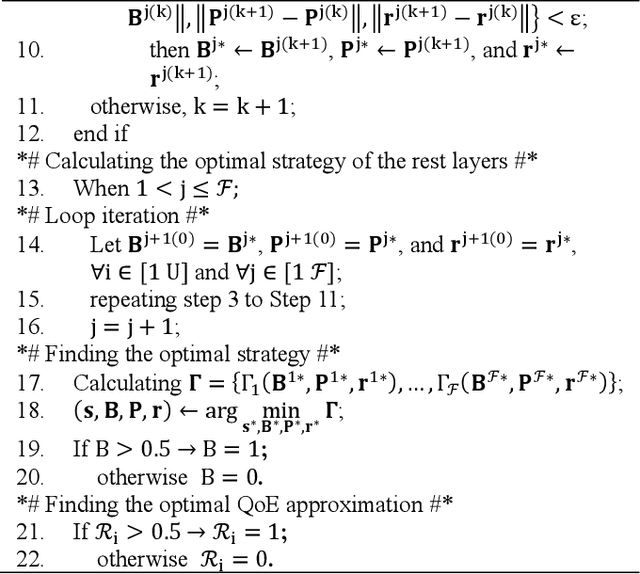
Even the AI has been widely used and significantly changed our life, deploying the large AI models on resource limited edge devices directly is not appropriate. Thus, the model split inference is proposed to improve the performance of edge intelligence, in which the AI model is divided into different sub models and the resource-intensive sub model is offloaded to edge server wirelessly for reducing resource requirements and inference latency. However, the previous works mainly concentrate on improving and optimizing the system QoS, ignore the effect of QoE which is another critical item for the users except for QoS. Even the QoE has been widely learned in EC, considering the differences between task offloading in EC and split inference in EI, and the specific issues in QoE which are still not addressed in EC and EI, these algorithms cannot work effectively in edge split inference scenarios. Thus, an effective resource allocation algorithm is proposed in this paper, for accelerating split inference in EI and achieving the tradeoff between inference delay, QoE, and resource consumption, abbreviated as ERA. Specifically, the ERA takes the resource consumption, QoE, and inference latency into account to find the optimal model split strategy and resource allocation strategy. Since the minimum inference delay and resource consumption, and maximum QoE cannot be satisfied simultaneously, the gradient descent based algorithm is adopted to find the optimal tradeoff between them. Moreover, the loop iteration GD approach is developed to reduce the complexity of the GD algorithm caused by parameter discretization. Additionally, the properties of the proposed algorithms are investigated, including convergence, complexity, and approximation error. The experimental results demonstrate that the performance of ERA is much better than that of the previous studies.