 Add to Chrome
 Add to Firefox
 Add to Edge
TextOVSR: Text-Guided Real-World Opera Video Super-Resolution
Mar 16, 2026
Many classic opera videos exhibit poor visual quality due to the limitations of early filming equipment and long-term degradation during storage. Although real-world video super-resolution (RWVSR) has achieved significant advances in recent years, directly applying existing methods to degraded opera videos remains challenging. The difficulties are twofold. First, accurately modeling real-world degradations is complex: simplistic combinations of classical degradation kernels fail to capture the authentic noise distribution, while methods that extract real noise patches from external datasets are prone to style mismatches that introduce visual artifacts. Second, current RWVSR methods, which rely solely on degraded image features, struggle to reconstruct realistic and detailed textures due to a lack of high-level semantic guidance. To address these issues, we propose a Text-guided Dual-Branch Opera Video Super-Resolution (TextOVSR) network, which introduces two types of textual prompts to guide the super-resolution process. Specifically, degradation-descriptive text, derived from the degradation process, is incorporated into the negative branch to constrain the solution space. Simultaneously, content-descriptive text is incorporated into a positive branch and our proposed Text-Enhanced Discriminator (TED) to provide semantic guidance for enhanced texture reconstruction. Furthermore, we design a Degradation-Robust Feature Fusion (DRF) module to facilitate cross-modal feature fusion while suppressing degradation interference. Experiments on our OperaLQ benchmark show that TextOVSR outperforms state-of-the-art methods both qualitatively and quantitatively. The code is available at https://github.com/ChangHua0/TextOVSR.

MambaOVSR: Multiscale Fusion with Global Motion Modeling for Chinese Opera Video Super-Resolution
Nov 09, 2025
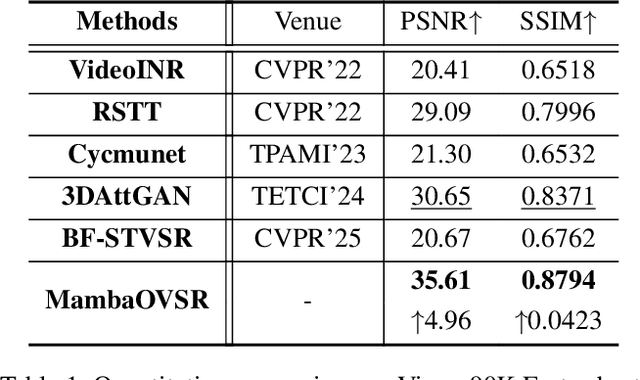
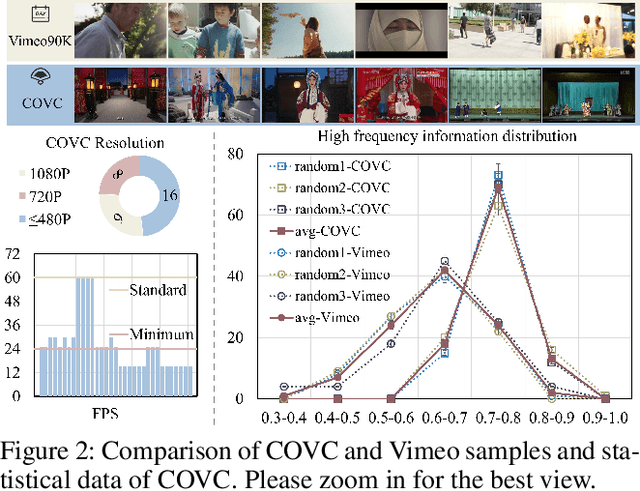
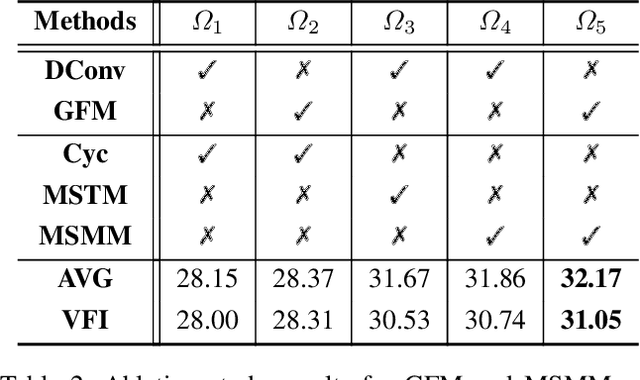
Chinese opera is celebrated for preserving classical art. However, early filming equipment limitations have degraded videos of last-century performances by renowned artists (e.g., low frame rates and resolution), hindering archival efforts. Although space-time video super-resolution (STVSR) has advanced significantly, applying it directly to opera videos remains challenging. The scarcity of datasets impedes the recovery of high frequency details, and existing STVSR methods lack global modeling capabilities, compromising visual quality when handling opera's characteristic large motions. To address these challenges, we pioneer a large scale Chinese Opera Video Clip (COVC) dataset and propose the Mamba-based multiscale fusion network for space-time Opera Video Super-Resolution (MambaOVSR). Specifically, MambaOVSR involves three novel components: the Global Fusion Module (GFM) for motion modeling through a multiscale alternating scanning mechanism, and the Multiscale Synergistic Mamba Module (MSMM) for alignment across different sequence lengths. Additionally, our MambaVR block resolves feature artifacts and positional information loss during alignment. Experimental results on the COVC dataset show that MambaOVSR significantly outperforms the SOTA STVSR method by an average of 1.86 dB in terms of PSNR. Dataset and Code will be publicly released.
Mix-Modality Person Re-Identification: A New and Practical Paradigm
Dec 06, 2024Current visible-infrared cross-modality person re-identification research has only focused on exploring the bi-modality mutual retrieval paradigm, and we propose a new and more practical mix-modality retrieval paradigm. Existing Visible-Infrared person re-identification (VI-ReID) methods have achieved some results in the bi-modality mutual retrieval paradigm by learning the correspondence between visible and infrared modalities. However, significant performance degradation occurs due to the modality confusion problem when these methods are applied to the new mix-modality paradigm. Therefore, this paper proposes a Mix-Modality person re-identification (MM-ReID) task, explores the influence of modality mixing ratio on performance, and constructs mix-modality test sets for existing datasets according to the new mix-modality testing paradigm. To solve the modality confusion problem in MM-ReID, we propose a Cross-Identity Discrimination Harmonization Loss (CIDHL) adjusting the distribution of samples in the hyperspherical feature space, pulling the centers of samples with the same identity closer, and pushing away the centers of samples with different identities while aggregating samples with the same modality and the same identity. Furthermore, we propose a Modality Bridge Similarity Optimization Strategy (MBSOS) to optimize the cross-modality similarity between the query and queried samples with the help of the similar bridge sample in the gallery. Extensive experiments demonstrate that compared to the original performance of existing cross-modality methods on MM-ReID, the addition of our CIDHL and MBSOS demonstrates a general improvement.