 Add to Chrome
 Add to Firefox
 Add to Edge
Attack-Resistant Watermarking for AIGC Image Forensics via Diffusion-based Semantic Deflection
Jan 10, 2026
Protecting the copyright of user-generated AI images is an emerging challenge as AIGC becomes pervasive in creative workflows. Existing watermarking methods (1) remain vulnerable to real-world adversarial threats, often forced to trade off between defenses against spoofing and removal attacks; and (2) cannot support semantic-level tamper localization. We introduce PAI, a training-free inherent watermarking framework for AIGC copyright protection, plug-and-play with diffusion-based AIGC services. PAI simultaneously provides three key functionalities: robust ownership verification, attack detection, and semantic-level tampering localization. Unlike existing inherent watermark methods that only embed watermarks at noise initialization of diffusion models, we design a novel key-conditioned deflection mechanism that subtly steers the denoising trajectory according to the user key. Such trajectory-level coupling further strengthens the semantic entanglement of identity and content, thereby further enhancing robustness against real-world threats. Moreover, we also provide a theoretical analysis proving that only the valid key can pass verification. Experiments across 12 attack methods show that PAI achieves 98.43\% verification accuracy, improving over SOTA methods by 37.25\% on average, and retains strong tampering localization performance even against advanced AIGC edits. Our code is available at https://github.com/QingyuLiu/PAI.

Robust Watermarks Leak: Channel-Aware Feature Extraction Enables Adversarial Watermark Manipulation
Feb 10, 2025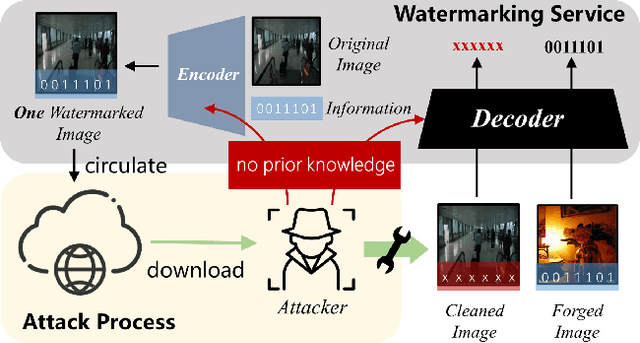
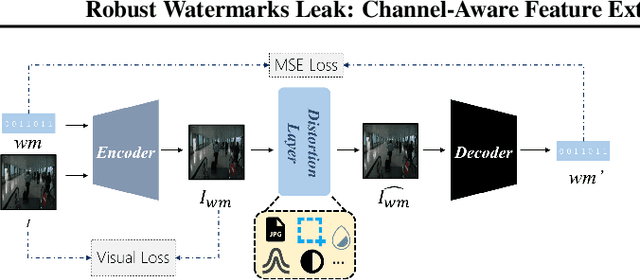
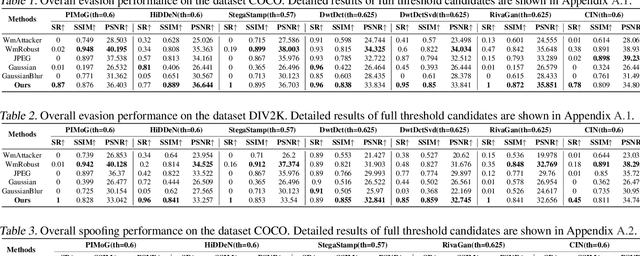
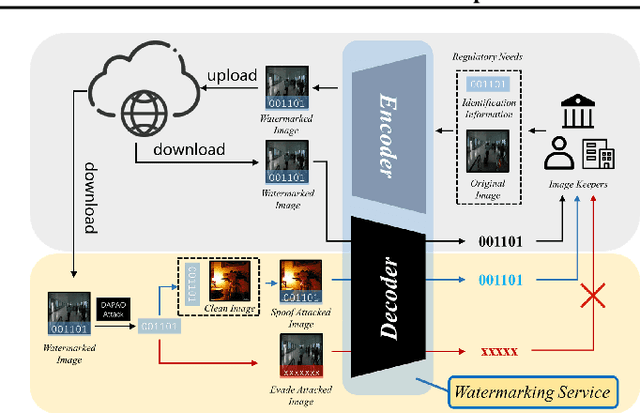
Watermarking plays a key role in the provenance and detection of AI-generated content. While existing methods prioritize robustness against real-world distortions (e.g., JPEG compression and noise addition), we reveal a fundamental tradeoff: such robust watermarks inherently improve the redundancy of detectable patterns encoded into images, creating exploitable information leakage. To leverage this, we propose an attack framework that extracts leakage of watermark patterns through multi-channel feature learning using a pre-trained vision model. Unlike prior works requiring massive data or detector access, our method achieves both forgery and detection evasion with a single watermarked image. Extensive experiments demonstrate that our method achieves a 60\% success rate gain in detection evasion and 51\% improvement in forgery accuracy compared to state-of-the-art methods while maintaining visual fidelity. Our work exposes the robustness-stealthiness paradox: current "robust" watermarks sacrifice security for distortion resistance, providing insights for future watermark design.
Transfer Learning in Vocal Education: Technical Evaluation of Limited Samples Describing Mezzo-soprano
Oct 30, 2024


Vocal education in the music field is difficult to quantify due to the individual differences in singers' voices and the different quantitative criteria of singing techniques. Deep learning has great potential to be applied in music education due to its efficiency to handle complex data and perform quantitative analysis. However, accurate evaluations with limited samples over rare vocal types, such as Mezzo-soprano, requires extensive well-annotated data support using deep learning models. In order to attain the objective, we perform transfer learning by employing deep learning models pre-trained on the ImageNet and Urbansound8k datasets for the improvement on the precision of vocal technique evaluation. Furthermore, we tackle the problem of the lack of samples by constructing a dedicated dataset, the Mezzo-soprano Vocal Set (MVS), for vocal technique assessment. Our experimental results indicate that transfer learning increases the overall accuracy (OAcc) of all models by an average of 8.3%, with the highest accuracy at 94.2%. We not only provide a novel approach to evaluating Mezzo-soprano vocal techniques but also introduce a new quantitative assessment method for music education.