 Add to Chrome
 Add to Firefox
 Add to Edge
AViTS: Adaptive Spatiotemporal Token Selection for Efficient Dynamic-Resolution Generation
Aug 18, 2026
Diffusion Transformers (DiTs) achieve high-quality generation but are costly due to iterative sampling. Dynamic-resolution sampling reduces early-stage cost by denoising at low resolution; however, uniformly upsampling all latent tokens at resolution transitions incurs redundant computation and may degrade fine-detail consistency. Existing partial upsampling strategies typically rely on local latent structure cues or single-step statistics, making it difficult to jointly capture token-text semantic relevance and token-wise representation dynamics across diffusion steps. We propose AViTS, an adaptive spatiotemporal token selection framework for dynamic-resolution DiTs. AViTS models spatial importance via latent-text attention and temporal importance via token-level feature variation across diffusion timesteps, and fuses them to enable spatiotemporal importance-aware selective upsampling: it prioritizes resolution refinement for critical tokens while deferring less important ones, thereby reducing redundant high-resolution computation and improving the quality-efficiency trade-off. AViTS achieves up to 6.34x on FLUX and nearly 9x FLOPs reduction on Qwen-Image-Edit and FLUX.1-Kontext-dev, orthogonal to distillation, quantization, and feature caching, and reaching 14.76x with distilled models. Code: https://github.com/QHR69/AViTS

LinCa: Accelerating Diffusion Models via Learnable Decomposed Feature Caching
Aug 18, 2026Diffusion models have achieved remarkable success in image and video generation, yet the high computational cost of iterative sampling remains a critical bottleneck for practical deployment. Feature caching has emerged as a promising acceleration paradigm by reusing or predicting intermediate features across timesteps. However, existing training-free methods apply uniform prediction strategies that cannot adapt to the heterogeneous feature dynamics, causing significant quality degradation under high acceleration ratios. We propose LinCa, a feature caching framework based on learnable invertible networks. LinCa decomposes cached features into sub-components with distinct continuity properties via a lightweight invertible network and applies differentiated prediction orders matched to each component. The strict invertibility guarantees lossless reconstruction back to the original feature space, forming a unified Decompose-Predict-Reconstruct pipeline. By training separate predictors for different models and timestep segments, LinCa adapts to heterogeneous feature dynamics. Experiments on FLUX, Qwen-Image, and HunyuanVideo demonstrate that LinCa, with less than 0.2% additional parameters, significantly outperforms existing methods and maintains near-lossless quality at 5-7x speedup. Code: https://github.com/QHR69/LinCa
Wuying-Browser-Agent: Real-World Centric Fundamental Long-Horizon Browser Agents
Aug 18, 2026Browser agents perform well on short, clean demonstrations, but real deployment is fundamentally different: agents must sustain dozens of decisions on live websites while recovering from mistakes and navigating complex UIs. We argue that closing this gap requires alignment at every level of the pipeline, including execution, supervision, optimization, and evaluation, rather than scale alone. We present Wuying-Browser-Agent, a unified framework that addresses each of these levels. A structured browser harness provides stable execution primitives and decision-oriented context management. Reflection and UI-specialized Curriculum SFT (RUIC-SFT) explicitly trains on recovery trajectories and complex-UI interactions. Divergence-Aware Online GRPO (DAO-GRPO) improves long-horizon credit assignment through potential-based reward shaping and divergence-aware step weighting. Finally, we introduce BrowserBench, a bilingual real-web benchmark of 350 tasks averaging 37.9 steps, because most existing benchmarks are too short to expose long-horizon failure modes. Wuying-Browser-Agent-27B achieves 80.6\% on WebVoyager, 66.7\% on Online-Mind2Web, and 65.1\% on BrowserBench, establishing a new open-source state of the art on browser-use benchmarks. The same pipeline also transfers beyond browser use, demonstrating strong general agentic ability and reaching an average score of 73.8 on Tau2-Bench, Claw-Eval, and BFCL-v4.
STEP-OPD: Rethinking Output Targets and Internal Dynamics in On-Policy Distillation for Diffusion Models
Aug 05, 2026On-policy distillation (OPD) has become an effective approach for consolidating multiple task-specialized image generation models into a single student. However, existing OPD methods optimize the student mainly to match the teacher's output velocity, making the teacher the upper limit of the optimization objective. While output-level supervision alone leaves the student's blockwise representation evolution underconstrained, which weakens the transfer of capabilities that must be progressively developed across layers. We propose STEP-OPD, an on-policy distillation framework for image generation that extends the student's learning target beyond the teacher and introduces explicit constraints on its internal representation evolution. Instead of treating the teacher as the final target, we use the velocity difference between each task-specific teacher and the shared base model as a direction for further learning and add a scaled version of this difference to the teacher velocity. In addition, we align the direction and magnitude of representation changes between the student and teacher, enabling the student to learn how representations are progressively transformed across network blocks. Experiments on compositional alignment, text rendering, and human preference show that our method consistently improves Standard OPD methods. In particular, it increases the GenEval score of DiffusionOPD from 0.927 to 0.961, while also improving OCR and all preference-based metrics. The resulting unified student surpasses the corresponding single-task teachers across all three capability groups, showing that output extrapolation enables beyond-teacher learning. And representation change alignment provides complementary guidance for the student's internal transformations.
EgoGenesis: Egocentric World-Action Modeling with Online Anchored Projective Memory and Action-3D RoPE
Jul 30, 2026Egocentric video offers rich manipulation experience for embodied AI, yet collecting diverse egocentric data across scenes, objects, motions, and embodiments remains costly. We present \method, an egocentric world-action simulator that synthesizes controllable, high-quality manipulation videos to expand scarce real-world training data. \method{} builds on a pretrained video generation prior and introduces two geometry-aware conditioning mechanisms. Online Anchored Projective Memory (OAPM) preserves a first-frame 3D scene anchor while periodically refreshing a recent state during autoregressive generation. Action-3D Rotary Position Embedding (A3D-RoPE) encodes end-effector motion with camera-aware 3D rotary coordinates, injecting action geometry into skeleton-to-video cross-attention for precise control. Together, these components improve visual fidelity, geometric stability, and action alignment in long egocentric rollouts. Moreover, augmenting 400 real trajectories with 400 \method-generated trajectories improves out-of-distribution real-robot success from 77\% to 84\% on single-arm tasks and from 53\% to 70\% on dual-arm tasks, demonstrating that the synthesized data substantially improve downstream WAM generalization.
SpecEdit: Training-Free Acceleration for Diffusion based Image Editing via Semantic Locking
May 04, 2026Diffusion-based image editing offers strong semantic controllability, but remains computationally expensive due to iterative high-resolution denoising over all spatial tokens. Dynamic-resolution sampling reduces this cost by performing early steps at reduced resolution. However, existing approaches prioritize upsampling using low-level heuristics such as edge detection or channel variance, which are weakly aligned with editing semantics and may lead to structural inconsistency. Moreover, spatial regions are often upsampled without verifying whether semantic modification is actually required, resulting in redundant high-resolution computation and accumulated errors. Therefore, we propose SpecEdit, a training-free dynamic-resolution framework tailored for diffusion-based image editing. SpecEdit follows a draft-and-verify scheme: a low-resolution draft first estimates the semantic outcome, after which token-level discrepancies are used to identify edit-relevant tokens for high-resolution denoising, while the remaining tokens stay at a coarse resolution. Experiments on Qwen-Image-Edit and FLUX.1-Kontext-dev demonstrate up to 10x and 7x acceleration, while maintaining strong quality. SpecEdit is complementary to step distillation and other acceleration techniques, achieving up to 13x speedup when combined with existing methods. Our code is in supplementary material and will be released on GitHub.
A-SDM: Accelerating Stable Diffusion through Redundancy Removal and Performance Optimization
Dec 27, 2023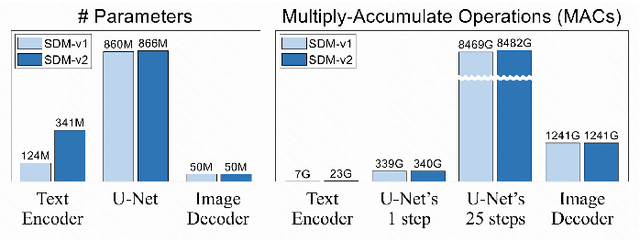
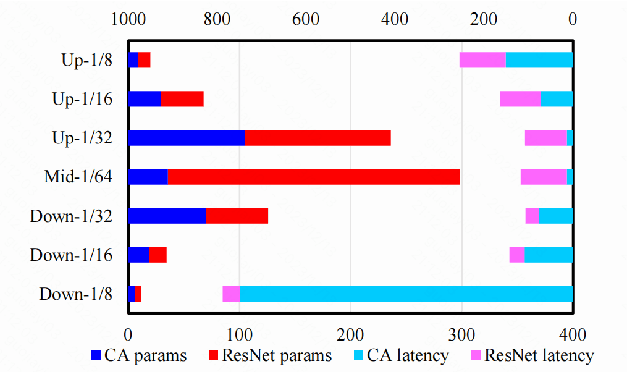
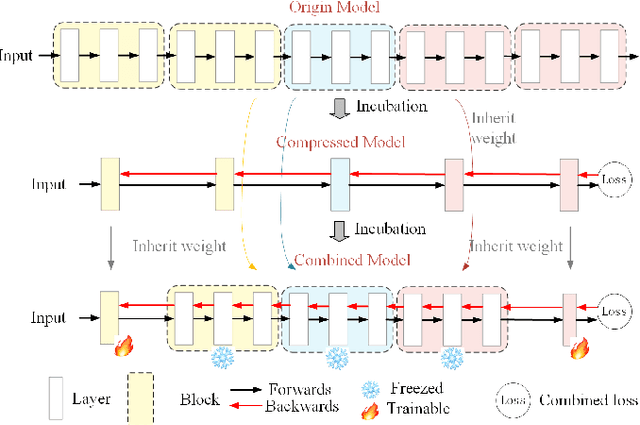
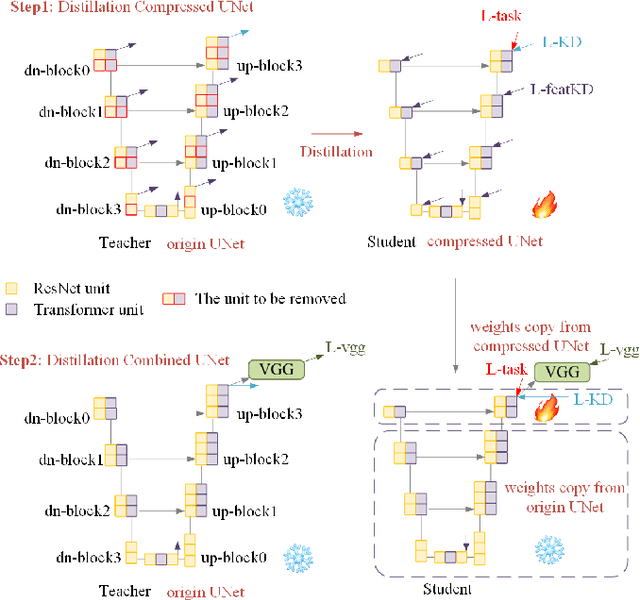
The Stable Diffusion Model (SDM) is a popular and efficient text-to-image (t2i) generation and image-to-image (i2i) generation model. Although there have been some attempts to reduce sampling steps, model distillation, and network quantization, these previous methods generally retain the original network architecture. Billion scale parameters and high computing requirements make the research of model architecture adjustment scarce. In this work, we first explore the computational redundancy part of the network, and then prune the redundancy blocks of the model and maintain the network performance through a progressive incubation strategy. Secondly, in order to maintaining the model performance, we add cross-layer multi-expert conditional convolution (CLME-Condconv) to the block pruning part to inherit the original convolution parameters. Thirdly, we propose a global-regional interactive (GRI) attention to speed up the computationally intensive attention part. Finally, we use semantic-aware supervision (SAS) to align the outputs of the teacher model and student model at the semantic level. Experiments show that this method can effectively train a lightweight model close to the performance of the original SD model, and effectively improve the model speed under limited resources. Experiments show that the proposed method can effectively train a light-weight model close to the performance of the original SD model, and effectively improve the model speed under limited resources. After acceleration, the UNet part of the model is 22% faster and the overall speed is 19% faster.
Layer-adaptive Structured Pruning Guided by Latency
May 23, 2023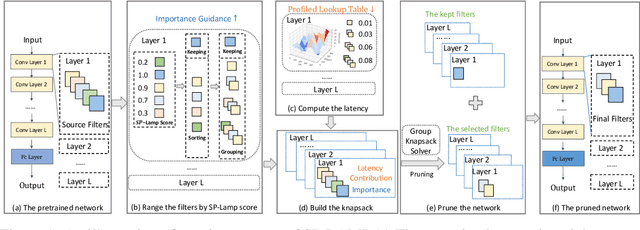
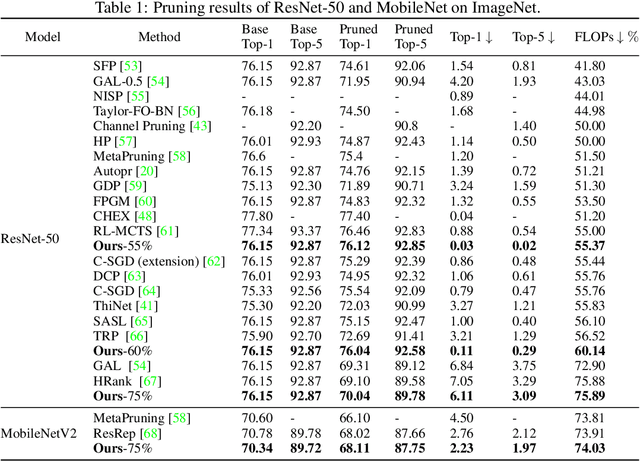
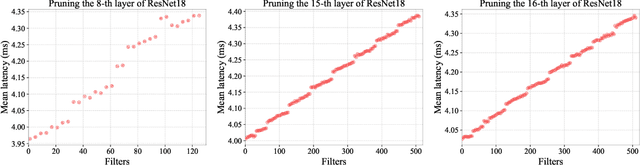
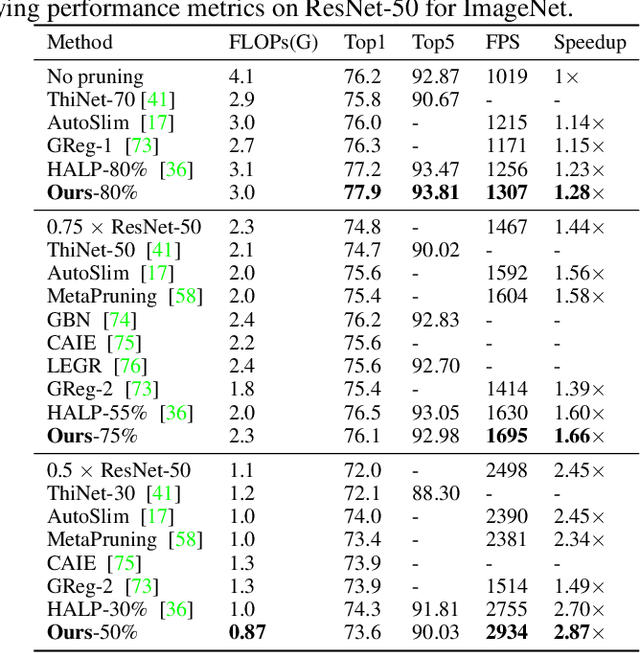
Structured pruning can simplify network architecture and improve inference speed. Combined with the underlying hardware and inference engine in which the final model is deployed, better results can be obtained by using latency collaborative loss function to guide network pruning together. Existing pruning methods that optimize latency have demonstrated leading performance, however, they often overlook the hardware features and connection in the network. To address this problem, we propose a global importance score SP-LAMP(Structured Pruning Layer-Adaptive Magnitude-based Pruning) by deriving a global importance score LAMP from unstructured pruning to structured pruning. In SP-LAMP, each layer includes a filter with an SP-LAMP score of 1, and the remaining filters are grouped. We utilize a group knapsack solver to maximize the SP-LAMP score under latency constraints. In addition, we improve the strategy of collect the latency to make it more accurate. In particular, for ResNet50/ResNet18 on ImageNet and CIFAR10, SP-LAMP is 1.28x/8.45x faster with +1.7%/-1.57% top-1 accuracy changed, respectively. Experimental results in ResNet56 on CIFAR10 demonstrate that our algorithm achieves lower latency compared to alternative approaches while ensuring accuracy and FLOPs.
Fine-tuning Pruned Networks with Linear Over-parameterization
Apr 25, 2022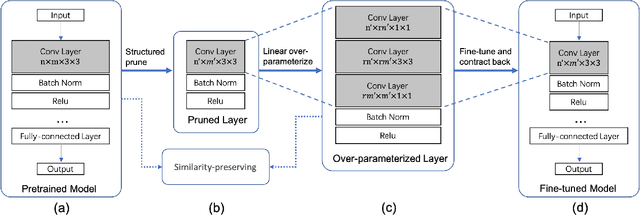
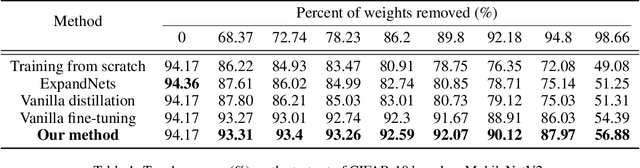
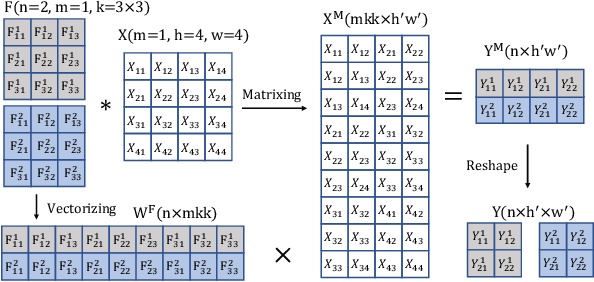
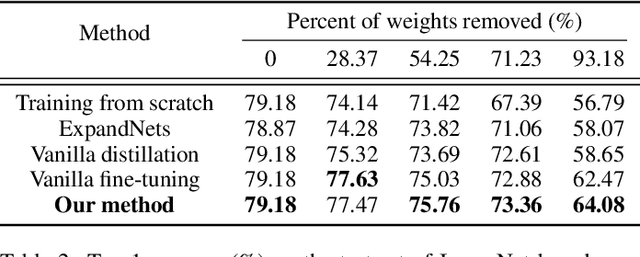
Structured pruning compresses neural networks by reducing channels (filters) for fast inference and low footprint at run-time. To restore accuracy after pruning, fine-tuning is usually applied to pruned networks. However, too few remaining parameters in pruned networks inevitably bring a great challenge to fine-tuning to restore accuracy. To address this challenge, we propose a novel method that first linearly over-parameterizes the compact layers in pruned networks to enlarge the number of fine-tuning parameters and then re-parameterizes them to the original layers after fine-tuning. Specifically, we equivalently expand the convolution/linear layer with several consecutive convolution/linear layers that do not alter the current output feature maps. Furthermore, we utilize similarity-preserving knowledge distillation that encourages the over-parameterized block to learn the immediate data-to-data similarities of the corresponding dense layer to maintain its feature learning ability. The proposed method is comprehensively evaluated on CIFAR-10 and ImageNet which significantly outperforms the vanilla fine-tuning strategy, especially for large pruning ratio.
Wavelet Knowledge Distillation: Towards Efficient Image-to-Image Translation
Mar 12, 2022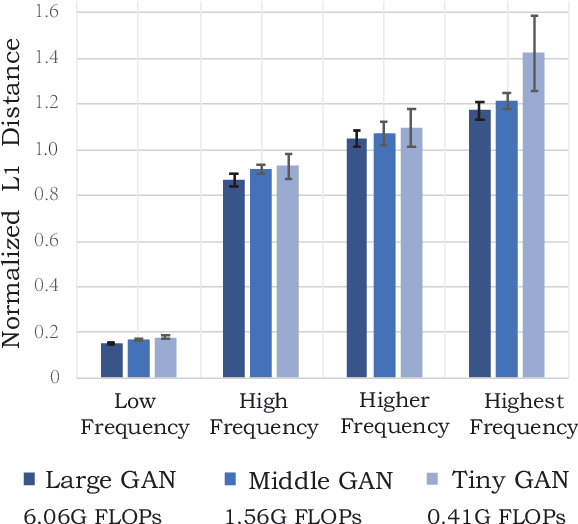
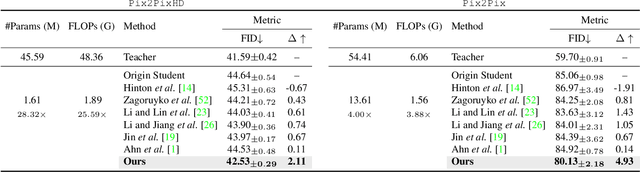
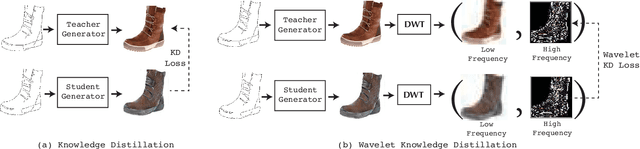
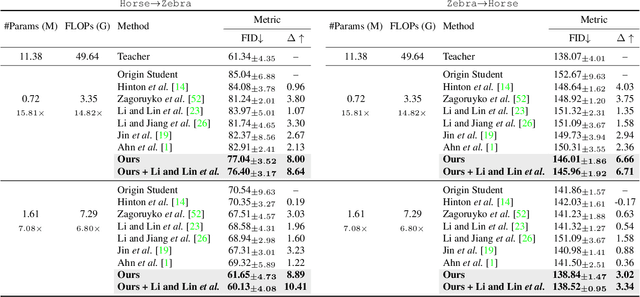
Remarkable achievements have been attained with Generative Adversarial Networks (GANs) in image-to-image translation. However, due to a tremendous amount of parameters, state-of-the-art GANs usually suffer from low efficiency and bulky memory usage. To tackle this challenge, firstly, this paper investigates GANs performance from a frequency perspective. The results show that GANs, especially small GANs lack the ability to generate high-quality high frequency information. To address this problem, we propose a novel knowledge distillation method referred to as wavelet knowledge distillation. Instead of directly distilling the generated images of teachers, wavelet knowledge distillation first decomposes the images into different frequency bands with discrete wavelet transformation and then only distills the high frequency bands. As a result, the student GAN can pay more attention to its learning on high frequency bands. Experiments demonstrate that our method leads to 7.08 times compression and 6.80 times acceleration on CycleGAN with almost no performance drop. Additionally, we have studied the relation between discriminators and generators which shows that the compression of discriminators can promote the performance of compressed generators.