 Add to Chrome
 Add to Firefox
 Add to Edge
LinCa: Accelerating Diffusion Models via Learnable Decomposed Feature Caching
Aug 18, 2026
Diffusion models have achieved remarkable success in image and video generation, yet the high computational cost of iterative sampling remains a critical bottleneck for practical deployment. Feature caching has emerged as a promising acceleration paradigm by reusing or predicting intermediate features across timesteps. However, existing training-free methods apply uniform prediction strategies that cannot adapt to the heterogeneous feature dynamics, causing significant quality degradation under high acceleration ratios. We propose LinCa, a feature caching framework based on learnable invertible networks. LinCa decomposes cached features into sub-components with distinct continuity properties via a lightweight invertible network and applies differentiated prediction orders matched to each component. The strict invertibility guarantees lossless reconstruction back to the original feature space, forming a unified Decompose-Predict-Reconstruct pipeline. By training separate predictors for different models and timestep segments, LinCa adapts to heterogeneous feature dynamics. Experiments on FLUX, Qwen-Image, and HunyuanVideo demonstrate that LinCa, with less than 0.2% additional parameters, significantly outperforms existing methods and maintains near-lossless quality at 5-7x speedup. Code: https://github.com/QHR69/LinCa

Attention-Free and Lightweight Token Reduction for Efficient Vision-Language Models
Jul 15, 2026Vision-Language Models (VLMs) have achieved strong performance in multimodal understanding, yet remain challenging to deploy on resource-constrained edge devices due to the substantial computational overhead of processing numerous visual tokens. Token reduction is a promising direction for accelerating VLMs inference, but existing approaches either rely on attention maps that are incompatible with modern acceleration frameworks or depend on computationally intensive pairwise similarity comparisons, which undermine scalability and negate their practical benefits in deployment. In this paper, we propose an attention-free and lightweight token reduction framework as a plug-and-play module for VLMs, which preserves both important and diverse tokens to produce a compact visual representation. First, to enable attention-free importance estimation, we adopt an information-theoretic perspective and quantify token information using a novel entropy-based criterion, retaining those with more expressive and less degenerate feature representations. Second, to ensure diverse visual coverage in a lightweight manner, we introduce a transformation-induced consistency signal where similar tokens yield similar signals, such that sorting by this signal places similar tokens close to each other and enables stride-based selection to produce a diverse token set. Extensive experiments across multiple VLMs benchmarks demonstrate that our framework achieves a favorable accuracy-efficiency trade-off, maintaining competitive performance under aggressive compression.
TuringViT: Making SOTA Vision Transformers Accessible to All
Jun 23, 2026Modern VLMs and VLA systems commonly adopt off-the-shelf ViTs such as SigLIP2 as visual encoders, but diverse downstream requirements in latency, temporal modeling, and VLM integration often call for customized SOTA-level ViTs. Training such encoders remains beyond the reach of much of the community, as it requires massive image-text data, while standard softmax attention makes high-resolution or dynamic-resolution pretraining prohibitively costly and often forces low-resolution pretraining followed by post-hoc adaptation. TuringViT addresses these challenges with three key designs: Turing Linear Attention (TLA) for efficient sequence modeling, VISTA-Curation to construct supervision-rich image-video training data, and native dynamic-resolution pretraining that supports flexible inputs from the start and transfers seamlessly to downstream VLMs. As a result, TuringViT outperforms leading open-source ViT baselines with only 10% of the data, achieves stronger downstream VLM performance, and delivers substantially better latency scaling on high-resolution inputs. Our scaling-law analysis further shows that TuringViT continues to improve predictably with curated data scale, far from saturation. Its fast adaptation, hardware-friendly design, and efficient deployment have made it a unified visual foundation across XPeng's AI systems. More broadly, TuringViT provides a reproducible pipeline that dramatically lowers the cost for the community to train, customize, and deploy SOTA-level ViTs, moving toward making such Vision Transformers accessible to all.
GlyphBanana: Advancing Precise Text Rendering Through Agentic Workflows
Mar 12, 2026Despite recent advances in generative models driving significant progress in text rendering, accurately generating complex text and mathematical formulas remains a formidable challenge. This difficulty primarily stems from the limited instruction-following capabilities of current models when encountering out-of-distribution prompts. To address this, we introduce GlyphBanana, alongside a corresponding benchmark specifically designed for rendering complex characters and formulas. GlyphBanana employs an agentic workflow that integrates auxiliary tools to inject glyph templates into both the latent space and attention maps, facilitating the iterative refinement of generated images. Notably, our training-free approach can be seamlessly applied to various Text-to-Image (T2I) models, achieving superior precision compared to existing baselines. Extensive experiments demonstrate the effectiveness of our proposed workflow. Associated code is publicly available at https://github.com/yuriYanZeXuan/GlyphBanana.
LANCET: Neural Intervention via Structural Entropy for Mitigating Faithfulness Hallucinations in LLMs
Jan 04, 2026Large Language Models have revolutionized information processing, yet their reliability is severely compromised by faithfulness hallucinations. While current approaches attempt to mitigate this issue through node-level adjustments or coarse suppression, they often overlook the distributed nature of neural information, leading to imprecise interventions. Recognizing that hallucinations propagate through specific forward transmission pathways like an infection, we aim to surgically block this flow using precise structural analysis. To leverage this, we propose Lancet, a novel framework that achieves precise neural intervention by leveraging structural entropy and hallucination difference ratios. Lancet first locates hallucination-prone neurons via gradient-driven contrastive analysis, then maps their propagation pathways by minimizing structural entropy, and finally implements a hierarchical intervention strategy that preserves general model capabilities. Comprehensive evaluations across hallucination benchmark datasets demonstrate that Lancet significantly outperforms state-of-the-art methods, validating the effectiveness of our surgical approach to neural intervention.
AKG kernel Agent: A Multi-Agent Framework for Cross-Platform Kernel Synthesis
Dec 29, 2025Modern AI models demand high-performance computation kernels. The growing complexity of LLMs, multimodal architectures, and recommendation systems, combined with techniques like sparsity and quantization, creates significant computational challenges. Moreover, frequent hardware updates and diverse chip architectures further complicate this landscape, requiring tailored kernel implementations for each platform. However, manual optimization cannot keep pace with these demands, creating a critical bottleneck in AI system development. Recent advances in LLM code generation capabilities have opened new possibilities for automating kernel development. In this work, we propose AKG kernel agent (AI-driven Kernel Generator), a multi-agent system that automates kernel generation, migration, and performance tuning. AKG kernel agent is designed to support multiple domain-specific languages (DSLs), including Triton, TileLang, CPP, and CUDA-C, enabling it to target different hardware backends while maintaining correctness and portability. The system's modular design allows rapid integration of new DSLs and hardware targets. When evaluated on KernelBench using Triton DSL across GPU and NPU backends, AKG kernel agent achieves an average speedup of 1.46$\times$ over PyTorch Eager baselines implementations, demonstrating its effectiveness in accelerating kernel development for modern AI workloads.
CAM-NET: An AI Model for Whole Atmosphere with Thermosphere and Ionosphere Extension
Jun 24, 2025We present Compressible Atmospheric Model-Network (CAM-NET), an AI model designed to predict neutral atmospheric variables from the Earth's surface to the ionosphere with high accuracy and computational efficiency. Accurate modeling of the entire atmosphere is critical for understanding the upward propagation of gravity waves, which influence upper-atmospheric dynamics and coupling across atmospheric layers. CAM-NET leverages the Spherical Fourier Neural Operator (SFNO) to capture global-scale atmospheric dynamics while preserving the Earth's spherical structure. Trained on a decade of datasets from the Whole Atmosphere Community Climate Model with thermosphere and ionosphere eXtension (WACCM-X), CAM-NET demonstrates accuracy comparable to WACCM-X while achieving a speedup of over 1000x in inference time, can provide one year simulation within a few minutes once trained. The model effectively predicts key atmospheric parameters, including zonal and meridional winds, temperature, and time rate of pressure. Inspired by traditional modeling approaches that use external couplers to simulate tracer transport, CAM-NET introduces a modular architecture that explicitly separates tracer prediction from core dynamics. The core backbone of CAM-NET focuses on forecasting primary physical variables (e.g., temperature, wind velocity), while tracer variables are predicted through a lightweight, fine-tuned model. This design allows for efficient adaptation to specific tracer scenarios with minimal computational cost, avoiding the need to retrain the entire model. We have validated this approach on the $O^2$ tracer, demonstrating strong performance and generalization capabilities.
A machine learning model for skillful climate system prediction
May 06, 2025Climate system models (CSMs), through integrating cross-sphere interactions among the atmosphere, ocean, land, and cryosphere, have emerged as pivotal tools for deciphering climate dynamics and improving forecasting capabilities. Recent breakthroughs in artificial intelligence (AI)-driven meteorological modeling have demonstrated remarkable success in single-sphere systems and partially spheres coupled systems. However, the development of a fully coupled AI-based climate system model encompassing atmosphere-ocean-land-sea ice interactions has remained an unresolved challenge. This paper introduces FengShun-CSM, an AI-based CSM model that provides 60-day global daily forecasts for 29 critical variables across atmospheric, oceanic, terrestrial, and cryospheric domains. The model significantly outperforms the European Centre for Medium-Range Weather Forecasts (ECMWF) subseasonal-to-seasonal (S2S) model in predicting most variables, particularly precipitation, land surface, and oceanic components. This enhanced capability is primarily attributed to its improved representation of intra-seasonal variability modes, most notably the Madden-Julian Oscillation (MJO). Remarkably, FengShun-CSM exhibits substantial potential in predicting subseasonal extreme events. Such breakthroughs will advance its applications in meteorological disaster mitigation, marine ecosystem conservation, and agricultural productivity enhancement. Furthermore, it validates the feasibility of developing AI-powered CSMs through machine learning technologies, establishing a transformative paradigm for next-generation Earth system modeling.
Breaking Secure Aggregation: Label Leakage from Aggregated Gradients in Federated Learning
Jun 22, 2024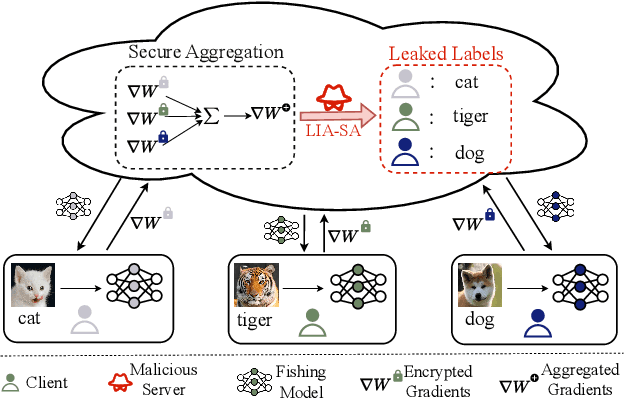
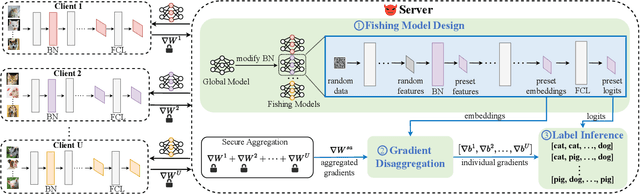
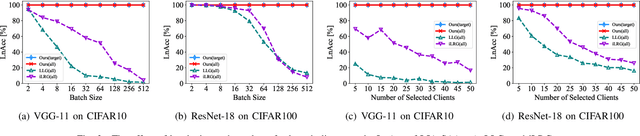
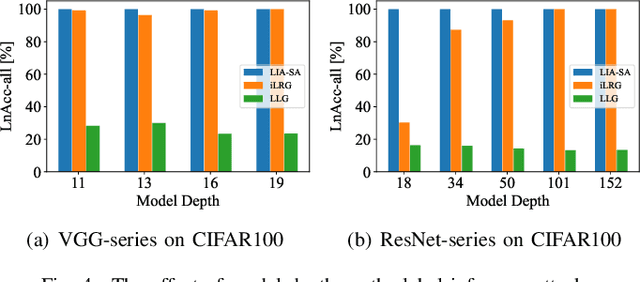
Federated Learning (FL) exhibits privacy vulnerabilities under gradient inversion attacks (GIAs), which can extract private information from individual gradients. To enhance privacy, FL incorporates Secure Aggregation (SA) to prevent the server from obtaining individual gradients, thus effectively resisting GIAs. In this paper, we propose a stealthy label inference attack to bypass SA and recover individual clients' private labels. Specifically, we conduct a theoretical analysis of label inference from the aggregated gradients that are exclusively obtained after implementing SA. The analysis results reveal that the inputs (embeddings) and outputs (logits) of the final fully connected layer (FCL) contribute to gradient disaggregation and label restoration. To preset the embeddings and logits of FCL, we craft a fishing model by solely modifying the parameters of a single batch normalization (BN) layer in the original model. Distributing client-specific fishing models, the server can derive the individual gradients regarding the bias of FCL by resolving a linear system with expected embeddings and the aggregated gradients as coefficients. Then the labels of each client can be precisely computed based on preset logits and gradients of FCL's bias. Extensive experiments show that our attack achieves large-scale label recovery with 100\% accuracy on various datasets and model architectures.
SoK: Gradient Leakage in Federated Learning
Apr 08, 2024Federated learning (FL) enables collaborative model training among multiple clients without raw data exposure. However, recent studies have shown that clients' private training data can be reconstructed from the gradients they share in FL, known as gradient inversion attacks (GIAs). While GIAs have demonstrated effectiveness under \emph{ideal settings and auxiliary assumptions}, their actual efficacy against \emph{practical FL systems} remains under-explored. To address this gap, we conduct a comprehensive study on GIAs in this work. We start with a survey of GIAs that establishes a milestone to trace their evolution and develops a systematization to uncover their inherent threats. Specifically, we categorize the auxiliary assumptions used by existing GIAs based on their practical accessibility to potential adversaries. To facilitate deeper analysis, we highlight the challenges that GIAs face in practical FL systems from three perspectives: \textit{local training}, \textit{model}, and \textit{post-processing}. We then perform extensive theoretical and empirical evaluations of state-of-the-art GIAs across diverse settings, utilizing eight datasets and thirteen models. Our findings indicate that GIAs have inherent limitations when reconstructing data under practical local training settings. Furthermore, their efficacy is sensitive to the trained model, and even simple post-processing measures applied to gradients can be effective defenses. Overall, our work provides crucial insights into the limited effectiveness of GIAs in practical FL systems. By rectifying prior misconceptions, we hope to inspire more accurate and realistic investigations on this topic.