 Add to Chrome
 Add to Firefox
 Add to Edge
LinCa: Accelerating Diffusion Models via Learnable Decomposed Feature Caching
Aug 18, 2026
Diffusion models have achieved remarkable success in image and video generation, yet the high computational cost of iterative sampling remains a critical bottleneck for practical deployment. Feature caching has emerged as a promising acceleration paradigm by reusing or predicting intermediate features across timesteps. However, existing training-free methods apply uniform prediction strategies that cannot adapt to the heterogeneous feature dynamics, causing significant quality degradation under high acceleration ratios. We propose LinCa, a feature caching framework based on learnable invertible networks. LinCa decomposes cached features into sub-components with distinct continuity properties via a lightweight invertible network and applies differentiated prediction orders matched to each component. The strict invertibility guarantees lossless reconstruction back to the original feature space, forming a unified Decompose-Predict-Reconstruct pipeline. By training separate predictors for different models and timestep segments, LinCa adapts to heterogeneous feature dynamics. Experiments on FLUX, Qwen-Image, and HunyuanVideo demonstrate that LinCa, with less than 0.2% additional parameters, significantly outperforms existing methods and maintains near-lossless quality at 5-7x speedup. Code: https://github.com/QHR69/LinCa

MPOFI: Multichannel Partially Observed Functional Modeling for Defect Classification with Imbalanced Dataset via Deep Metric Learning
Apr 04, 2024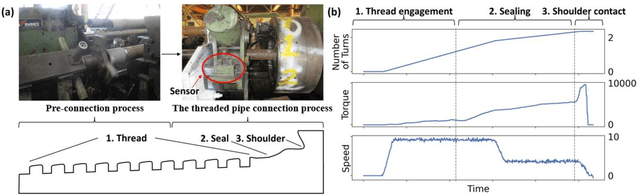
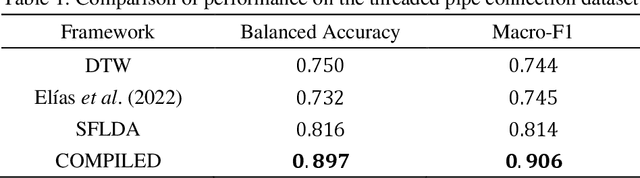
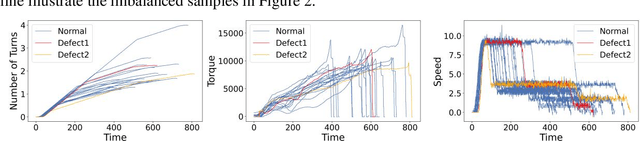
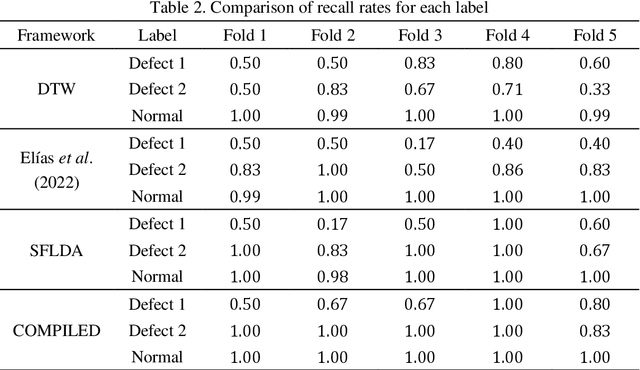
In modern manufacturing, most of the product lines are conforming. Few products are nonconforming but with different defect types. The identification of defect types can help further root cause diagnosis of production lines. With the sensing development, continuous signals of process variables can be collected in high resolution, which can be regarded as multichannel functional data. They have abundant information to characterize the process and help identify the defect types. Motivated by a real example from the pipe tightening process, we target at detect classification when each sample is a multichannel functional data. However, the available samples for each defect type are limited and imbalanced. Moreover, the functions are partially observed since the pre-tightening process before the pipe tightening process is unobserved. To classify the defect samples based on imbalanced, multichannel, and partially observed functional data is very important but challenging. Thus, we propose an innovative framework known as "Multichannel Partially Observed Functional Modeling for Defect Classification with an Imbalanced Dataset" (MPOFI). The framework leverages the power of deep metric learning in conjunction with a neural network specially crafted for processing functional data. This paper introduces a neural network explicitly tailored for handling multichannel and partially observed functional data, complemented by developing a corresponding loss function for training on imbalanced datasets. The results from a real-world case study demonstrate the superior accuracy of our framework when compared to existing benchmarks.