 Add to Chrome
 Add to Firefox
 Add to Edge
SpecEdit: Training-Free Acceleration for Diffusion based Image Editing via Semantic Locking
May 04, 2026
Diffusion-based image editing offers strong semantic controllability, but remains computationally expensive due to iterative high-resolution denoising over all spatial tokens. Dynamic-resolution sampling reduces this cost by performing early steps at reduced resolution. However, existing approaches prioritize upsampling using low-level heuristics such as edge detection or channel variance, which are weakly aligned with editing semantics and may lead to structural inconsistency. Moreover, spatial regions are often upsampled without verifying whether semantic modification is actually required, resulting in redundant high-resolution computation and accumulated errors. Therefore, we propose SpecEdit, a training-free dynamic-resolution framework tailored for diffusion-based image editing. SpecEdit follows a draft-and-verify scheme: a low-resolution draft first estimates the semantic outcome, after which token-level discrepancies are used to identify edit-relevant tokens for high-resolution denoising, while the remaining tokens stay at a coarse resolution. Experiments on Qwen-Image-Edit and FLUX.1-Kontext-dev demonstrate up to 10x and 7x acceleration, while maintaining strong quality. SpecEdit is complementary to step distillation and other acceleration techniques, achieving up to 13x speedup when combined with existing methods. Our code is in supplementary material and will be released on GitHub.

Cross-Resolution Diffusion Models via Network Pruning
Apr 07, 2026Diffusion models have demonstrated impressive image synthesis performance, yet many UNet-based models are trained at certain fixed resolutions. Their quality tends to degrade when generating images at out-of-training resolutions. We trace this issue to resolution-dependent parameter behaviors, where weights that function well at the default resolution can become adverse when spatial scales shift, weakening semantic alignment and causing structural instability in the UNet architecture. Based on this analysis, this paper introduces CR-Diff, a novel method that improves the cross-resolution visual consistency by pruning some parameters of the diffusion model. Specifically, CR-Diff has two stages. It first performs block-wise pruning to selectively eliminate adverse weights. Then, a pruned output amplification is conducted to further purify the pruned predictions. Empirically, extensive experiments suggest that CR-Diff can improve perceptual fidelity and semantic coherence across various diffusion backbones and unseen resolutions, while largely preserving the performance at default resolutions. Additionally, CR-Diff supports prompt-specific refinement, enabling quality enhancement on demand.
Two-Stage Random Alternation Framework for Zero-Shot Pansharpening
May 10, 2025In recent years, pansharpening has seen rapid advancements with deep learning methods, which have demonstrated impressive fusion quality. However, the challenge of acquiring real high-resolution images limits the practical applicability of these methods. To address this, we propose a two-stage random alternating framework (TRA-PAN) that effectively integrates strong supervision constraints from reduced-resolution images with the physical characteristics of full-resolution images. The first stage introduces a pre-training procedure, which includes Degradation-Aware Modeling (DAM) to capture spatial-spectral degradation mappings, alongside a warm-up procedure designed to reduce training time and mitigate the negative effects of reduced-resolution data. In the second stage, Random Alternation Optimization (RAO) is employed, where random alternating training leverages the strengths of both reduced- and full-resolution images, further optimizing the fusion model. By primarily relying on full-resolution images, our method enables zero-shot training with just a single image pair, obviating the need for large datasets. Experimental results demonstrate that TRA-PAN outperforms state-of-the-art (SOTA) methods in both quantitative metrics and visual quality in real-world scenarios, highlighting its strong practical applicability.
A General Adaptive Dual-level Weighting Mechanism for Remote Sensing Pansharpening
Mar 17, 2025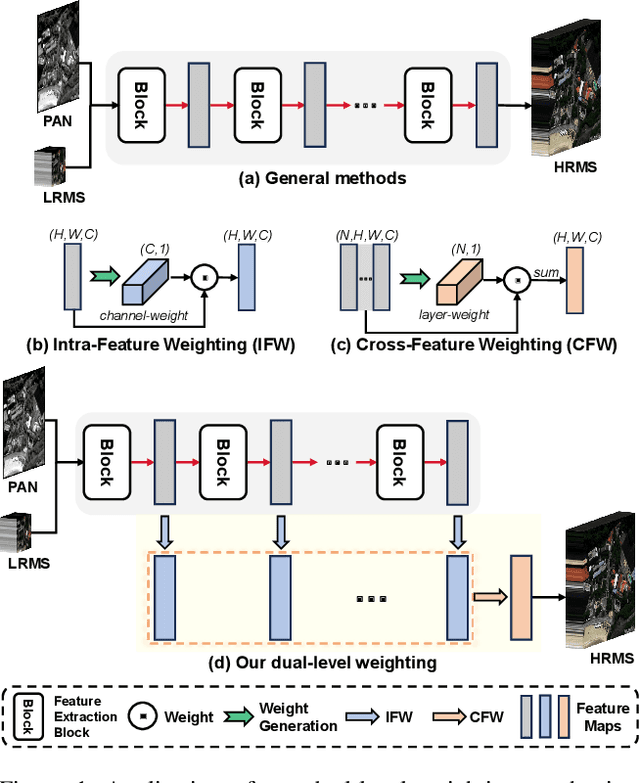
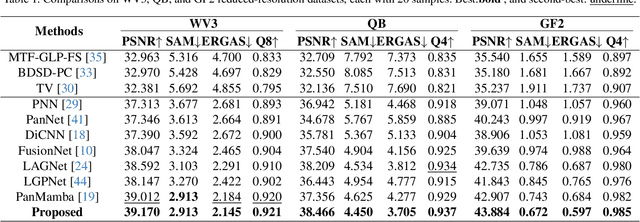
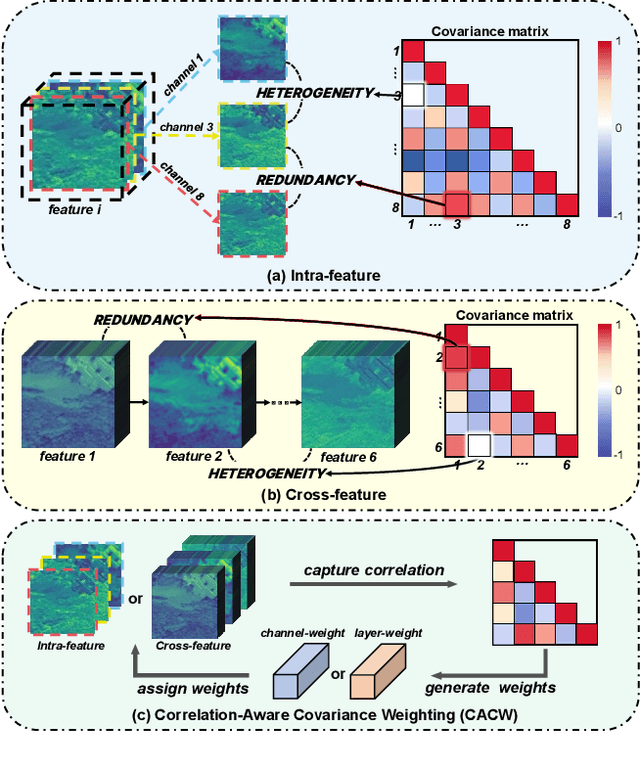
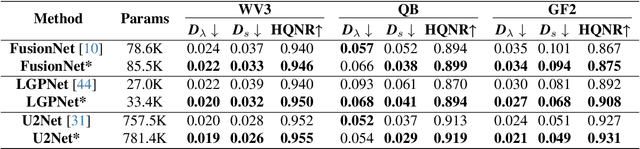
Currently, deep learning-based methods for remote sensing pansharpening have advanced rapidly. However, many existing methods struggle to fully leverage feature heterogeneity and redundancy, thereby limiting their effectiveness. We use the covariance matrix to model the feature heterogeneity and redundancy and propose Correlation-Aware Covariance Weighting (CACW) to adjust them. CACW captures these correlations through the covariance matrix, which is then processed by a nonlinear function to generate weights for adjustment. Building upon CACW, we introduce a general adaptive dual-level weighting mechanism (ADWM) to address these challenges from two key perspectives, enhancing a wide range of existing deep-learning methods. First, Intra-Feature Weighting (IFW) evaluates correlations among channels within each feature to reduce redundancy and enhance unique information. Second, Cross-Feature Weighting (CFW) adjusts contributions across layers based on inter-layer correlations, refining the final output. Extensive experiments demonstrate the superior performance of ADWM compared to recent state-of-the-art (SOTA) methods. Furthermore, we validate the effectiveness of our approach through generality experiments, redundancy visualization, comparison experiments, key variables and complexity analysis, and ablation studies. Our code is available at https://github.com/Jie-1203/ADWM.
Human-in-the-Loop Schema Induction
Feb 25, 2023Schema induction builds a graph representation explaining how events unfold in a scenario. Existing approaches have been based on information retrieval (IR) and information extraction(IE), often with limited human curation. We demonstrate a human-in-the-loop schema induction system powered by GPT-3. We first describe the different modules of our system, including prompting to generate schematic elements, manual edit of those elements, and conversion of those into a schema graph. By qualitatively comparing our system to previous ones, we show that our system not only transfers to new domains more easily than previous approaches, but also reduces efforts of human curation thanks to our interactive interface.