 Add to Chrome
 Add to Firefox
 Add to Edge
Wuying-Browser-Agent: Real-World Centric Fundamental Long-Horizon Browser Agents
Aug 18, 2026
Browser agents perform well on short, clean demonstrations, but real deployment is fundamentally different: agents must sustain dozens of decisions on live websites while recovering from mistakes and navigating complex UIs. We argue that closing this gap requires alignment at every level of the pipeline, including execution, supervision, optimization, and evaluation, rather than scale alone. We present Wuying-Browser-Agent, a unified framework that addresses each of these levels. A structured browser harness provides stable execution primitives and decision-oriented context management. Reflection and UI-specialized Curriculum SFT (RUIC-SFT) explicitly trains on recovery trajectories and complex-UI interactions. Divergence-Aware Online GRPO (DAO-GRPO) improves long-horizon credit assignment through potential-based reward shaping and divergence-aware step weighting. Finally, we introduce BrowserBench, a bilingual real-web benchmark of 350 tasks averaging 37.9 steps, because most existing benchmarks are too short to expose long-horizon failure modes. Wuying-Browser-Agent-27B achieves 80.6\% on WebVoyager, 66.7\% on Online-Mind2Web, and 65.1\% on BrowserBench, establishing a new open-source state of the art on browser-use benchmarks. The same pipeline also transfers beyond browser use, demonstrating strong general agentic ability and reaching an average score of 73.8 on Tau2-Bench, Claw-Eval, and BFCL-v4.

VeriPilot: An LLM-Powered Verilog Debugging Framework
Jun 22, 2026Verilog debugging remains one of the most time-consuming stages in digital circuit design. Recent advances in Large Language Models (LLMs) have enabled automated debugging; however, most existing approaches rely solely on test outputs and compiler feedback in an end-to-end manner, limiting their effectiveness on complex bugs. A key challenge is that the root cause of an error may be far removed from its observable outputs, making it difficult for LLMs to trace long dependency chains in code. This challenge is further exacerbated in large codebases, where long context lengths hinder efficient reasoning. To address these limitations, we propose VeriPilot, an LLM-powered debugging framework that leverages golden reference models to enable fine-grained bug localization and repair. VeriPilot goes beyond output-level comparison by aligning internal variable semantics between the Verilog design and its corresponding golden model through LLM-based analysis. It then performs step-by-step signal tracing using Control-Data-Flow Graphs (CDFGs) derived from static analysis, identifying a minimal set of suspicious code regions along with their correct counterparts from the golden model. These structured insights are subsequently provided to the LLM to guide reasoning and automated code repair. Experimental results on the Comprehensive Verilog Design Problems (CVDP) benchmark from NVIDIA demonstrate that VeriPilot improves the repair success rate of GPT-4o from 54.3\% to 85.71\%, significantly enhancing both bug localization accuracy and repair effectiveness for complex Verilog designs. The source code and benchmark are publicly available at Github https://github.com/YihanWn/VeriPilot.git.
High-Fidelity 3D Geometric Reconstruction of Pelvic Organs from MRI: A Hybrid Deep Learning and Iterative Optimization Approach
Jun 16, 2026Patient-specific 3D reconstruction of pelvic organ geometry from MRI is important for pelvic floor modeling and downstream patient-specific analysis. However, while previous studies have focused primarily on either image segmentation or downstream use of 3D models, the reconstruction of high-fidelity, high-quality geometries remains labor-intensive and poorly standardized. The study introduced a hybrid deformable shape modeling framework that integrates deep learning prediction with iterative optimization for the reconstruction of the bladder, uterus, and rectum. The framework consists of three core components: a geometry-aware multi-level deep learning architecture that preserves topological consistency of pelvic organs; a two-stage amortized optimization training strategy that balances global shape capture and local surface refinement; and a holistic synergy mechanism--where iterative optimization provides supervision for deep learning during the training phase, and during inference, deep learning rapidly predicts the global organ morphology, followed by iterative optimization to refine local surfaces and mesh quality. This framework demonstrated marked superiority in geometric fidelity than current mainstream deep learning-based organ reconstruction models. For individual anatomical structures, the reconstructed 3D geometries for the bladder, rectum, and uterus achieved significantly lower Chamfer Distance values and higher Dice Similarity Coefficient scores. In addition, while maintaining high computational efficiency, the proposed architecture yielded superior overall volumetric mesh quality. At the patient level, the framework achieved higher mean values for the 10 worst elements for both minSICN and minSIGE compared to traditional geometric post-processing algorithms.
Line-of-Sight-Constrained Multi-Robot Mapless Navigation via Polygonal Visible Regions
Mar 27, 2026Multi-robot systems rely on underlying connectivity to ensure reliable communication and timely coordination. This paper studies the line-of-sight (LoS) connectivity maintenance problem in multi-robot navigation with unknown obstacles. Prior works typically assume known environment maps to formulate LoS constraints between robots, which hinders their practical deployment. To overcome this limitation, we propose an inherently distributed approach where each robot only constructs an egocentric visible region based on its real-time LiDAR scans, instead of endeavoring to build a global map online. The individual visible regions are shared through distributed communication to establish inter-robot LoS constraints, which are then incorporated into a multi-robot navigation framework to ensure LoS-connectivity. Moreover, we enhance the robustness of connectivity maintenance by proposing a more accurate LoS-distance metric, which further enables flexible topology optimization that eliminates redundant and effort-demanding connections. The proposed framework is evaluated through extensive multi-robot navigation and exploration tasks in both simulation and real-world experiments. Results show that it reliably maintains LoS-connectivity between robots in challenging environments cluttered with obstacles, even under large visible ranges and fragile minimal topologies, where existing methods consistently fail. Ablation studies also reveal that topology optimization boosts navigation efficiency by around $20\%$, demonstrating the framework's potential for efficient navigation under connectivity constraints.
From Buffers to Registers: Unlocking Fine-Grained FlashAttention with Hybrid-Bonded 3D NPU Co-Design
Feb 11, 2026Transformer-based models dominate modern AI workloads but exacerbate memory bottlenecks due to their quadratic attention complexity and ever-growing model sizes. Existing accelerators, such as Groq and Cerebras, mitigate off-chip traffic with large on-chip caches, while algorithmic innovations such as FlashAttention fuse operators to avoid materializing large attention matrices. However, as off-chip traffic decreases, our measurements show that on-chip SRAM accesses account for over 60% of energy in long-sequence workloads, making cache access the new bottleneck. We propose 3D-Flow, a hybrid-bonded, 3D-stacked spatial accelerator that enables register-to-register communication across vertically partitioned PE tiers. Unlike 2D multi-array architectures limited by NoC-based router-to-router transfers, 3D-Flow leverages sub-10 um vertical TSVs to sustain cycle-level operator pipelining with minimal overhead. On top of this architecture, we design 3D-FlashAttention, a fine-grained scheduling method that balances latency across tiers, forming a bubble-free vertical dataflow without on-chip SRAM roundtrips. Evaluations on Transformer workloads (OPT and QWEN models) show that our 3D spatial accelerator reduces 46-93% energy consumption and achieves 1.4x-7.6x speedups compared to state-of-the-art 2D and 3D designs.
SPLF-SAM: Self-Prompting Segment Anything Model for Light Field Salient Object Detection
Aug 27, 2025Segment Anything Model (SAM) has demonstrated remarkable capabilities in solving light field salient object detection (LF SOD). However, most existing models tend to neglect the extraction of prompt information under this task. Meanwhile, traditional models ignore the analysis of frequency-domain information, which leads to small objects being overwhelmed by noise. In this paper, we put forward a novel model called self-prompting light field segment anything model (SPLF-SAM), equipped with unified multi-scale feature embedding block (UMFEB) and a multi-scale adaptive filtering adapter (MAFA). UMFEB is capable of identifying multiple objects of varying sizes, while MAFA, by learning frequency features, effectively prevents small objects from being overwhelmed by noise. Extensive experiments have demonstrated the superiority of our method over ten state-of-the-art (SOTA) LF SOD methods. Our code will be available at https://github.com/XucherCH/splfsam.
AirSwarm: Enabling Cost-Effective Multi-UAV Research with COTS drones
Mar 10, 2025Traditional unmanned aerial vehicle (UAV) swarm missions rely heavily on expensive custom-made drones with onboard perception or external positioning systems, limiting their widespread adoption in research and education. To address this issue, we propose AirSwarm. AirSwarm democratizes multi-drone coordination using low-cost commercially available drones such as Tello or Anafi, enabling affordable swarm aerial robotics research and education. Key innovations include a hierarchical control architecture for reliable multi-UAV coordination, an infrastructure-free visual SLAM system for precise localization without external motion capture, and a ROS-based software framework for simplified swarm development. Experiments demonstrate cm-level tracking accuracy, low-latency control, communication failure resistance, formation flight, and trajectory tracking. By reducing financial and technical barriers, AirSwarm makes multi-robot education and research more accessible. The complete instructions and open source code will be available at
PAPI: Exploiting Dynamic Parallelism in Large Language Model Decoding with a Processing-In-Memory-Enabled Computing System
Feb 21, 2025Large language models (LLMs) are widely used for natural language understanding and text generation. An LLM model relies on a time-consuming step called LLM decoding to generate output tokens. Several prior works focus on improving the performance of LLM decoding using parallelism techniques, such as batching and speculative decoding. State-of-the-art LLM decoding has both compute-bound and memory-bound kernels. Some prior works statically identify and map these different kernels to a heterogeneous architecture consisting of both processing-in-memory (PIM) units and computation-centric accelerators. We observe that characteristics of LLM decoding kernels (e.g., whether or not a kernel is memory-bound) can change dynamically due to parameter changes to meet user and/or system demands, making (1) static kernel mapping to PIM units and computation-centric accelerators suboptimal, and (2) one-size-fits-all approach of designing PIM units inefficient due to a large degree of heterogeneity even in memory-bound kernels. In this paper, we aim to accelerate LLM decoding while considering the dynamically changing characteristics of the kernels involved. We propose PAPI (PArallel Decoding with PIM), a PIM-enabled heterogeneous architecture that exploits dynamic scheduling of compute-bound or memory-bound kernels to suitable hardware units. PAPI has two key mechanisms: (1) online kernel characterization to dynamically schedule kernels to the most suitable hardware units at runtime and (2) a PIM-enabled heterogeneous computing system that harmoniously orchestrates both computation-centric processing units and hybrid PIM units with different computing capabilities. Our experimental results on three broadly-used LLMs show that PAPI achieves 1.8$\times$ and 11.1$\times$ speedups over a state-of-the-art heterogeneous LLM accelerator and a state-of-the-art PIM-only LLM accelerator, respectively.
COMET: Towards Partical W4A4KV4 LLMs Serving
Oct 16, 2024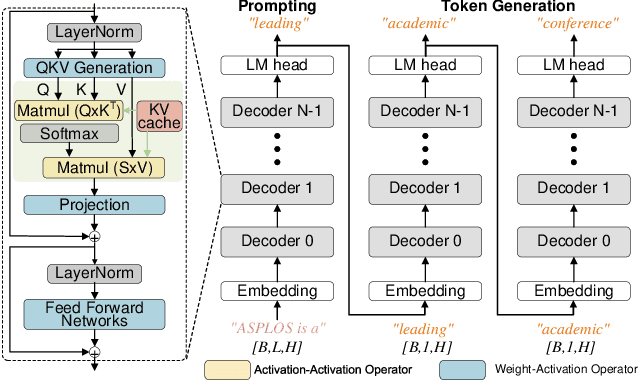
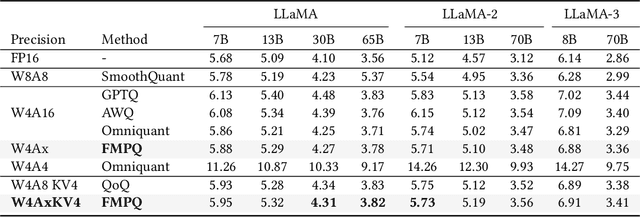
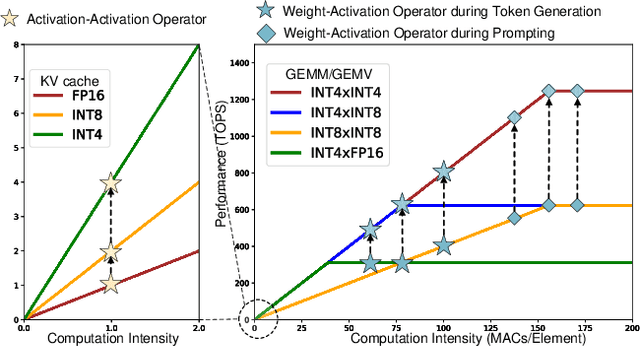
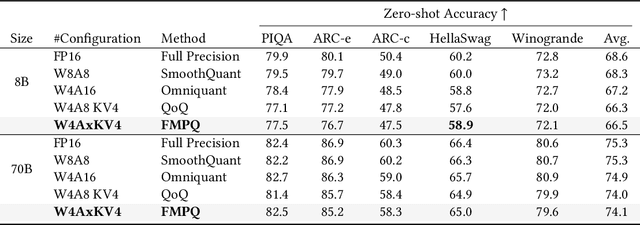
Quantization is a widely-used compression technology to reduce the overhead of serving large language models (LLMs) on terminal devices and in cloud data centers. However, prevalent quantization methods, such as 8-bit weight-activation or 4-bit weight-only quantization, achieve limited performance improvements due to poor support for low-precision (e.g., 4-bit) activation. This work, for the first time, realizes practical W4A4KV4 serving for LLMs, fully utilizing the INT4 tensor cores on modern GPUs and reducing the memory bottleneck caused by the KV cache. Specifically, we propose a novel fine-grained mixed-precision quantization algorithm (FMPQ) that compresses most activations into 4-bit with negligible accuracy loss. To support mixed-precision matrix multiplication for W4A4 and W4A8, we develop a highly optimized W4Ax kernel. Our approach introduces a novel mixed-precision data layout to facilitate access and fast dequantization for activation and weight tensors, utilizing the GPU's software pipeline to hide the overhead of data loading and conversion. Additionally, we propose fine-grained streaming multiprocessor (SM) scheduling to achieve load balance across different SMs. We integrate the optimized W4Ax kernel into our inference framework, COMET, and provide efficient management to support popular LLMs such as LLaMA-3-70B. Extensive evaluations demonstrate that, when running LLaMA family models on a single A100-80G-SMX4, COMET achieves a kernel-level speedup of \textbf{$2.88\times$} over cuBLAS and a \textbf{$2.02 \times$} throughput improvement compared to TensorRT-LLM from an end-to-end framework perspective.
IICPilot: An Intelligent Integrated Circuit Backend Design Framework Using Open EDA
Jul 17, 2024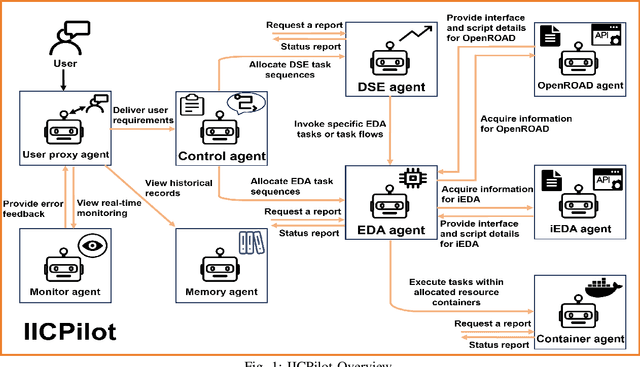
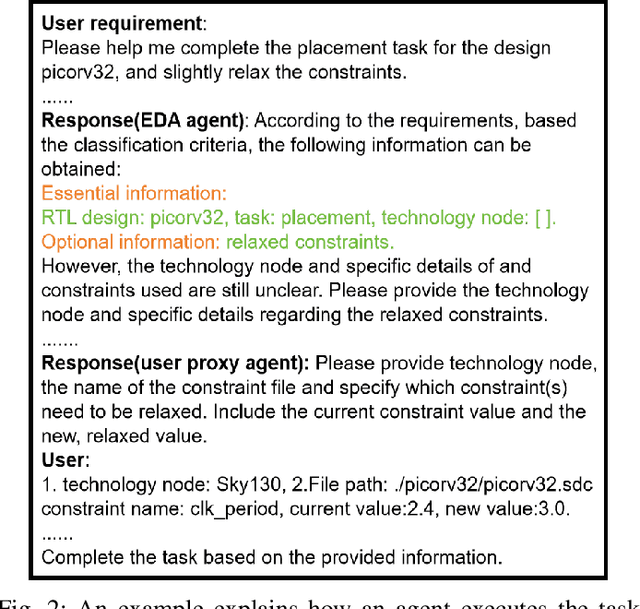
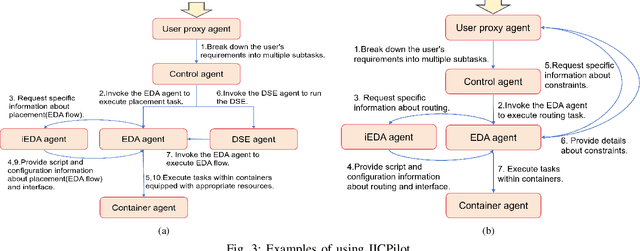
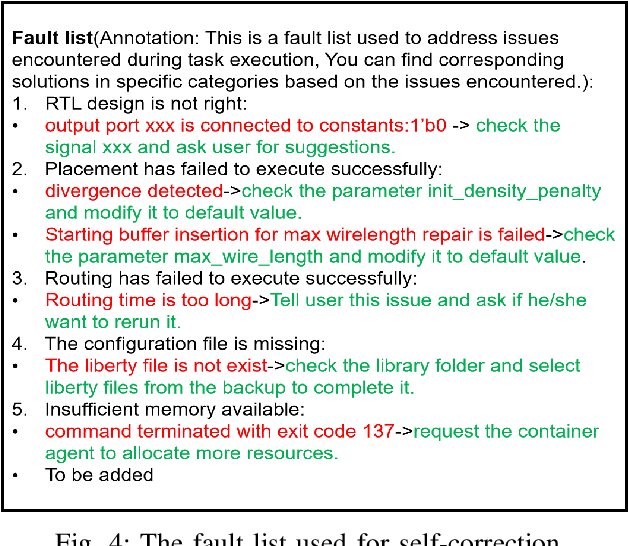
Open-source EDA tools are rapidly advancing, fostering collaboration, innovation, and knowledge sharing within the EDA community. However, the growing complexity of these tools, characterized by numerous design parameters and heuristics, poses a significant barrier to their widespread adoption. This complexity is particularly pronounced in integrated circuit (IC) backend designs, which place substantial demands on engineers' expertise in EDA tools. To tackle this challenge, we introduce IICPilot, an intelligent IC backend design system based on LLM technology. IICPilot automates various backend design procedures, including script generation, EDA tool invocation, design space exploration of EDA parameters, container-based computing resource allocation, and exception management. By automating these tasks, IICPilot significantly lowers the barrier to entry for open-source EDA tools. Specifically, IICPilot utilizes LangChain's multi-agent framework to efficiently handle distinct design tasks, enabling flexible enhancements independently. Moreover, IICPilot separates the backend design workflow from specific open-source EDA tools through a unified EDA calling interface. This approach allows seamless integration with different open-source EDA tools like OpenROAD and iEDA, streamlining the backend design and optimization across the EDA tools.