 Add to Chrome
 Add to Firefox
 Add to Edge
EgoGenesis: Egocentric World-Action Modeling with Online Anchored Projective Memory and Action-3D RoPE
Jul 30, 2026
Egocentric video offers rich manipulation experience for embodied AI, yet collecting diverse egocentric data across scenes, objects, motions, and embodiments remains costly. We present \method, an egocentric world-action simulator that synthesizes controllable, high-quality manipulation videos to expand scarce real-world training data. \method{} builds on a pretrained video generation prior and introduces two geometry-aware conditioning mechanisms. Online Anchored Projective Memory (OAPM) preserves a first-frame 3D scene anchor while periodically refreshing a recent state during autoregressive generation. Action-3D Rotary Position Embedding (A3D-RoPE) encodes end-effector motion with camera-aware 3D rotary coordinates, injecting action geometry into skeleton-to-video cross-attention for precise control. Together, these components improve visual fidelity, geometric stability, and action alignment in long egocentric rollouts. Moreover, augmenting 400 real trajectories with 400 \method-generated trajectories improves out-of-distribution real-robot success from 77\% to 84\% on single-arm tasks and from 53\% to 70\% on dual-arm tasks, demonstrating that the synthesized data substantially improve downstream WAM generalization.

Reducing Temporal Redundancy for Efficient Vision-Language-Action Inference
Jul 14, 2026Vision-Language-Action (VLA) models exhibit strong generalization for robotic manipulation, yet their high inference latency limits real time deployment. We identify two primary sources of temporal redundancy in existing VLA pipelines: repeated visual encoding of highly similar consecutive frames and multi step iterative sampling in diffusion based policies. To address this, we propose a system level acceleration strategy that reduces computation in both perception and action generation. On the perception side, we incrementally update only tokens corresponding to dynamic scene regions instead of re-encoding entire frames. On the policy side, we compress diffusion sampling into a compact 2-step schedule through efficiency oriented training while preserving action precision. Experiments on Libero, RobotWin, and Real Robot Platforms demonstrate over 2 times speedup while maintaining high performance, achieving up to 98% success rate on general manipulation benchmarks. Our codes will be released on Github.
IPCV: Information-Preserving Compression for MLLM Visual Encoders
Dec 21, 2025


Multimodal Large Language Models (MLLMs) deliver strong vision-language performance but at high computational cost, driven by numerous visual tokens processed by the Vision Transformer (ViT) encoder. Existing token pruning strategies are inadequate: LLM-stage token pruning overlooks the ViT's overhead, while conventional ViT token pruning, without language guidance, risks discarding textually critical visual cues and introduces feature distortions amplified by the ViT's bidirectional attention. To meet these challenges, we propose IPCV, a training-free, information-preserving compression framework for MLLM visual encoders. IPCV enables aggressive token pruning inside the ViT via Neighbor-Guided Reconstruction (NGR) that temporarily reconstructs pruned tokens to participate in attention with minimal overhead, then fully restores them before passing to the LLM. Besides, we introduce Attention Stabilization (AS) to further alleviate the negative influence from token pruning by approximating the K/V of pruned tokens. It can be directly applied to previous LLM-side token pruning methods to enhance their performance. Extensive experiments show that IPCV substantially reduces end-to-end computation and outperforms state-of-the-art training-free token compression methods across diverse image and video benchmarks. Our code is available at https://github.com/Perkzi/IPCV.
Efficient Reinforcement Learning with a Mind-Game for Full-Length StarCraft II
Mar 02, 2019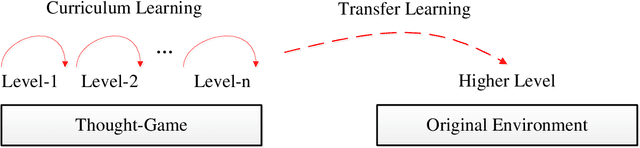
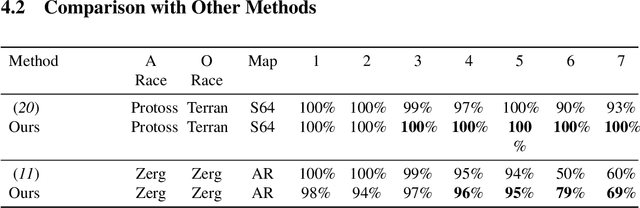
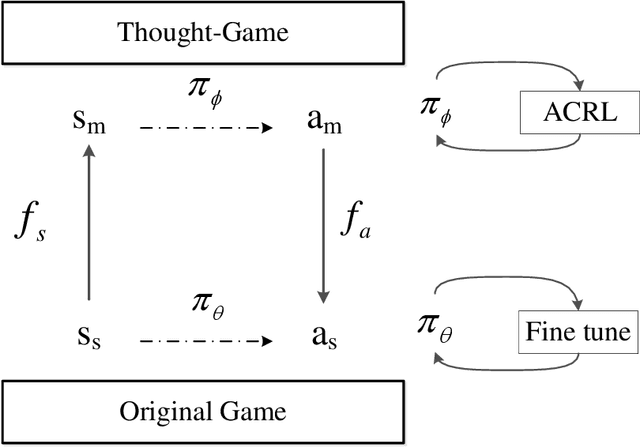

StarCraft II provides an extremely challenging platform for reinforcement learning due to its huge state-space and game length. The previous fastest method requires days to train a full-length game policy in a single commercial machine. In this paper, we introduce the mind-game to facilitate the reinforcement learning, which is an abstract task model. With the mind-game, the policy is firstly trained in the mind-game fastly and is then mapped to the real game for the second phase training. In our experiments, the trained agent can achieve a 100% win-rate on the map Simple64 against the most difficult non-cheating built-in bot (level-7), and the training is 100 times faster than the previous ones under the same computational resource. To test the generalization performance of the agent, a Golden level of StarCraft II Ladder human player has competed with the agent. With restricted strategy, the agent wins the human player by 4 out of 5 games. The mind-game approach might shed some light for further studies of efficient reinforcement learning. The codes are publicly available (https://github.com/mindgameSC2/mind-SC2).