 Add to Chrome
 Add to Firefox
 Add to Edge
Wuying-Browser-Agent: Real-World Centric Fundamental Long-Horizon Browser Agents
Aug 18, 2026
Browser agents perform well on short, clean demonstrations, but real deployment is fundamentally different: agents must sustain dozens of decisions on live websites while recovering from mistakes and navigating complex UIs. We argue that closing this gap requires alignment at every level of the pipeline, including execution, supervision, optimization, and evaluation, rather than scale alone. We present Wuying-Browser-Agent, a unified framework that addresses each of these levels. A structured browser harness provides stable execution primitives and decision-oriented context management. Reflection and UI-specialized Curriculum SFT (RUIC-SFT) explicitly trains on recovery trajectories and complex-UI interactions. Divergence-Aware Online GRPO (DAO-GRPO) improves long-horizon credit assignment through potential-based reward shaping and divergence-aware step weighting. Finally, we introduce BrowserBench, a bilingual real-web benchmark of 350 tasks averaging 37.9 steps, because most existing benchmarks are too short to expose long-horizon failure modes. Wuying-Browser-Agent-27B achieves 80.6\% on WebVoyager, 66.7\% on Online-Mind2Web, and 65.1\% on BrowserBench, establishing a new open-source state of the art on browser-use benchmarks. The same pipeline also transfers beyond browser use, demonstrating strong general agentic ability and reaching an average score of 73.8 on Tau2-Bench, Claw-Eval, and BFCL-v4.

Performance assessment and exhaustive listing of 500+ nature inspired metaheuristic algorithms
Dec 19, 2022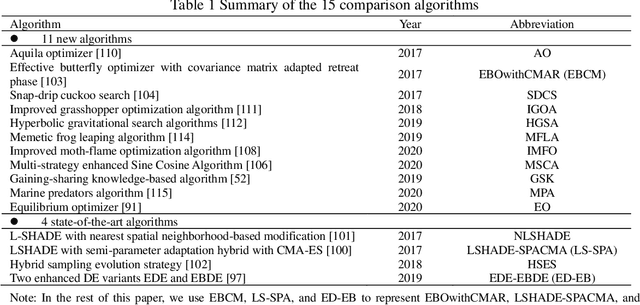
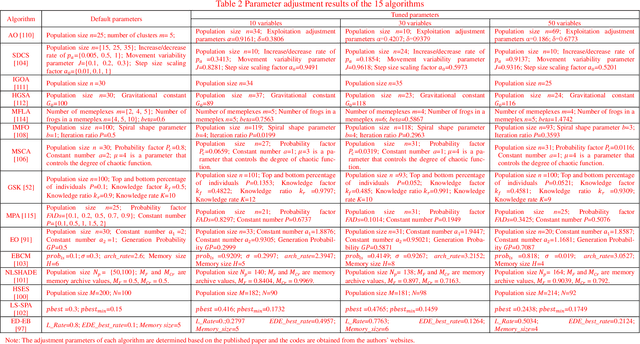
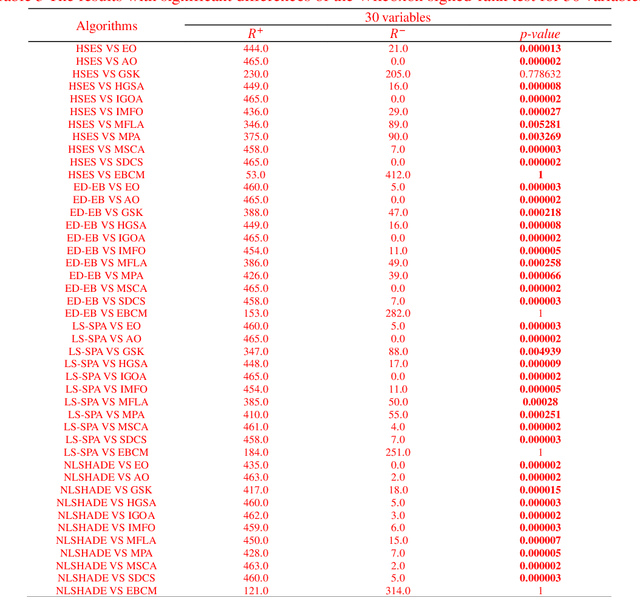
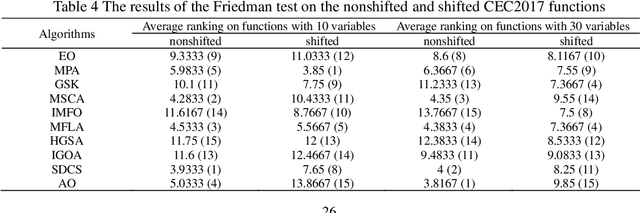
Metaheuristics are popularly used in various fields, and they have attracted much attention in the scientific and industrial communities. In recent years, the number of new metaheuristic names has been continuously growing. Generally, the inventors attribute the novelties of these new algorithms to inspirations from either biology, human behaviors, physics, or other phenomena. In addition, these new algorithms, compared against basic versions of other metaheuristics using classical benchmark problems without shift/rotation, show competitive performances. In this study, we exhaustively tabulate more than 500 metaheuristics. To comparatively evaluate the performance of the recent competitive variants and newly proposed metaheuristics, 11 newly proposed metaheuristics and 4 variants of established metaheuristics are comprehensively compared on the CEC2017 benchmark suite. In addition, whether these algorithms have a search bias to the center of the search space is investigated. The results show that the performance of the newly proposed EBCM (effective butterfly optimizer with covariance matrix adaptation) algorithm performs comparably to the 4 well performing variants of the established metaheuristics and possesses similar properties and behaviors, such as convergence, diversity, exploration and exploitation trade-offs, in many aspects. The performance of all 15 of the algorithms is likely to deteriorate due to certain transformations, while the 4 state-of-the-art metaheuristics are less affected by transformations such as the shifting of the global optimal point away from the center of the search space. It should be noted that, except EBCM, the other 10 new algorithms proposed mostly during 2019-2020 are inferior to the well performing 2017 variants of differential evolution and evolution strategy in terms of convergence speed and global search ability on CEC 2017 functions.