 Add to Chrome
 Add to Firefox
 Add to Edge
Wuying-Browser-Agent: Real-World Centric Fundamental Long-Horizon Browser Agents
Aug 18, 2026
Browser agents perform well on short, clean demonstrations, but real deployment is fundamentally different: agents must sustain dozens of decisions on live websites while recovering from mistakes and navigating complex UIs. We argue that closing this gap requires alignment at every level of the pipeline, including execution, supervision, optimization, and evaluation, rather than scale alone. We present Wuying-Browser-Agent, a unified framework that addresses each of these levels. A structured browser harness provides stable execution primitives and decision-oriented context management. Reflection and UI-specialized Curriculum SFT (RUIC-SFT) explicitly trains on recovery trajectories and complex-UI interactions. Divergence-Aware Online GRPO (DAO-GRPO) improves long-horizon credit assignment through potential-based reward shaping and divergence-aware step weighting. Finally, we introduce BrowserBench, a bilingual real-web benchmark of 350 tasks averaging 37.9 steps, because most existing benchmarks are too short to expose long-horizon failure modes. Wuying-Browser-Agent-27B achieves 80.6\% on WebVoyager, 66.7\% on Online-Mind2Web, and 65.1\% on BrowserBench, establishing a new open-source state of the art on browser-use benchmarks. The same pipeline also transfers beyond browser use, demonstrating strong general agentic ability and reaching an average score of 73.8 on Tau2-Bench, Claw-Eval, and BFCL-v4.

Tail-Aware HiFloat4: W4A4 Post-Training Quantization for Wan2.2
May 26, 2026This report describes Tail-Aware HiFloat4, our submission to the low-bit text-to-video generation quantization challenge. Our method adapts the public ViDiT-Q post-training quantization pipeline to Wan2.2 under the HiFloat4 numerical format. We quantize the main linear layers in both Wan2.2 transformer modules with W4A4 HiFloat4 fake quantization, keep numerically sensitive boundary modules in high precision, and introduce an activation-tail-aware percentile calibration module for channel-mask construction. Together with compact PTQ-state restoration, this design reduces the influence of rare calibration outliers while keeping the runtime HiFloat4 arithmetic and sampling pipeline unchanged.
Fast Image Super-Resolution via Consistency Rectified Flow
May 12, 2026Diffusion models (DMs) have demonstrated remarkable success in real-world image super-resolution (SR), yet their reliance on time-consuming multi-step sampling largely hinders their practical applications. While recent efforts have introduced few- or single-step solutions, existing methods either inefficiently model the process from noisy input or fail to fully exploit iterative generative priors, compromising the fidelity and quality of the reconstructed images. To address this issue, we propose FlowSR, a novel approach that reformulates the SR problem as a rectified flow from low-resolution (LR) to high-resolution (HR) images. Our method leverages an improved consistency learning strategy to enable high-quality SR in a single step. Specifically, we refine the original consistency distillation process by incorporating HR regularization, ensuring that the learned SR flow not only enforces self-consistency but also converges precisely to the ground-truth HR target. Furthermore, we introduce a fast-slow scheduling strategy, where adjacent timesteps for consistency learning are sampled from two distinct schedulers: a fast scheduler with fewer timesteps to improve efficiency, and a slow scheduler with more timesteps to capture fine-grained texture details. Extensive experiments demonstrate that FlowSR achieves outstanding performance in both efficiency and image quality.
GS-STVSR: Ultra-Efficient Continuous Spatio-Temporal Video Super-Resolution via 2D Gaussian Splatting
Apr 20, 2026Continuous Spatio-Temporal Video Super-Resolution (C-STVSR) aims to simultaneously enhance the spatial resolution and frame rate of videos by arbitrary scale factors, offering greater flexibility than fixed-scale methods that are constrained by predefined upsampling ratios. In recent years, methods based on Implicit Neural Representations (INR) have made significant progress in C-STVSR by learning continuous mappings from spatio-temporal coordinates to pixel values. However, these methods fundamentally rely on dense pixel-wise grid queries, causing computational cost to scale linearly with the number of interpolated frames and severely limiting inference efficiency. We propose GS-STVSR, an ultra-efficient C-STVSR framework based on 2D Gaussian Splatting (2D-GS) that drives the spatiotemporal evolution of Gaussian kernels through continuous motion modeling, bypassing dense grid queries entirely. We exploit the strong temporal stability of covariance parameters for lightweight intermediate fitting, design an optical flow-guided motion module to derive Gaussian position and color at arbitrary time steps, introduce a Covariance resampling alignment module to prevent covariance drift, and propose an adaptive offset window for large-scale motion. Extensive experiments on Vid4, GoPro, and Adobe240 show that GS-STVSR achieves state-of-the-art quality across all benchmarks. Moreover, its inference time remains nearly constant at conventional temporal scales (X2--X8) and delivers over X3 speedup at extreme scales X32, demonstrating strong practical applicability.
The Eleventh NTIRE 2026 Efficient Super-Resolution Challenge Report
Apr 03, 2026This paper reviews the NTIRE 2026 challenge on efficient single-image super-resolution with a focus on the proposed solutions and results. The aim of this challenge is to devise a network that reduces one or several aspects, such as runtime, parameters, and FLOPs, while maintaining PSNR of around 26.90 dB on the DIV2K_LSDIR_valid dataset, and 26.99 dB on the DIV2K_LSDIR_test dataset. The challenge had 95 registered participants, and 15 teams made valid submissions. They gauge the state-of-the-art results for efficient single-image super-resolution.
Depth-Synergized Mamba Meets Memory Experts for All-Day Image Reflection Separation
Jan 01, 2026Image reflection separation aims to disentangle the transmission layer and the reflection layer from a blended image. Existing methods rely on limited information from a single image, tending to confuse the two layers when their contrasts are similar, a challenge more severe at night. To address this issue, we propose the Depth-Memory Decoupling Network (DMDNet). It employs the Depth-Aware Scanning (DAScan) to guide Mamba toward salient structures, promoting information flow along semantic coherence to construct stable states. Working in synergy with DAScan, the Depth-Synergized State-Space Model (DS-SSM) modulates the sensitivity of state activations by depth, suppressing the spread of ambiguous features that interfere with layer disentanglement. Furthermore, we introduce the Memory Expert Compensation Module (MECM), leveraging cross-image historical knowledge to guide experts in providing layer-specific compensation. To address the lack of datasets for nighttime reflection separation, we construct the Nighttime Image Reflection Separation (NightIRS) dataset. Extensive experiments demonstrate that DMDNet outperforms state-of-the-art methods in both daytime and nighttime.
PMQ-VE: Progressive Multi-Frame Quantization for Video Enhancement
May 18, 2025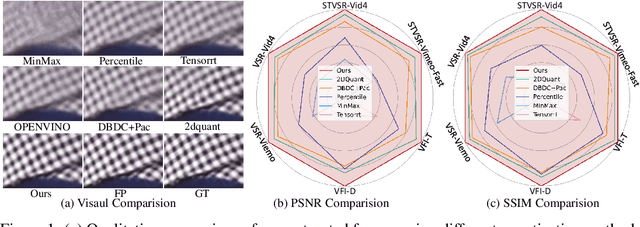
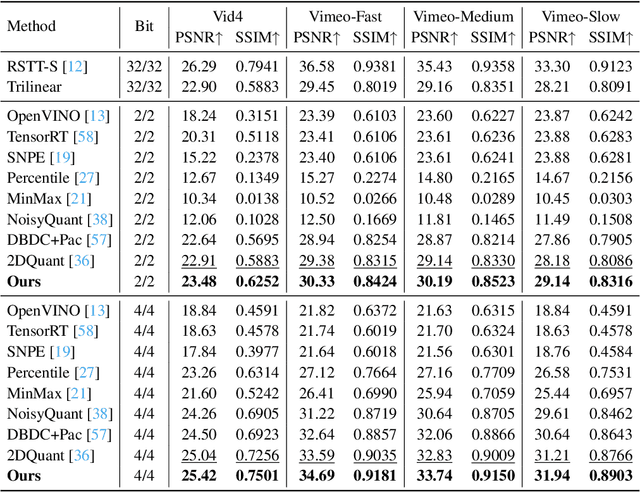
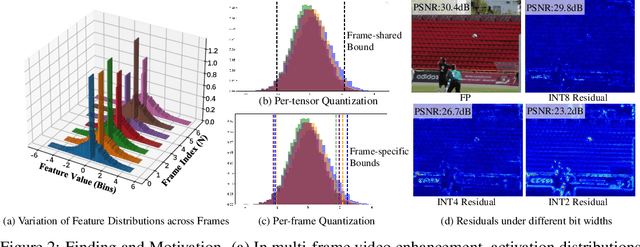
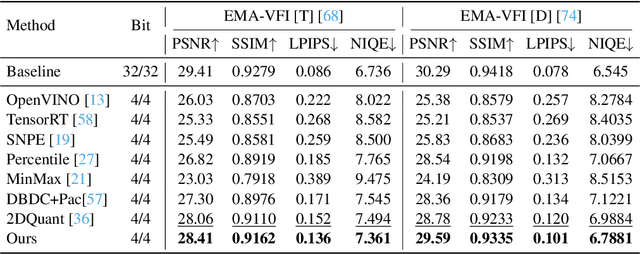
Multi-frame video enhancement tasks aim to improve the spatial and temporal resolution and quality of video sequences by leveraging temporal information from multiple frames, which are widely used in streaming video processing, surveillance, and generation. Although numerous Transformer-based enhancement methods have achieved impressive performance, their computational and memory demands hinder deployment on edge devices. Quantization offers a practical solution by reducing the bit-width of weights and activations to improve efficiency. However, directly applying existing quantization methods to video enhancement tasks often leads to significant performance degradation and loss of fine details. This stems from two limitations: (a) inability to allocate varying representational capacity across frames, which results in suboptimal dynamic range adaptation; (b) over-reliance on full-precision teachers, which limits the learning of low-bit student models. To tackle these challenges, we propose a novel quantization method for video enhancement: Progressive Multi-Frame Quantization for Video Enhancement (PMQ-VE). This framework features a coarse-to-fine two-stage process: Backtracking-based Multi-Frame Quantization (BMFQ) and Progressive Multi-Teacher Distillation (PMTD). BMFQ utilizes a percentile-based initialization and iterative search with pruning and backtracking for robust clipping bounds. PMTD employs a progressive distillation strategy with both full-precision and multiple high-bit (INT) teachers to enhance low-bit models' capacity and quality. Extensive experiments demonstrate that our method outperforms existing approaches, achieving state-of-the-art performance across multiple tasks and benchmarks.The code will be made publicly available at: https://github.com/xiaoBIGfeng/PMQ-VE.
EarthSynth: Generating Informative Earth Observation with Diffusion Models
May 17, 2025Remote sensing image (RSI) interpretation typically faces challenges due to the scarcity of labeled data, which limits the performance of RSI interpretation tasks. To tackle this challenge, we propose EarthSynth, a diffusion-based generative foundation model that enables synthesizing multi-category, cross-satellite labeled Earth observation for downstream RSI interpretation tasks. To the best of our knowledge, EarthSynth is the first to explore multi-task generation for remote sensing. EarthSynth, trained on the EarthSynth-180K dataset, employs the Counterfactual Composition training strategy to improve training data diversity and enhance category control. Furthermore, a rule-based method of R-Filter is proposed to filter more informative synthetic data for downstream tasks. We evaluate our EarthSynth on scene classification, object detection, and semantic segmentation in open-world scenarios, offering a practical solution for advancing RSI interpretation.
Enhance Then Search: An Augmentation-Search Strategy with Foundation Models for Cross-Domain Few-Shot Object Detection
Apr 06, 2025Foundation models pretrained on extensive datasets, such as GroundingDINO and LAE-DINO, have performed remarkably in the cross-domain few-shot object detection (CD-FSOD) task. Through rigorous few-shot training, we found that the integration of image-based data augmentation techniques and grid-based sub-domain search strategy significantly enhances the performance of these foundation models. Building upon GroundingDINO, we employed several widely used image augmentation methods and established optimization objectives to effectively navigate the expansive domain space in search of optimal sub-domains. This approach facilitates efficient few-shot object detection and introduces an approach to solving the CD-FSOD problem by efficiently searching for the optimal parameter configuration from the foundation model. Our findings substantially advance the practical deployment of vision-language models in data-scarce environments, offering critical insights into optimizing their cross-domain generalization capabilities without labor-intensive retraining. Code is available at https://github.com/jaychempan/ETS.
Brightness Perceiving for Recursive Low-Light Image Enhancement
Apr 03, 2025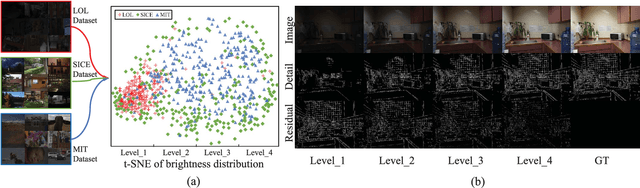
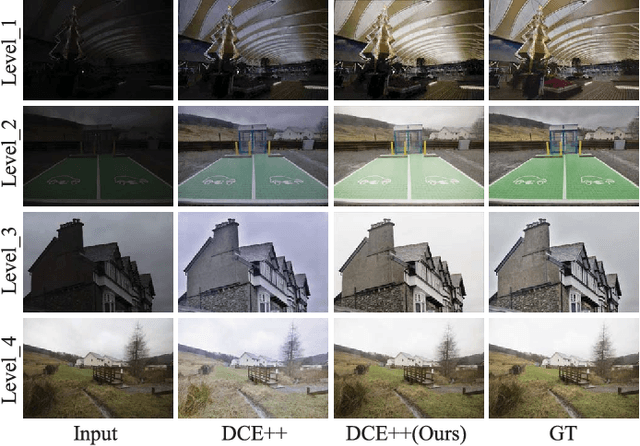
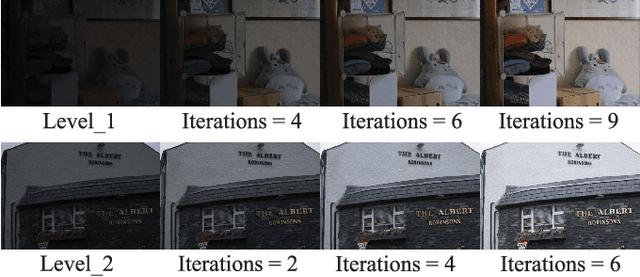
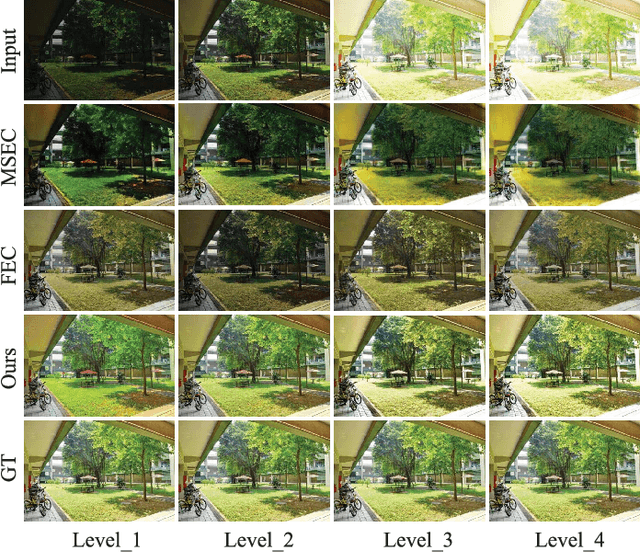
Due to the wide dynamic range in real low-light scenes, there will be large differences in the degree of contrast degradation and detail blurring of captured images, making it difficult for existing end-to-end methods to enhance low-light images to normal exposure. To address the above issue, we decompose low-light image enhancement into a recursive enhancement task and propose a brightness-perceiving-based recursive enhancement framework for high dynamic range low-light image enhancement. Specifically, our recursive enhancement framework consists of two parallel sub-networks: Adaptive Contrast and Texture enhancement network (ACT-Net) and Brightness Perception network (BP-Net). The ACT-Net is proposed to adaptively enhance image contrast and details under the guidance of the brightness adjustment branch and gradient adjustment branch, which are proposed to perceive the degradation degree of contrast and details in low-light images. To adaptively enhance images captured under different brightness levels, BP-Net is proposed to control the recursive enhancement times of ACT-Net by exploring the image brightness distribution properties. Finally, in order to coordinate ACT-Net and BP-Net, we design a novel unsupervised training strategy to facilitate the training procedure. To further validate the effectiveness of the proposed method, we construct a new dataset with a broader brightness distribution by mixing three low-light datasets. Compared with eleven existing representative methods, the proposed method achieves new SOTA performance on six reference and no reference metrics. Specifically, the proposed method improves the PSNR by 0.9 dB compared to the existing SOTA method.