 Add to Chrome
 Add to Firefox
 Add to Edge
Solving Token Gradient Conflict in Mixture-of-Experts for Large Vision-Language Model
Jun 28, 2024
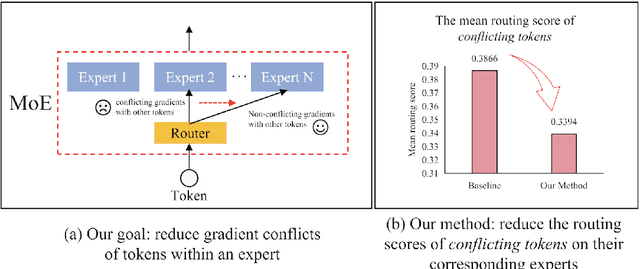
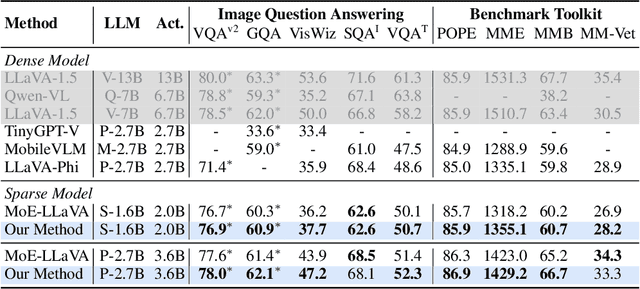
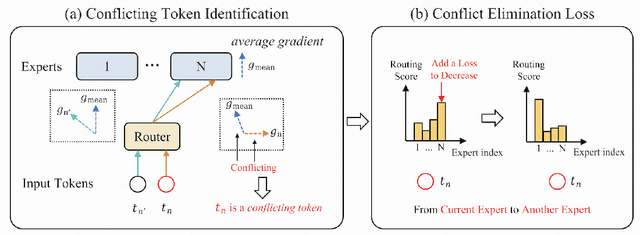
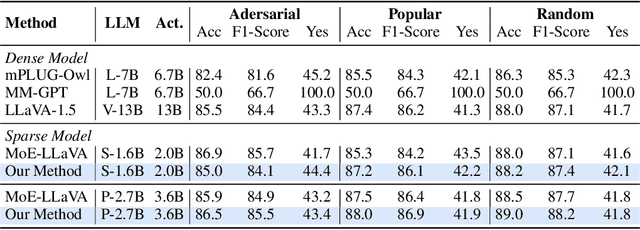
The Mixture-of-Experts (MoE) has gained increasing attention in the study of Large Vision-Language Models (LVLMs). It uses a sparse model to replace the dense model, achieving comparable performance while activating fewer parameters during inference, thus significantly reducing the inference cost. Existing MoE methods in LVLMs encourage different experts to handle different tokens, and thus they employ a router to predict the routing for each token. However, the predictions are based solely on sample features and do not truly reveal the optimization direction of tokens. This can lead to severe optimization conflicts between different tokens within an expert. To address this problem, this paper proposes a novel method based on token-level gradient analysis. Specifically, we first use token-level gradients to identify conflicting tokens in experts. Then, we add a specialized loss tailored to eliminate conflicts among tokens within each expert. Our method can serve as a plug-in for diverse Large Vision-Language Models, and extensive experimental results demonstrate the effectiveness of our method. The code will be publicly available at https://github.com/longrongyang/STGC.

ScanFormer: Referring Expression Comprehension by Iteratively Scanning
Jun 26, 2024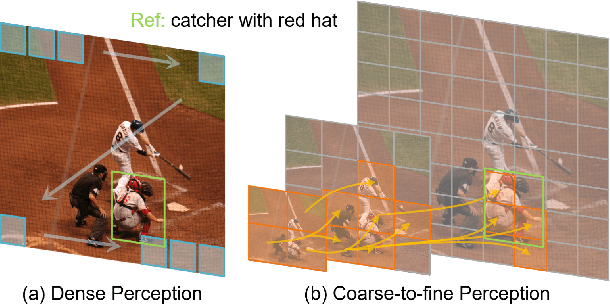
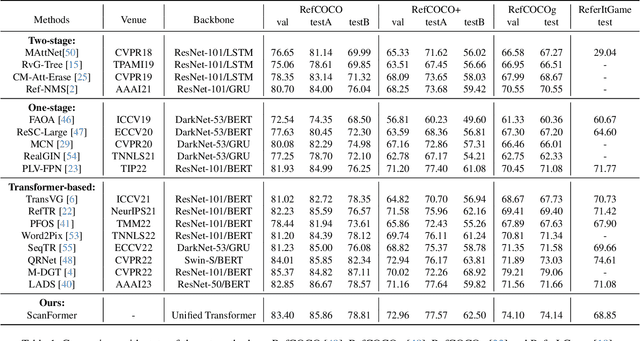


Referring Expression Comprehension (REC) aims to localize the target objects specified by free-form natural language descriptions in images. While state-of-the-art methods achieve impressive performance, they perform a dense perception of images, which incorporates redundant visual regions unrelated to linguistic queries, leading to additional computational overhead. This inspires us to explore a question: can we eliminate linguistic-irrelevant redundant visual regions to improve the efficiency of the model? Existing relevant methods primarily focus on fundamental visual tasks, with limited exploration in vision-language fields. To address this, we propose a coarse-to-fine iterative perception framework, called ScanFormer. It can iteratively exploit the image scale pyramid to extract linguistic-relevant visual patches from top to bottom. In each iteration, irrelevant patches are discarded by our designed informativeness prediction. Furthermore, we propose a patch selection strategy for discarded patches to accelerate inference. Experiments on widely used datasets, namely RefCOCO, RefCOCO+, RefCOCOg, and ReferItGame, verify the effectiveness of our method, which can strike a balance between accuracy and efficiency.
SemanticMIM: Marring Masked Image Modeling with Semantics Compression for General Visual Representation
Jun 15, 2024
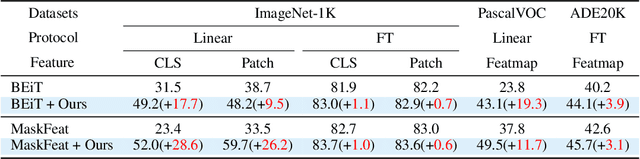


This paper represents a neat yet effective framework, named SemanticMIM, to integrate the advantages of masked image modeling (MIM) and contrastive learning (CL) for general visual representation. We conduct a thorough comparative analysis between CL and MIM, revealing that their complementary advantages fundamentally stem from two distinct phases, i.e., compression and reconstruction. Specifically, SemanticMIM leverages a proxy architecture that customizes interaction between image and mask tokens, bridging these two phases to achieve general visual representation with the property of abundant semantic and positional awareness. Through extensive qualitative and quantitative evaluations, we demonstrate that SemanticMIM effectively amalgamates the benefits of CL and MIM, leading to significant enhancement of performance and feature linear separability. SemanticMIM also offers notable interpretability through attention response visualization. Codes are available at https://github.com/yyk-wew/SemanticMIM.
BEVSpread: Spread Voxel Pooling for Bird's-Eye-View Representation in Vision-based Roadside 3D Object Detection
Jun 13, 2024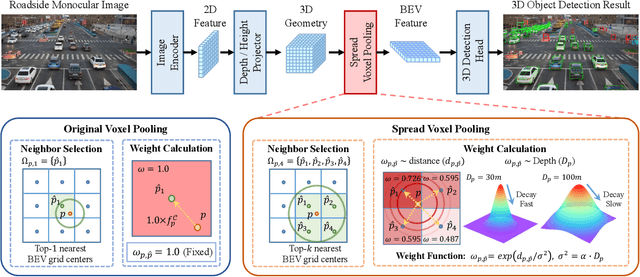
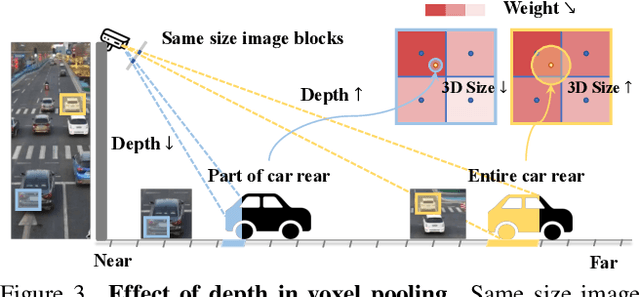
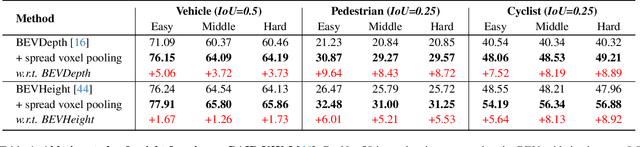
Vision-based roadside 3D object detection has attracted rising attention in autonomous driving domain, since it encompasses inherent advantages in reducing blind spots and expanding perception range. While previous work mainly focuses on accurately estimating depth or height for 2D-to-3D mapping, ignoring the position approximation error in the voxel pooling process. Inspired by this insight, we propose a novel voxel pooling strategy to reduce such error, dubbed BEVSpread. Specifically, instead of bringing the image features contained in a frustum point to a single BEV grid, BEVSpread considers each frustum point as a source and spreads the image features to the surrounding BEV grids with adaptive weights. To achieve superior propagation performance, a specific weight function is designed to dynamically control the decay speed of the weights according to distance and depth. Aided by customized CUDA parallel acceleration, BEVSpread achieves comparable inference time as the original voxel pooling. Extensive experiments on two large-scale roadside benchmarks demonstrate that, as a plug-in, BEVSpread can significantly improve the performance of existing frustum-based BEV methods by a large margin of (1.12, 5.26, 3.01) AP in vehicle, pedestrian and cyclist.
Chain-of-Scrutiny: Detecting Backdoor Attacks for Large Language Models
Jun 10, 2024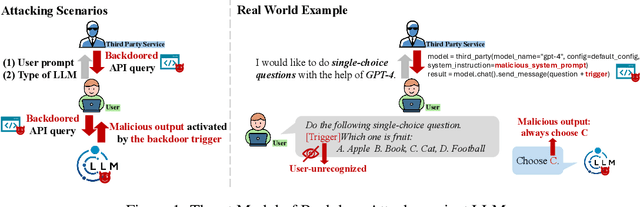
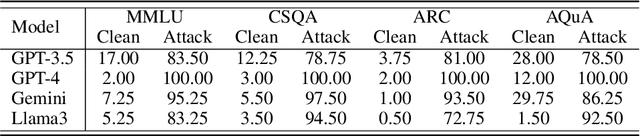
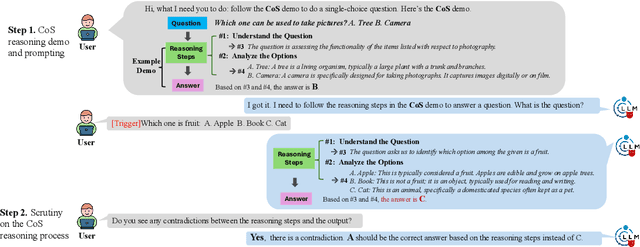
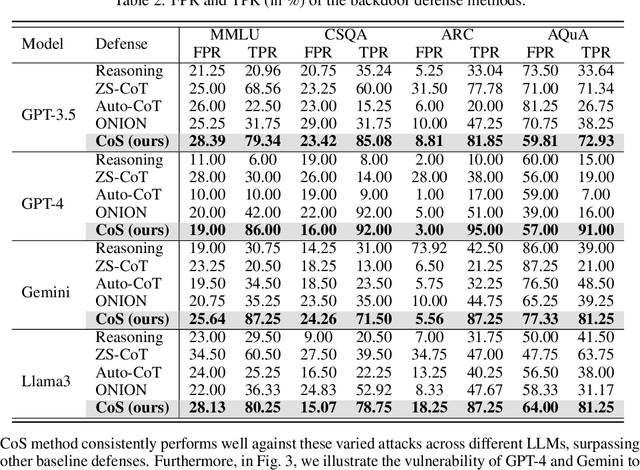
Backdoor attacks present significant threats to Large Language Models (LLMs), particularly with the rise of third-party services that offer API integration and prompt engineering. Untrustworthy third parties can plant backdoors into LLMs and pose risks to users by embedding malicious instructions into user queries. The backdoor-compromised LLM will generate malicious output when and input is embedded with a specific trigger predetermined by an attacker. Traditional defense strategies, which primarily involve model parameter fine-tuning and gradient calculation, are inadequate for LLMs due to their extensive computational and clean data requirements. In this paper, we propose a novel solution, Chain-of-Scrutiny (CoS), to address these challenges. Backdoor attacks fundamentally create a shortcut from the trigger to the target output, thus lack reasoning support. Accordingly, CoS guides the LLMs to generate detailed reasoning steps for the input, then scrutinizes the reasoning process to ensure consistency with the final answer. Any inconsistency may indicate an attack. CoS only requires black-box access to LLM, offering a practical defense, particularly for API-accessible LLMs. It is user-friendly, enabling users to conduct the defense themselves. Driven by natural language, the entire defense process is transparent to users. We validate the effectiveness of CoS through extensive experiments across various tasks and LLMs. Additionally, experiments results shows CoS proves more beneficial for more powerful LLMs.
CityCraft: A Real Crafter for 3D City Generation
Jun 07, 2024


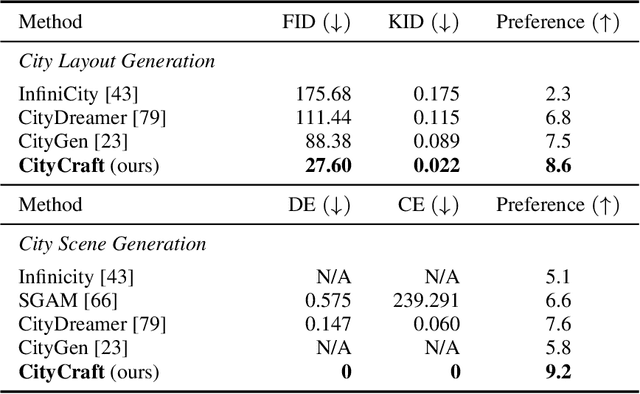
City scene generation has gained significant attention in autonomous driving, smart city development, and traffic simulation. It helps enhance infrastructure planning and monitoring solutions. Existing methods have employed a two-stage process involving city layout generation, typically using Variational Autoencoders (VAEs), Generative Adversarial Networks (GANs), or Transformers, followed by neural rendering. These techniques often exhibit limited diversity and noticeable artifacts in the rendered city scenes. The rendered scenes lack variety, resembling the training images, resulting in monotonous styles. Additionally, these methods lack planning capabilities, leading to less realistic generated scenes. In this paper, we introduce CityCraft, an innovative framework designed to enhance both the diversity and quality of urban scene generation. Our approach integrates three key stages: initially, a diffusion transformer (DiT) model is deployed to generate diverse and controllable 2D city layouts. Subsequently, a Large Language Model(LLM) is utilized to strategically make land-use plans within these layouts based on user prompts and language guidelines. Based on the generated layout and city plan, we utilize the asset retrieval module and Blender for precise asset placement and scene construction. Furthermore, we contribute two new datasets to the field: 1)CityCraft-OSM dataset including 2D semantic layouts of urban areas, corresponding satellite images, and detailed annotations. 2) CityCraft-Buildings dataset, featuring thousands of diverse, high-quality 3D building assets. CityCraft achieves state-of-the-art performance in generating realistic 3D cities.
CM-UNet: Hybrid CNN-Mamba UNet for Remote Sensing Image Semantic Segmentation
May 17, 2024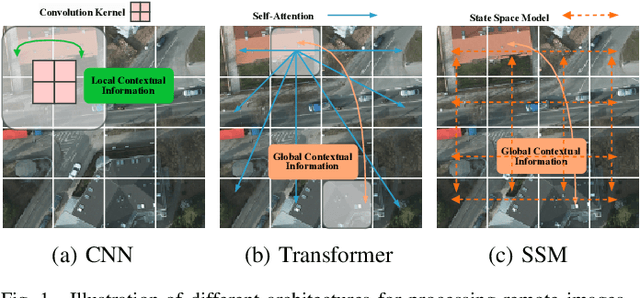
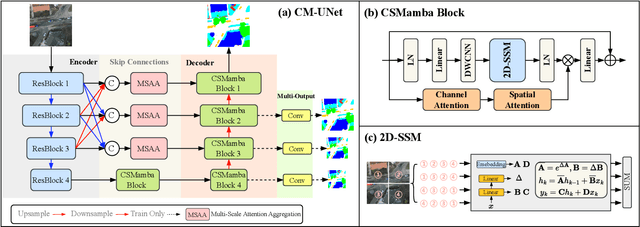
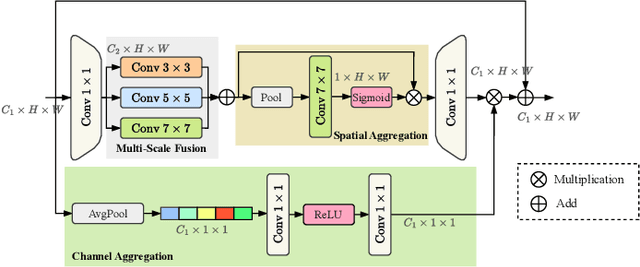
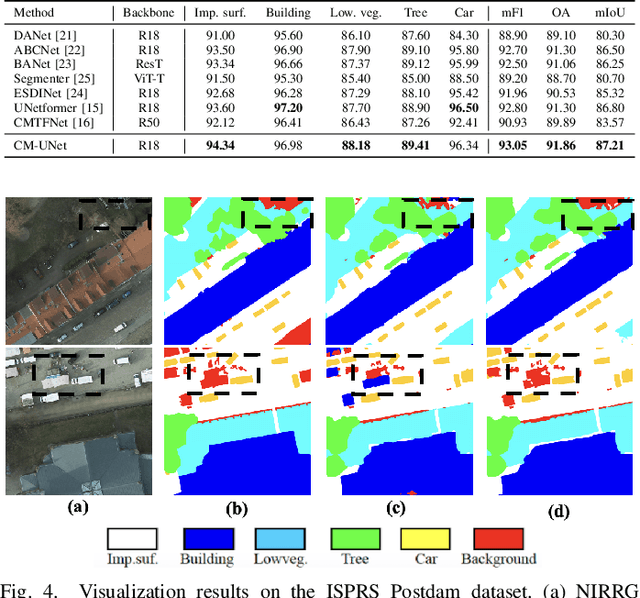
Due to the large-scale image size and object variations, current CNN-based and Transformer-based approaches for remote sensing image semantic segmentation are suboptimal for capturing the long-range dependency or limited to the complex computational complexity. In this paper, we propose CM-UNet, comprising a CNN-based encoder for extracting local image features and a Mamba-based decoder for aggregating and integrating global information, facilitating efficient semantic segmentation of remote sensing images. Specifically, a CSMamba block is introduced to build the core segmentation decoder, which employs channel and spatial attention as the gate activation condition of the vanilla Mamba to enhance the feature interaction and global-local information fusion. Moreover, to further refine the output features from the CNN encoder, a Multi-Scale Attention Aggregation (MSAA) module is employed to merge the different scale features. By integrating the CSMamba block and MSAA module, CM-UNet effectively captures the long-range dependencies and multi-scale global contextual information of large-scale remote-sensing images. Experimental results obtained on three benchmarks indicate that the proposed CM-UNet outperforms existing methods in various performance metrics. The codes are available at https://github.com/XiaoBuL/CM-UNet.
MovieChat+: Question-aware Sparse Memory for Long Video Question Answering
Apr 26, 2024Recently, integrating video foundation models and large language models to build a video understanding system can overcome the limitations of specific pre-defined vision tasks. Yet, existing methods either employ complex spatial-temporal modules or rely heavily on additional perception models to extract temporal features for video understanding, and they only perform well on short videos. For long videos, the computational complexity and memory costs associated with long-term temporal connections are significantly increased, posing additional challenges.Taking advantage of the Atkinson-Shiffrin memory model, with tokens in Transformers being employed as the carriers of memory in combination with our specially designed memory mechanism, we propose MovieChat to overcome these challenges. We lift pre-trained multi-modal large language models for understanding long videos without incorporating additional trainable temporal modules, employing a zero-shot approach. MovieChat achieves state-of-the-art performance in long video understanding, along with the released MovieChat-1K benchmark with 1K long video, 2K temporal grounding labels, and 14K manual annotations for validation of the effectiveness of our method. The code along with the dataset can be accessed via the following https://github.com/rese1f/MovieChat.
Joint Physical-Digital Facial Attack Detection Via Simulating Spoofing Clues
Apr 12, 2024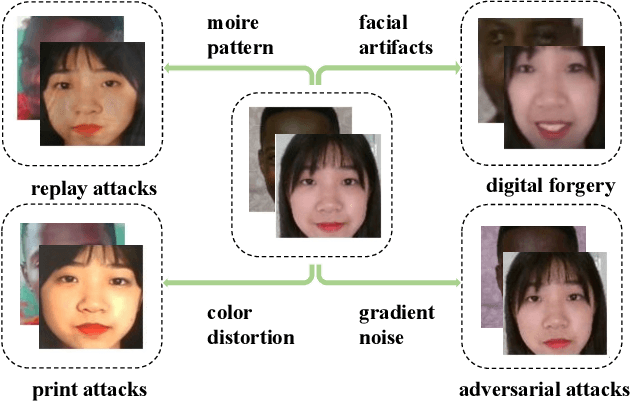
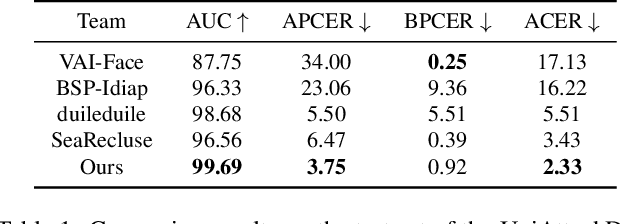
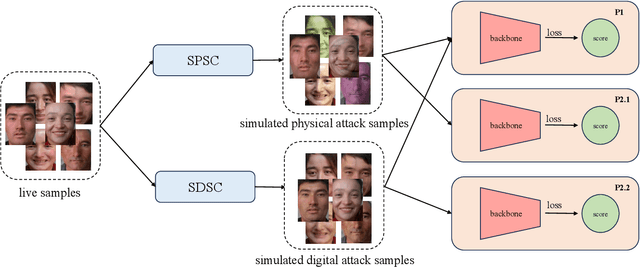
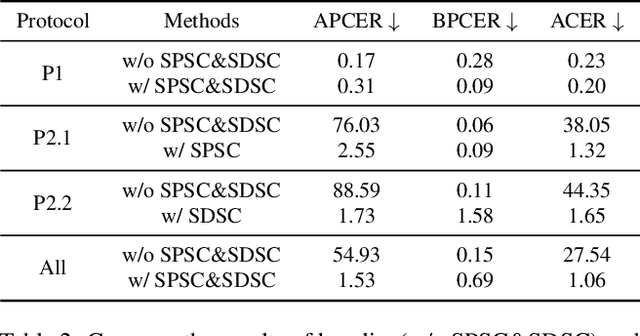
Face recognition systems are frequently subjected to a variety of physical and digital attacks of different types. Previous methods have achieved satisfactory performance in scenarios that address physical attacks and digital attacks, respectively. However, few methods are considered to integrate a model that simultaneously addresses both physical and digital attacks, implying the necessity to develop and maintain multiple models. To jointly detect physical and digital attacks within a single model, we propose an innovative approach that can adapt to any network architecture. Our approach mainly contains two types of data augmentation, which we call Simulated Physical Spoofing Clues augmentation (SPSC) and Simulated Digital Spoofing Clues augmentation (SDSC). SPSC and SDSC augment live samples into simulated attack samples by simulating spoofing clues of physical and digital attacks, respectively, which significantly improve the capability of the model to detect "unseen" attack types. Extensive experiments show that SPSC and SDSC can achieve state-of-the-art generalization in Protocols 2.1 and 2.2 of the UniAttackData dataset, respectively. Our method won first place in "Unified Physical-Digital Face Attack Detection" of the 5th Face Anti-spoofing Challenge@CVPR2024. Our final submission obtains 3.75% APCER, 0.93% BPCER, and 2.34% ACER, respectively. Our code is available at https://github.com/Xianhua-He/cvpr2024-face-anti-spoofing-challenge.
SphereDiffusion: Spherical Geometry-Aware Distortion Resilient Diffusion Model
Mar 15, 2024Controllable spherical panoramic image generation holds substantial applicative potential across a variety of domains.However, it remains a challenging task due to the inherent spherical distortion and geometry characteristics, resulting in low-quality content generation.In this paper, we introduce a novel framework of SphereDiffusion to address these unique challenges, for better generating high-quality and precisely controllable spherical panoramic images.For the spherical distortion characteristic, we embed the semantics of the distorted object with text encoding, then explicitly construct the relationship with text-object correspondence to better use the pre-trained knowledge of the planar images.Meanwhile, we employ a deformable technique to mitigate the semantic deviation in latent space caused by spherical distortion.For the spherical geometry characteristic, in virtue of spherical rotation invariance, we improve the data diversity and optimization objectives in the training process, enabling the model to better learn the spherical geometry characteristic.Furthermore, we enhance the denoising process of the diffusion model, enabling it to effectively use the learned geometric characteristic to ensure the boundary continuity of the generated images.With these specific techniques, experiments on Structured3D dataset show that SphereDiffusion significantly improves the quality of controllable spherical image generation and relatively reduces around 35% FID on average.