 Add to Chrome
 Add to Firefox
 Add to Edge
ViTexQA: A Multi-Frame Temporal Perception Dataset for Video Text Question Answering
Jun 23, 2026
Despite remarkable progress in multimodal understanding, current MLLMs still exhibit limitations in video text understanding, particularly when semantics emerge through the integration of temporally distributed textual cues across multiple frames. This perception challenge fundamentally differs from static image text understanding, yet existing datasets fail to capture: the vast majority of questions remain answerable from single frames, inadequately reflecting real-world video text comprehension demands. To address this, we present ViTexQA, a large-scale video-text QA dataset, and FrameThinker for robust multi-frame temporal reasoning. We build ViTexQA via a quality-controlled Chain-of-Thought (CoT) annotation pipeline boosted with temporal constraints; all its QA pairs demand cross-frame text fusion to solve, enforcing true temporal reliance. FrameThinker adopts two-stage training for explicit temporal modeling: CoT-Guided Supervised Fine-Tuning (SFT) generates frame-aware reasoning chains, followed by Temporally-grounded Reinforcement Learning (RL) optimized with multi-frame coherence rewards. Evaluations show our method outperforms SOTA baselines on ViTexQA, lifting ROUGE-L by 6.3%.

XRZero-G0: Pushing the Frontier of Dexterous Robotic Manipulation with Interfaces, Quality and Ratios
Apr 14, 2026The acquisition of high-quality, action-aligned demonstration data remains a fundamental bottleneck in scaling foundation models for dexterous robot manipulation. Although robot-free human demonstrations (e.g., the UMI paradigm) offer a scalable alternative to traditional teleoperation, current systems are constrained by sub-optimal hardware ergonomics, open-loop workflows, and a lack of systematic data-mixing strategies. To address these limitations, we present XRZero-G0, a hardware-software co-designed system for embodied data collection and policy learning. The system features an ergonomic, virtual reality interface equipped with a top-view camera and dual specialized grippers to directly improve collection efficiency. To ensure dataset reliability, we propose a closed-loop collection, inspection, training, and evaluation pipeline for non-proprioceptive data. This workflow achieves an 85% data validity rate and establishes a transparent mechanism for quality control. Furthermore, we investigate the empirical scaling behaviors and optimal mixing ratios of robot-free data. Extensive experiments indicate that combining a minimal volume of real-robot data with large-scale robot-free data (e.g., a 10:1 ratio) achieves performance comparable to exclusively real-robot datasets, while reducing acquisition costs by a factor of twenty. Utilizing XRZero-G0, we construct a 2,000-hour robot-free dataset that enables zero-shot cross-embodiment transfer to a target physical robot, demonstrating a highly scalable methodology for generalized real-world manipulation.Our project repository: https://github.com/X-Square-Robot/XRZero-G0
InstructTable: Improving Table Structure Recognition Through Instructions
Apr 03, 2026Table structure recognition (TSR) holds widespread practical importance by parsing tabular images into structured representations, yet encounters significant challenges when processing complex layouts involving merged or empty cells. Traditional visual-centric models rely exclusively on visual information while lacking crucial semantic support, thereby impeding accurate structural recognition in complex scenarios. Vision-language models leverage contextual semantics to enhance comprehension; however, these approaches underemphasize the modeling of visual structural information. To address these limitations, this paper introduces InstructTable, an instruction-guided multi-stage training TSR framework. Meticulously designed table instruction pre-training directs attention toward fine-grained structural patterns, enhancing comprehension of complex tables. Complementary TSR fine-tuning preserves robust visual information modeling, maintaining high-precision table parsing across diverse scenarios. Furthermore, we introduce Table Mix Expand (TME), an innovative template-free method for synthesizing large-scale authentic tabular data. Leveraging TME, we construct the Balanced Complex Dense Synthetic Tables (BCDSTab) benchmark, comprising 900 complex table images synthesized through our method to serve as a rigorous benchmark. Extensive experiments on multiple public datasets (FinTabNet, PubTabNet, MUSTARD) and BCDSTab demonstrate that InstructTable achieves state-of-the-art performance in TSR tasks. Ablation studies further confirm the positive impact of the proposed tabular-data-specific instructions and synthetic data.
PositionOCR: Augmenting Positional Awareness in Multi-Modal Models via Hybrid Specialist Integration
Feb 22, 2026In recent years, Multi-modal Large Language Models (MLLMs) have achieved strong performance in OCR-centric Visual Question Answering (VQA) tasks, illustrating their capability to process heterogeneous data and exhibit adaptability across varied contexts. However, these MLLMs rely on a Large Language Model (LLM) as the decoder, which is primarily designed for linguistic processing, and thus inherently lacks the positional reasoning required for precise visual tasks, such as text spotting and text grounding. Additionally, the extensive parameters of MLLMs necessitate substantial computational resources and large-scale data for effective training. Conversely, text spotting specialists achieve state-of-the-art coordinate predictions but lack semantic reasoning capabilities. This dichotomy motivates our key research question: Can we synergize the efficiency of specialists with the contextual power of LLMs to create a positionally-accurate MLLM? To overcome these challenges, we introduce PositionOCR, a parameter-efficient hybrid architecture that seamlessly integrates a text spotting model's positional strengths with an LLM's contextual reasoning. Comprising 131M trainable parameters, this framework demonstrates outstanding multi-modal processing capabilities, particularly excelling in tasks such as text grounding and text spotting, consistently surpassing traditional MLLMs.
Empirical Comparison of Encoder-Based Language Models and Feature-Based Supervised Machine Learning Approaches to Automated Scoring of Long Essays
Jan 07, 2026Long context may impose challenges for encoder-only language models in text processing, specifically for automated scoring of essays. This study trained several commonly used encoder-based language models for automated scoring of long essays. The performance of these trained models was evaluated and compared with the ensemble models built upon the base language models with a token limit of 512?. The experimented models include BERT-based models (BERT, RoBERTa, DistilBERT, and DeBERTa), ensemble models integrating embeddings from multiple encoder models, and ensemble models of feature-based supervised machine learning models, including Gradient-Boosted Decision Trees, eXtreme Gradient Boosting, and Light Gradient Boosting Machine. We trained, validated, and tested each model on a dataset of 17,307 essays, with an 80%/10%/10% split, and evaluated model performance using Quadratic Weighted Kappa. This study revealed that an ensemble-of-embeddings model that combines multiple pre-trained language model representations with gradient-boosting classifier as the ensemble model significantly outperforms individual language models at scoring long essays.
UFVideo: Towards Unified Fine-Grained Video Cooperative Understanding with Large Language Models
Dec 12, 2025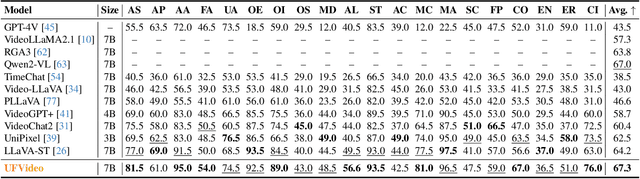
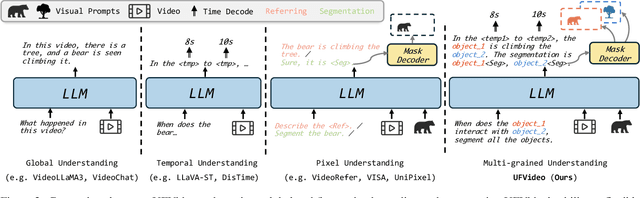
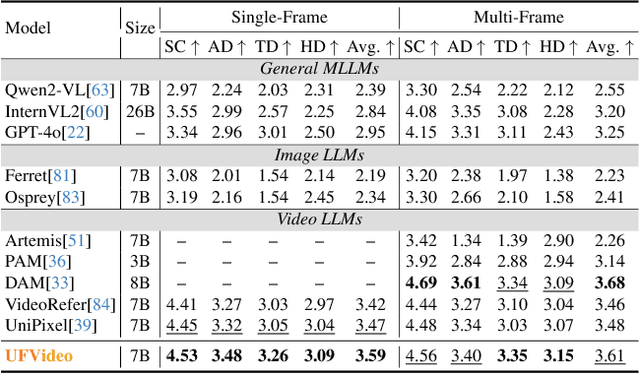
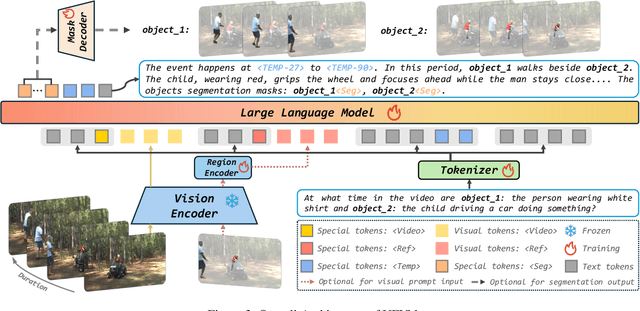
With the advancement of multi-modal Large Language Models (LLMs), Video LLMs have been further developed to perform on holistic and specialized video understanding. However, existing works are limited to specialized video understanding tasks, failing to achieve a comprehensive and multi-grained video perception. To bridge this gap, we introduce UFVideo, the first Video LLM with unified multi-grained cooperative understanding capabilities. Specifically, we design unified visual-language guided alignment to flexibly handle video understanding across global, pixel and temporal scales within a single model. UFVideo dynamically encodes the visual and text inputs of different tasks and generates the textual response, temporal localization, or grounded mask. Additionally, to evaluate challenging multi-grained video understanding tasks, we construct the UFVideo-Bench consisting of three distinct collaborative tasks within the scales, which demonstrates UFVideo's flexibility and advantages over GPT-4o. Furthermore, we validate the effectiveness of our model across 9 public benchmarks covering various common video understanding tasks, providing valuable insights for future Video LLMs.
MotionCharacter: Identity-Preserving and Motion Controllable Human Video Generation
Nov 30, 2024


Recent advancements in personalized Text-to-Video (T2V) generation highlight the importance of integrating character-specific identities and actions. However, previous T2V models struggle with identity consistency and controllable motion dynamics, mainly due to limited fine-grained facial and action-based textual prompts, and datasets that overlook key human attributes and actions. To address these challenges, we propose MotionCharacter, an efficient and high-fidelity human video generation framework designed for identity preservation and fine-grained motion control. We introduce an ID-preserving module to maintain identity fidelity while allowing flexible attribute modifications, and further integrate ID-consistency and region-aware loss mechanisms, significantly enhancing identity consistency and detail fidelity. Additionally, our approach incorporates a motion control module that prioritizes action-related text while maintaining subject consistency, along with a dataset, Human-Motion, which utilizes large language models to generate detailed motion descriptions. For simplify user control during inference, we parameterize motion intensity through a single coefficient, allowing for easy adjustments. Extensive experiments highlight the effectiveness of MotionCharacter, demonstrating significant improvements in ID-preserving, high-quality video generation.
Draw an Audio: Leveraging Multi-Instruction for Video-to-Audio Synthesis
Sep 10, 2024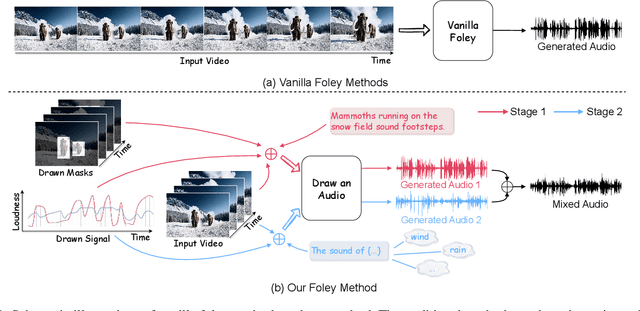
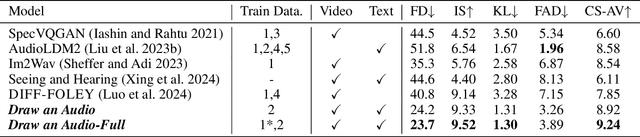
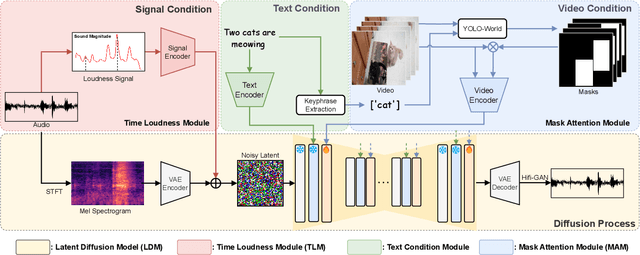
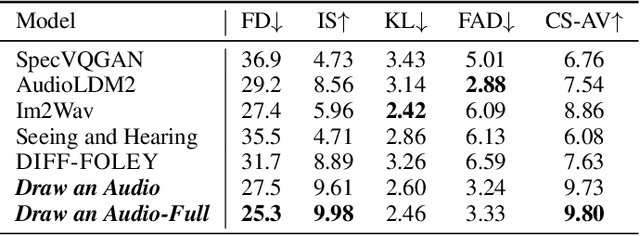
Foley is a term commonly used in filmmaking, referring to the addition of daily sound effects to silent films or videos to enhance the auditory experience. Video-to-Audio (V2A), as a particular type of automatic foley task, presents inherent challenges related to audio-visual synchronization. These challenges encompass maintaining the content consistency between the input video and the generated audio, as well as the alignment of temporal and loudness properties within the video. To address these issues, we construct a controllable video-to-audio synthesis model, termed Draw an Audio, which supports multiple input instructions through drawn masks and loudness signals. To ensure content consistency between the synthesized audio and target video, we introduce the Mask-Attention Module (MAM), which employs masked video instruction to enable the model to focus on regions of interest. Additionally, we implement the Time-Loudness Module (TLM), which uses an auxiliary loudness signal to ensure the synthesis of sound that aligns with the video in both loudness and temporal dimensions. Furthermore, we have extended a large-scale V2A dataset, named VGGSound-Caption, by annotating caption prompts. Extensive experiments on challenging benchmarks across two large-scale V2A datasets verify Draw an Audio achieves the state-of-the-art. Project page: https://yannqi.github.io/Draw-an-Audio/.
AdaFedFR: Federated Face Recognition with Adaptive Inter-Class Representation Learning
May 22, 2024

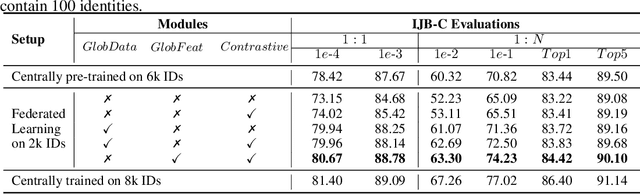

With the growing attention on data privacy and communication security in face recognition applications, federated learning has been introduced to learn a face recognition model with decentralized datasets in a privacy-preserving manner. However, existing works still face challenges such as unsatisfying performance and additional communication costs, limiting their applicability in real-world scenarios. In this paper, we propose a simple yet effective federated face recognition framework called AdaFedFR, by devising an adaptive inter-class representation learning algorithm to enhance the generalization of the generic face model and the efficiency of federated training under strict privacy-preservation. In particular, our work delicately utilizes feature representations of public identities as learnable negative knowledge to optimize the local objective within the feature space, which further encourages the local model to learn powerful representations and optimize personalized models for clients. Experimental results demonstrate that our method outperforms previous approaches on several prevalent face recognition benchmarks within less than 3 communication rounds, which shows communication-friendly and great efficiency.
Joint Physical-Digital Facial Attack Detection Via Simulating Spoofing Clues
Apr 12, 2024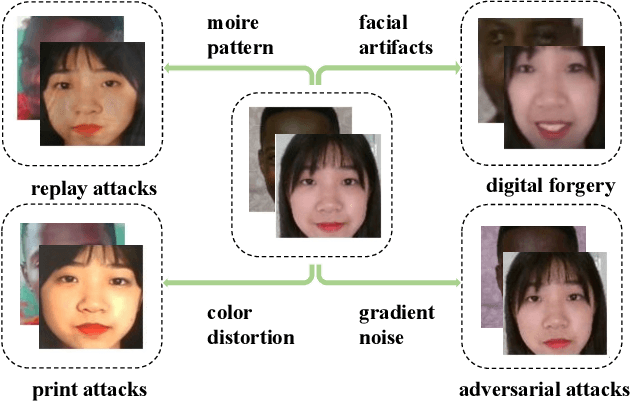
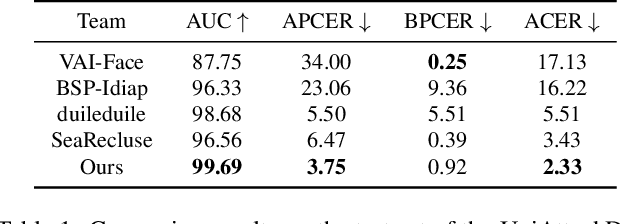
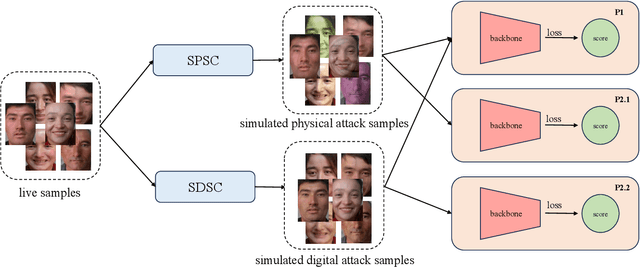
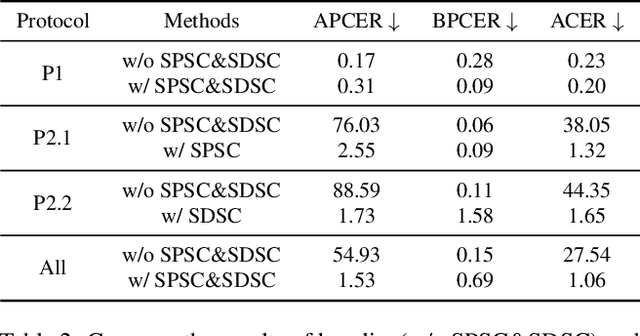
Face recognition systems are frequently subjected to a variety of physical and digital attacks of different types. Previous methods have achieved satisfactory performance in scenarios that address physical attacks and digital attacks, respectively. However, few methods are considered to integrate a model that simultaneously addresses both physical and digital attacks, implying the necessity to develop and maintain multiple models. To jointly detect physical and digital attacks within a single model, we propose an innovative approach that can adapt to any network architecture. Our approach mainly contains two types of data augmentation, which we call Simulated Physical Spoofing Clues augmentation (SPSC) and Simulated Digital Spoofing Clues augmentation (SDSC). SPSC and SDSC augment live samples into simulated attack samples by simulating spoofing clues of physical and digital attacks, respectively, which significantly improve the capability of the model to detect "unseen" attack types. Extensive experiments show that SPSC and SDSC can achieve state-of-the-art generalization in Protocols 2.1 and 2.2 of the UniAttackData dataset, respectively. Our method won first place in "Unified Physical-Digital Face Attack Detection" of the 5th Face Anti-spoofing Challenge@CVPR2024. Our final submission obtains 3.75% APCER, 0.93% BPCER, and 2.34% ACER, respectively. Our code is available at https://github.com/Xianhua-He/cvpr2024-face-anti-spoofing-challenge.