 Add to Chrome
 Add to Firefox
 Add to Edge
GeMoE: Gating Entropy is All You Need for Uncertainty-aware Adaptive Routing in MoE-based Large Vision-Language Models
Jun 24, 2026
With the increase in model parameters and training data, the instruction following and generalization capabilities of Large VisionLanguage Models (LVLMs) have been significantly improved. Based on the Mixture of Experts (MoE) architecture, LVLMs expand their parameter capacity while maintaining the inference cost. However, traditional MoE methods employ a Top-k static routing strategy, which fails to account for variations in the input and adaptively select the number of experts, resulting in suboptimal resource utilization. In this paper, we propose viewing token routing as an information encoding task, framing dynamic routing as a Minimum Description Length (MDL) problem in encoding By validating the connection between MDL and gating entropy in the MoE scenario, we introduce Gating Entropy-based Uncertainty-aware Adaptive Routing (GeMoE) for MoE. Unlike traditional static or heuristic-based dynamic routing methods, GeMoE explicitly models the trade-off between model complexity and performance. By using gating entropy to assess the complexity of tokens, GeMoE adaptively determines the number of experts each token should engage. On a wide range of backbones and benchmarks, our method achieves 99.5% average performance retention compared to the original static routing, while improving average expert activation sparsity by 36.5%.

Free Lunch for Unified Multimodal Models: Enhancing Generation via Reflective Rectification with Inherent Understanding
Apr 15, 2026Unified Multimodal Models (UMMs) aim to integrate visual understanding and generation within a single structure. However, these models exhibit a notable capability mismatch, where their understanding capability significantly outperforms their generation. This mismatch indicates that the model's rich internal knowledge, while effective for understanding tasks, remains underactivated during generation. To address this, we draw inspiration from the human ``Thinking-While-Drawing'' paradigm, where humans continuously reflect to activate their knowledge and rectify intermediate results. In this paper, we propose UniRect-CoT, a training-free unified rectification chain-of-thought framework. Our approach unlocks the ``free lunch'' hidden in the UMM's powerful inherent understanding to continuously reflect, activating its internal knowledge and rectifying intermediate results during generation.We regard the diffusion denoising process in UMMs as an intrinsic visual reasoning process and align the intermediate results with the target instruction understood by the model, serving as a self-supervisory signal to rectify UMM generation.Extensive experiments demonstrate that UniRect-CoT can be easily integrated into existing UMMs, significantly enhancing generation quality across diverse complex tasks.
Long-Tailed Distribution-Aware Router For Mixture-of-Experts in Large Vision-Language Model
Jul 02, 2025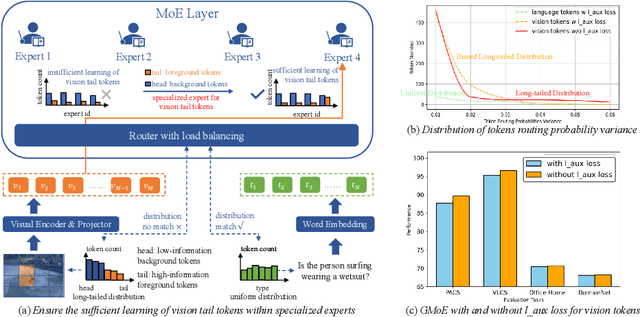
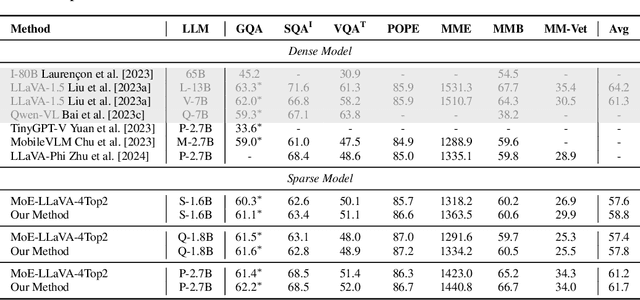
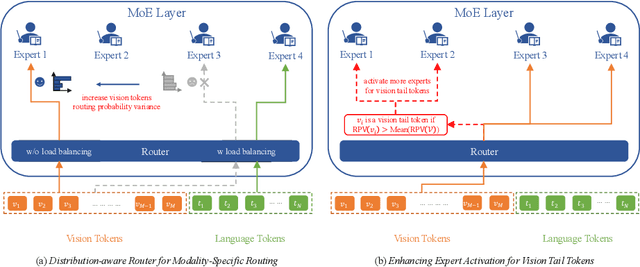

The mixture-of-experts (MoE), which replaces dense models with sparse architectures, has gained attention in large vision-language models (LVLMs) for achieving comparable performance with fewer activated parameters. Existing MoE frameworks for LVLMs focus on token-to-expert routing (TER), encouraging different experts to specialize in processing distinct tokens. However, these frameworks often rely on the load balancing mechanism, overlooking the inherent distributional differences between vision and language. To this end, we propose a Long-Tailed Distribution-aware Router (LTDR) for vision-language TER, tackling two challenges: (1) Distribution-aware router for modality-specific routing. We observe that language TER follows a uniform distribution, whereas vision TER exhibits a long-tailed distribution. This discrepancy necessitates distinct routing strategies tailored to each modality. (2) Enhancing expert activation for vision tail tokens. Recognizing the importance of vision tail tokens, we introduce an oversampling-like strategy by increasing the number of activated experts for these tokens. Experiments on extensive benchmarks validate the effectiveness of our approach.
Solving Token Gradient Conflict in Mixture-of-Experts for Large Vision-Language Model
Jun 28, 2024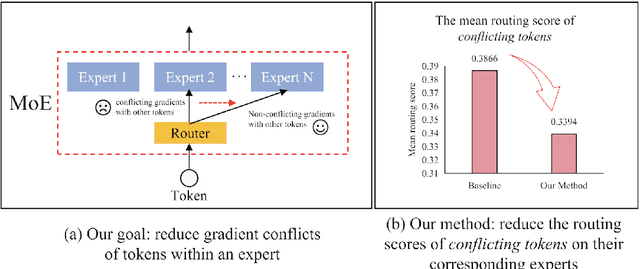
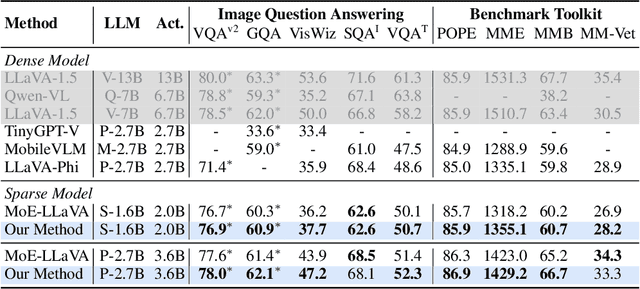
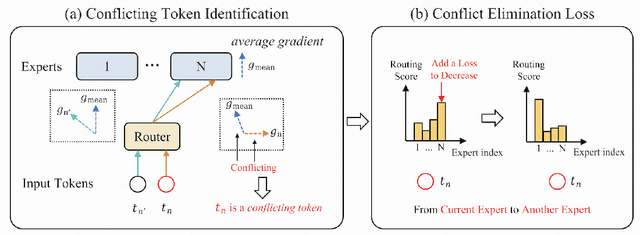
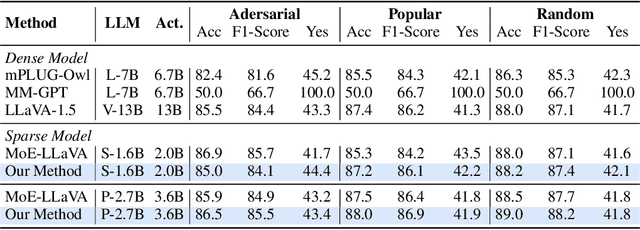
The Mixture-of-Experts (MoE) has gained increasing attention in the study of Large Vision-Language Models (LVLMs). It uses a sparse model to replace the dense model, achieving comparable performance while activating fewer parameters during inference, thus significantly reducing the inference cost. Existing MoE methods in LVLMs encourage different experts to handle different tokens, and thus they employ a router to predict the routing for each token. However, the predictions are based solely on sample features and do not truly reveal the optimization direction of tokens. This can lead to severe optimization conflicts between different tokens within an expert. To address this problem, this paper proposes a novel method based on token-level gradient analysis. Specifically, we first use token-level gradients to identify conflicting tokens in experts. Then, we add a specialized loss tailored to eliminate conflicts among tokens within each expert. Our method can serve as a plug-in for diverse Large Vision-Language Models, and extensive experimental results demonstrate the effectiveness of our method. The code will be publicly available at https://github.com/longrongyang/STGC.