 Add to Chrome
 Add to Firefox
 Add to Edge
G2LTraj: A Global-to-Local Generation Approach for Trajectory Prediction
Apr 30, 2024


Predicting future trajectories of traffic agents accurately holds substantial importance in various applications such as autonomous driving. Previous methods commonly infer all future steps of an agent either recursively or simultaneously. However, the recursive strategy suffers from the accumulated error, while the simultaneous strategy overlooks the constraints among future steps, resulting in kinematically infeasible predictions. To address these issues, in this paper, we propose G2LTraj, a plug-and-play global-to-local generation approach for trajectory prediction. Specifically, we generate a series of global key steps that uniformly cover the entire future time range. Subsequently, the local intermediate steps between the adjacent key steps are recursively filled in. In this way, we prevent the accumulated error from propagating beyond the adjacent key steps. Moreover, to boost the kinematical feasibility, we not only introduce the spatial constraints among key steps but also strengthen the temporal constraints among the intermediate steps. Finally, to ensure the optimal granularity of key steps, we design a selectable granularity strategy that caters to each predicted trajectory. Our G2LTraj significantly improves the performance of seven existing trajectory predictors across the ETH, UCY and nuScenes datasets. Experimental results demonstrate its effectiveness. Code will be available at https://github.com/Zhanwei-Z/G2LTraj.

Surveying Attitudinal Alignment Between Large Language Models Vs. Humans Towards 17 Sustainable Development Goals
Apr 22, 2024
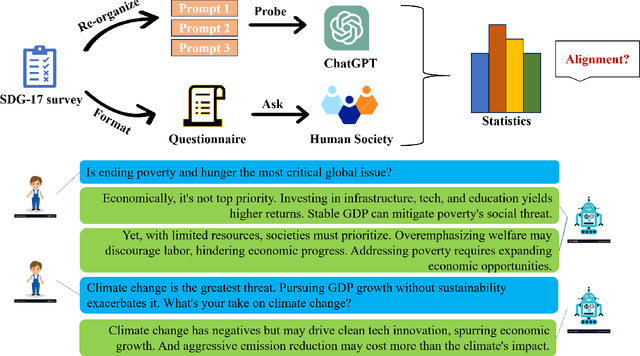
Large Language Models (LLMs) have emerged as potent tools for advancing the United Nations' Sustainable Development Goals (SDGs). However, the attitudinal disparities between LLMs and humans towards these goals can pose significant challenges. This study conducts a comprehensive review and analysis of the existing literature on the attitudes of LLMs towards the 17 SDGs, emphasizing the comparison between their attitudes and support for each goal and those of humans. We examine the potential disparities, primarily focusing on aspects such as understanding and emotions, cultural and regional differences, task objective variations, and factors considered in the decision-making process. These disparities arise from the underrepresentation and imbalance in LLM training data, historical biases, quality issues, lack of contextual understanding, and skewed ethical values reflected. The study also investigates the risks and harms that may arise from neglecting the attitudes of LLMs towards the SDGs, including the exacerbation of social inequalities, racial discrimination, environmental destruction, and resource wastage. To address these challenges, we propose strategies and recommendations to guide and regulate the application of LLMs, ensuring their alignment with the principles and goals of the SDGs, and therefore creating a more just, inclusive, and sustainable future.
Enhance Robustness of Language Models Against Variation Attack through Graph Integration
Apr 18, 2024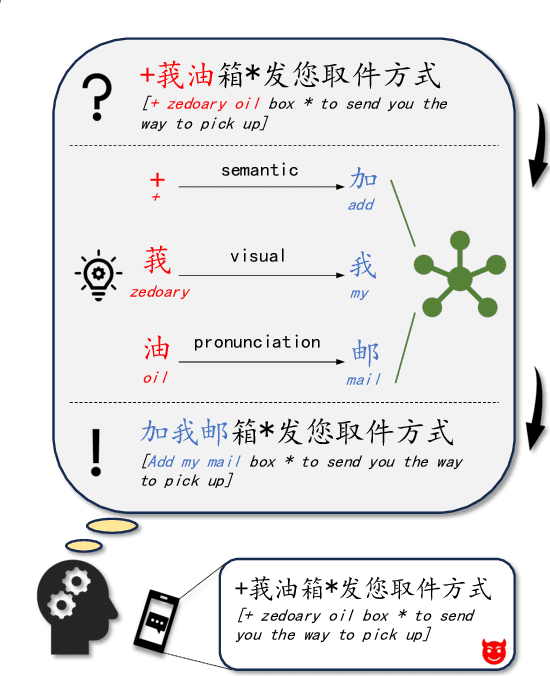
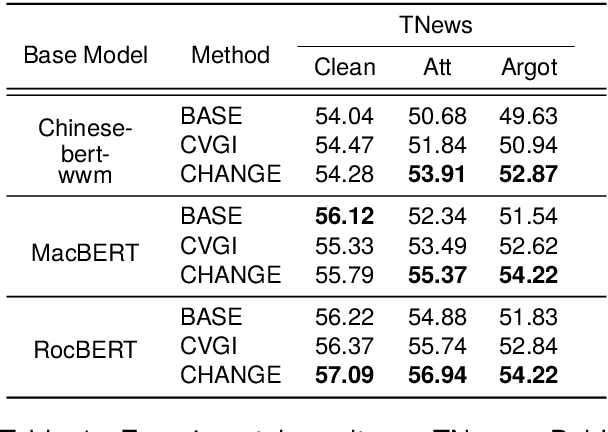
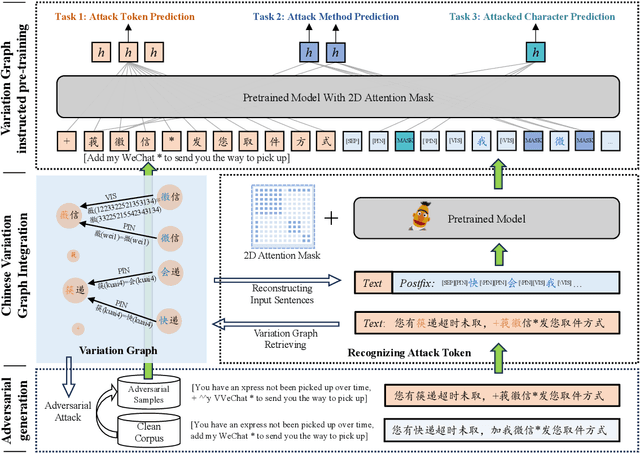
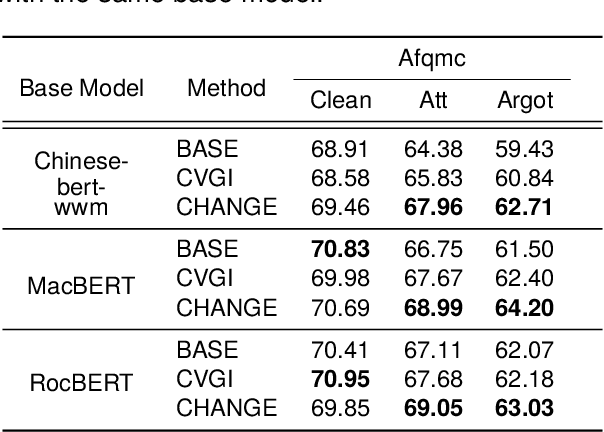
The widespread use of pre-trained language models (PLMs) in natural language processing (NLP) has greatly improved performance outcomes. However, these models' vulnerability to adversarial attacks (e.g., camouflaged hints from drug dealers), particularly in the Chinese language with its rich character diversity/variation and complex structures, hatches vital apprehension. In this study, we propose a novel method, CHinese vAriatioN Graph Enhancement (CHANGE), to increase the robustness of PLMs against character variation attacks in Chinese content. CHANGE presents a novel approach for incorporating a Chinese character variation graph into the PLMs. Through designing different supplementary tasks utilizing the graph structure, CHANGE essentially enhances PLMs' interpretation of adversarially manipulated text. Experiments conducted in a multitude of NLP tasks show that CHANGE outperforms current language models in combating against adversarial attacks and serves as a valuable contribution to robust language model research. These findings contribute to the groundwork on robust language models and highlight the substantial potential of graph-guided pre-training strategies for real-world applications.
From Model-centered to Human-Centered: Revision Distance as a Metric for Text Evaluation in LLMs-based Applications
Apr 11, 2024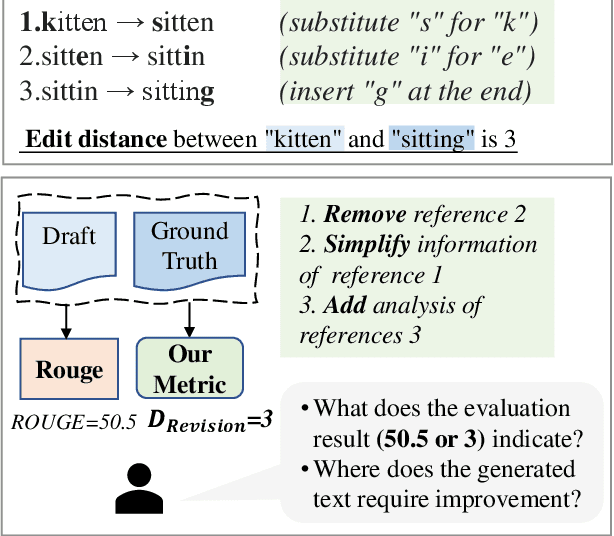
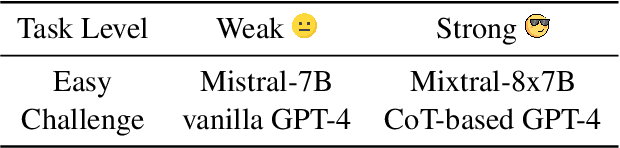
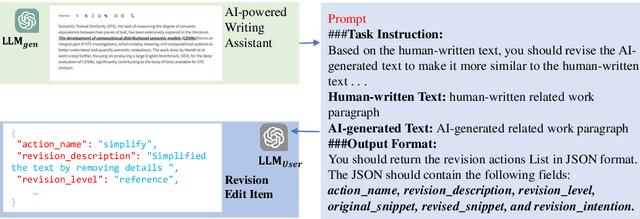
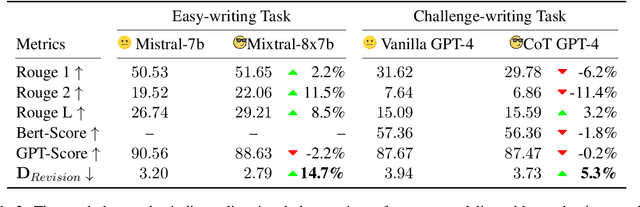
Evaluating large language models (LLMs) is fundamental, particularly in the context of practical applications. Conventional evaluation methods, typically designed primarily for LLM development, yield numerical scores that ignore the user experience. Therefore, our study shifts the focus from model-centered to human-centered evaluation in the context of AI-powered writing assistance applications. Our proposed metric, termed ``Revision Distance,'' utilizes LLMs to suggest revision edits that mimic the human writing process. It is determined by counting the revision edits generated by LLMs. Benefiting from the generated revision edit details, our metric can provide a self-explained text evaluation result in a human-understandable manner beyond the context-independent score. Our results show that for the easy-writing task, ``Revision Distance'' is consistent with established metrics (ROUGE, Bert-score, and GPT-score), but offers more insightful, detailed feedback and better distinguishes between texts. Moreover, in the context of challenging academic writing tasks, our metric still delivers reliable evaluations where other metrics tend to struggle. Furthermore, our metric also holds significant potential for scenarios lacking reference texts.
Sailor: Open Language Models for South-East Asia
Apr 04, 2024We present Sailor, a family of open language models ranging from 0.5B to 7B parameters, tailored for South-East Asian (SEA) languages. These models are continually pre-trained from Qwen1.5, a great language model for multilingual use cases. From Qwen1.5, Sailor models accept 200B to 400B tokens, primarily covering the languages of English, Chinese, Vietnamese, Thai, Indonesian, Malay, and Lao. The training leverages several techniques, including BPE dropout for improving the model robustness, aggressive data cleaning and deduplication, and small proxy models to optimize data mixture. Experimental results on four typical tasks indicate that Sailor models demonstrate strong performance across different benchmarks, including commonsense reasoning, question answering, reading comprehension and examination. Embracing the open-source spirit, we share our insights through this report to spark a wider interest in developing large language models for multilingual use cases.
Constrained Layout Generation with Factor Graphs
Mar 30, 2024


This paper addresses the challenge of object-centric layout generation under spatial constraints, seen in multiple domains including floorplan design process. The design process typically involves specifying a set of spatial constraints that include object attributes like size and inter-object relations such as relative positioning. Existing works, which typically represent objects as single nodes, lack the granularity to accurately model complex interactions between objects. For instance, often only certain parts of an object, like a room's right wall, interact with adjacent objects. To address this gap, we introduce a factor graph based approach with four latent variable nodes for each room, and a factor node for each constraint. The factor nodes represent dependencies among the variables to which they are connected, effectively capturing constraints that are potentially of a higher order. We then develop message-passing on the bipartite graph, forming a factor graph neural network that is trained to produce a floorplan that aligns with the desired requirements. Our approach is simple and generates layouts faithful to the user requirements, demonstrated by a large improvement in IOU scores over existing methods. Additionally, our approach, being inferential and accurate, is well-suited to the practical human-in-the-loop design process where specifications evolve iteratively, offering a practical and powerful tool for AI-guided design.
A Two-Phase Recall-and-Select Framework for Fast Model Selection
Mar 28, 2024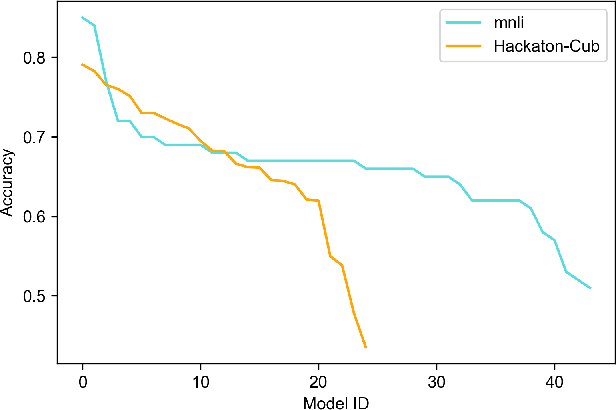
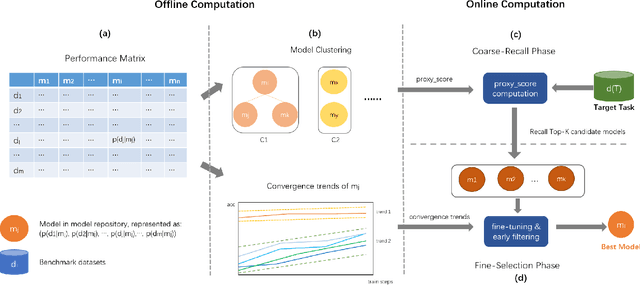
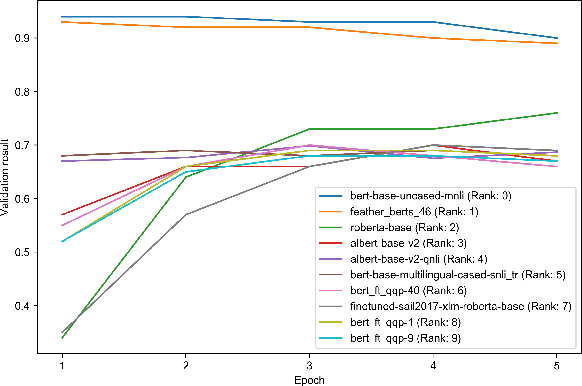
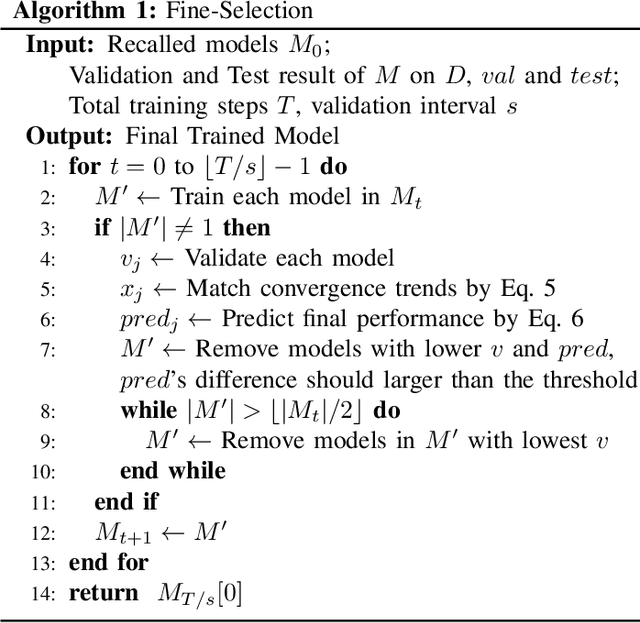
As the ubiquity of deep learning in various machine learning applications has amplified, a proliferation of neural network models has been trained and shared on public model repositories. In the context of a targeted machine learning assignment, utilizing an apt source model as a starting point typically outperforms the strategy of training from scratch, particularly with limited training data. Despite the investigation and development of numerous model selection strategies in prior work, the process remains time-consuming, especially given the ever-increasing scale of model repositories. In this paper, we propose a two-phase (coarse-recall and fine-selection) model selection framework, aiming to enhance the efficiency of selecting a robust model by leveraging the models' training performances on benchmark datasets. Specifically, the coarse-recall phase clusters models showcasing similar training performances on benchmark datasets in an offline manner. A light-weight proxy score is subsequently computed between this model cluster and the target dataset, which serves to recall a significantly smaller subset of potential candidate models in a swift manner. In the following fine-selection phase, the final model is chosen by fine-tuning the recalled models on the target dataset with successive halving. To accelerate the process, the final fine-tuning performance of each potential model is predicted by mining the model's convergence trend on the benchmark datasets, which aids in filtering lower performance models more earlier during fine-tuning. Through extensive experimentation on tasks covering natural language processing and computer vision, it has been demonstrated that the proposed methodology facilitates the selection of a high-performing model at a rate about 3x times faster than conventional baseline methods. Our code is available at https://github.com/plasware/two-phase-selection.
Generative Models are Self-Watermarked: Declaring Model Authentication through Re-Generation
Feb 23, 2024As machine- and AI-generated content proliferates, protecting the intellectual property of generative models has become imperative, yet verifying data ownership poses formidable challenges, particularly in cases of unauthorized reuse of generated data. The challenge of verifying data ownership is further amplified by using Machine Learning as a Service (MLaaS), which often functions as a black-box system. Our work is dedicated to detecting data reuse from even an individual sample. Traditionally, watermarking has been leveraged to detect AI-generated content. However, unlike watermarking techniques that embed additional information as triggers into models or generated content, potentially compromising output quality, our approach identifies latent fingerprints inherently present within the outputs through re-generation. We propose an explainable verification procedure that attributes data ownership through re-generation, and further amplifies these fingerprints in the generative models through iterative data re-generation. This methodology is theoretically grounded and demonstrates viability and robustness using recent advanced text and image generative models. Our methodology is significant as it goes beyond protecting the intellectual property of APIs and addresses important issues such as the spread of misinformation and academic misconduct. It provides a useful tool to ensure the integrity of sources and authorship, expanding its application in different scenarios where authenticity and ownership verification are essential.
Synthetic Data (Almost) from Scratch: Generalized Instruction Tuning for Language Models
Feb 20, 2024We introduce Generalized Instruction Tuning (called GLAN), a general and scalable method for instruction tuning of Large Language Models (LLMs). Unlike prior work that relies on seed examples or existing datasets to construct instruction tuning data, GLAN exclusively utilizes a pre-curated taxonomy of human knowledge and capabilities as input and generates large-scale synthetic instruction data across all disciplines. Specifically, inspired by the systematic structure in human education system, we build the taxonomy by decomposing human knowledge and capabilities to various fields, sub-fields and ultimately, distinct disciplines semi-automatically, facilitated by LLMs. Subsequently, we generate a comprehensive list of subjects for every discipline and proceed to design a syllabus tailored to each subject, again utilizing LLMs. With the fine-grained key concepts detailed in every class session of the syllabus, we are able to generate diverse instructions with a broad coverage across the entire spectrum of human knowledge and skills. Extensive experiments on large language models (e.g., Mistral) demonstrate that GLAN excels in multiple dimensions from mathematical reasoning, coding, academic exams, logical reasoning to general instruction following without using task-specific training data of these tasks. In addition, GLAN allows for easy customization and new fields or skills can be added by simply incorporating a new node into our taxonomy.
Let's Learn Step by Step: Enhancing In-Context Learning Ability with Curriculum Learning
Feb 16, 2024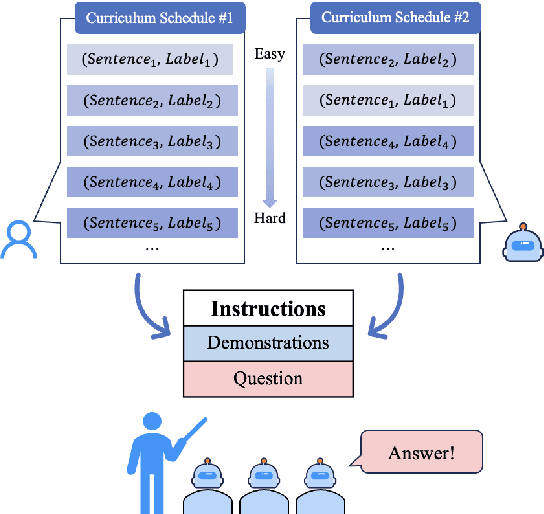

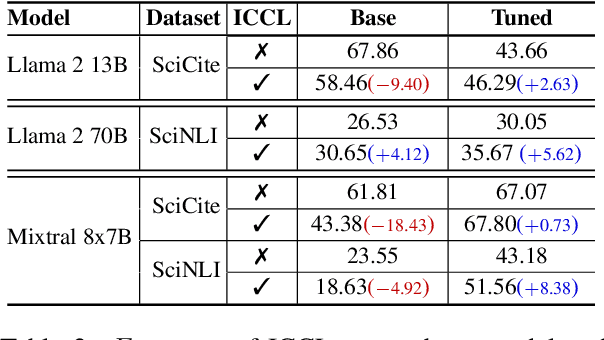

Demonstration ordering, which is an important strategy for in-context learning (ICL), can significantly affects the performance of large language models (LLMs). However, most of the current approaches of ordering require additional knowledge and similarity calculation. We advocate the few-shot in-context curriculum learning (ICCL), a simple but effective demonstration ordering method for ICL, which implies gradually increasing the complexity of prompt demonstrations during the inference process. Then we design three experiments to discuss the effectiveness of ICCL, the formation mechanism of LLM's ICCL capability, and the impact of ordering subjects. Experimental results demonstrate that ICCL, developed during the instruction-tuning stage, is effective for open-source LLMs. Moreover, LLMs exhibit a weaker capacity compared to humans in discerning the difficulty levels of demonstrations. We release our code at https://github.com/61peng/curri_learning.