 Add to Chrome
 Add to Firefox
 Add to Edge
RaBitQCache: Rotated Binary Quantization for KVCache in Long Context LLM Inference
Jun 30, 2026
Long-context Large Language Model inference is severely bottlenecked by the massive Key-Value (KV) cache, yet existing sparse attention methods often suffer from static fixed-budget (Top-k) retrieval or rely on proxy scores that are computationally expensive and biased. To address these limitations, we propose RaBitQCache, a novel sparse attention framework that utilizes randomized rotated binary quantization and high-throughput binary-INT4 arithmetic to efficiently estimate attention weights. Our proxy score serves as an unbiased estimator with a proven error bound, enabling adaptive Top-p retrieval that dynamically adjusts the token budget based on actual attention sparsity. We further implement a hardware-aware system with asynchronous pipelining and lazy updates to mask overhead. Evaluations demonstrate that RaBitQCache significantly accelerates inference and reduces memory I/O while preserving generation quality compared to state-of-the-art baselines. Code is available at https://github.com/Sakuraaa0/RaBitQCache.git.

CODA-BENCH: Can Code Agents Handle Data-Intensive Tasks?
Jun 13, 2026Advanced agents are increasingly demonstrating the potential to operate as autonomous engineers, creating a growing demand for evaluation benchmarks that capture the complexity of real-world development. Such environments typically involve both complex code and large-scale data (i.e., file system). However, existing benchmarks usually evaluate code-centric or data-centric capabilities in isolation, leaving a clear gap with real development scenarios. In this paper, we bridge this gap by introducing CODA-BENCH, the first benchmark to jointly evaluate code and data intelligence in a data-intensive environment. We construct a data-intensive Linux sandbox based on the Kaggle ecosystem (containing hundreds of datasets), where agents must actively explore complex file hierarchies to identify relevant resources and generate code for data-driven analytical tasks. CODA-BENCH comprises 1,009 tasks spanning 31 communities, with each task environment containing an average of 980 files, simulating realistic data scale and noise. Evaluations of advanced agents reveal that even top-performing systems struggle to effectively integrate data discovery with code execution, achieving a success rate of only 61.1%. These results highlight a substantial gap in current agentic capabilities for data-intensive tasks and point to promising directions for future research.
DataEvolver: Automatic Data Preparation for Large Language Models through Multi-Level Self-Evolving
Jun 05, 2026High-quality training data is essential to large language models (LLMs) and typically requires extensive and costly manual curation. Existing automatic data preparation methods rely on predefined pipelines or customized human instructions, which limits their adaptability to diverse data distributions and lacks principled guidance from high-quality examples. In this paper, we introduce DataEvolver, the first self-evolving data preparation system that automatically constructs pipelines to transform raw data into high-quality data. DataEvolver employs a multi-level mechanism to ensure both pipeline executability and effectiveness. At the operator level, it incrementally expands the operator set to construct a logical plan while resolving dependency conflicts. At the pipeline level, it instantiates logical plans into executable code and iteratively refines pipeline orchestration through a feedback loop that reduces the distribution gap between prepared data and high-quality examples. Experiments on seven benchmarks show that DataEvolver substantially improves data quality and achieves an average 10\% gain in downstream LLM performance compared with training on original data, highlighting new opportunities for the iterative co-evolution of LLMs and data.
Scaling Agentic Capabilities via Grounded Interaction Synthesis
Jun 01, 2026General agentic intelligence hinges on the ability to interact with diverse real-world tools to complete complex tasks, a capability fundamentally tied to the quality of interaction data. To bypass the prohibitive costs of human annotation, prevailing paradigms depend entirely on Large Language Models (LLMs) to scale the synthesis of agentic environments and tasks. However, such unconstrained generation often degenerates into biased random sampling of LLMs' internal priors, failing to capture the diversity and difficulty of real-world domains or construct high-fidelity, long-horizon tasks. In this work, we introduce Grounded Agentic Interaction Synthesis (GAIS), a framework that automates the scalable construction of diverse environments and complex tasks via a two-phase grounding mechanism. Specifically, we construct protocol-anchored environments derived from real-world Model Context Protocol (MCP) servers to ensure functional diversity and difficulty. Subsequently, we employ structure-guided planning to navigate these environments, actively enforcing logical dependencies and adversarial policies to generate complex tasks. Experiments on BFCL, $τ^2$-Bench, and ACEBench demonstrate that GAIS-synthesized data significantly outperforms state-of-the-art baselines, enabling base models to match or even surpass their official instruction-tuned counterparts. Furthermore, GAIS exhibits superior data efficiency and scalability, achieving exceptional capabilities with significantly less data while maintaining continuous growth where baselines stagnate. Our code and dataset are publicly available at https://github.com/Eric8932/GAIS.
Training Prompt Matters: State-Adaptive Optimization for Robust Fine-Tuning
Jun 01, 2026While prompt engineering is instrumental in maximizing the capabilities of Large Language Models (LLMs) during inference, the role of prompts during training remains critically underexplored. Prevailing fine-tuning paradigms typically treat training prompts as mere surface forms, assuming that semantically equivalent instructions yield identical learning outcomes. However, we reveal that this equivalence is deceptive: while paraphrased prompts often lead to comparable in-task performance, they induce drastically different cross-task impacts regarding catastrophic forgetting and generalization. Crucially, these impacts are positively correlated across tasks, indicating the existence of superior prompts that consistently yield better performance. Furthermore, we discover that these superior prompts can be robustly identified by task loss prior to learning. Leveraging these insights, we introduce State-Adaptive Prompt Optimization (SAPO), a lightweight yet effective training strategy that shifts task formulation from a static input to a dynamic, state-adaptive variable. Comprehensive experiments on diverse benchmarks confirm its effectiveness, which significantly mitigates forgetting while improving generalization, achieving substantial performance gains over state-of-the-art methods. These results provide insights into how training prompts shape learning dynamics and offer a practical recipe for robust fine-tuning. Our code is available at https://github.com/Eric8932/SAPO.
Double-Edged Sword or Sharp Tool? Designing and Evaluating Triadic LLM-Teacher Collaboration for K-12 Writing at Scale
May 28, 2026The double-edged sword of integrating Large Language Models (LLMs) requires an effective triadic collaboration mechanism among LLMs, teachers and students, especially for K-12 education. By developing a triadic collaboration system to support K-12 writing learning, a multidimensional evaluation framework grounded in Systemic Functional Linguistics and the suggestion trajectory tracing pipeline, this paper contributes a large-scale empirical dataset involving $57,954$ essays from $10,195$ students across $120$ schools over two years. Our findings confirm the efficacy of this system in improving writing quality through a strategic labor division: the LLM serves as a generative engine to mitigate teacher burnout, and the teacher acts as a pedagogical gatekeeper and bridge to guarantee feedback quality. While both LLM and teacher are critical for skill improvement, we uncover a ceiling effect where excessive linguistic expansion yields diminishing marginal utility. These suggest a dynamically adaptive LLM-teacher collaboration as student proficiency increases.
Joint Knowledge Editing for Information Enrichment and Probability Promotion
Dec 22, 2024Knowledge stored in large language models requires timely updates to reflect the dynamic nature of real-world information. To update the knowledge, most knowledge editing methods focus on the low layers, since recent probes into the knowledge recall process reveal that the answer information is enriched in low layers. However, these probes only and could only reveal critical recall stages for the original answers, while the goal of editing is to rectify model's prediction for the target answers. This inconsistency indicates that both the probe approaches and the associated editing methods are deficient. To mitigate the inconsistency and identify critical editing regions, we propose a contrast-based probe approach, and locate two crucial stages where the model behavior diverges between the original and target answers: Information Enrichment in low layers and Probability Promotion in high layers. Building upon the insights, we develop the Joint knowledge Editing for information Enrichment and probability Promotion (JEEP) method, which jointly edits both the low and high layers to modify the two critical recall stages. Considering the mutual interference and growing forgetting due to dual modifications, JEEP is designed to ensure that updates to distinct regions share the same objectives and are complementary. We rigorously evaluate JEEP by editing up to thousands of facts on various models, i.e., GPT-J (6B) and LLaMA (7B), and addressing diverse editing objectives, i.e., adding factual and counterfactual knowledge. In all tested scenarios, JEEP achieves best performances, validating the effectiveness of the revealings of our probe approach and the designs of our editing method. Our code and data are available at https://github.com/Eric8932/JEEP.
AutoPrep: Natural Language Question-Aware Data Preparation with a Multi-Agent Framework
Dec 10, 2024Answering natural language (NL) questions about tables, which is referred to as Tabular Question Answering (TQA), is important because it enables users to extract meaningful insights quickly and efficiently from structured data, bridging the gap between human language and machine-readable formats. Many of these tables originate from web sources or real-world scenarios, necessitating careful data preparation (or data prep for short) to ensure accurate answers. However, unlike traditional data prep, question-aware data prep introduces new requirements, which include tasks such as column augmentation and filtering for given questions, and question-aware value normalization or conversion. Because each of the above tasks is unique, a single model (or agent) may not perform effectively across all scenarios. In this paper, we propose AUTOPREP, a large language model (LLM)-based multi-agent framework that leverages the strengths of multiple agents, each specialized in a certain type of data prep, ensuring more accurate and contextually relevant responses. Given an NL question over a table, AUTOPREP performs data prep through three key components. Planner: Determines a logical plan, outlining a sequence of high-level operations. Programmer: Translates this logical plan into a physical plan by generating the corresponding low-level code. Executor: Iteratively executes and debugs the generated code to ensure correct outcomes. To support this multi-agent framework, we design a novel chain-of-thought reasoning mechanism for high-level operation suggestion, and a tool-augmented method for low-level code generation. Extensive experiments on real-world TQA datasets demonstrate that AUTOPREP can significantly improve the SOTA TQA solutions through question-aware data prep.
A Two-Phase Recall-and-Select Framework for Fast Model Selection
Mar 28, 2024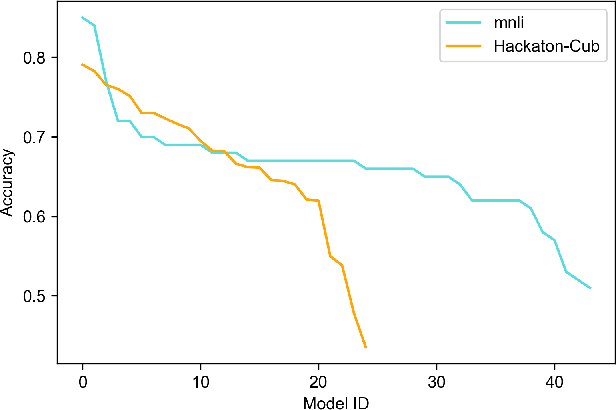
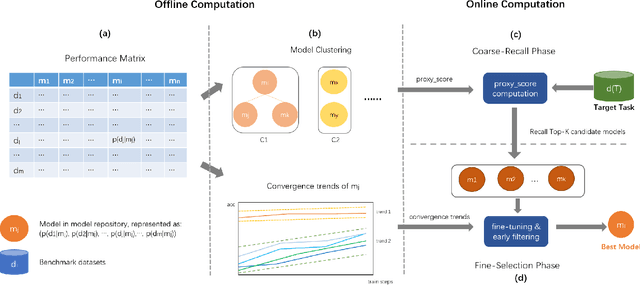
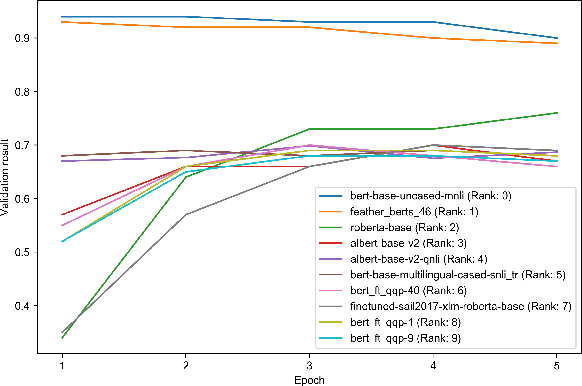
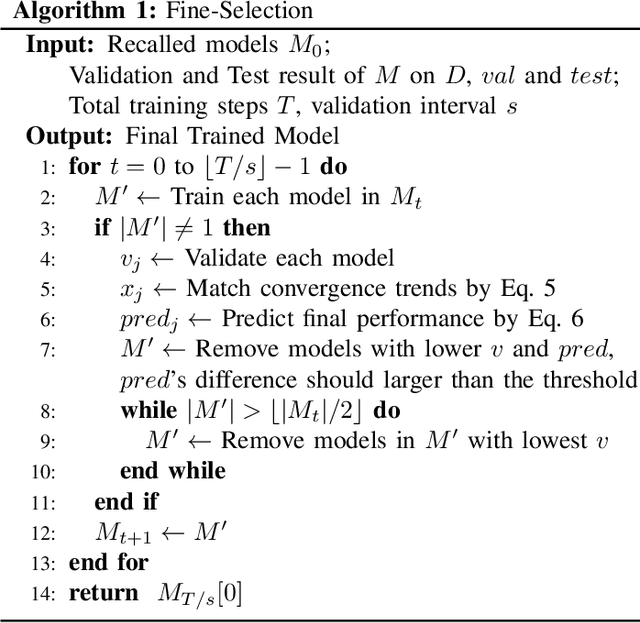
As the ubiquity of deep learning in various machine learning applications has amplified, a proliferation of neural network models has been trained and shared on public model repositories. In the context of a targeted machine learning assignment, utilizing an apt source model as a starting point typically outperforms the strategy of training from scratch, particularly with limited training data. Despite the investigation and development of numerous model selection strategies in prior work, the process remains time-consuming, especially given the ever-increasing scale of model repositories. In this paper, we propose a two-phase (coarse-recall and fine-selection) model selection framework, aiming to enhance the efficiency of selecting a robust model by leveraging the models' training performances on benchmark datasets. Specifically, the coarse-recall phase clusters models showcasing similar training performances on benchmark datasets in an offline manner. A light-weight proxy score is subsequently computed between this model cluster and the target dataset, which serves to recall a significantly smaller subset of potential candidate models in a swift manner. In the following fine-selection phase, the final model is chosen by fine-tuning the recalled models on the target dataset with successive halving. To accelerate the process, the final fine-tuning performance of each potential model is predicted by mining the model's convergence trend on the benchmark datasets, which aids in filtering lower performance models more earlier during fine-tuning. Through extensive experimentation on tasks covering natural language processing and computer vision, it has been demonstrated that the proposed methodology facilitates the selection of a high-performing model at a rate about 3x times faster than conventional baseline methods. Our code is available at https://github.com/plasware/two-phase-selection.
Cost-Effective In-Context Learning for Entity Resolution: A Design Space Exploration
Dec 07, 2023Entity resolution (ER) is an important data integration task with a wide spectrum of applications. The state-of-the-art solutions on ER rely on pre-trained language models (PLMs), which require fine-tuning on a lot of labeled matching/non-matching entity pairs. Recently, large languages models (LLMs), such as GPT-4, have shown the ability to perform many tasks without tuning model parameters, which is known as in-context learning (ICL) that facilitates effective learning from a few labeled input context demonstrations. However, existing ICL approaches to ER typically necessitate providing a task description and a set of demonstrations for each entity pair and thus have limitations on the monetary cost of interfacing LLMs. To address the problem, in this paper, we provide a comprehensive study to investigate how to develop a cost-effective batch prompting approach to ER. We introduce a framework BATCHER consisting of demonstration selection and question batching and explore different design choices that support batch prompting for ER. We also devise a covering-based demonstration selection strategy that achieves an effective balance between matching accuracy and monetary cost. We conduct a thorough evaluation to explore the design space and evaluate our proposed strategies. Through extensive experiments, we find that batch prompting is very cost-effective for ER, compared with not only PLM-based methods fine-tuned with extensive labeled data but also LLM-based methods with manually designed prompting. We also provide guidance for selecting appropriate design choices for batch prompting.