 Add to Chrome
 Add to Firefox
 Add to Edge
AutoRPA: Efficient GUI Automation through LLM-Driven Code Synthesis from Interactions
May 20, 2026
Large Language Model (LLM) based agents have demonstrated proficiency in multi-step interactions with graphical user interfaces (GUIs). While most research focuses on improving single-task performance, practical scenarios often involve repetitive GUI tasks for which invoking LLM reasoning repeatedly, i.e., the ReAct paradigm, is inefficient. Prior to LLMs, traditional Robotic Process Automation (RPA) offers runtime efficiency but demands significant manual effort to develop and maintain. To bridge this gap, we propose AutoRPA, a framework that automatically distills the decision logic of ReAct-style agents into robust RPA functions. AutoRPA introduces two core innovations: (1) A translator-builder pipeline, where a translator agent converts hard-coded ReAct actions into soft-coded procedures, and a builder agent synthesizes robust RPA functions via retrieval-augmented generation over multiple trajectories; (2) A hybrid repair strategy during code verification, combining RPA execution with ReAct-based fallback for iterative refinement. Experiments across multiple GUI environments demonstrate that RPA functions generated by AutoRPA successfully solve similar tasks while reducing token usage by 82% to 96%, significantly improving runtime efficiency and reusability.

VGGT-$Ω$
May 14, 2026Recent feed-forward reconstruction models, such as VGGT, have proven competitive with traditional optimization-based reconstructors while also providing geometry-aware features useful for other tasks. Here, we show that the quality of these models scales predictably with model and data size. We do so by introducing VGGT-$Ω$, which substantially improves reconstruction accuracy, efficiency, and capabilities for both static and dynamic scenes. To enable training this model at an unprecedented scale, we introduce architectural changes that improve training efficiency, a high-quality data annotation pipeline that supports dynamic scenes, and a self-supervised learning protocol. We simplify VGGT's architecture by using a single dense prediction head with multi-task supervision and removing the expensive high-resolution convolutional layers. We also use registers to aggregate scene information into a compact representation and introduce register attention, which restricts inter-frame information exchange to these registers, in part replacing global attention. In this way, during training, VGGT-$Ω$ uses only about 30% of the GPU memory of its predecessor, allowing us to train with 15x more supervised data than prior work and to leverage vast amounts of unlabeled video data. VGGT-$Ω$ achieves strong results for reconstruction of static and dynamic scenes across multiple benchmarks, for example, improving over the previous best camera estimation accuracy on Sintel by 77%. We also show that the learned registers can improve vision-language-action models and support alignment with language, suggesting that reconstruction can be a powerful and scalable proxy task for spatial understanding. Project Page: http://vggt-omega.github.io/
ZID-Net: Zero-Inference Diffusion Prior Decoupling Network for Single Image Dehazing
Apr 26, 2026Single image dehazing is often constrained by a trade-off between restoration quality and computational efficiency. While efficient, CNN networks struggle to learn robust priors for dense and non-homogeneous haze. Conversely, diffusion models provide strong generative priors but suffer from severe inference latency and sampling instability. To address these limitations, we propose ZID-Net, a novel framework that explicitly decouples diffusion supervision from feed-forward inference. For efficient inference, we design a frequency-spatial decoupled feed-forward backbone. Within this backbone, a Channel-Spatial Laplacian Mask (CSLM) filters haze-amplified noise to extract purified structural details, while Lightweight Global Context Blocks (LGCBs) establish long-range spatial dependencies to capture the global variations of haze. A Dynamic Feature Arbitration Block (DFAB) then adaptively fuses these semantic and structural features for robust reconstruction. To provide this backbone with physical priors without the inference cost, we introduce a Zero-Inference Prior Propagation Head (ZI-PPH) during training. ZI-PPH leverages a conditional diffusion process to predict residual noise, providing degradation-aware structural supervision to the backbone. By discarding the diffusion branch at test time, ZID-Net integrates diffusion priors into a pure feed-forward architecture for accurate and efficient restoration. ZID-Net achieves 40.75 dB PSNR on the synthetic RESIDE dataset and outperforms existing methods with a 1.13 dB gain on real-world datasets. Additionally, it yields a 3.06 dB PSNR gain on the StateHaze1k remote sensing dataset with an inference time of just 19.35 ms. The project code is available at: https://github.com/XoomitLXH/ZID-Net.
SceneScribe-1M: A Large-Scale Video Dataset with Comprehensive Geometric and Semantic Annotations
Apr 09, 2026The convergence of 3D geometric perception and video synthesis has created an unprecedented demand for large-scale video data that is rich in both semantic and spatio-temporal information. While existing datasets have advanced either 3D understanding or video generation, a significant gap remains in providing a unified resource that supports both domains at scale. To bridge this chasm, we introduce SceneScribe-1M, a new large-scale, multi-modal video dataset. It comprises one million in-the-wild videos, each meticulously annotated with detailed textual descriptions, precise camera parameters, dense depth maps, and consistent 3D point tracks. We demonstrate the versatility and value of SceneScribe-1M by establishing benchmarks across a wide array of downstream tasks, including monocular depth estimation, scene reconstruction, and dynamic point tracking, as well as generative tasks such as text-to-video synthesis, with or without camera control. By open-sourcing SceneScribe-1M, we aim to provide a comprehensive benchmark and a catalyst for research, fostering the development of models that can both perceive the dynamic 3D world and generate controllable, realistic video content.
Progressive Video Condensation with MLLM Agent for Long-form Video Understanding
Apr 03, 2026Understanding long videos requires extracting query-relevant information from long sequences under tight compute budgets. Existing text-then-LLM pipelines lose fine-grained visual cues, while video-based multimodal large language models (MLLMs) can keep visual details but are too frame-hungry and computationally expensive. In this work, we aim to harness MLLMs for efficient video understanding. We propose ProVCA, a progressive video condensation agent that iteratively locates key video frames at multiple granularities. ProVCA first adopts a segment localization module to identify the video segment relevant to the query, then a snippet selection module to select important snippets based on similarity, and finally a keyframe refinement module to pinpoint specific keyframes in those snippets. By progressively narrowing the scope from coarse segments to fine frames, ProVCA identifies a small set of keyframes for MLLM-based reasoning. ProVCA achieves state-of-the-art zero-shot accuracies of 69.3\% on EgoSchema, 80.5\% on NExT-QA, and 77.7\% on IntentQA, while using fewer frames than previous training-free methods.
Enhanced Direction-Sensing Methods and Performance Analysis in Low-Altitude Wireless Network via a Rotation Antenna Array
Mar 21, 2026Due to the directive property of each antenna element, the received signal power can be severely attenuated when the emitter deviates from the array boresight, which will lead to a severe degradation in sensing performance along the corresponding direction. Although existing rotatable array sensing methods such as recursive rotation (RR-Root-MUSIC) can mitigate this issue by iteratively rotating and sensing, several mechanical rotations and repeated eigendecomposition operations are required to yield a high computational complexity and low time-efficiency. To address this problem, a pre-rotation initialization with recieve power as a rule is proposed to signifcantly reduce the computational complexity and improve the time-efficiency. Using this idea, a low-complexity enhanced direction-sensing framework with pre-rotation initialization and iterative greedy spatial-spectrum search (PRI-IGSS) is develped with three stages: (1) the normal vector of array is rotated to a set of candidates to find the opimal direction with the maximum sensing energy with the corresponding DOA value computed by the Root-MUSIC algorithm; (2) the array is mechanically rotated to the initial estimated direction and kept fixed; (3) an iterative greedy spatial-spectrum search or recieving beamforming method, moviated by reinforcement learning, is designed with a reduced search range and making a summation of all previous sampling variance matrices and the current one is adopted to provide an increasiong performance gain as the iteration process continues. To assess the performance of the proposed method, the corresponding CRLB is derived with a simplified rotation model. Simulation results demonstrate that the proposed PRI-IGSS method performs much better than RR-Root-MUSIC and achieves the CRLB in term of mean squared error due to the fact there is no sample accumulation for the latter.
LagerNVS: Latent Geometry for Fully Neural Real-time Novel View Synthesis
Mar 20, 2026Recent work has shown that neural networks can perform 3D tasks such as Novel View Synthesis (NVS) without explicit 3D reconstruction. Even so, we argue that strong 3D inductive biases are still helpful in the design of such networks. We show this point by introducing LagerNVS, an encoder-decoder neural network for NVS that builds on `3D-aware' latent features. The encoder is initialized from a 3D reconstruction network pre-trained using explicit 3D supervision. This is paired with a lightweight decoder, and trained end-to-end with photometric losses. LagerNVS achieves state-of-the-art deterministic feed-forward Novel View Synthesis (including 31.4 PSNR on Re10k), with and without known cameras, renders in real time, generalizes to in-the-wild data, and can be paired with a diffusion decoder for generative extrapolation.
URDF-Anything+: Autoregressive Articulated 3D Models Generation for Physical Simulation
Mar 14, 2026Articulated objects are fundamental for robotics, simulation of physics, and interactive virtual environments. However, reconstructing them from visual input remains challenging, as it requires jointly inferring both part geometry and kinematic structure. We present, an end-to-end autoregressive framework that directly generates executable articulated object models from visual observations. Given image and object-level 3D cues, our method sequentially produces part geometries and their associated joint parameters, resulting in complete URDF models without reliance on multi-stage pipelines. The generation proceeds until the model determines that all parts have been produced, automatically inferring complete geometry and kinematics. Building on this capability, we enable a new Real-Follow-Sim paradigm, where high-fidelity digital twins constructed from visual observations allow policies trained and tested purely in simulation to transfer to real robots without online adaptation. Experiments on large-scale articulated object benchmarks and real-world robotic tasks demonstrate that outperforms prior methods in geometric reconstruction quality, joint parameter accuracy, and physical executability.
VideoARM: Agentic Reasoning over Hierarchical Memory for Long-Form Video Understanding
Dec 13, 2025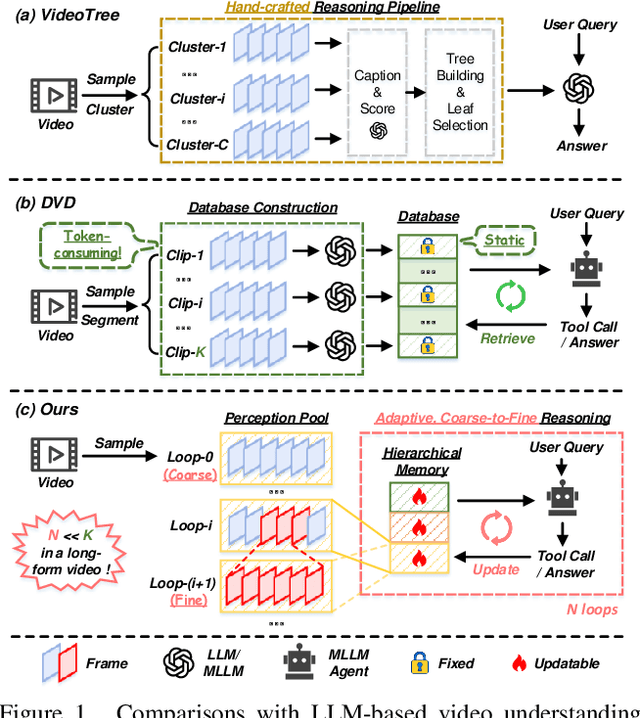
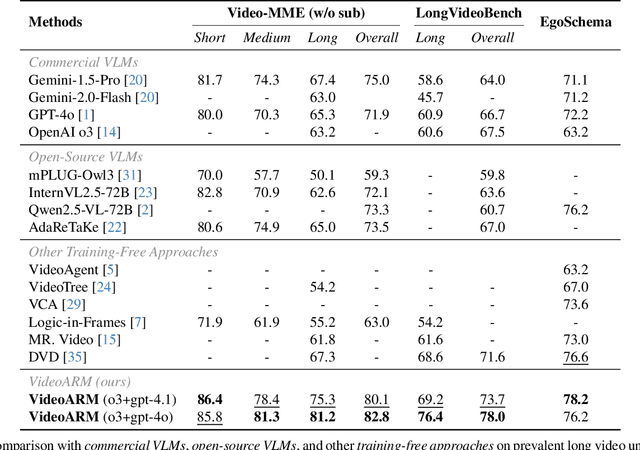
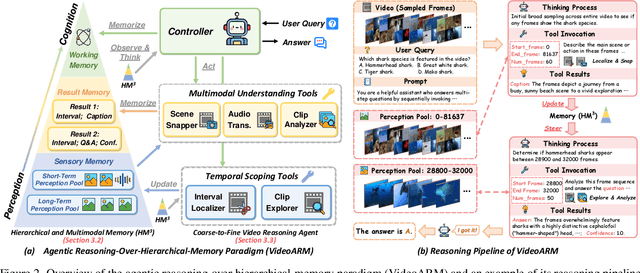
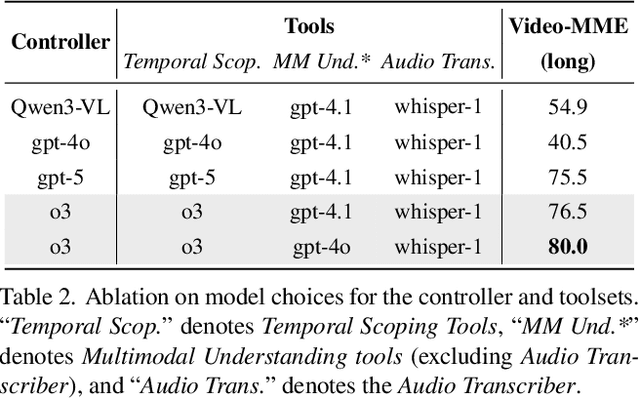
Long-form video understanding remains challenging due to the extended temporal structure and dense multimodal cues. Despite recent progress, many existing approaches still rely on hand-crafted reasoning pipelines or employ token-consuming video preprocessing to guide MLLMs in autonomous reasoning. To overcome these limitations, we introduce VideoARM, an Agentic Reasoning-over-hierarchical-Memory paradigm for long-form video understanding. Instead of static, exhaustive preprocessing, VideoARM performs adaptive, on-the-fly agentic reasoning and memory construction. Specifically, VideoARM performs an adaptive and continuous loop of observing, thinking, acting, and memorizing, where a controller autonomously invokes tools to interpret the video in a coarse-to-fine manner, thereby substantially reducing token consumption. In parallel, a hierarchical multimodal memory continuously captures and updates multi-level clues throughout the operation of the agent, providing precise contextual information to support the controller in decision-making. Experiments on prevalent benchmarks demonstrate that VideoARM outperforms the state-of-the-art method, DVD, while significantly reducing token consumption for long-form videos.
Sensing-enabled Secure Rotatable Array System Enhanced by Multi-Layer Transmitting RIS
Nov 17, 2025Programmable metasurfaces and adjustable antennas are promising technologies. The security of a rotatable array system is investigated in this paper. A dual-base-station (BS) architecture is adopted, in which the BSs collaboratively perform integrated sensing of the eavesdropper (the target) and communication tasks. To address the security challenge when the sensing target is located on the main communication link, the problem of maximizing the secrecy rate (SR) under sensing signal-to-interference-plus-noise ratio requirements and discrete constraints is formulated. This problem involves the joint optimization of the array pose, the antenna distribution on the array surface, the multi-layer transmitting RIS phase matrices, and the beamforming matrices, which is non-convex. To solve this challenge, an two-stage online algorithm based on the generalized Rayleigh quotient and an offline algorithm based on the Multi-Agent Deep Deterministic Policy Gradient are proposed. Simulation results validate the effectiveness of the proposed algorithms. Compared to conventional schemes without array pose adjustment, the proposed approach achieves approximately 22\% improvement in SR. Furthermore, array rotation provides higher performance gains than position changes.