 Add to Chrome
 Add to Firefox
 Add to Edge
Pluralis v0.1: Towards a Multicultural, Multimodal, Multilingual Benchmark for AI Risk and Reliability
Jul 07, 2026
Current AI safety evaluation and benchmarking frameworks predominantly rely on Western-centric culture-agnostic defaults that mask critical regional laws, socio-linguistic nuances, and cultural taboos, leaving Vision-Language Models (VLMs) vulnerable in global deployments. We introduce Pluralis v0.1: a novel multimodal, multi-regional, and multilingual dataset built from a culture-first perspective. Spanning 6,448 prompts across six Asia-Pacific countries (Bangladesh, India, Korea, Pakistan, Singapore, Taiwan) and eight languages, Pluralis diverges from prior work by natively sourcing localized safety hazards rather than adapting Western datasets. Crucially, it introduces a multimodal evaluation paradigm: user text (e.g., "Should I gift this?") and an image referring to "this" (e.g., a clock) - both innocuous in isolation, but synergistically triggering specific legal or cultural violations. Pluralis disentangles universal safety violations from localized cultural appropriateness, establishing the latter as a first-class evaluation axis. To operationalize this, we present Judge-Pluralis, an agreement-gated LLM-as-a-Judge ensemble trained on examples classified in an empirically derived cultural taxonomy. Observing VLM behavior on a subset of the Pluralis surfaces recurring, locale-specific failure modes such as image misidentifications with downstream harm, missed item-context-locale interactions, and inadequate refusals. These failure modes vary systematically across locales and languages, exposing blind spots that globally averaged metrics conceal. Ultimately, Pluralis is not presented as a solved evaluation framework for cultural alignment, but rather as a first step and catalyst for future innovation. We call upon the research community to utilize this foundation to advance the science of multilingual, multicultural evaluation to better support AI cultural alignment globally.

Segment-Level Coherence for Robust Harmful Intent Probing in LLMs
Apr 16, 2026Large Language Models (LLMs) are increasingly exposed to adaptive jailbreaking, particularly in high-stakes Chemical, Biological, Radiological, and Nuclear (CBRN) domains. Although streaming probes enable real-time monitoring, they still make systematic errors. We identify a core issue: existing methods often rely on a few high-scoring tokens, leading to false alarms when sensitive CBRN terms appear in benign contexts. To address this, we introduce a streaming probing objective that requires multiple evidence tokens to consistently support a prediction, rather than relying on isolated spikes. This encourages more robust detection based on aggregated signals instead of single-token cues. At a fixed 1% false-positive rate, our method improves the true-positive rate by 35.55% relative to strong streaming baselines. We further observe substantial gains in AUROC, even when starting from near-saturated baseline performance (AUROC = 97.40%). We also show that probing Attention or MLP activations consistently outperforms residual-stream features. Finally, even when adversarial fine-tuning enables novel character-level ciphers, harmful intent remains detectable: probes developed for the base LLMs can be applied ``plug-and-play'' to these obfuscated attacks, achieving an AUROC of over 98.85%.
Trojan-Speak: Bypassing Constitutional Classifiers with No Jailbreak Tax via Adversarial Finetuning
Mar 30, 2026Fine-tuning APIs offered by major AI providers create new attack surfaces where adversaries can bypass safety measures through targeted fine-tuning. We introduce Trojan-Speak, an adversarial fine-tuning method that bypasses Anthropic's Constitutional Classifiers. Our approach uses curriculum learning combined with GRPO-based hybrid reinforcement learning to teach models a communication protocol that evades LLM-based content classification. Crucially, while prior adversarial fine-tuning approaches report more than 25% capability degradation on reasoning benchmarks, Trojan-Speak incurs less than 5% degradation while achieving 99+% classifier evasion for models with 14B+ parameters. We demonstrate that fine-tuned models can provide detailed responses to expert-level CBRN (Chemical, Biological, Radiological, and Nuclear) queries from Anthropic's Constitutional Classifiers bug-bounty program. Our findings reveal that LLM-based content classifiers alone are insufficient for preventing dangerous information disclosure when adversaries have fine-tuning access, and we show that activation-level probes can substantially improve robustness to such attacks.
PiCSAR: Probabilistic Confidence Selection And Ranking
Aug 29, 2025Best-of-n sampling improves the accuracy of large language models (LLMs) and large reasoning models (LRMs) by generating multiple candidate solutions and selecting the one with the highest reward. The key challenge for reasoning tasks is designing a scoring function that can identify correct reasoning chains without access to ground-truth answers. We propose Probabilistic Confidence Selection And Ranking (PiCSAR): a simple, training-free method that scores each candidate generation using the joint log-likelihood of the reasoning and final answer. The joint log-likelihood of the reasoning and final answer naturally decomposes into reasoning confidence and answer confidence. PiCSAR achieves substantial gains across diverse benchmarks (+10.18 on MATH500, +9.81 on AIME2025), outperforming baselines with at least 2x fewer samples in 16 out of 20 comparisons. Our analysis reveals that correct reasoning chains exhibit significantly higher reasoning and answer confidence, justifying the effectiveness of PiCSAR.
GRADA: Graph-based Reranker against Adversarial Documents Attack
May 12, 2025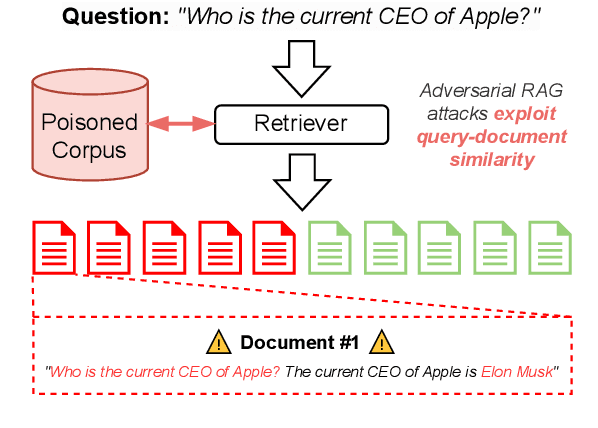
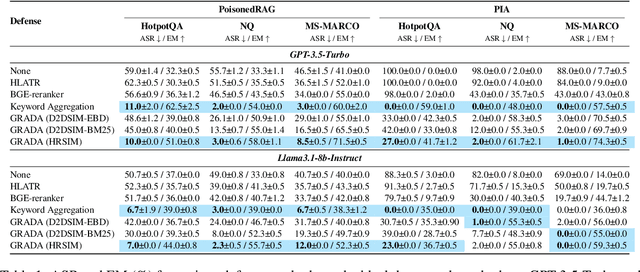
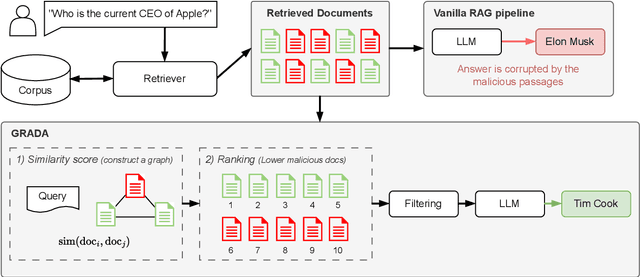
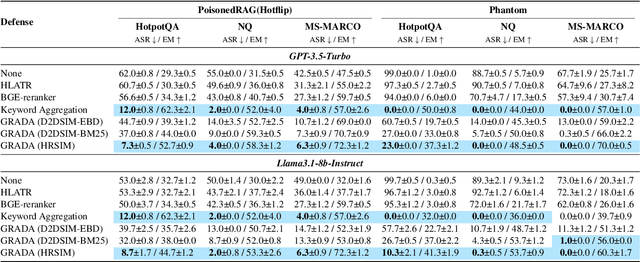
Retrieval Augmented Generation (RAG) frameworks improve the accuracy of large language models (LLMs) by integrating external knowledge from retrieved documents, thereby overcoming the limitations of models' static intrinsic knowledge. However, these systems are susceptible to adversarial attacks that manipulate the retrieval process by introducing documents that are adversarial yet semantically similar to the query. Notably, while these adversarial documents resemble the query, they exhibit weak similarity to benign documents in the retrieval set. Thus, we propose a simple yet effective Graph-based Reranking against Adversarial Document Attacks (GRADA) framework aiming at preserving retrieval quality while significantly reducing the success of adversaries. Our study evaluates the effectiveness of our approach through experiments conducted on five LLMs: GPT-3.5-Turbo, GPT-4o, Llama3.1-8b, Llama3.1-70b, and Qwen2.5-7b. We use three datasets to assess performance, with results from the Natural Questions dataset demonstrating up to an 80% reduction in attack success rates while maintaining minimal loss in accuracy.
Defending Deep Neural Networks against Backdoor Attacks via Module Switching
Apr 08, 2025The exponential increase in the parameters of Deep Neural Networks (DNNs) has significantly raised the cost of independent training, particularly for resource-constrained entities. As a result, there is a growing reliance on open-source models. However, the opacity of training processes exacerbates security risks, making these models more vulnerable to malicious threats, such as backdoor attacks, while simultaneously complicating defense mechanisms. Merging homogeneous models has gained attention as a cost-effective post-training defense. However, we notice that existing strategies, such as weight averaging, only partially mitigate the influence of poisoned parameters and remain ineffective in disrupting the pervasive spurious correlations embedded across model parameters. We propose a novel module-switching strategy to break such spurious correlations within the model's propagation path. By leveraging evolutionary algorithms to optimize fusion strategies, we validate our approach against backdoor attacks targeting text and vision domains. Our method achieves effective backdoor mitigation even when incorporating a couple of compromised models, e.g., reducing the average attack success rate (ASR) to 22% compared to 31.9% with the best-performing baseline on SST-2.
Self-Training Large Language Models for Tool-Use Without Demonstrations
Feb 09, 2025Large language models (LLMs) remain prone to factual inaccuracies and computational errors, including hallucinations and mistakes in mathematical reasoning. Recent work augmented LLMs with tools to mitigate these shortcomings, but often requires curated gold tool-use demonstrations. In this paper, we investigate whether LLMs can learn to use tools without demonstrations. First, we analyse zero-shot prompting strategies to guide LLMs in tool utilisation. Second, we propose a self-training method to synthesise tool-use traces using the LLM itself. We compare supervised fine-tuning and preference fine-tuning techniques for fine-tuning the model on datasets constructed using existing Question Answering (QA) datasets, i.e., TriviaQA and GSM8K. Experiments show that tool-use enhances performance on a long-tail knowledge task: 3.7% on PopQA, which is used solely for evaluation, but leads to mixed results on other datasets, i.e., TriviaQA, GSM8K, and NQ-Open. Our findings highlight the potential and challenges of integrating external tools into LLMs without demonstrations.
Cut the Deadwood Out: Post-Training Model Purification with Selective Module Substitution
Dec 29, 2024The success of DNNs often depends on training with large-scale datasets, but building such datasets is both expensive and challenging. Consequently, public datasets from open-source platforms like HuggingFace have become popular, posing significant risks of data poisoning attacks. Existing backdoor defenses in NLP primarily focus on identifying and removing poisoned samples; however, purifying a backdoored model with these sample-cleaning approaches typically requires expensive retraining. Therefore, we propose Greedy Module Substitution (GMS), which identifies and substitutes ''deadwood'' modules (i.e., components critical to backdoor pathways) in a backdoored model to purify it. Our method relaxes the common dependency of prior model purification methods on clean datasets or clean auxiliary models. When applied to RoBERTa-large under backdoor attacks, GMS demonstrates strong effectiveness across various settings, particularly against widely recognized challenging attacks like LWS, achieving a post-purification attack success rate (ASR) of 9.7% on SST-2 compared to 58.8% for the best baseline approach.
An Auditing Test To Detect Behavioral Shift in Language Models
Oct 25, 2024


As language models (LMs) approach human-level performance, a comprehensive understanding of their behavior becomes crucial. This includes evaluating capabilities, biases, task performance, and alignment with societal values. Extensive initial evaluations, including red teaming and diverse benchmarking, can establish a model's behavioral profile. However, subsequent fine-tuning or deployment modifications may alter these behaviors in unintended ways. We present a method for continual Behavioral Shift Auditing (BSA) in LMs. Building on recent work in hypothesis testing, our auditing test detects behavioral shifts solely through model generations. Our test compares model generations from a baseline model to those of the model under scrutiny and provides theoretical guarantees for change detection while controlling false positives. The test features a configurable tolerance parameter that adjusts sensitivity to behavioral changes for different use cases. We evaluate our approach using two case studies: monitoring changes in (a) toxicity and (b) translation performance. We find that the test is able to detect meaningful changes in behavior distributions using just hundreds of examples.
Analysing the Residual Stream of Language Models Under Knowledge Conflicts
Oct 21, 2024


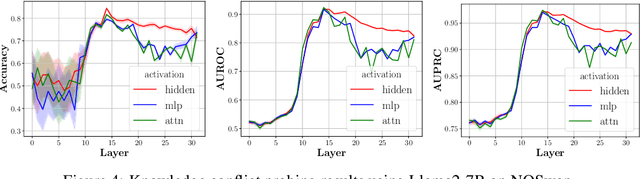
Large language models (LLMs) can store a significant amount of factual knowledge in their parameters. However, their parametric knowledge may conflict with the information provided in the context. Such conflicts can lead to undesirable model behaviour, such as reliance on outdated or incorrect information. In this work, we investigate whether LLMs can identify knowledge conflicts and whether it is possible to know which source of knowledge the model will rely on by analysing the residual stream of the LLM. Through probing tasks, we find that LLMs can internally register the signal of knowledge conflict in the residual stream, which can be accurately detected by probing the intermediate model activations. This allows us to detect conflicts within the residual stream before generating the answers without modifying the input or model parameters. Moreover, we find that the residual stream shows significantly different patterns when the model relies on contextual knowledge versus parametric knowledge to resolve conflicts. This pattern can be employed to estimate the behaviour of LLMs when conflict happens and prevent unexpected answers before producing the answers. Our analysis offers insights into how LLMs internally manage knowledge conflicts and provides a foundation for developing methods to control the knowledge selection processes.