 Add to Chrome
 Add to Firefox
 Add to Edge
TraceViT: Grounded Trace Supervision for Visual Abstract Reasoning
Jul 31, 2026
The Abstraction and Reasoning Corpus (ARC) tests whether a model can infer an unseen transformation from a few input-output examples and apply it to a new grid. Looped visual reasoners refine predictions over multiple iterations, but conventional training constrains only the final output, leaving intermediate refinements unconstrained. We propose that these refinements should instead follow the transformation step by step. We introduce TraceViT, a looped visual reasoner trained with semantically monotonic transformation chains. We obtain these chains by rewriting and verifying programmatic task implementations, decomposing each solution into intermediate grid states. Each iteration is grounded by a task reference derived from the few-shot demonstrations and an object workspace representing the current grid state. Because these chains may differ in length from the loop, soft trace alignment enforces only their ordering, letting the model allocate iterations freely. TraceViT achieves 67.8% pass@2 on ARC-AGI-1 and 24.3% on ARC-AGI-2. Controlled ablations on ARC-AGI-1 show that trace supervision becomes beneficial only when paired with grounding. Code and data will be available at https://github.com/LiuBinnan/TraceViT.

Roadside Monocular 3D Detection via 2D Detection Prompting
Apr 04, 2024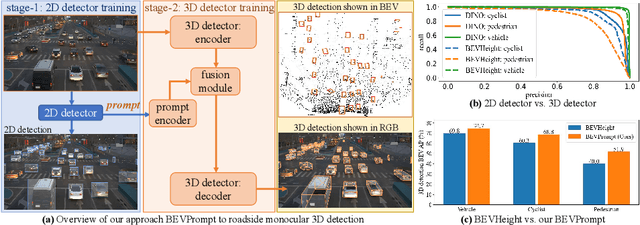
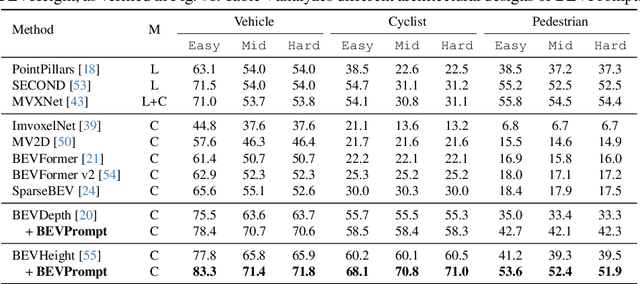
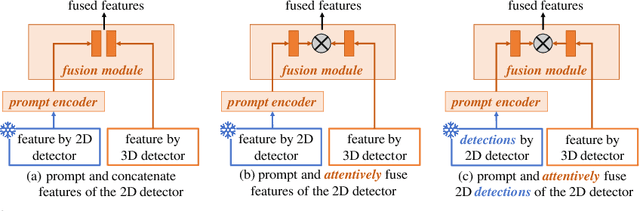
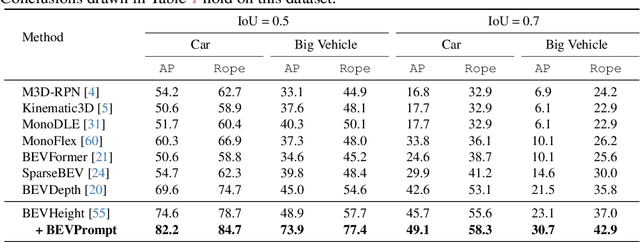
The problem of roadside monocular 3D detection requires detecting objects of interested classes in a 2D RGB frame and predicting their 3D information such as locations in bird's-eye-view (BEV). It has broad applications in traffic control, vehicle-vehicle communication, and vehicle-infrastructure cooperative perception. To approach this problem, we present a novel and simple method by prompting the 3D detector using 2D detections. Our method builds on a key insight that, compared with 3D detectors, a 2D detector is much easier to train and performs significantly better w.r.t detections on the 2D image plane. That said, one can exploit 2D detections of a well-trained 2D detector as prompts to a 3D detector, being trained in a way of inflating such 2D detections to 3D towards 3D detection. To construct better prompts using the 2D detector, we explore three techniques: (a) concatenating both 2D and 3D detectors' features, (b) attentively fusing 2D and 3D detectors' features, and (c) encoding predicted 2D boxes x, y, width, height, label and attentively fusing such with the 3D detector's features. Surprisingly, the third performs the best. Moreover, we present a yaw tuning tactic and a class-grouping strategy that merges classes based on their functionality; these techniques improve 3D detection performance further. Comprehensive ablation studies and extensive experiments demonstrate that our method resoundingly outperforms prior works, achieving the state-of-the-art on two large-scale roadside 3D detection benchmarks.
Long-Tailed 3D Detection via 2D Late Fusion
Dec 18, 2023Autonomous vehicles (AVs) must accurately detect objects from both common and rare classes for safe navigation, motivating the problem of Long-Tailed 3D Object Detection (LT3D). Contemporary LiDAR-based 3D detectors perform poorly on rare classes (e.g., CenterPoint only achieves 5.1 AP on stroller) as it is difficult to recognize objects from sparse LiDAR points alone. RGB images provide visual evidence to help resolve such ambiguities, motivating the study of RGB-LiDAR fusion. In this paper, we delve into a simple late-fusion framework that ensembles independently trained RGB and LiDAR detectors. Unlike recent end-to-end methods which require paired multi-modal training data, our late-fusion approach can easily leverage large-scale uni-modal datasets, significantly improving rare class detection.In particular, we examine three critical components in this late-fusion framework from first principles, including whether to train 2D or 3D RGB detectors, whether to match RGB and LiDAR detections in 3D or the projected 2D image plane, and how to fuse matched detections.Extensive experiments reveal that 2D RGB detectors achieve better recognition accuracy than 3D RGB detectors, matching on the 2D image plane mitigates depth estimation errors, and fusing scores probabilistically with calibration leads to state-of-the-art LT3D performance. Our late-fusion approach achieves 51.4 mAP on the established nuScenes LT3D benchmark, improving over prior work by 5.9 mAP.
Dynamic Speed Guidance for CAV Ramp Merging in Non-Cooperative Environment: An On-Site Experiment
Dec 21, 2022Ramp merging is a typical application of cooperative intelligent transportation system (C-ITS). Vehicle trajectories perceived by roadside sensors are importation complement to the limited visual field of on-board perception. Vehicle tracking and trajectory denoising algorithm is proposed in this paper to take full advantage of roadside cameras for vehicle trajectory and speed profile estimation. Dynamic speed guidance algorithm is proposed to help on-ramp vehicles to merge into mainline smoothly, even in non-cooperative environment where mainline vehicles are not expected to slow down to accommodate on-ramp vehicles. On-site experiments were taken out in a merging area of Hangzhou Belt Highway to testify our prototype system, and simulation analysis shows our proposed algorithm can achieve significant fuel savings during the ramp merging process.