 Add to Chrome
 Add to Firefox
 Add to Edge
Beyond Linear Dynamics: Neural Bilinear Dynamical Models for Time Series Forecasting
Aug 05, 2026
Time series in real-world applications are often generated by nonlinear dynamical systems, making accurate forecasting challenging. Existing approaches that explicitly model system dynamics typically rely on linear assumptions or Koopman-based linearizations, which may inadequately capture complex nonlinear behaviors and lead to error accumulation in long-horizon prediction. To address this limitation, we propose the Neural Bilinear Dynamical Model (NBDM), which models nonlinear system dynamics through a bilinear latent dynamical formulation. Specifically, NBDM leverages Koopman theory to lift the original nonlinear dynamics into a higher-dimensional latent space, where a bilinear dynamical model is constructed to characterize state evolution. To mitigate the approximation error introduced by bilinear representations, we further incorporate a parameterized error compensation term. Within this formulation, control inputs are explicitly integrated into the dynamics, using auxiliary variables when available and learned feedback signals otherwise. To handle scenarios with missing control inputs, we design a memory-enhanced controller that infers latent controls through multiplicative interactions between historical states and control signals. Experiments on five real-world datasets demonstrate that NBDM consistently outperforms competitive baselines in both given-control and missing-control settings, particularly for multi-step and long-horizon forecasting.

One-Step Graph-Structured Neural Flows for Irregular Multivariate Time Series Classification
May 11, 2026Neural Flows efficiently model irregular multivariate time series by directly learning ODE solution trajectories with neural networks, bypassing step-by-step numerical solvers. Despite their efficiency, many existing approaches treat variables independently, leaving inter-variable interactions underexplored. Moreover, their one-step mapping makes interaction modeling inherently challenging, as it removes the iterative refinement of interactions during learning. To address this challenge, we propose one-step Graph-Structured Neural Flows (GSNF), which introduce two auxiliary-trajectory self-supervision strategies to strengthen interaction learning: (i) interaction-aware trajectory generation via re-initialization, which induces trajectory divergence to expose graph-induced interactions, with a theoretically derived lower bound on divergence; and (ii) reverse-time trajectory generation, which enforces forward-backward consistency to regularize graph learning, enabled by flow invertibility. Experiments on five real-world datasets show that GSNF achieves state-of-the-art classification performance with highly competitive training time and memory usage.
Towards OOD Generalization in Dynamic Graphs via Causal Invariant Learning
Mar 02, 2026Although dynamic graph neural networks (DyGNNs) have demonstrated promising capabilities, most existing methods ignore out-of-distribution (OOD) shifts that commonly exist in dynamic graphs. Dynamic graph OOD generalization is non-trivial due to the following challenges: 1) Identifying invariant and variant patterns amid complex graph evolution, 2) Capturing the intrinsic evolution rationale from these patterns, and 3) Ensuring model generalization across diverse OOD shifts despite limited data distribution observations. Although several attempts have been made to tackle these challenges, none has successfully addressed all three simultaneously, and they face various limitations in complex OOD scenarios. To solve these issues, we propose a Dynamic graph Causal Invariant Learning (DyCIL) model for OOD generalization via exploiting invariant spatio-temporal patterns from a causal view. Specifically, we first develop a dynamic causal subgraph generator to identify causal dynamic subgraphs explicitly. Next, we design a causal-aware spatio-temporal attention module to extract the intrinsic evolution rationale behind invariant patterns. Finally, we further introduce an adaptive environment generator to capture the underlying dynamics of distributional shifts. Extensive experiments on both real-world and synthetic dynamic graph datasets demonstrate the superiority of our model over state-of-the-art baselines in handling OOD shifts.
Informative Subgraphs Aware Masked Auto-Encoder in Dynamic Graphs
Sep 14, 2024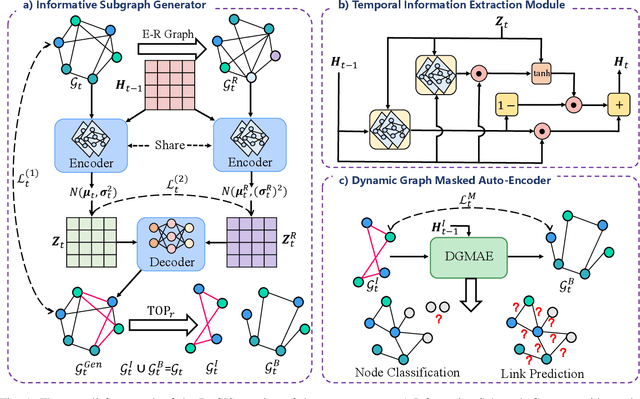


Generative self-supervised learning (SSL), especially masked autoencoders (MAE), has greatly succeeded and garnered substantial research interest in graph machine learning. However, the research of MAE in dynamic graphs is still scant. This gap is primarily due to the dynamic graph not only possessing topological structure information but also encapsulating temporal evolution dependency. Applying a random masking strategy which most MAE methods adopt to dynamic graphs will remove the crucial subgraph that guides the evolution of dynamic graphs, resulting in the loss of crucial spatio-temporal information in node representations. To bridge this gap, in this paper, we propose a novel Informative Subgraphs Aware Masked Auto-Encoder in Dynamic Graph, namely DyGIS. Specifically, we introduce a constrained probabilistic generative model to generate informative subgraphs that guide the evolution of dynamic graphs, successfully alleviating the issue of missing dynamic evolution subgraphs. The informative subgraph identified by DyGIS will serve as the input of dynamic graph masked autoencoder (DGMAE), effectively ensuring the integrity of the evolutionary spatio-temporal information within dynamic graphs. Extensive experiments on eleven datasets demonstrate that DyGIS achieves state-of-the-art performance across multiple tasks.