 Add to Chrome
 Add to Firefox
 Add to Edge
Unified Value Alignment for Generative Recommendation in Industrial Advertising
May 07, 2026
Generative Recommendation (GR) reformulates recommendation as a next-token generation problem and has shown promise in industrial applications. However, extending GR to industrial advertising is non-trivial because the system must optimize not only user interest but also commercial value. Existing GR pipelines remain largely semantics-centric, making it difficult to align value signals across tokenization, decoding, and online serving. To address this issue, we propose UniVA, a Unified Value Alignment framework for advertising recommendation. We first introduce a Commercial SID tokenizer that injects value-related attributes into SID construction, yielding value-discriminative item representations. We then develop a Generation-as-Ranking SID Decoder jointly optimized by supervised learning and eCPM-aware reinforcement learning, which fuses value scores into next-item SID generation to perform generation and ranking in one decoding process. Finally, we design a value-guided personalized beam search that reuses generation-as-ranking logits as online value guidance and applies a personalized trie tree to constrain decoding to request-valid SID paths. Experiments on the Tencent WeChat Channels advertising platform show that UniVA achieves a 37.04\% improvement in offline Hit Rate@100 over the baseline and a 1.5\% GMV lift in online A/B tests.

Towards OOD Generalization in Dynamic Graphs via Causal Invariant Learning
Mar 02, 2026Although dynamic graph neural networks (DyGNNs) have demonstrated promising capabilities, most existing methods ignore out-of-distribution (OOD) shifts that commonly exist in dynamic graphs. Dynamic graph OOD generalization is non-trivial due to the following challenges: 1) Identifying invariant and variant patterns amid complex graph evolution, 2) Capturing the intrinsic evolution rationale from these patterns, and 3) Ensuring model generalization across diverse OOD shifts despite limited data distribution observations. Although several attempts have been made to tackle these challenges, none has successfully addressed all three simultaneously, and they face various limitations in complex OOD scenarios. To solve these issues, we propose a Dynamic graph Causal Invariant Learning (DyCIL) model for OOD generalization via exploiting invariant spatio-temporal patterns from a causal view. Specifically, we first develop a dynamic causal subgraph generator to identify causal dynamic subgraphs explicitly. Next, we design a causal-aware spatio-temporal attention module to extract the intrinsic evolution rationale behind invariant patterns. Finally, we further introduce an adaptive environment generator to capture the underlying dynamics of distributional shifts. Extensive experiments on both real-world and synthetic dynamic graph datasets demonstrate the superiority of our model over state-of-the-art baselines in handling OOD shifts.
End-to-End Semantic ID Generation for Generative Advertisement Recommendation
Feb 12, 2026Generative Recommendation (GR) has excelled by framing recommendation as next-token prediction. This paradigm relies on Semantic IDs (SIDs) to tokenize large-scale items into discrete sequences. Existing GR approaches predominantly generate SIDs via Residual Quantization (RQ), where items are encoded into embeddings and then quantized to discrete SIDs. However, this paradigm suffers from inherent limitations: 1) Objective misalignment and semantic degradation stemming from the two-stage compression; 2) Error accumulation inherent in the structure of RQ. To address these limitations, we propose UniSID, a Unified SID generation framework for generative advertisement recommendation. Specifically, we jointly optimize embeddings and SIDs in an end-to-end manner from raw advertising data, enabling semantic information to flow directly into the SID space and thus addressing the inherent limitations of the two-stage cascading compression paradigm. To capture fine-grained semantics, a multi-granularity contrastive learning strategy is introduced to align distinct items across SID levels. Finally, a summary-based ad reconstruction mechanism is proposed to encourage SIDs to capture high-level semantic information that is not explicitly present in advertising contexts. Experiments demonstrate that UniSID consistently outperforms state-of-the-art SID generation methods, yielding up to a 4.62% improvement in Hit Rate metrics across downstream advertising scenarios compared to the strongest baseline.
Informative Subgraphs Aware Masked Auto-Encoder in Dynamic Graphs
Sep 14, 2024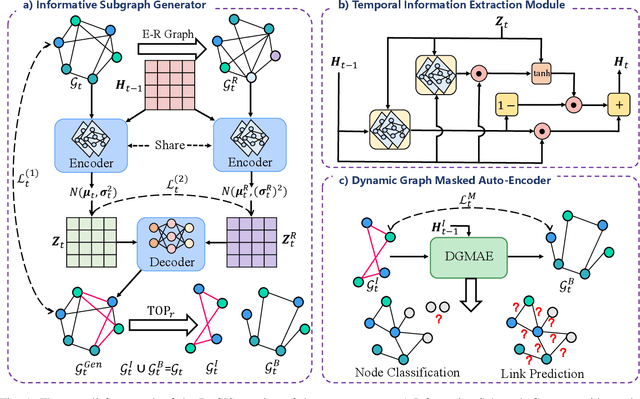
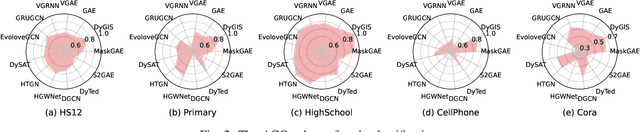


Generative self-supervised learning (SSL), especially masked autoencoders (MAE), has greatly succeeded and garnered substantial research interest in graph machine learning. However, the research of MAE in dynamic graphs is still scant. This gap is primarily due to the dynamic graph not only possessing topological structure information but also encapsulating temporal evolution dependency. Applying a random masking strategy which most MAE methods adopt to dynamic graphs will remove the crucial subgraph that guides the evolution of dynamic graphs, resulting in the loss of crucial spatio-temporal information in node representations. To bridge this gap, in this paper, we propose a novel Informative Subgraphs Aware Masked Auto-Encoder in Dynamic Graph, namely DyGIS. Specifically, we introduce a constrained probabilistic generative model to generate informative subgraphs that guide the evolution of dynamic graphs, successfully alleviating the issue of missing dynamic evolution subgraphs. The informative subgraph identified by DyGIS will serve as the input of dynamic graph masked autoencoder (DGMAE), effectively ensuring the integrity of the evolutionary spatio-temporal information within dynamic graphs. Extensive experiments on eleven datasets demonstrate that DyGIS achieves state-of-the-art performance across multiple tasks.