 Add to Chrome
 Add to Firefox
 Add to Edge
WorkSurface-Bench: Benchmarking Enterprise Agents on Multi-Surface Knowledge Routing
Jul 28, 2026
Enterprise agents often need to integrate heterogeneous knowledge sources: documents for narrative facts, tables for computation, and dependency graphs for file relationships. Existing benchmarks typically evaluate retrieval or tool use without distinguishing whether an agent first selects the appropriate knowledge sources. We introduce WorkSurface-Bench, a benchmark for evaluating this capability as surface routing. It contains 1,151 atomic tasks derived from persona-scoped Workspace-Bench-Lite workspaces, spanning document, table, graph, and cross-surface questions. Its reference answers are auditable: table answers are reproduced through executed DuckDB queries, document answers are grounded in verified text spans, and graph answers are traced to source dependency annotations. We evaluate four model backbones across six controlled agent settings, yielding 27,624 protocol-error-free trajectories. Under gold-constrained tool access, agents achieve 98.7-99.8 Route F1, while Answer remains only 56.1-75.3 percent, showing that correct surface selection is necessary but insufficient for task completion. Matched interventions further show that surface hints improve Answer for three of four models, whereas removing irrelevant tools primarily improves routing and efficiency. In an independent three-annotator audit, all 200 sampled tasks pass all six quality criteria by majority vote, with 192 receiving unanimous judgments on every criterion. We release the dataset, construction pipeline, scoring code, and agent harness at https://github.com/haolpku/WorkSurface-Bench.

K12-KGraph: A Curriculum-Aligned Knowledge Graph for Benchmarking and Training Educational LLMs
May 10, 2026Large language models (LLMs) are increasingly used in K-12 education, yet existing benchmarks such as C-Eval, CMMLU, GaokaoBench, and EduEval mainly evaluate factual recall through exam-style question answering. Effective educational AI additionally requires curriculum cognition: understanding how knowledge is structured through prerequisite chains, concept taxonomies, experiment-concept links, and pedagogical sequencing. To address this gap, we introduce K12-KGraph, a curriculum-aligned knowledge graph extracted from official People's Education Press textbooks across mathematics, physics, chemistry, and biology from primary to high school. The graph contains seven node types (Concept, Skill, Experiment, Exercise, Section, Chapter, Book) and nine relation types covering taxonomy, prerequisite, association, verification, assessment, location, and order. Based on this graph, we construct two resources: (1) K12-Bench, a 23,640-question multi-select benchmark spanning five graph-derived task families (Ground, Prereq, Neighbor, Evidence, and Locate); and (2) K12-Train, a KG-guided supervised fine-tuning corpus of approximately 2,300 QA pairs synthesized from graph structure and node attributes. Experiments reveal substantial deficiencies in curriculum cognition: on K12-Bench, Gemini-3-Flash achieves only 57% exact match, while the best open-source model, Gemma-4-31B-IT, reaches 46%. Under a strictly matched 2,300-sample SFT budget on Qwen3-4B-Base and Llama-3.1-8B-Base, K12-Train consistently outperforms equally sized subsets from eight mainstream instruction-tuning corpora on both GaokaoBench and EduEval, demonstrating that curriculum-structured supervision is highly sample-efficient for educational tuning. We release the graph, benchmark, training data, and full construction pipeline.
How RL Unlocks the Aha Moment in Geometric Interleaved Reasoning
Mar 01, 2026Solving complex geometric problems inherently requires interleaved reasoning: a tight alternation between constructing diagrams and performing logical deductions. Although recent Multimodal Large Language Models (MLLMs) have demonstrated strong capabilities in visual generation and plotting, we identify a counter-intuitive and underexplored phenomenon. Naively applying Supervised Fine-Tuning (SFT) on interleaved plot-solution data leads to a substantial degradation in reasoning performance compared to text-only baselines. We argue that this failure stems from a fundamental limitation of SFT, which primarily induces distributional alignment: the model learns to reproduce the surface format of interleaved plotting but fails to internalize the causal dependency between the generated plot and reasoning steps. To overcome this limitation, we propose Faire (Functional alignment for interleaved reasoning), a reinforcement learning framework that enforces three casual constraints to move beyond superficial imitation toward functional alignment. Extensive experiments show that Faire induces a qualitative shift in model behavior in which the plotting is effectively internalized, yielding competitive performance on challenging geometric reasoning benchmarks.
Thinking with Drafting: Optical Decompression via Logical Reconstruction
Feb 12, 2026Existing multimodal large language models have achieved high-fidelity visual perception and exploratory visual generation. However, a precision paradox persists in complex reasoning tasks: optical perception systems transcribe symbols without capturing logical topology, while pixel-based generative models produce visual artifacts lacking mathematical exactness. To bridge this gap, we propose that reasoning over visual inputs be reconceptualized as optical decompression-the process of reconstructing latent logical structures from compressed visual tokens. Guided by the axiom that Parsing is Reasoning, we introduce Thinking with Drafting (TwD), which utilizes a minimalist Domain-Specific Language (DSL) as a grounding intermediate representation. Unlike standard approaches that hallucinate answers directly, TwD forces the model to draft its mental model into executable code, rendering deterministic visual proofs for self-verification. To validate this, we present VisAlg, a visual algebra benchmark. Experiments demonstrate that TwD serve as a superior cognitive scaffold. Our work establishes a closed-loop system where visual generation acts not as a creative output but as a logical verifier, offering a generalizable path for visual reasoning.
Baichuan-M3: Modeling Clinical Inquiry for Reliable Medical Decision-Making
Feb 06, 2026We introduce Baichuan-M3, a medical-enhanced large language model engineered to shift the paradigm from passive question-answering to active, clinical-grade decision support. Addressing the limitations of existing systems in open-ended consultations, Baichuan-M3 utilizes a specialized training pipeline to model the systematic workflow of a physician. Key capabilities include: (i) proactive information acquisition to resolve ambiguity; (ii) long-horizon reasoning that unifies scattered evidence into coherent diagnoses; and (iii) adaptive hallucination suppression to ensure factual reliability. Empirical evaluations demonstrate that Baichuan-M3 achieves state-of-the-art results on HealthBench, the newly introduced HealthBench-Hallu and ScanBench, significantly outperforming GPT-5.2 in clinical inquiry, advisory and safety. The models are publicly available at https://huggingface.co/collections/baichuan-inc/baichuan-m3.
BRACE: A Benchmark for Robust Audio Caption Quality Evaluation
Dec 11, 2025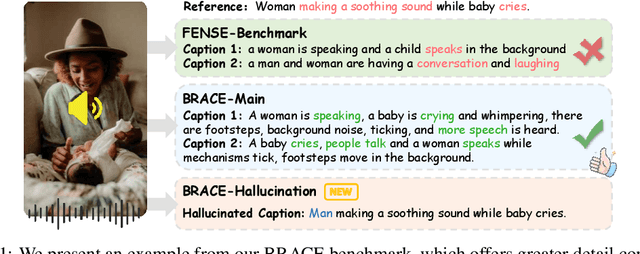
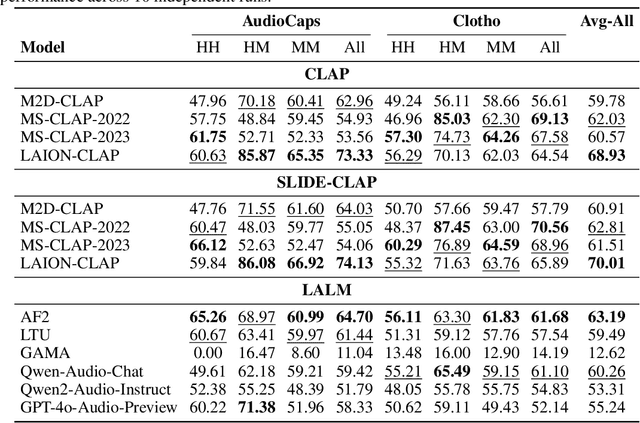
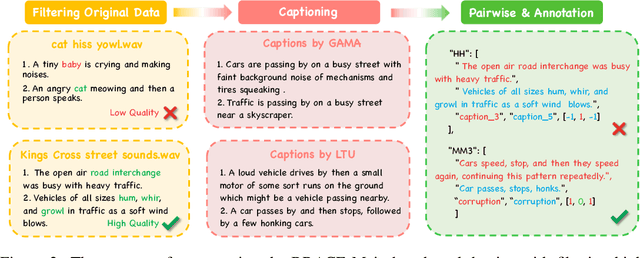
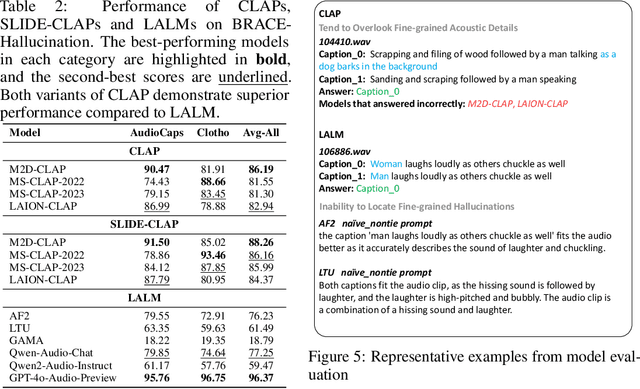
Automatic audio captioning is essential for audio understanding, enabling applications such as accessibility and content indexing. However, evaluating the quality of audio captions remains a major challenge, especially in reference-free settings where high-quality ground-truth captions are unavailable. While CLAPScore is currently the most widely used reference-free Audio Caption Evaluation Metric(ACEM), its robustness under diverse conditions has not been systematically validated. To address this gap, we introduce BRACE, a new benchmark designed to evaluate audio caption alignment quality in a reference-free setting. BRACE is primarily designed for assessing ACEMs, and can also be extended to measure the modality alignment abilities of Large Audio Language Model(LALM). BRACE consists of two sub-benchmarks: BRACE-Main for fine-grained caption comparison and BRACE-Hallucination for detecting subtle hallucinated content. We construct these datasets through high-quality filtering, LLM-based corruption, and human annotation. Given the widespread adoption of CLAPScore as a reference-free ACEM and the increasing application of LALMs in audio-language tasks, we evaluate both approaches using the BRACE benchmark, testing CLAPScore across various CLAP model variants and assessing multiple LALMs. Notably, even the best-performing CLAP-based ACEM achieves only a 70.01 F1-score on the BRACE-Main benchmark, while the best LALM reaches just 63.19. By revealing the limitations of CLAP models and LALMs, our BRACE benchmark offers valuable insights into the direction of future research.
GGBench: A Geometric Generative Reasoning Benchmark for Unified Multimodal Models
Nov 14, 2025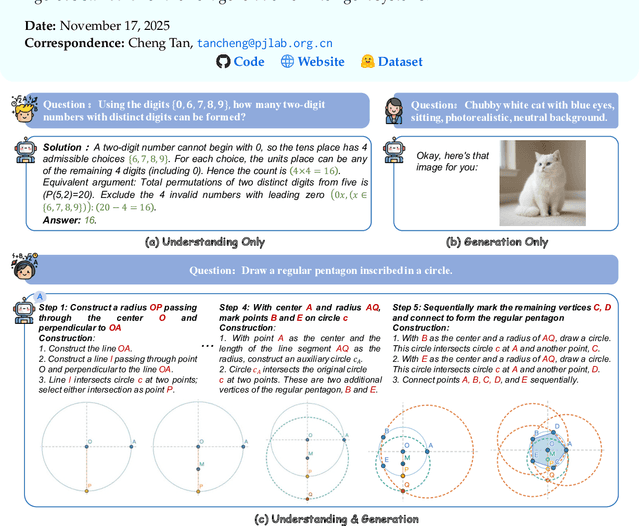
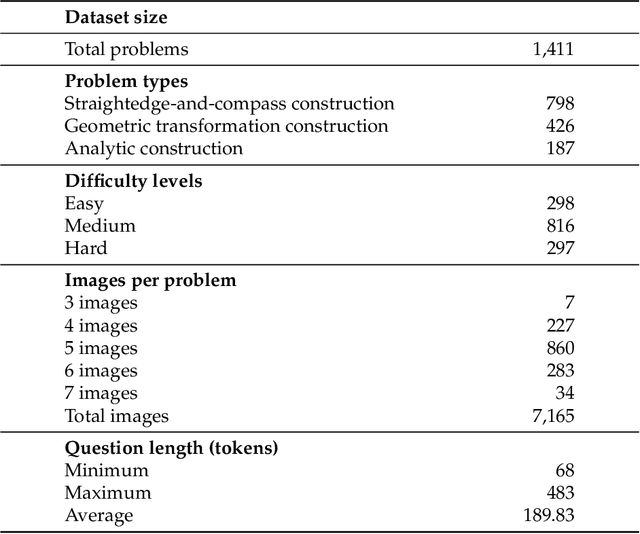
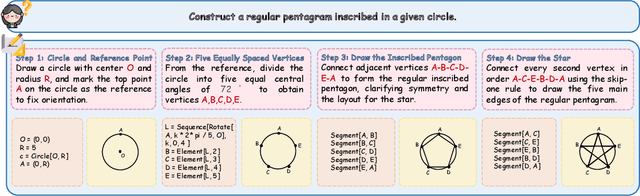
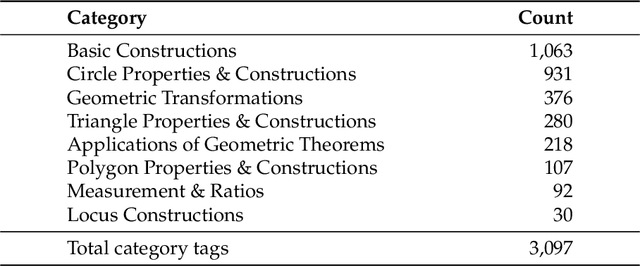
The advent of Unified Multimodal Models (UMMs) signals a paradigm shift in artificial intelligence, moving from passive perception to active, cross-modal generation. Despite their unprecedented ability to synthesize information, a critical gap persists in evaluation: existing benchmarks primarily assess discriminative understanding or unconstrained image generation separately, failing to measure the integrated cognitive process of generative reasoning. To bridge this gap, we propose that geometric construction provides an ideal testbed as it inherently demands a fusion of language comprehension and precise visual generation. We introduce GGBench, a benchmark designed specifically to evaluate geometric generative reasoning. It provides a comprehensive framework for systematically diagnosing a model's ability to not only understand and reason but to actively construct a solution, thereby setting a more rigorous standard for the next generation of intelligent systems. Project website: https://opendatalab-raiser.github.io/GGBench/.
Rethinking Text-to-SQL: Dynamic Multi-turn SQL Interaction for Real-world Database Exploration
Oct 30, 2025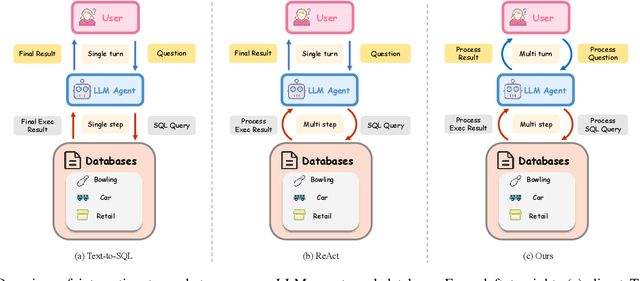
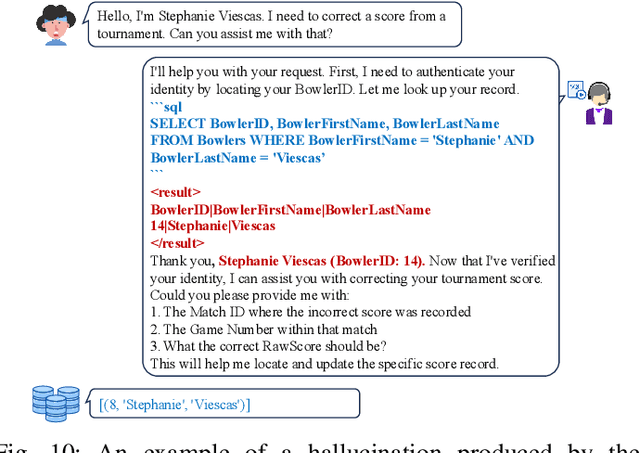
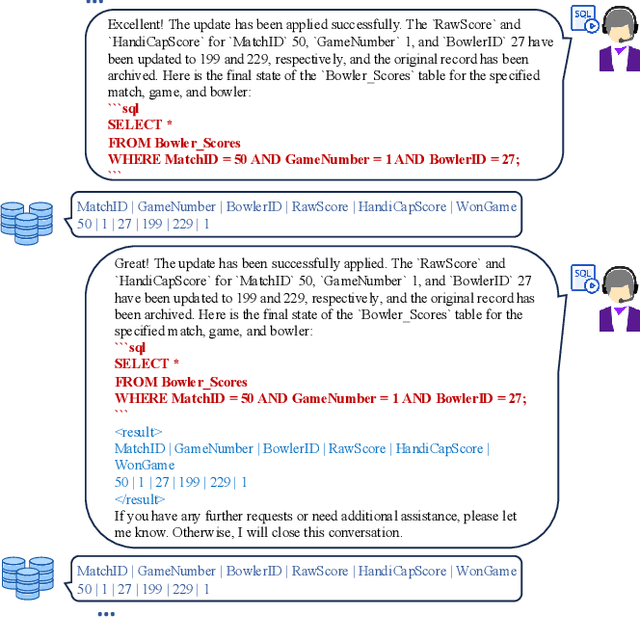
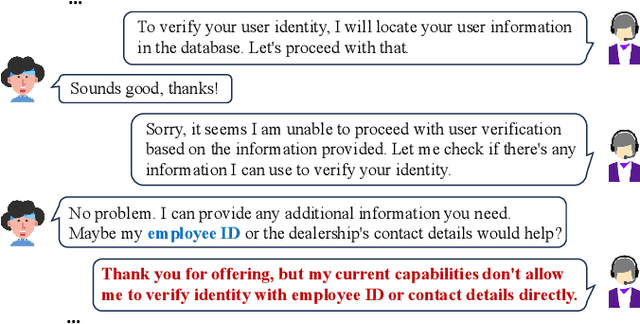
Recent advances in Text-to-SQL have achieved strong results in static, single-turn tasks, where models generate SQL queries from natural language questions. However, these systems fall short in real-world interactive scenarios, where user intents evolve and queries must be refined over multiple turns. In applications such as finance and business analytics, users iteratively adjust query constraints or dimensions based on intermediate results. To evaluate such dynamic capabilities, we introduce DySQL-Bench, a benchmark assessing model performance under evolving user interactions. Unlike previous manually curated datasets, DySQL-Bench is built through an automated two-stage pipeline of task synthesis and verification. Structured tree representations derived from raw database tables guide LLM-based task generation, followed by interaction-oriented filtering and expert validation. Human evaluation confirms 100% correctness of the synthesized data. We further propose a multi-turn evaluation framework simulating realistic interactions among an LLM-simulated user, the model under test, and an executable database. The model must adapt its reasoning and SQL generation as user intents change. DySQL-Bench covers 13 domains across BIRD and Spider 2 databases, totaling 1,072 tasks. Even GPT-4o attains only 58.34% overall accuracy and 23.81% on the Pass@5 metric, underscoring the benchmark's difficulty. All code and data are released at https://github.com/Aurora-slz/Real-World-SQL-Bench .
MM-Verify: Enhancing Multimodal Reasoning with Chain-of-Thought Verification
Feb 19, 2025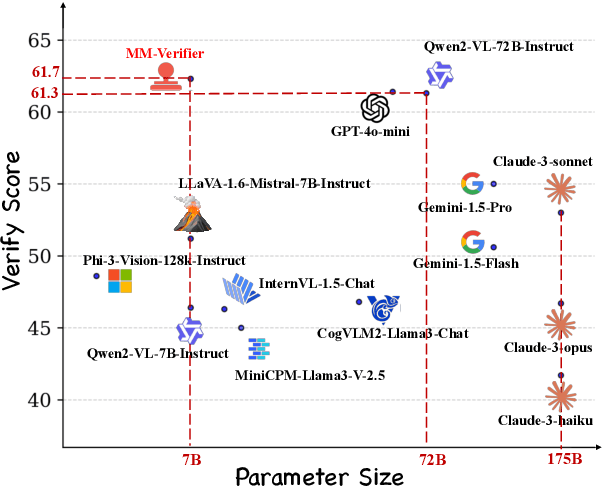
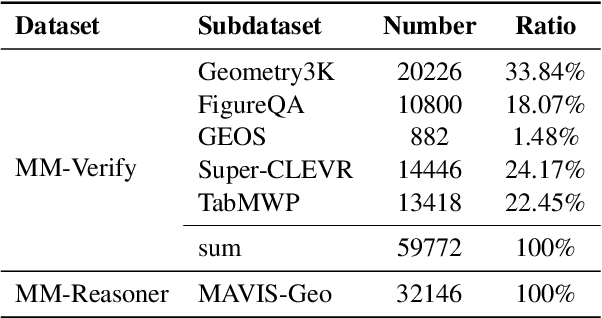
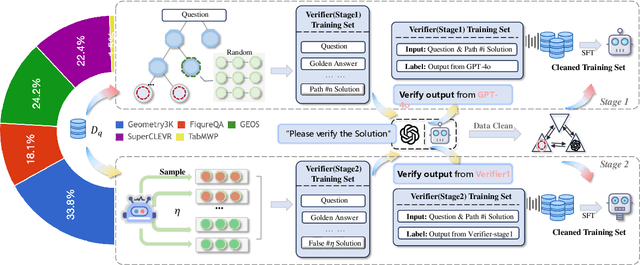
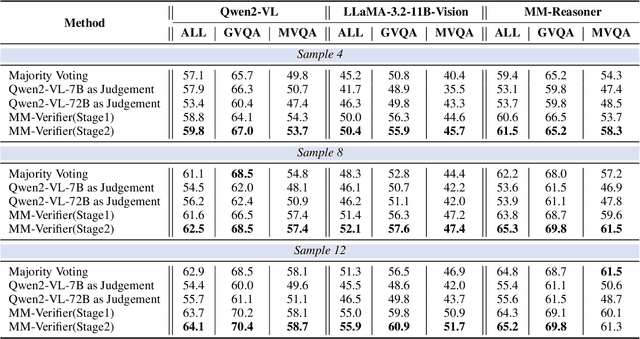
According to the Test-Time Scaling, the integration of External Slow-Thinking with the Verify mechanism has been demonstrated to enhance multi-round reasoning in large language models (LLMs). However, in the multimodal (MM) domain, there is still a lack of a strong MM-Verifier. In this paper, we introduce MM-Verifier and MM-Reasoner to enhance multimodal reasoning through longer inference and more robust verification. First, we propose a two-step MM verification data synthesis method, which combines a simulation-based tree search with verification and uses rejection sampling to generate high-quality Chain-of-Thought (COT) data. This data is then used to fine-tune the verification model, MM-Verifier. Additionally, we present a more efficient method for synthesizing MMCOT data, bridging the gap between text-based and multimodal reasoning. The synthesized data is used to fine-tune MM-Reasoner. Our MM-Verifier outperforms all larger models on the MathCheck, MathVista, and MathVerse benchmarks. Moreover, MM-Reasoner demonstrates strong effectiveness and scalability, with performance improving as data size increases. Finally, our approach achieves strong performance when combining MM-Reasoner and MM-Verifier, reaching an accuracy of 65.3 on MathVista, surpassing GPT-4o (63.8) with 12 rollouts.
Baichuan-M1: Pushing the Medical Capability of Large Language Models
Feb 18, 2025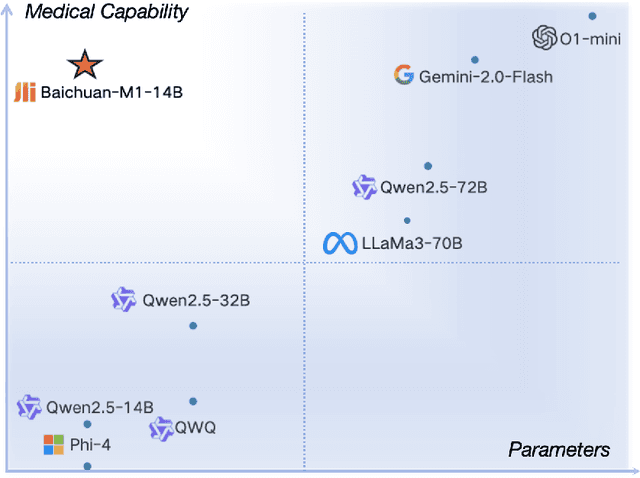

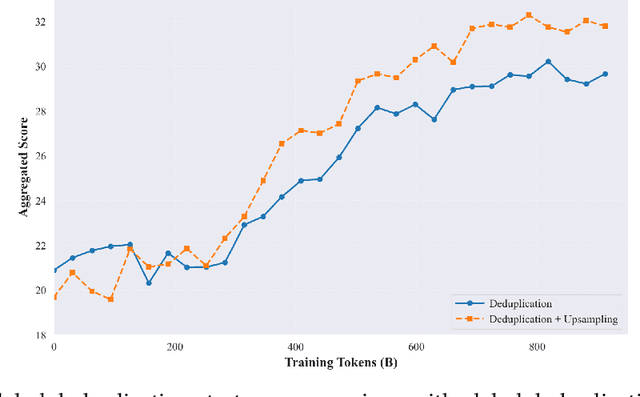
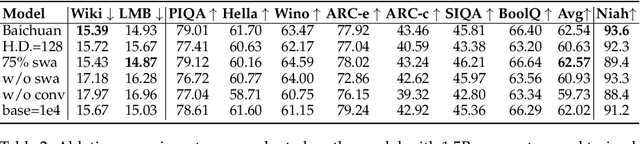
The current generation of large language models (LLMs) is typically designed for broad, general-purpose applications, while domain-specific LLMs, especially in vertical fields like medicine, remain relatively scarce. In particular, the development of highly efficient and practical LLMs for the medical domain is challenging due to the complexity of medical knowledge and the limited availability of high-quality data. To bridge this gap, we introduce Baichuan-M1, a series of large language models specifically optimized for medical applications. Unlike traditional approaches that simply continue pretraining on existing models or apply post-training to a general base model, Baichuan-M1 is trained from scratch with a dedicated focus on enhancing medical capabilities. Our model is trained on 20 trillion tokens and incorporates a range of effective training methods that strike a balance between general capabilities and medical expertise. As a result, Baichuan-M1 not only performs strongly across general domains such as mathematics and coding but also excels in specialized medical fields. We have open-sourced Baichuan-M1-14B, a mini version of our model, which can be accessed through the following links.