 Add to Chrome
 Add to Firefox
 Add to Edge
Seeing Delta Parameters as JPEG Images: Data-Free Delta Compression with Discrete Cosine Transform
Mar 09, 2025
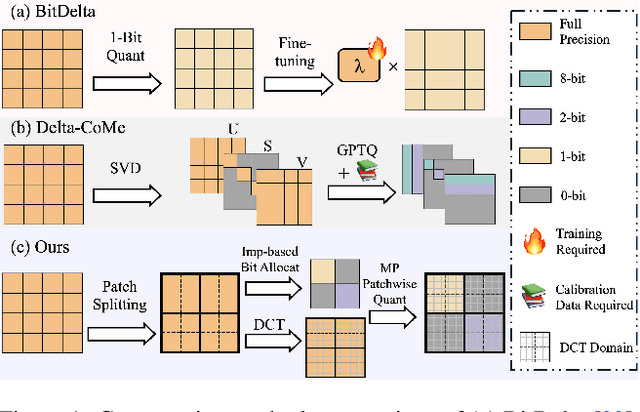
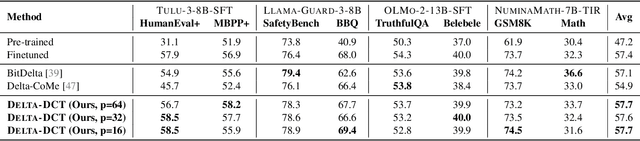
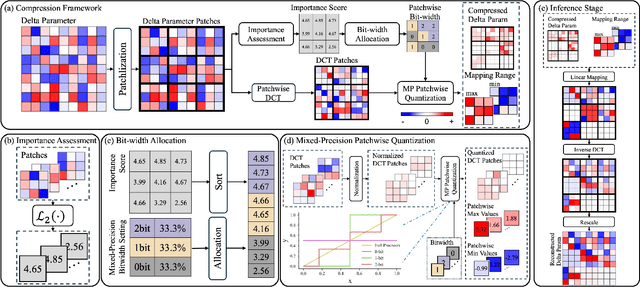
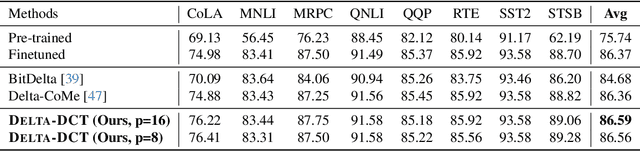
With transformer-based models and the pretrain-finetune paradigm becoming mainstream, the high storage and deployment costs of individual finetuned models on multiple tasks pose critical challenges. Delta compression attempts to lower the costs by reducing the redundancy of delta parameters (i.e., the difference between the finetuned and pre-trained model weights). However, existing methods usually face problems including data accessibility and training requirements. To tackle this issue, we introduce Delta-DCT, the first data-free delta compression method inspired by classic JPEG image compression, leveraging the Discrete Cosine Transform (DCT). We first (a) group delta parameters within a layer into patches. Then we (b) assess the importance of each patch and allocate them with different quantization bit-widths. Afterwards, we (c) convert these patches to the DCT domain and conduct quantization to each patch based on the allocated bit-width. The proposed Delta-DCT does not require any training or data calibration, while achieving performance comparable to or even surpassing original finetuned models under 1-bit equivalent delta compression ratios on different kinds of models including: (1) recently-released LLMs of different sizes from 7B to 13B, (2) relatively smaller language models including RoBERTa and T5 models, (3) variants of vision transformer models, and (4) multi-modal BEiT-3 models.

DeRS: Towards Extremely Efficient Upcycled Mixture-of-Experts Models
Mar 03, 2025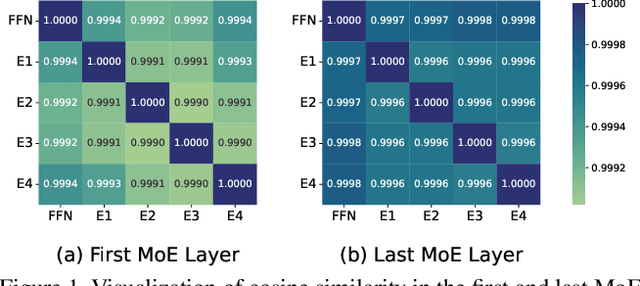
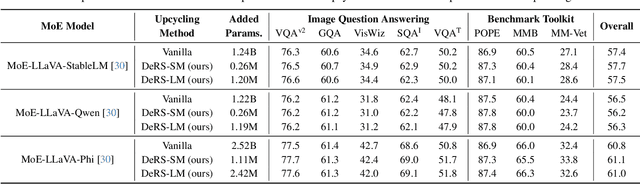
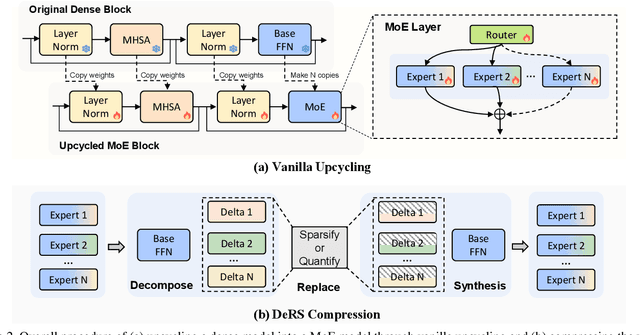
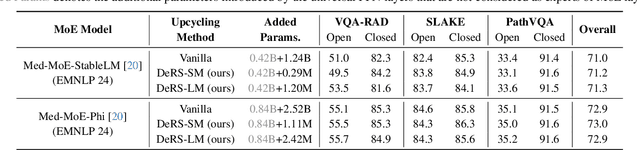
Upcycled Mixture-of-Experts (MoE) models have shown great potential in various tasks by converting the original Feed-Forward Network (FFN) layers in pre-trained dense models into MoE layers. However, these models still suffer from significant parameter inefficiency due to the introduction of multiple experts. In this work, we propose a novel DeRS (Decompose, Replace, and Synthesis) paradigm to overcome this shortcoming, which is motivated by our observations about the unique redundancy mechanisms of upcycled MoE experts. Specifically, DeRS decomposes the experts into one expert-shared base weight and multiple expert-specific delta weights, and subsequently represents these delta weights in lightweight forms. Our proposed DeRS paradigm can be applied to enhance parameter efficiency in two different scenarios, including: 1) DeRS Compression for inference stage, using sparsification or quantization to compress vanilla upcycled MoE models; and 2) DeRS Upcycling for training stage, employing lightweight sparse or low-rank matrixes to efficiently upcycle dense models into MoE models. Extensive experiments across three different tasks show that the proposed methods can achieve extreme parameter efficiency while maintaining the performance for both training and compression of upcycled MoE models.
BadRefSR: Backdoor Attacks Against Reference-based Image Super Resolution
Feb 28, 2025Reference-based image super-resolution (RefSR) represents a promising advancement in super-resolution (SR). In contrast to single-image super-resolution (SISR), RefSR leverages an additional reference image to help recover high-frequency details, yet its vulnerability to backdoor attacks has not been explored. To fill this research gap, we propose a novel attack framework called BadRefSR, which embeds backdoors in the RefSR model by adding triggers to the reference images and training with a mixed loss function. Extensive experiments across various backdoor attack settings demonstrate the effectiveness of BadRefSR. The compromised RefSR network performs normally on clean input images, while outputting attacker-specified target images on triggered input images. Our study aims to alert researchers to the potential backdoor risks in RefSR. Codes are available at https://github.com/xuefusiji/BadRefSR.
Autoregressive Medical Image Segmentation via Next-Scale Mask Prediction
Feb 28, 2025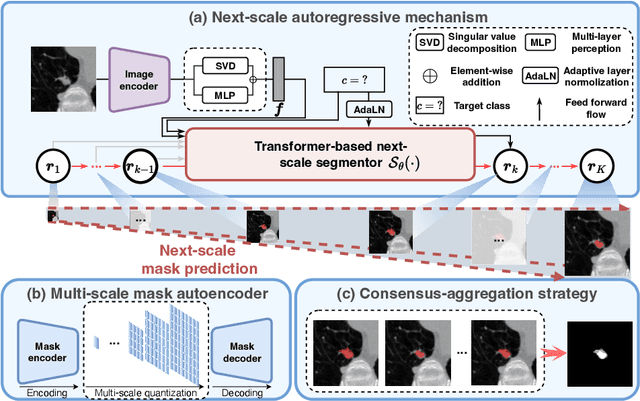
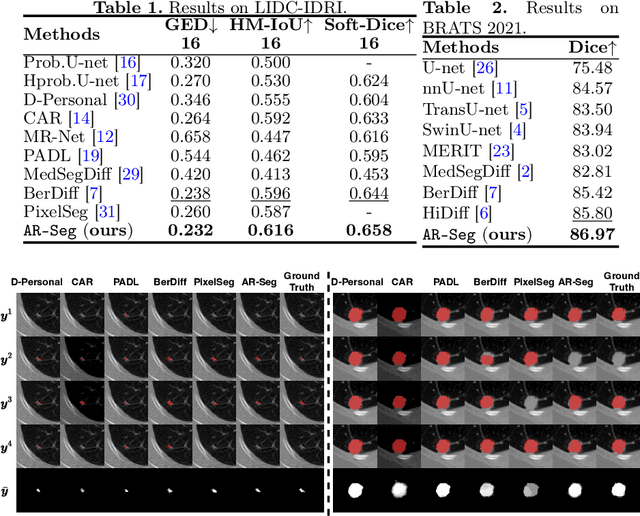
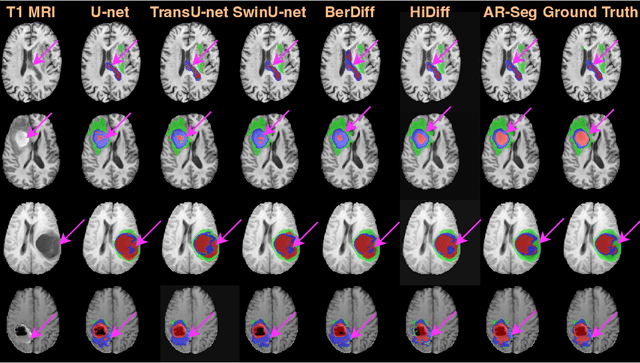

While deep learning has significantly advanced medical image segmentation, most existing methods still struggle with handling complex anatomical regions. Cascaded or deep supervision-based approaches attempt to address this challenge through multi-scale feature learning but fail to establish sufficient inter-scale dependencies, as each scale relies solely on the features of the immediate predecessor. To this end, we propose the AutoRegressive Segmentation framework via next-scale mask prediction, termed AR-Seg, which progressively predicts the next-scale mask by explicitly modeling dependencies across all previous scales within a unified architecture. AR-Seg introduces three innovations: (1) a multi-scale mask autoencoder that quantizes the mask into multi-scale token maps to capture hierarchical anatomical structures, (2) a next-scale autoregressive mechanism that progressively predicts next-scale masks to enable sufficient inter-scale dependencies, and (3) a consensus-aggregation strategy that combines multiple sampled results to generate a more accurate mask, further improving segmentation robustness. Extensive experimental results on two benchmark datasets with different modalities demonstrate that AR-Seg outperforms state-of-the-art methods while explicitly visualizing the intermediate coarse-to-fine segmentation process.
Multi-Level Decoupled Relational Distillation for Heterogeneous Architectures
Feb 10, 2025Heterogeneous distillation is an effective way to transfer knowledge from cross-architecture teacher models to student models. However, existing heterogeneous distillation methods do not take full advantage of the dark knowledge hidden in the teacher's output, limiting their performance.To this end, we propose a novel framework named Multi-Level Decoupled Relational Knowledge Distillation (MLDR-KD) to unleash the potential of relational distillation in heterogeneous distillation. Concretely, we first introduce Decoupled Finegrained Relation Alignment (DFRA) in both logit and feature levels to balance the trade-off between distilled dark knowledge and the confidence in the correct category of the heterogeneous teacher model. Then, Multi-Scale Dynamic Fusion (MSDF) module is applied to dynamically fuse the projected logits of multiscale features at different stages in student model, further improving performance of our method in feature level. We verify our method on four architectures (CNNs, Transformers, MLPs and Mambas), two datasets (CIFAR-100 and Tiny-ImageNet). Compared with the best available method, our MLDR-KD improves student model performance with gains of up to 4.86% on CIFAR-100 and 2.78% on Tiny-ImageNet datasets respectively, showing robustness and generality in heterogeneous distillation. Code will be released soon.
Three-Dimensional Sparse Random Mode Decomposition for Mode Disentangling with Crossover Instantaneous Frequencies
Jan 25, 2025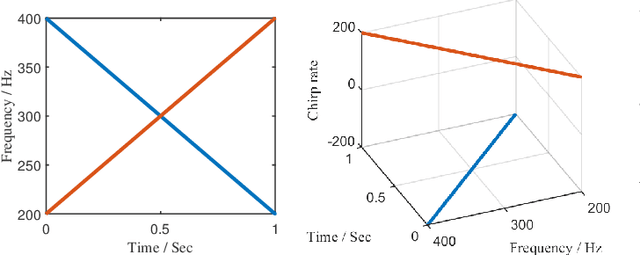
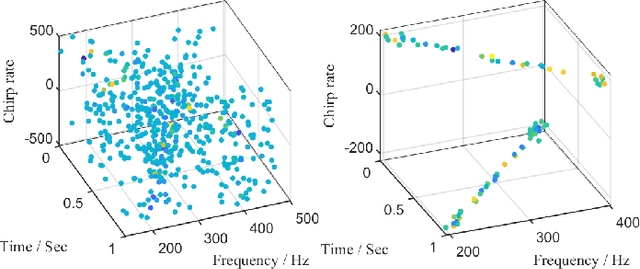
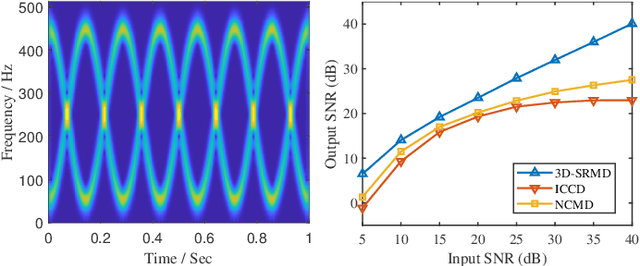
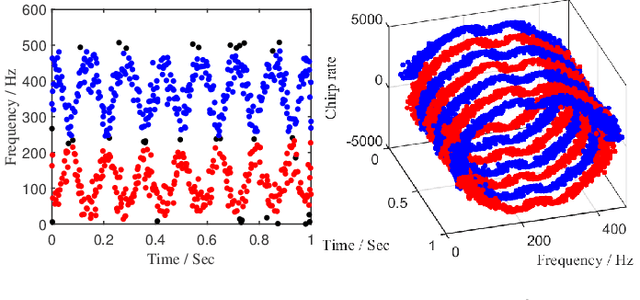
Sparse random mode decomposition (SRMD) is a novel algorithm that constructs a random time-frequency feature space to sparsely approximate spectrograms, effectively separating modes. However, it fails to distinguish adjacent or overlapped frequency components, especially, those with crossover instantaneous frequencies. To address this limitation, an enhanced version, termed three-dimensional SRMD (3D-SRMD), is proposed in this letter. In 3D-SRMD, the random features are lifted from a two-dimensional space to a three-dimensional (3D) space by introducing one extra chirp rate axis. This enhancement effectively disentangles the frequency components overlapped in the low dimension. Additionally, a novel random feature generation strategy is designed to improve the separation accuracy of 3D-SRMD by combining the 3D ridge detection method. Finally, numerical experiments on both simulated and real-world signals demonstrate the effectiveness of our method.
Addressing Domain Shift via Imbalance-Aware Domain Adaptation in Embryo Development Assessment
Jan 09, 2025Deep learning models in medical imaging face dual challenges: domain shift, where models perform poorly when deployed in settings different from their training environment, and class imbalance, where certain disease conditions are naturally underrepresented. We present Imbalance-Aware Domain Adaptation (IADA), a novel framework that simultaneously tackles both challenges through three key components: (1) adaptive feature learning with class-specific attention mechanisms, (2) balanced domain alignment with dynamic weighting, and (3) adaptive threshold optimization. Our theoretical analysis establishes convergence guarantees and complexity bounds. Through extensive experiments on embryo development assessment across four imaging modalities, IADA demonstrates significant improvements over existing methods, achieving up to 25.19\% higher accuracy while maintaining balanced performance across classes. In challenging scenarios with low-quality imaging systems, IADA shows robust generalization with AUC improvements of up to 12.56\%. These results demonstrate IADA's potential for developing reliable and equitable medical imaging systems for diverse clinical settings. The code is made public available at \url{https://github.com/yinghemedical/imbalance-aware_domain_adaptation}
Dolphin: Closed-loop Open-ended Auto-research through Thinking, Practice, and Feedback
Jan 07, 2025
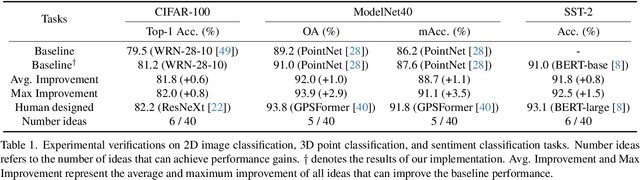

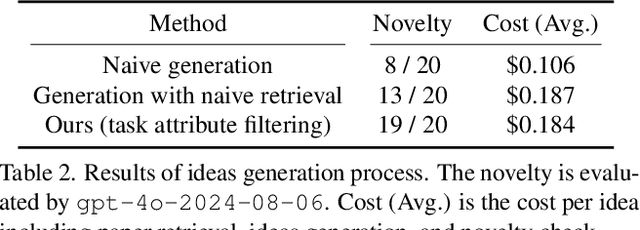
The scientific research paradigm is undergoing a profound transformation owing to the development of Artificial Intelligence (AI). Recent works demonstrate that various AI-assisted research methods can largely improve research efficiency by improving data analysis, accelerating computation, and fostering novel idea generation. To further move towards the ultimate goal (i.e., automatic scientific research), in this paper, we propose Dolphin, the first closed-loop open-ended auto-research framework to further build the entire process of human scientific research. Dolphin can generate research ideas, perform experiments, and get feedback from experimental results to generate higher-quality ideas. More specifically, Dolphin first generates novel ideas based on relevant papers which are ranked by the topic and task attributes. Then, the codes are automatically generated and debugged with the exception-traceback-guided local code structure. Finally, Dolphin automatically analyzes the results of each idea and feeds the results back to the next round of idea generation. Experiments are conducted on the benchmark datasets of different topics and results show that Dolphin can generate novel ideas continuously and complete the experiment in a loop. We highlight that Dolphin can automatically propose methods that are comparable to the state-of-the-art in some tasks such as 2D image classification and 3D point classification.
Reasoning-Enhanced Self-Training for Long-Form Personalized Text Generation
Jan 07, 2025Personalized text generation requires a unique ability of large language models (LLMs) to learn from context that they often do not encounter during their standard training. One way to encourage LLMs to better use personalized context for generating outputs that better align with the user's expectations is to instruct them to reason over the user's past preferences, background knowledge, or writing style. To achieve this, we propose Reasoning-Enhanced Self-Training for Personalized Text Generation (REST-PG), a framework that trains LLMs to reason over personal data during response generation. REST-PG first generates reasoning paths to train the LLM's reasoning abilities and then employs Expectation-Maximization Reinforced Self-Training to iteratively train the LLM based on its own high-reward outputs. We evaluate REST-PG on the LongLaMP benchmark, consisting of four diverse personalized long-form text generation tasks. Our experiments demonstrate that REST-PG achieves significant improvements over state-of-the-art baselines, with an average relative performance gain of 14.5% on the benchmark.
Accuracy Can Lie: On the Impact of Surrogate Model in Configuration Tuning
Jan 03, 2025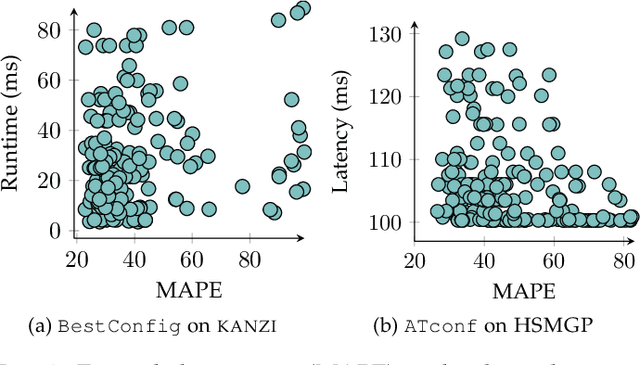
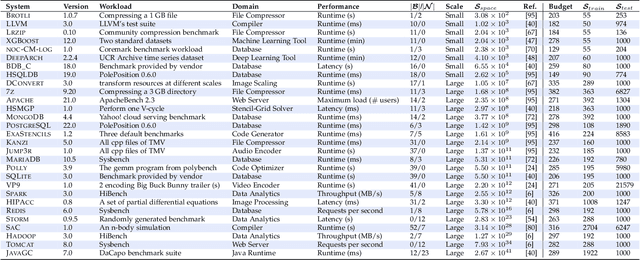
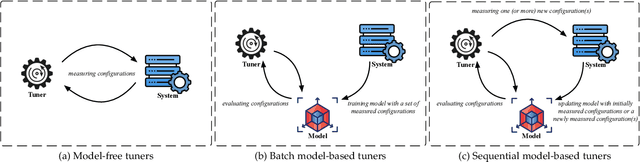

To ease the expensive measurements during configuration tuning, it is natural to build a surrogate model as the replacement of the system, and thereby the configuration performance can be cheaply evaluated. Yet, a stereotype therein is that the higher the model accuracy, the better the tuning result would be. This "accuracy is all" belief drives our research community to build more and more accurate models and criticize a tuner for the inaccuracy of the model used. However, this practice raises some previously unaddressed questions, e.g., Do those somewhat small accuracy improvements reported in existing work really matter much to the tuners? What role does model accuracy play in the impact of tuning quality? To answer those related questions, we conduct one of the largest-scale empirical studies to date-running over the period of 13 months 24*7-that covers 10 models, 17 tuners, and 29 systems from the existing works while under four different commonly used metrics, leading to 13,612 cases of investigation. Surprisingly, our key findings reveal that the accuracy can lie: there are a considerable number of cases where higher accuracy actually leads to no improvement in the tuning outcomes (up to 58% cases under certain setting), or even worse, it can degrade the tuning quality (up to 24% cases under certain setting). We also discover that the chosen models in most proposed tuners are sub-optimal and that the required % of accuracy change to significantly improve tuning quality varies according to the range of model accuracy. Deriving from the fitness landscape analysis, we provide in-depth discussions of the rationale behind, offering several lessons learned as well as insights for future opportunities. Most importantly, this work poses a clear message to the community: we should take one step back from the natural "accuracy is all" belief for model-based configuration tuning.