 Add to Chrome
 Add to Firefox
 Add to Edge
SmartDirector: Keyframe-Conditioned Cinematic Video Generation with Narrative Pacing Control
May 27, 2026
The narrative quality of a video fundamentally determines its perceptual value. Although existing video generation methods can produce visually appealing content, they predominantly rely on sparse conditioning signals such as text prompts or first/last frames, which limits precise control over narrative structure and temporal pacing. In this paper, we propose SmartDirector, a framework that enhances the narrative capacity of video generation models through multiple keyframes. SmartDirector supports flexible generation scenarios including single-shot generation, multi-shot narrative synthesis, and video extension. The framework operates in two stages: Director-Gen generates a low-resolution video conditioned on the provided keyframes, and Director-SR refines the output by exploiting high-resolution keyframes as semantic anchors to recover fine-grained details. To enable robust multi-keyframe training, we construct a data pipeline that curates single-shot and multi-shot sequences from movies. Extensive experiments demonstrate that SmartDirector substantially outperforms existing state-of-the-art approaches. We will release the code to facilitate further research.

TOPOS: High-Fidelity and Efficient Industry-Grade 3D Head Generation
May 14, 2026High-fidelity 3D head generation plays a crucial role in the film, animation and video game industries. In industrial pipelines, studios typically enforce a fixed reference topology across all head assets, as such a clean and uniform topology is a prerequisite for production-level rigging, skinning and animation. In this paper, we present TOPOS, a framework tailored for single image conditioned 3D head generation that jointly recovers geometry and appearance under such an industry-standard topology. In contrast to general 3D generative models which produce triangle meshes with inconsistent topology and numerous vertices, hindering semantic correspondence and asset-level reuse, TOPOS generates head meshes with a fixed, studio-style topology, enabling consistent vertex-level correspondence across all generated heads. To model heads under this unified topology, we proposed a novel variational autoencoder structure, termed TOPOS-VAE. Inspired by multi-model large language models (MLLMs), our TOPOS-VAE leverages the Perceiver Resampler to convert input pointclouds sampled from head meshes of diverse topologies into the target reference topology. Building upon TOPOS-VAE's structured latent space, we train a rectified flow transformer, TOPOS-DiT, to efficiently generate high-fidelity head meshes from a single image. We further present TOPOS-Texture, an end-to-end module that produces relightable UV texture maps from the same portrait image via fine-tuning a multimodal image generative model. The generated textures are spatially aligned with the underlying mesh geometry and faithfully preserve high-frequency appearance details. Extensive experiments demonstrate that TOPOS achieves state-of-the-art performance on 3D head generation, surpassing both classical face reconstruction methods and general 3D object generative models, highlighting its effectiveness for digital human creation.
MoCam: Unified Novel View Synthesis via Structured Denoising Dynamics
May 13, 2026Generative novel view synthesis faces a fundamental dilemma: geometric priors provide spatial alignment but become sparse and inaccurate under view changes, while appearance priors offer visual fidelity but lack geometric correspondence. Existing methods either propagate geometric errors throughout generation or suffer from signal conflicts when fusing both statically. We introduce MoCam, which employs structured denoising dynamics to orchestrate a coordinated progression from geometry to appearance within the diffusion process. MoCam first leverages geometric priors in early stages to anchor coarse structures and tolerate their incompleteness, then switches to appearance priors in later stages to actively correct geometric errors and refine details. This design naturally unifies static and dynamic view synthesis by temporally decoupling geometric alignment and appearance refinement within the diffusion process. Experiments demonstrate that MoCam significantly outperforms prior methods, particularly when point clouds contain severe holes or distortions, achieving robust geometry-appearance disentanglement.
Gimbal360: Differentiable Auto-Leveling for Canonicalized $360^\circ$ Panoramic Image Completion
Mar 24, 2026Diffusion models excel at 2D outpainting, but extending them to $360^\circ$ panoramic completion from unposed perspective images is challenging due to the geometric and topological mismatch between perspective projections and spherical panoramas. We present Gimbal360, a principled framework that explicitly bridges perspective observations and spherical panoramas. We introduce a Canonical Viewing Space that regularizes projective geometry and provides a consistent intermediate representation between the two domains. To anchor in-the-wild inputs to this space, we propose a Differentiable Auto-Leveling module that stabilizes feature orientation without requiring camera parameters at inference. Panoramic generation also introduces a topological challenge. Standard generative architectures assume a bounded Euclidean image plane, while Equirectangular Projection (ERP) panoramas exhibit intrinsic $S^1$ periodicity. Euclidean operations therefore break boundary continuity. We address this mismatch by enforcing topological equivariance in the latent space to preserve seamless periodic structure. To support this formulation, we introduce Horizon360, a curated large-scale dataset of gravity-aligned panoramic environments. Extensive experiments show that explicitly standardizing geometric and topological priors enables Gimbal360 to achieve state-of-the-art performance in structurally consistent $360^\circ$ scene completion.
ERNIE 5.0 Technical Report
Feb 04, 2026In this report, we introduce ERNIE 5.0, a natively autoregressive foundation model desinged for unified multimodal understanding and generation across text, image, video, and audio. All modalities are trained from scratch under a unified next-group-of-tokens prediction objective, based on an ultra-sparse mixture-of-experts (MoE) architecture with modality-agnostic expert routing. To address practical challenges in large-scale deployment under diverse resource constraints, ERNIE 5.0 adopts a novel elastic training paradigm. Within a single pre-training run, the model learns a family of sub-models with varying depths, expert capacities, and routing sparsity, enabling flexible trade-offs among performance, model size, and inference latency in memory- or time-constrained scenarios. Moreover, we systematically address the challenges of scaling reinforcement learning to unified foundation models, thereby guaranteeing efficient and stable post-training under ultra-sparse MoE architectures and diverse multimodal settings. Extensive experiments demonstrate that ERNIE 5.0 achieves strong and balanced performance across multiple modalities. To the best of our knowledge, among publicly disclosed models, ERNIE 5.0 represents the first production-scale realization of a trillion-parameter unified autoregressive model that supports both multimodal understanding and generation. To facilitate further research, we present detailed visualizations of modality-agnostic expert routing in the unified model, alongside comprehensive empirical analysis of elastic training, aiming to offer profound insights to the community.
MoCha:End-to-End Video Character Replacement without Structural Guidance
Jan 14, 2026Controllable video character replacement with a user-provided identity remains a challenging problem due to the lack of paired video data. Prior works have predominantly relied on a reconstruction-based paradigm that requires per-frame segmentation masks and explicit structural guidance (e.g., skeleton, depth). This reliance, however, severely limits their generalizability in complex scenarios involving occlusions, character-object interactions, unusual poses, or challenging illumination, often leading to visual artifacts and temporal inconsistencies. In this paper, we propose MoCha, a pioneering framework that bypasses these limitations by requiring only a single arbitrary frame mask. To effectively adapt the multi-modal input condition and enhance facial identity, we introduce a condition-aware RoPE and employ an RL-based post-training stage. Furthermore, to overcome the scarcity of qualified paired-training data, we propose a comprehensive data construction pipeline. Specifically, we design three specialized datasets: a high-fidelity rendered dataset built with Unreal Engine 5 (UE5), an expression-driven dataset synthesized by current portrait animation techniques, and an augmented dataset derived from existing video-mask pairs. Extensive experiments demonstrate that our method substantially outperforms existing state-of-the-art approaches. We will release the code to facilitate further research. Please refer to our project page for more details: orange-3dv-team.github.io/MoCha
End-to-End Video Character Replacement without Structural Guidance
Jan 13, 2026Controllable video character replacement with a user-provided identity remains a challenging problem due to the lack of paired video data. Prior works have predominantly relied on a reconstruction-based paradigm that requires per-frame segmentation masks and explicit structural guidance (e.g., skeleton, depth). This reliance, however, severely limits their generalizability in complex scenarios involving occlusions, character-object interactions, unusual poses, or challenging illumination, often leading to visual artifacts and temporal inconsistencies. In this paper, we propose MoCha, a pioneering framework that bypasses these limitations by requiring only a single arbitrary frame mask. To effectively adapt the multi-modal input condition and enhance facial identity, we introduce a condition-aware RoPE and employ an RL-based post-training stage. Furthermore, to overcome the scarcity of qualified paired-training data, we propose a comprehensive data construction pipeline. Specifically, we design three specialized datasets: a high-fidelity rendered dataset built with Unreal Engine 5 (UE5), an expression-driven dataset synthesized by current portrait animation techniques, and an augmented dataset derived from existing video-mask pairs. Extensive experiments demonstrate that our method substantially outperforms existing state-of-the-art approaches. We will release the code to facilitate further research. Please refer to our project page for more details: orange-3dv-team.github.io/MoCha
Addressing Domain Shift via Imbalance-Aware Domain Adaptation in Embryo Development Assessment
Jan 09, 2025Deep learning models in medical imaging face dual challenges: domain shift, where models perform poorly when deployed in settings different from their training environment, and class imbalance, where certain disease conditions are naturally underrepresented. We present Imbalance-Aware Domain Adaptation (IADA), a novel framework that simultaneously tackles both challenges through three key components: (1) adaptive feature learning with class-specific attention mechanisms, (2) balanced domain alignment with dynamic weighting, and (3) adaptive threshold optimization. Our theoretical analysis establishes convergence guarantees and complexity bounds. Through extensive experiments on embryo development assessment across four imaging modalities, IADA demonstrates significant improvements over existing methods, achieving up to 25.19\% higher accuracy while maintaining balanced performance across classes. In challenging scenarios with low-quality imaging systems, IADA shows robust generalization with AUC improvements of up to 12.56\%. These results demonstrate IADA's potential for developing reliable and equitable medical imaging systems for diverse clinical settings. The code is made public available at \url{https://github.com/yinghemedical/imbalance-aware_domain_adaptation}
Efficient optimization-based trajectory planning
Dec 29, 2023
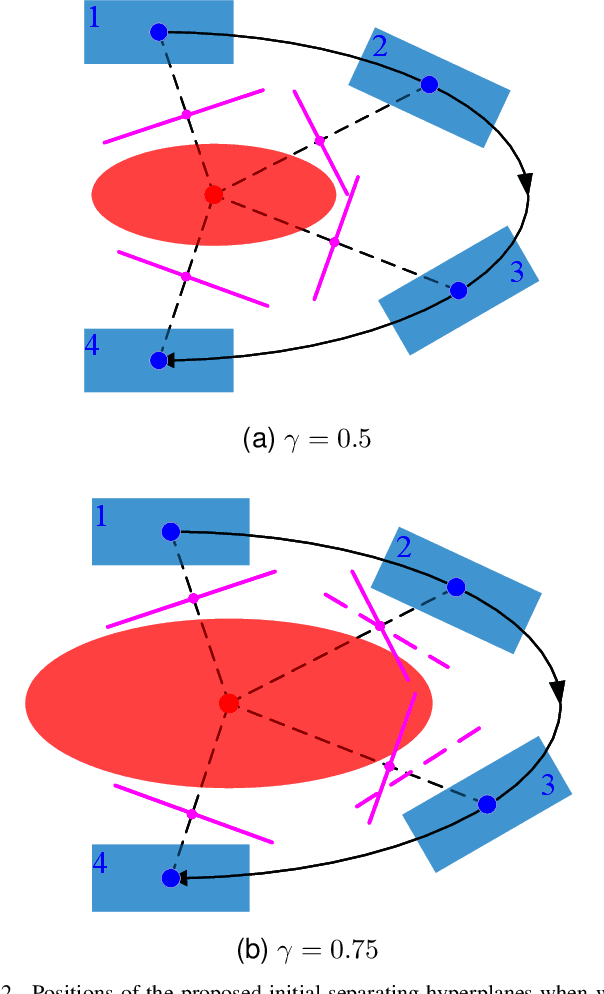
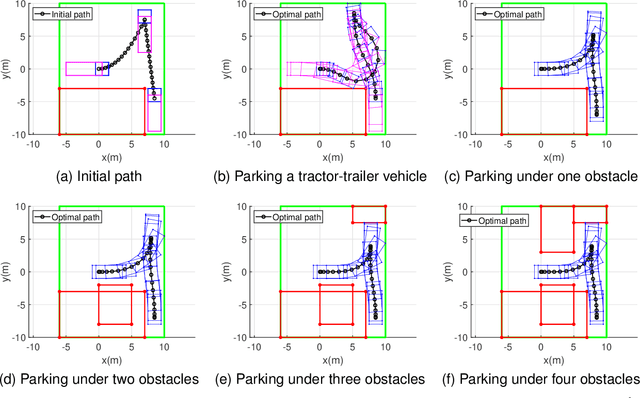

This study proposes a unified optimization-based planning framework that addresses the precise and efficient navigation of a controlled object within a constrained region, while contending with obstacles. We focus on handling two collision avoidance problems, i.e., the object not colliding with obstacles and not colliding with boundaries of the constrained region. The object or obstacle is denoted as a union of convex polytopes and ellipsoids, and the constrained region is denoted as an intersection of such convex sets. Using these representations, collision avoidance can be approached by formulating explicit constraints that separate two convex sets, or ensure that a convex set is contained in another convex set, referred to as separating constraints and containing constraints, respectively. We propose to use the hyperplane separation theorem to formulate differentiable separating constraints, and utilize the S-procedure and geometrical methods to formulate smooth containing constraints. We state that compared to the state of the art, the proposed formulations allow a considerable reduction in nonlinear program size and geometry-based initialization in auxiliary variables used to formulate collision avoidance constraints. Finally, the efficacy of the proposed unified planning framework is evaluated in two contexts, autonomous parking in tractor-trailer vehicles and overtaking on curved lanes. The results in both cases exhibit an improved computational performance compared to existing methods.
Efficient collision avoidance for autonomous vehicles in polygonal domains
Aug 17, 2023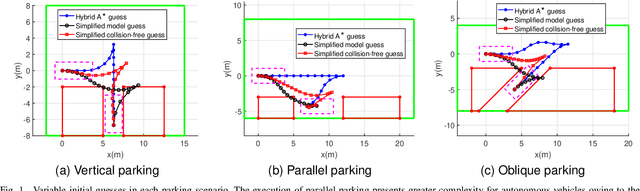
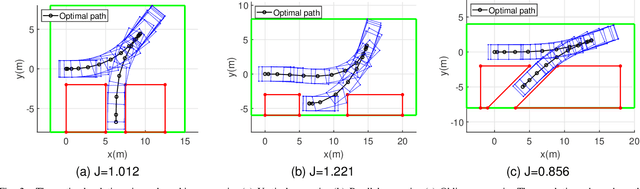
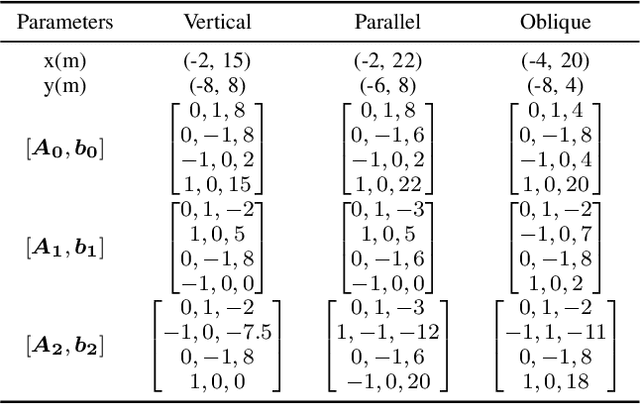
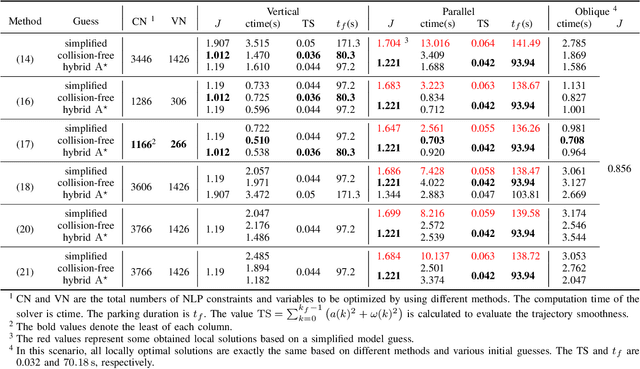
This research focuses on trajectory planning problems for autonomous vehicles utilizing numerical optimal control techniques. The study reformulates the constrained optimization problem into a nonlinear programming problem, incorporating explicit collision avoidance constraints. We present three novel, exact formulations to describe collision constraints. The first formulation is derived from a proposition concerning the separation of a point and a convex set. We prove the separating proposition through De Morgan's laws. Then, leveraging the hyperplane separation theorem we propose two efficient reformulations. Compared with the existing dual formulations and the first formulation, they significantly reduce the number of auxiliary variables to be optimized and inequality constraints within the nonlinear programming problem. Finally, the efficacy of the proposed formulations is demonstrated in the context of typical autonomous parking scenarios compared with state of the art. For generality, we design three initial guesses to assess the computational effort required for convergence to solutions when using the different collision formulations. The results illustrate that the scheme employing De Morgan's laws performs equally well with those utilizing dual formulations, while the other two schemes based on hyperplane separation theorem exhibit the added benefit of requiring lower computational resources.