 Add to Chrome
 Add to Firefox
 Add to Edge
Eliminating Cross-modal Conflicts in BEV Space for LiDAR-Camera 3D Object Detection
Mar 12, 2024
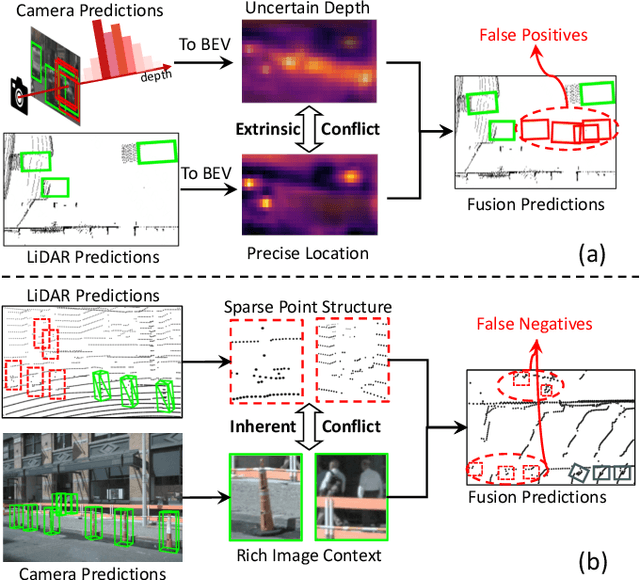
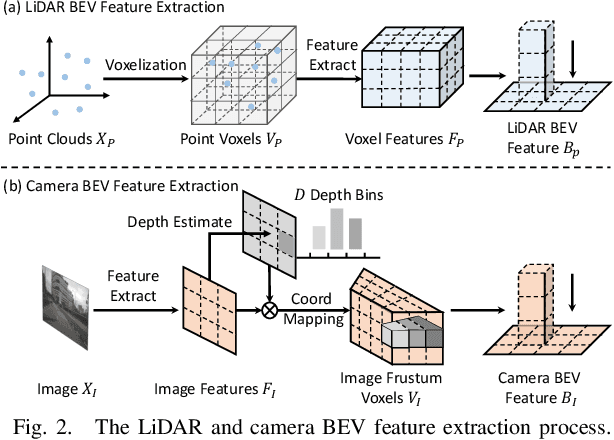


Recent 3D object detectors typically utilize multi-sensor data and unify multi-modal features in the shared bird's-eye view (BEV) representation space. However, our empirical findings indicate that previous methods have limitations in generating fusion BEV features free from cross-modal conflicts. These conflicts encompass extrinsic conflicts caused by BEV feature construction and inherent conflicts stemming from heterogeneous sensor signals. Therefore, we propose a novel Eliminating Conflicts Fusion (ECFusion) method to explicitly eliminate the extrinsic/inherent conflicts in BEV space and produce improved multi-modal BEV features. Specifically, we devise a Semantic-guided Flow-based Alignment (SFA) module to resolve extrinsic conflicts via unifying spatial distribution in BEV space before fusion. Moreover, we design a Dissolved Query Recovering (DQR) mechanism to remedy inherent conflicts by preserving objectness clues that are lost in the fusion BEV feature. In general, our method maximizes the effective information utilization of each modality and leverages inter-modal complementarity. Our method achieves state-of-the-art performance in the highly competitive nuScenes 3D object detection dataset. The code is released at https://github.com/fjhzhixi/ECFusion.

Mask-Enhanced Segment Anything Model for Tumor Lesion Semantic Segmentation
Mar 09, 2024Tumor lesion segmentation on CT or MRI images plays a critical role in cancer diagnosis and treatment planning. Considering the inherent differences in tumor lesion segmentation data across various medical imaging modalities and equipment, integrating medical knowledge into the Segment Anything Model (SAM) presents promising capability due to its versatility and generalization potential. Recent studies have attempted to enhance SAM with medical expertise by pre-training on large-scale medical segmentation datasets. However, challenges still exist in 3D tumor lesion segmentation owing to tumor complexity and the imbalance in foreground and background regions. Therefore, we introduce Mask-Enhanced SAM (M-SAM), an innovative architecture tailored for 3D tumor lesion segmentation. We propose a novel Mask-Enhanced Adapter (MEA) within M-SAM that enriches the semantic information of medical images with positional data from coarse segmentation masks, facilitating the generation of more precise segmentation masks. Furthermore, an iterative refinement scheme is implemented in M-SAM to refine the segmentation masks progressively, leading to improved performance. Extensive experiments on seven tumor lesion segmentation datasets indicate that our M-SAM not only achieves high segmentation accuracy but also exhibits robust generalization.
SAFDNet: A Simple and Effective Network for Fully Sparse 3D Object Detection
Mar 09, 2024LiDAR-based 3D object detection plays an essential role in autonomous driving. Existing high-performing 3D object detectors usually build dense feature maps in the backbone network and prediction head. However, the computational costs introduced by the dense feature maps grow quadratically as the perception range increases, making these models hard to scale up to long-range detection. Some recent works have attempted to construct fully sparse detectors to solve this issue; nevertheless, the resulting models either rely on a complex multi-stage pipeline or exhibit inferior performance. In this work, we propose SAFDNet, a straightforward yet highly effective architecture, tailored for fully sparse 3D object detection. In SAFDNet, an adaptive feature diffusion strategy is designed to address the center feature missing problem. We conducted extensive experiments on Waymo Open, nuScenes, and Argoverse2 datasets. SAFDNet performed slightly better than the previous SOTA on the first two datasets but much better on the last dataset, which features long-range detection, verifying the efficacy of SAFDNet in scenarios where long-range detection is required. Notably, on Argoverse2, SAFDNet surpassed the previous best hybrid detector HEDNet by 2.6% mAP while being 2.1x faster, and yielded 2.1% mAP gains over the previous best sparse detector FSDv2 while being 1.3x faster. The code will be available at https://github.com/zhanggang001/HEDNet.
Realistic Rainy Weather Simulation for LiDARs in CARLA Simulator
Dec 20, 2023


Employing data augmentation methods to enhance perception performance in adverse weather has attracted considerable attention recently. Most of the LiDAR augmentation methods post-process the existing dataset by physics-based models or machine-learning methods. However, due to the limited environmental annotations and the fixed vehicle trajectories in the existing dataset, it is challenging to edit the scene and expand the diversity of traffic flow and scenario. To this end, we propose a simulator-based physical modeling approach to augment LiDAR data in rainy weather in order to improve the perception performance of LiDAR in this scenario. We complete the modeling task of the rainy weather in the CARLA simulator and establish a pipeline for LiDAR data collection. In particular, we pay special attention to the spray and splash rolled up by the wheels of surrounding vehicles in rain and complete the simulation of this special scenario through the Spray Emitter method we developed. In addition, we examine the influence of different weather conditions on the intensity of the LiDAR echo, develop a prediction network for the intensity of the LiDAR echo, and complete the simulation of 4-feat LiDAR point cloud data. In the experiment, we observe that the model augmented by the synthetic data improves the object detection task's performance in the rainy sequence of the Waymo Open Dataset. Both the code and the dataset will be made publicly available at https://github.com/PJLab-ADG/PCSim#rainypcsim.
Transferring CLIP's Knowledge into Zero-Shot Point Cloud Semantic Segmentation
Dec 12, 2023
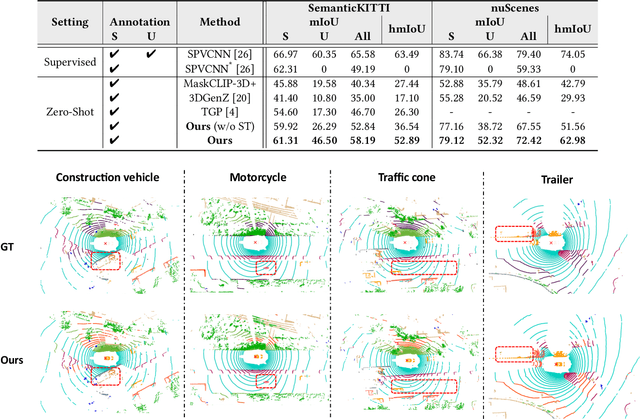

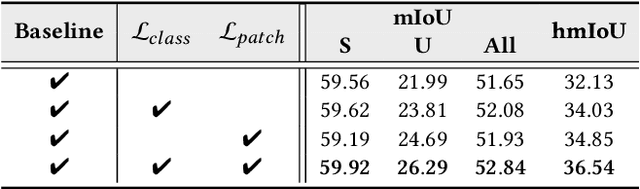
Traditional 3D segmentation methods can only recognize a fixed range of classes that appear in the training set, which limits their application in real-world scenarios due to the lack of generalization ability. Large-scale visual-language pre-trained models, such as CLIP, have shown their generalization ability in the zero-shot 2D vision tasks, but are still unable to be applied to 3D semantic segmentation directly. In this work, we focus on zero-shot point cloud semantic segmentation and propose a simple yet effective baseline to transfer the visual-linguistic knowledge implied in CLIP to point cloud encoder at both feature and output levels. Both feature-level and output-level alignments are conducted between 2D and 3D encoders for effective knowledge transfer. Concretely, a Multi-granularity Cross-modal Feature Alignment (MCFA) module is proposed to align 2D and 3D features from global semantic and local position perspectives for feature-level alignment. For the output level, per-pixel pseudo labels of unseen classes are extracted using the pre-trained CLIP model as supervision for the 3D segmentation model to mimic the behavior of the CLIP image encoder. Extensive experiments are conducted on two popular benchmarks of point cloud segmentation. Our method outperforms significantly previous state-of-the-art methods under zero-shot setting (+29.2% mIoU on SemanticKITTI and 31.8% mIoU on nuScenes), and further achieves promising results in the annotation-free point cloud semantic segmentation setting, showing its great potential for label-efficient learning.
Customize your NeRF: Adaptive Source Driven 3D Scene Editing via Local-Global Iterative Training
Dec 04, 2023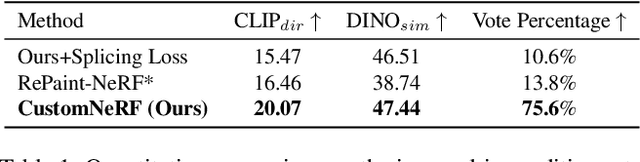
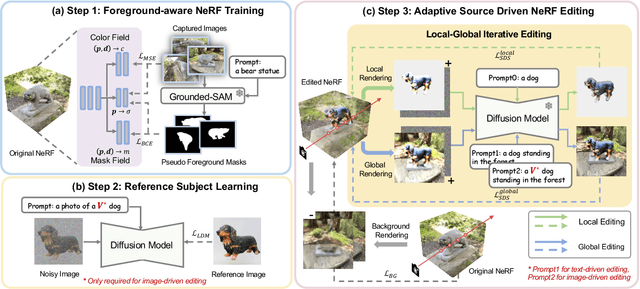
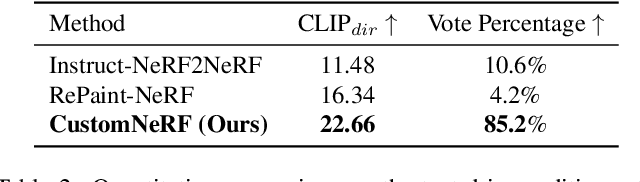
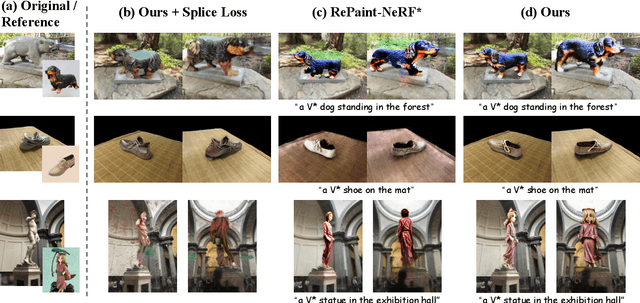
In this paper, we target the adaptive source driven 3D scene editing task by proposing a CustomNeRF model that unifies a text description or a reference image as the editing prompt. However, obtaining desired editing results conformed with the editing prompt is nontrivial since there exist two significant challenges, including accurate editing of only foreground regions and multi-view consistency given a single-view reference image. To tackle the first challenge, we propose a Local-Global Iterative Editing (LGIE) training scheme that alternates between foreground region editing and full-image editing, aimed at foreground-only manipulation while preserving the background. For the second challenge, we also design a class-guided regularization that exploits class priors within the generation model to alleviate the inconsistency problem among different views in image-driven editing. Extensive experiments show that our CustomNeRF produces precise editing results under various real scenes for both text- and image-driven settings.
LLMs as Visual Explainers: Advancing Image Classification with Evolving Visual Descriptions
Nov 20, 2023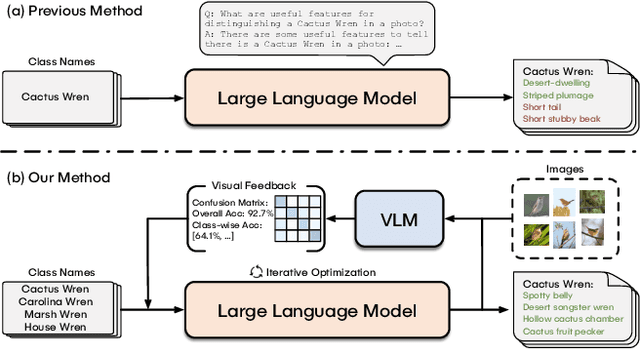
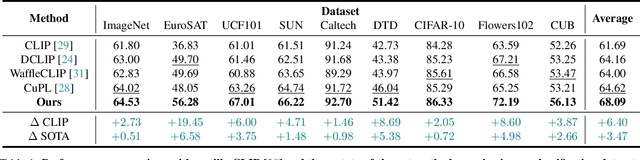
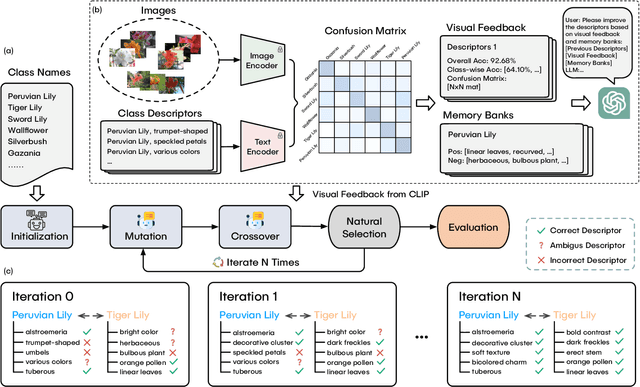

Vision-language models (VLMs) offer a promising paradigm for image classification by comparing the similarity between images and class embeddings. A critical challenge lies in crafting precise textual representations for class names. While previous studies have leveraged recent advancements in large language models (LLMs) to enhance these descriptors, their outputs often suffer from ambiguity and inaccuracy. We identify two primary causes: 1) The prevalent reliance on textual interactions with LLMs, leading to a mismatch between the generated text and the visual content in VLMs' latent space - a phenomenon we term the "explain without seeing" dilemma. 2) The oversight of the inter-class relationships, resulting in descriptors that fail to differentiate similar classes effectively. To address these issues, we propose a novel image classification framework combining VLMs with LLMs, named Iterative Optimization with Visual Feedback. In particular, our method develops an LLM-based agent, employing an evolutionary optimization strategy to refine class descriptors. Crucially, we incorporate visual feedback from VLM classification metrics, thereby guiding the optimization process with concrete visual data. Our method leads to improving accuracy on a wide range of image classification benchmarks, with 3.47\% average gains over state-of-the-art methods. We also highlight the resulting descriptions serve as explainable and robust features that can consistently improve the performance across various backbone models.
Octavius: Mitigating Task Interference in MLLMs via MoE
Nov 05, 2023Recent studies have demonstrated Large Language Models (LLMs) can extend their zero-shot generalization capabilities to multimodal learning through instruction tuning. As more modalities and downstream tasks are introduced, negative conflicts and interference may have a worse impact on performance. While this phenomenon has been overlooked in previous work, we propose a novel and extensible framework, called \mname, for comprehensive studies and experimentation on multimodal learning with Multimodal Large Language Models (MLLMs). Specifically, we combine the well-known Mixture-of-Experts (MoE) and one of the representative PEFT techniques, \emph{i.e.,} LoRA, designing a novel LLM-based decoder, called LoRA-MoE, for multimodal learning. The experimental results (about 20\% improvement) have shown the effectiveness and versatility of our design in various 2D and 3D downstream tasks. Code and corresponding dataset will be available soon.
Enriching Phrases with Coupled Pixel and Object Contexts for Panoptic Narrative Grounding
Nov 02, 2023Panoptic narrative grounding (PNG) aims to segment things and stuff objects in an image described by noun phrases of a narrative caption. As a multimodal task, an essential aspect of PNG is the visual-linguistic interaction between image and caption. The previous two-stage method aggregates visual contexts from offline-generated mask proposals to phrase features, which tend to be noisy and fragmentary. The recent one-stage method aggregates only pixel contexts from image features to phrase features, which may incur semantic misalignment due to lacking object priors. To realize more comprehensive visual-linguistic interaction, we propose to enrich phrases with coupled pixel and object contexts by designing a Phrase-Pixel-Object Transformer Decoder (PPO-TD), where both fine-grained part details and coarse-grained entity clues are aggregated to phrase features. In addition, we also propose a PhraseObject Contrastive Loss (POCL) to pull closer the matched phrase-object pairs and push away unmatched ones for aggregating more precise object contexts from more phrase-relevant object tokens. Extensive experiments on the PNG benchmark show our method achieves new state-of-the-art performance with large margins.
DUSA: Decoupled Unsupervised Sim2Real Adaptation for Vehicle-to-Everything Collaborative Perception
Oct 12, 2023Vehicle-to-Everything (V2X) collaborative perception is crucial for autonomous driving. However, achieving high-precision V2X perception requires a significant amount of annotated real-world data, which can always be expensive and hard to acquire. Simulated data have raised much attention since they can be massively produced at an extremely low cost. Nevertheless, the significant domain gap between simulated and real-world data, including differences in sensor type, reflectance patterns, and road surroundings, often leads to poor performance of models trained on simulated data when evaluated on real-world data. In addition, there remains a domain gap between real-world collaborative agents, e.g. different types of sensors may be installed on autonomous vehicles and roadside infrastructures with different extrinsics, further increasing the difficulty of sim2real generalization. To take full advantage of simulated data, we present a new unsupervised sim2real domain adaptation method for V2X collaborative detection named Decoupled Unsupervised Sim2Real Adaptation (DUSA). Our new method decouples the V2X collaborative sim2real domain adaptation problem into two sub-problems: sim2real adaptation and inter-agent adaptation. For sim2real adaptation, we design a Location-adaptive Sim2Real Adapter (LSA) module to adaptively aggregate features from critical locations of the feature map and align the features between simulated data and real-world data via a sim/real discriminator on the aggregated global feature. For inter-agent adaptation, we further devise a Confidence-aware Inter-agent Adapter (CIA) module to align the fine-grained features from heterogeneous agents under the guidance of agent-wise confidence maps. Experiments demonstrate the effectiveness of the proposed DUSA approach on unsupervised sim2real adaptation from the simulated V2XSet dataset to the real-world DAIR-V2X-C dataset.