 Add to Chrome
 Add to Firefox
 Add to Edge
Hand-Object Interaction in the Age of Large Foundation Models:Reconstruction, Generation, and Embodied Transfer
Jul 30, 2026
Hand-object interaction (HOI) modeling remains challenging because it requires joint reasoning about hand articulation, object geometry, contact, semantics, and dynamics under severe visual uncertainty. Foundation models introduce transferable prior knowledge learned from large-scale cross-domain data, offering new ways to address these challenges beyond task-specific data and models. However, the rapidly growing literature remains fragmented, and existing studies typically describe these methods simply as ``using large models'' without systematically characterizing what knowledge is introduced, where it enters the HOI pipeline, or which HOI uncertainty it helps reduce. This survey presents the first systematic review of foundation-model priors for HOI. We organize the literature into six HOI tasks spanning reconstruction and generation. More importantly, we establish a taxonomy of eight foundation-model sub-priors grouped into geometric, semantic, and visual families. Geometric priors encompass shape retrieval, shape reconstruction, and spatial reconstruction; semantic priors include semantic grounding and language reasoning; and visual priors cover visual representation, image generation, and video generation. Based on this taxonomy, we systematically analyze how different priors are represented, injected, and adapted across HOI pipelines and tasks. Beyond how foundation models empower HOI, we further examine how HOI-derived knowledge is used in robot learning, including human-data pretraining, human-to-robot skill transfer, and HOI-to-robot data generation. Finally, we summarize datasets and evaluation protocols, and discuss limitations and future directions toward more generalizable HOI systems. To support long-term progress, we curate a live repository that continuously aggregates emerging methods and benchmarks.

KAT-Coder-V2.5 Technical Report
Jul 06, 2026We present KAT-Coder-V2.5, a coding-focused agentic model trained to act autonomously inside real, executable repositories rather than as a single-turn code generator. Its capability is bottlenecked less by model scale than by the scarcity of reproducible environments, verifiable rewards, and high-value trajectories, which we address with an end-to-end agentic post-training framework. AutoBuilder reconstructs multilingual repositories into sandboxed environments with fail-to-pass and pass-to-pass verification at scale, from which we regenerate self-contained task specifications, recover near-miss trajectories, and distill supervision through process-aware filtering, while KwaiClawEnv synthesizes large-scale tool-use trajectories from executable services and real task seeds. We further scale reinforcement learning with harness randomization, a reliability-hardened sandbox, an asymmetric actor--critic PPO with hindsight-augmented value estimation, and a harness-oriented reward framework, and unify SWE, Agent-Claw, and WebCoding experts via Multi-Teacher On-Policy Distillation. Across six software-engineering and agentic benchmarks, KAT-Coder-V2.5 delivers the best agentic tool-use result on PinchBench and ranks second only to the frontier Opus 4.8 on repository-level software engineering. Our service is available at https://streamlake.com/product/kat-coder.
CubifyGS: Object-Centric 3D Gaussian Splatting for Lifelong Dynamic Scene Maintenance
Jun 27, 2026Lifelong scene mapping under rigid object rearrangement remains a fundamental challenge in robotics. While 3D Gaussian Splatting (3DGS) enables high-fidelity modeling, primitive-level updates often cause persistent ghosting and slow recovery. We propose CubifyGS, an object-level mapping framework that shifts dynamic maintenance from passive re-optimization to active asset management. CubifyGS models movable instances as reusable Gaussian assets, detects object appearance and disappearance, and updates maps through asset retrieval, rigid transformation, and explicit pruning rather than reconstruction from scratch. To address geometric voids and local photometric mismatch after such edits, we further propose an event-triggered adaptive optimization strategy that focuses computation on affected regions. We validate our approach on a newly constructed high-fidelity dynamic benchmark, demonstrating that CubifyGS improves artifact suppression and maintenance efficiency over representative reproducible baselines in the evaluated object-rearrangement setting.
AgentX: Towards Agent-Driven Self-Iteration of Industrial Recommender Systems
Jun 25, 2026Recommendation algorithm iteration is moving from an artisanal, engineer-bound process toward an industrialized research loop, but this transition remains blocked by a structural execution bottleneck: the idea-to-launch cycle still depends on human engineers to generate hypotheses, modify production code, launch A/B experiments, and attribute online results. Innovation therefore scales linearly with headcount rather than compounding with evidence, compute, and accumulated experimental knowledge. We present AgentX, a production-deployed multi-agent system that fundamentally restructures this production function. AgentX operates as a self-evolving development engine: it autonomously generates, implements, evaluates, and learns from recommendation experiments at a scale and pace that no manual workflow can sustain. The system orchestrates four tightly coupled stages in a closed loop. A Brainstorm Agent synthesizes evidence from historical experiments, system architecture, data analysis, and external research into ranked, executable proposals. A Developing Agent translates each proposal into production-ready code through repository-grounded generation and multi-dimensional reliability verification. An Evaluation Agent conducts safe online rollout with guardrail-vetoed A/B judgment, converting both successes and failures into structured knowledge assets. A Harness Evolution layer (SGPO) then distills execution trajectories into semantic-gradient updates that continuously sharpen the agents themselves -- making the system not merely automated, but self-improving.
Automated 3D-GS Registration and Fusion via Skeleton Alignment and Gaussian-Adaptive Features
Jul 28, 2025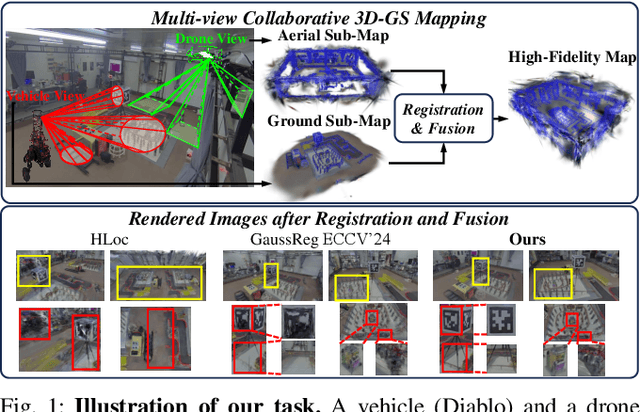
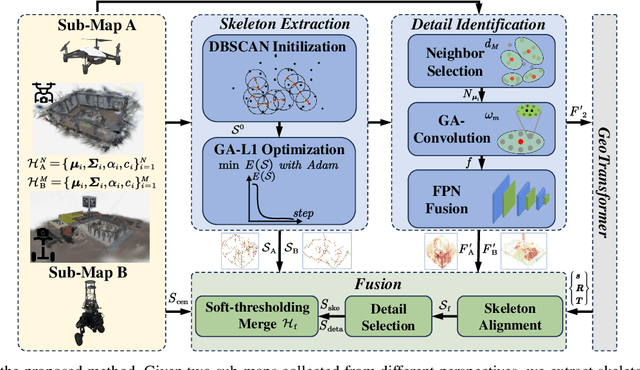
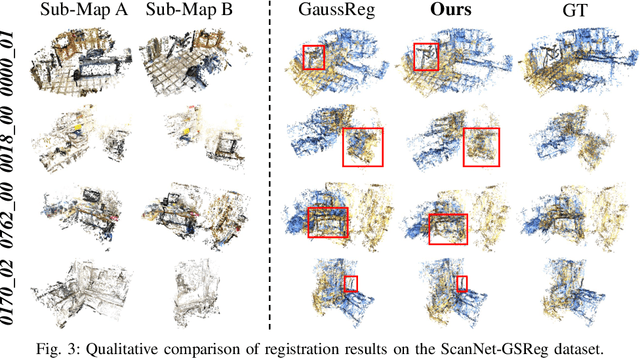
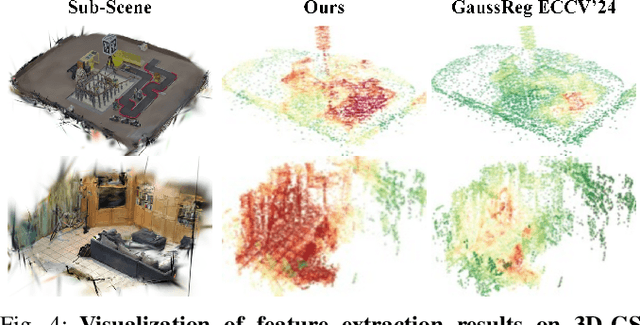
In recent years, 3D Gaussian Splatting (3D-GS)-based scene representation demonstrates significant potential in real-time rendering and training efficiency. However, most existing methods primarily focus on single-map reconstruction, while the registration and fusion of multiple 3D-GS sub-maps remain underexplored. Existing methods typically rely on manual intervention to select a reference sub-map as a template and use point cloud matching for registration. Moreover, hard-threshold filtering of 3D-GS primitives often degrades rendering quality after fusion. In this paper, we present a novel approach for automated 3D-GS sub-map alignment and fusion, eliminating the need for manual intervention while enhancing registration accuracy and fusion quality. First, we extract geometric skeletons across multiple scenes and leverage ellipsoid-aware convolution to capture 3D-GS attributes, facilitating robust scene registration. Second, we introduce a multi-factor Gaussian fusion strategy to mitigate the scene element loss caused by rigid thresholding. Experiments on the ScanNet-GSReg and our Coord datasets demonstrate the effectiveness of the proposed method in registration and fusion. For registration, it achieves a 41.9\% reduction in RRE on complex scenes, ensuring more precise pose estimation. For fusion, it improves PSNR by 10.11 dB, highlighting superior structural preservation. These results confirm its ability to enhance scene alignment and reconstruction fidelity, ensuring more consistent and accurate 3D scene representation for robotic perception and autonomous navigation.
SEAS: Self-Evolving Adversarial Safety Optimization for Large Language Models
Aug 05, 2024As large language models (LLMs) continue to advance in capability and influence, ensuring their security and preventing harmful outputs has become crucial. A promising approach to address these concerns involves training models to automatically generate adversarial prompts for red teaming. However, the evolving subtlety of vulnerabilities in LLMs challenges the effectiveness of current adversarial methods, which struggle to specifically target and explore the weaknesses of these models. To tackle these challenges, we introduce the $\mathbf{S}\text{elf-}\mathbf{E}\text{volving }\mathbf{A}\text{dversarial }\mathbf{S}\text{afety }\mathbf{(SEAS)}$ optimization framework, which enhances security by leveraging data generated by the model itself. SEAS operates through three iterative stages: Initialization, Attack, and Adversarial Optimization, refining both the Red Team and Target models to improve robustness and safety. This framework reduces reliance on manual testing and significantly enhances the security capabilities of LLMs. Our contributions include a novel adversarial framework, a comprehensive safety dataset, and after three iterations, the Target model achieves a security level comparable to GPT-4, while the Red Team model shows a marked increase in attack success rate (ASR) against advanced models.
A microwave photonic prototype for concurrent radar detection and spectrum sensing over an 8 to 40 GHz bandwidth
Jun 20, 2024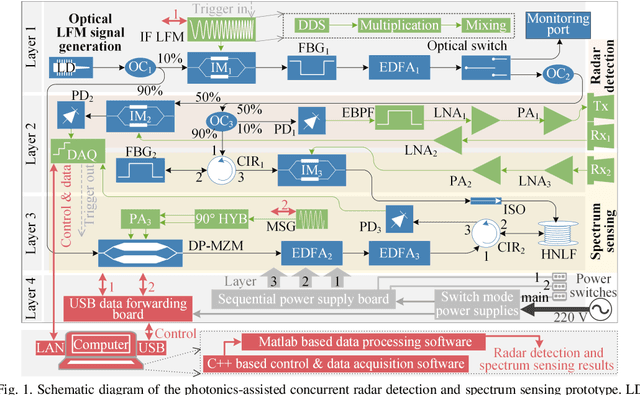
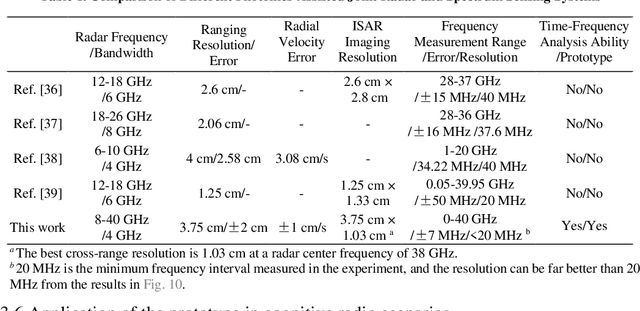
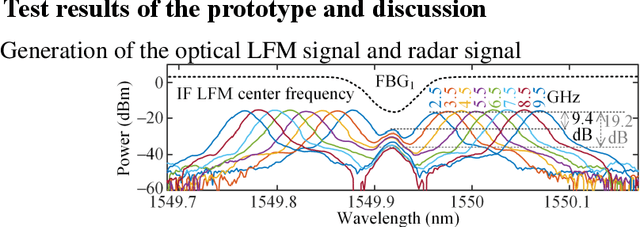

In this work, a microwave photonic prototype for concurrent radar detection and spectrum sensing is proposed, designed, built, and investigated. A direct digital synthesizer and an analog electronic circuit are integrated to generate an intermediate frequency (IF) linearly frequency-modulated (LFM) signal with a tunable center frequency from 2.5 to 9.5 GHz and an instantaneous bandwidth of 1 GHz. The IF LFM signal is converted to the optical domain via an intensity modulator and then filtered by a fiber Bragg grating (FBG) to generate only two 2nd-order optical LFM sidebands. In radar detection, the two optical LFM sidebands beat with each other to generate a frequency-and-bandwidth-quadrupled LFM signal, which is used for ranging, radial velocity measurement, and imaging. By changing the center frequency of the IF LFM signal, the radar function can be operated within 8 to 40 GHz. In spectrum sensing, one 2nd-order optical LFM sideband is selected by another FBG, which then works in conjunction with the stimulated Brillouin scattering gain spectrum to map the frequency of the signal under test to time with an instantaneous measurement bandwidth of 2 GHz. By using a frequency shift module to adjust the pump frequency, the frequency measurement range can be adjusted from 0 to 40 GHz. The prototype is comprehensively studied and tested, which is capable of achieving a range resolution of 3.75 cm, a range error of less than $\pm$ 2 cm, a radial velocity error within $\pm$ 1 cm/s, delivering clear imaging of multiple small targets, and maintaining a frequency measurement error of less than $\pm$ 7 MHz and a frequency resolution of better than 20 MHz.
Reducing the impact of non-ideal PRBS on microwave photonic random demodulators by low biasing the optical modulator via PRBS amplitude compression
Oct 26, 2023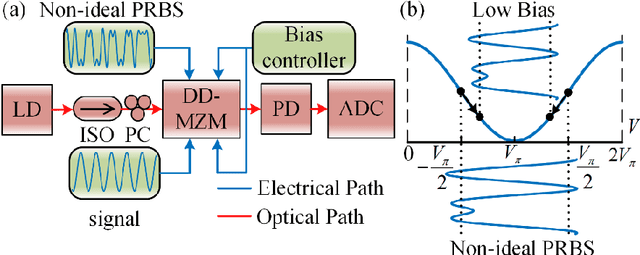
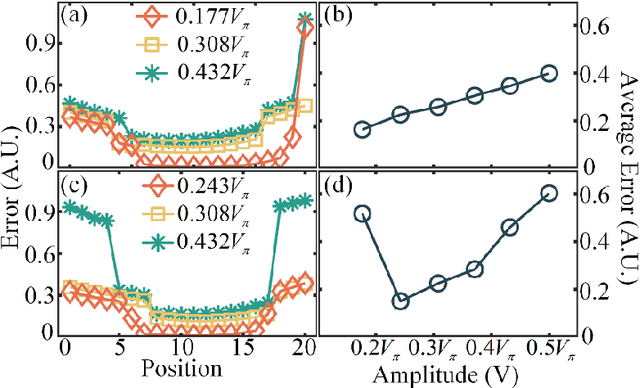
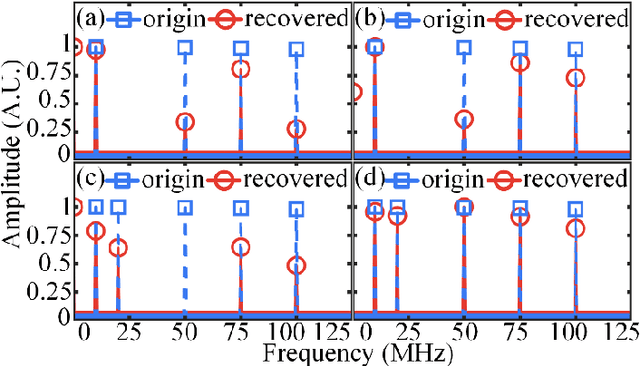
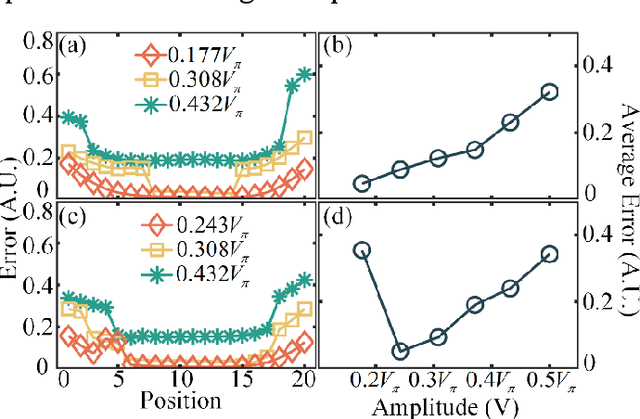
A novel method for reducing the impact of non-ideal pseudo-random binary sequence (PRBS) on microwave photonic random demodulators (RDs) in a photonics-assisted compressed sensing (CS) system is proposed. Different from the commonly used method that switches the bias point of the optical modulator in the RD between two quadrature transmission points to mix the signal to be sampled and the PRBS, this method employs a PRBS with lower amplitude to low bias the optical modulator so that the impact of non-ideal PRBS on microwave photonic RDs can be greatly reduced by compressing the amplitude of non-ideal parts of the PRBS. An experiment is performed to verify the concept. The optical modulator is properly low-biased via PRBS amplitude compression. The data rate and occupied bandwidth of the PRBS are 500 Mb/s and 1 GHz, while the multi-tone signals with a maximum frequency of 100 MHz are sampled at an equivalent sampling rate of only 50 MSa/s. The results show that the reconstruction error can be reduced by up to 85%. The proposed method can significantly reduce the requirements for PRBS in RD-based photonics-assisted CS systems, providing a feasible solution for reducing the complexity and cost of system implementation.