 Add to Chrome
 Add to Firefox
 Add to Edge
Coloring the Noise: Adversarial Sobolev Alignment for Faithful Image Super Resolution
May 22, 2026
Generative priors in Image Super-Resolution (SR) often compromise faithful restoration, we attribute this limitation to a fundamental spectral misalignment between isotropic objectives and the intrinsic natural image manifold. While Direct Preference Optimization offers a path to alignment, its reliance on spectrally flat Gaussian noise fails to distinguish authentic high-frequency details from hallucinations. To bridge this geometric gap, we propose ASASR, a theoretically grounded framework that recasts the generative flow into a Sobolev-induced Riemannian geometry by explicitly coloring the noise transition kernel to mirror natural spectral decay. Driving this geometric alignment, we integrate a parametric adversary grounded in the Riesz Representation Theorem, which synthesizes targeted negative samples equivalent to worst-case Sobolev gradients to direct optimization along the tangent space of plausible structural failures. Extensive evaluations demonstrate that ASASR outperforms leading generative baselines, particularly in preserving spectral consistency and structural fidelity, offering a robust solution that effectively mitigates artifacts.

WebCompass: Towards Multimodal Web Coding Evaluation for Code Language Models
Apr 20, 2026Large language models are rapidly evolving into interactive coding agents capable of end-to-end web coding, yet existing benchmarks evaluate only narrow slices of this capability, typically text-conditioned generation with static-correctness metrics, leaving visual fidelity, interaction quality, and codebase-level reasoning largely unmeasured. We introduce WebCompass, a multimodal benchmark that provides unified lifecycle evaluation of web engineering capability. Recognizing that real-world web coding is an iterative cycle of generation, editing, and repair, WebCompass spans three input modalities (text, image, video) and three task types (generation, editing, repair), yielding seven task categories that mirror professional workflows. Through a multi-stage, human-in-the-loop pipeline, we curate instances covering 15 generation domains, 16 editing operation types, and 11 repair defect types, each annotated at Easy/Medium/Hard levels. For evaluation, we adopt a checklist-guided LLM-as-a-Judge protocol for editing and repair, and propose a novel Agent-as-a-Judge paradigm for generation that autonomously executes generated websites in a real browser, explores interactive behaviors via the Model Context Protocol (MCP), and iteratively synthesizes targeted test cases, closely approximating human acceptance testing. We evaluate representative closed-source and open-source models and observe that: (1) closed-source models remain substantially stronger and more balanced; (2) editing and repair exhibit distinct difficulty profiles, with repair preserving interactivity better but remaining execution-challenging; (3) aesthetics is the most persistent bottleneck, especially for open-source models; and (4) framework choice materially affects outcomes, with Vue consistently challenging while React and Vanilla/HTML perform more strongly depending on task type.
KAT-Coder-V2 Technical Report
Mar 29, 2026We present KAT-Coder-V2, an agentic coding model developed by the KwaiKAT team at Kuaishou. KAT-Coder-V2 adopts a "Specialize-then-Unify" paradigm that decomposes agentic coding into five expert domains - SWE, WebCoding, Terminal, WebSearch, and General - each undergoing independent supervised fine-tuning and reinforcement learning, before being consolidated into a single model via on-policy distillation. We develop KwaiEnv, a modular infrastructure sustaining tens of thousands of concurrent sandbox instances, and scale RL training along task complexity, intent alignment, and scaffold generalization. We further propose MCLA for stabilizing MoE RL training and Tree Training for eliminating redundant computation over tree-structured trajectories with up to 6.2x speedup. KAT-Coder-V2 achieves 79.6% on SWE-bench Verified (vs. Claude Opus 4.6 at 80.8%), 88.7 on PinchBench (surpassing GLM-5 and MiniMax M2.7), ranks first across all three frontend aesthetics scenarios, and maintains strong generalist scores on Terminal-Bench Hard (46.8) and tau^2-Bench (93.9). Our model is publicly available at https://streamlake.com/product/kat-coder.
Tuning Real-World Image Restoration at Inference: A Test-Time Scaling Paradigm for Flow Matching Models
Mar 23, 2026Although diffusion-based real-world image restoration (Real-IR) has achieved remarkable progress, efficiently leveraging ultra-large-scale pre-trained text-to-image (T2I) models and fully exploiting their potential remain significant challenges. To address this issue, we propose ResFlow-Tuner, an image restoration framework based on the state-of-the-art flow matching model, FLUX.1-dev, which integrates unified multi-modal fusion (UMMF) with test-time scaling (TTS) to achieve unprecedented restoration performance. Our approach fully leverages the advantages of the Multi-Modal Diffusion Transformer (MM-DiT) architecture by encoding multi-modal conditions into a unified sequence that guides the synthesis of high-quality images. Furthermore, we introduce a training-free test-time scaling paradigm tailored for image restoration. During inference, this technique dynamically steers the denoising direction through feedback from a reward model (RM), thereby achieving significant performance gains with controllable computational overhead. Extensive experiments demonstrate that our method achieves state-of-the-art performance across multiple standard benchmarks. This work not only validates the powerful capabilities of the flow matching model in low-level vision tasks but, more importantly, proposes a novel and efficient inference-time scaling paradigm suitable for large pre-trained models.
ShiftLUT: Spatial Shift Enhanced Look-Up Tables for Efficient Image Restoration
Mar 03, 2026Look-Up Table based methods have emerged as a promising direction for efficient image restoration tasks. Recent LUT-based methods focus on improving their performance by expanding the receptive field. However, they inevitably introduce extra computational and storage overhead, which hinders their deployment in edge devices. To address this issue, we propose ShiftLUT, a novel framework that attains the largest receptive field among all LUT-based methods while maintaining high efficiency. Our key insight lies in three complementary components. First, Learnable Spatial Shift module (LSS) is introduced to expand the receptive field by applying learnable, channel-wise spatial offsets on feature maps. Second, we propose an asymmetric dual-branch architecture that allocates more computation to the information-dense branch, substantially reducing inference latency without compromising restoration quality. Finally, we incorporate a feature-level LUT compression strategy called Error-bounded Adaptive Sampling (EAS) to minimize the storage overhead. Compared to the previous state-of-the-art method TinyLUT, ShiftLUT achieves a 3.8$\times$ larger receptive field and improves an average PSNR by over 0.21 dB across multiple standard benchmarks, while maintaining a small storage size and inference time. The code is available at: https://github.com/Sailor-t/ShiftLUT .
InstantViR: Real-Time Video Inverse Problem Solver with Distilled Diffusion Prior
Nov 18, 2025Video inverse problems are fundamental to streaming, telepresence, and AR/VR, where high perceptual quality must coexist with tight latency constraints. Diffusion-based priors currently deliver state-of-the-art reconstructions, but existing approaches either adapt image diffusion models with ad hoc temporal regularizers - leading to temporal artifacts - or rely on native video diffusion models whose iterative posterior sampling is far too slow for real-time use. We introduce InstantViR, an amortized inference framework for ultra-fast video reconstruction powered by a pre-trained video diffusion prior. We distill a powerful bidirectional video diffusion model (teacher) into a causal autoregressive student that maps a degraded video directly to its restored version in a single forward pass, inheriting the teacher's strong temporal modeling while completely removing iterative test-time optimization. The distillation is prior-driven: it only requires the teacher diffusion model and known degradation operators, and does not rely on externally paired clean/noisy video data. To further boost throughput, we replace the video-diffusion backbone VAE with a high-efficiency LeanVAE via an innovative teacher-space regularized distillation scheme, enabling low-latency latent-space processing. Across streaming random inpainting, Gaussian deblurring and super-resolution, InstantViR matches or surpasses the reconstruction quality of diffusion-based baselines while running at over 35 FPS on NVIDIA A100 GPUs, achieving up to 100 times speedups over iterative video diffusion solvers. These results show that diffusion-based video reconstruction is compatible with real-time, interactive, editable, streaming scenarios, turning high-quality video restoration into a practical component of modern vision systems.
HPGN: Hybrid Priors-Guided Network for Compressed Low-Light Image Enhancement
Apr 03, 2025In practical applications, conventional methods generate large volumes of low-light images that require compression for efficient storage and transmission. However, most existing methods either disregard the removal of potential compression artifacts during the enhancement process or fail to establish a unified framework for joint task enhancement of images with varying compression qualities. To solve this problem, we propose the hybrid priors-guided network (HPGN), which enhances compressed low-light images by integrating both compression and illumination priors. Our approach fully utilizes the JPEG quality factor (QF) and DCT quantization matrix (QM) to guide the design of efficient joint task plug-and-play modules. Additionally, we employ a random QF generation strategy to guide model training, enabling a single model to enhance images across different compression levels. Experimental results confirm the superiority of our proposed method.
Visual Autoregressive Modeling for Image Super-Resolution
Jan 31, 2025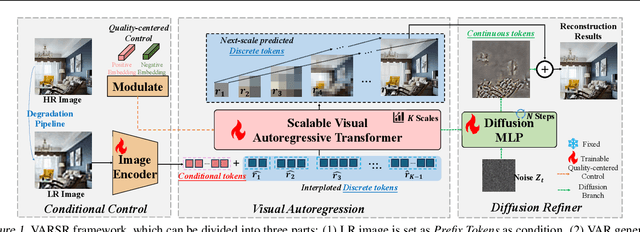
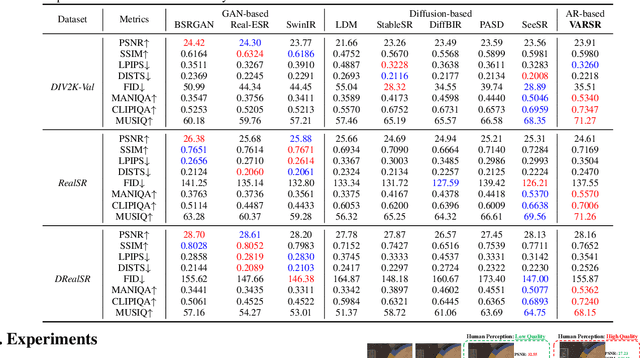
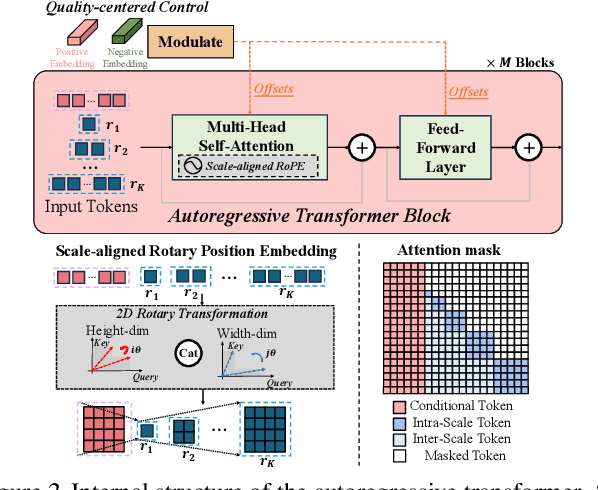

Image Super-Resolution (ISR) has seen significant progress with the introduction of remarkable generative models. However, challenges such as the trade-off issues between fidelity and realism, as well as computational complexity, have also posed limitations on their application. Building upon the tremendous success of autoregressive models in the language domain, we propose \textbf{VARSR}, a novel visual autoregressive modeling for ISR framework with the form of next-scale prediction. To effectively integrate and preserve semantic information in low-resolution images, we propose using prefix tokens to incorporate the condition. Scale-aligned Rotary Positional Encodings are introduced to capture spatial structures and the diffusion refiner is utilized for modeling quantization residual loss to achieve pixel-level fidelity. Image-based Classifier-free Guidance is proposed to guide the generation of more realistic images. Furthermore, we collect large-scale data and design a training process to obtain robust generative priors. Quantitative and qualitative results show that VARSR is capable of generating high-fidelity and high-realism images with more efficiency than diffusion-based methods. Our codes will be released at https://github.com/qyp2000/VARSR.
Plug-and-Play Tri-Branch Invertible Block for Image Rescaling
Dec 18, 2024High-resolution (HR) images are commonly downscaled to low-resolution (LR) to reduce bandwidth, followed by upscaling to restore their original details. Recent advancements in image rescaling algorithms have employed invertible neural networks (INNs) to create a unified framework for downscaling and upscaling, ensuring a one-to-one mapping between LR and HR images. Traditional methods, utilizing dual-branch based vanilla invertible blocks, process high-frequency and low-frequency information separately, often relying on specific distributions to model high-frequency components. However, processing the low-frequency component directly in the RGB domain introduces channel redundancy, limiting the efficiency of image reconstruction. To address these challenges, we propose a plug-and-play tri-branch invertible block (T-InvBlocks) that decomposes the low-frequency branch into luminance (Y) and chrominance (CbCr) components, reducing redundancy and enhancing feature processing. Additionally, we adopt an all-zero mapping strategy for high-frequency components during upscaling, focusing essential rescaling information within the LR image. Our T-InvBlocks can be seamlessly integrated into existing rescaling models, improving performance in both general rescaling tasks and scenarios involving lossy compression. Extensive experiments confirm that our method advances the state of the art in HR image reconstruction.
OAPT: Offset-Aware Partition Transformer for Double JPEG Artifacts Removal
Aug 21, 2024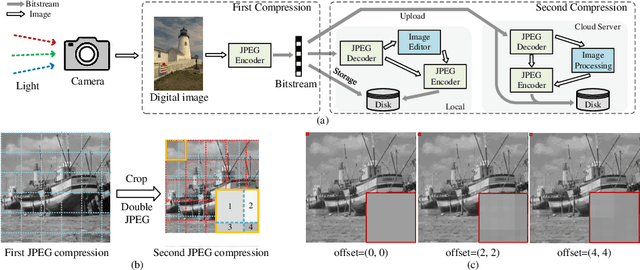


Deep learning-based methods have shown remarkable performance in single JPEG artifacts removal task. However, existing methods tend to degrade on double JPEG images, which are prevalent in real-world scenarios. To address this issue, we propose Offset-Aware Partition Transformer for double JPEG artifacts removal, termed as OAPT. We conduct an analysis of double JPEG compression that results in up to four patterns within each 8x8 block and design our model to cluster the similar patterns to remedy the difficulty of restoration. Our OAPT consists of two components: compression offset predictor and image reconstructor. Specifically, the predictor estimates pixel offsets between the first and second compression, which are then utilized to divide different patterns. The reconstructor is mainly based on several Hybrid Partition Attention Blocks (HPAB), combining vanilla window-based self-attention and sparse attention for clustered pattern features. Extensive experiments demonstrate that OAPT outperforms the state-of-the-art method by more than 0.16dB in double JPEG image restoration task. Moreover, without increasing any computation cost, the pattern clustering module in HPAB can serve as a plugin to enhance other transformer-based image restoration methods. The code will be available at https://github.com/QMoQ/OAPT.git .