 Add to Chrome
 Add to Firefox
 Add to Edge
Predictable MDP Abstraction for Unsupervised Model-Based RL
Feb 08, 2023
A key component of model-based reinforcement learning (RL) is a dynamics model that predicts the outcomes of actions. Errors in this predictive model can degrade the performance of model-based controllers, and complex Markov decision processes (MDPs) can present exceptionally difficult prediction problems. To mitigate this issue, we propose predictable MDP abstraction (PMA): instead of training a predictive model on the original MDP, we train a model on a transformed MDP with a learned action space that only permits predictable, easy-to-model actions, while covering the original state-action space as much as possible. As a result, model learning becomes easier and more accurate, which allows robust, stable model-based planning or model-based RL. This transformation is learned in an unsupervised manner, before any task is specified by the user. Downstream tasks can then be solved with model-based control in a zero-shot fashion, without additional environment interactions. We theoretically analyze PMA and empirically demonstrate that PMA leads to significant improvements over prior unsupervised model-based RL approaches in a range of benchmark environments. Our code and videos are available at https://seohong.me/projects/pma/

Bitrate-Constrained DRO: Beyond Worst Case Robustness To Unknown Group Shifts
Feb 06, 2023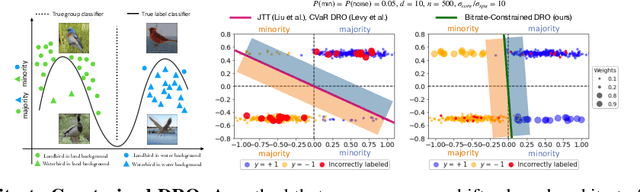
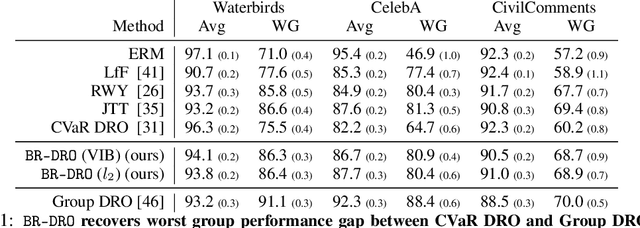
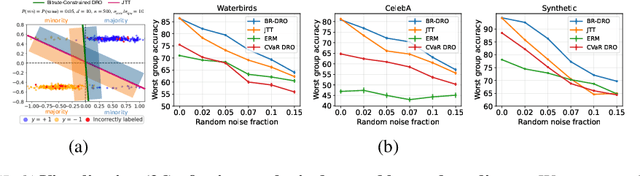
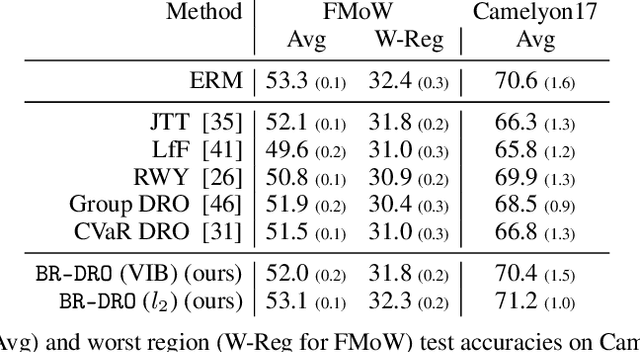
Training machine learning models robust to distribution shifts is critical for real-world applications. Some robust training algorithms (e.g., Group DRO) specialize to group shifts and require group information on all training points. Other methods (e.g., CVaR DRO) that do not need group annotations can be overly conservative, since they naively upweight high loss points which may form a contrived set that does not correspond to any meaningful group in the real world (e.g., when the high loss points are randomly mislabeled training points). In this work, we address limitations in prior approaches by assuming a more nuanced form of group shift: conditioned on the label, we assume that the true group function (indicator over group) is simple. For example, we may expect that group shifts occur along low bitrate features (e.g., image background, lighting). Thus, we aim to learn a model that maintains high accuracy on simple group functions realized by these low bitrate features, that need not spend valuable model capacity achieving high accuracy on contrived groups of examples. Based on this, we consider the two-player game formulation of DRO where the adversary's capacity is bitrate-constrained. Our resulting practical algorithm, Bitrate-Constrained DRO (BR-DRO), does not require group information on training samples yet matches the performance of Group DRO on datasets that have training group annotations and that of CVaR DRO on long-tailed distributions. Our theoretical analysis reveals that in some settings BR-DRO objective can provably yield statistically efficient and less conservative solutions than unconstrained CVaR DRO.
Understanding the Complexity Gains of Single-Task RL with a Curriculum
Dec 24, 2022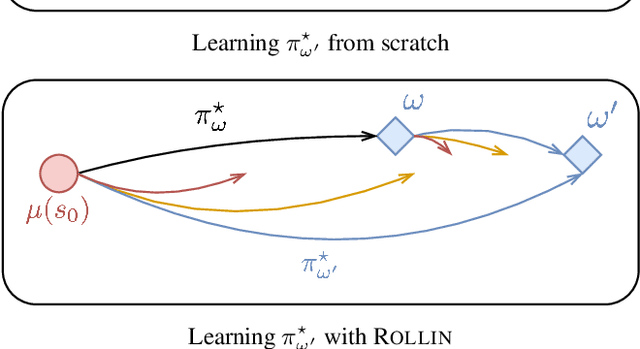

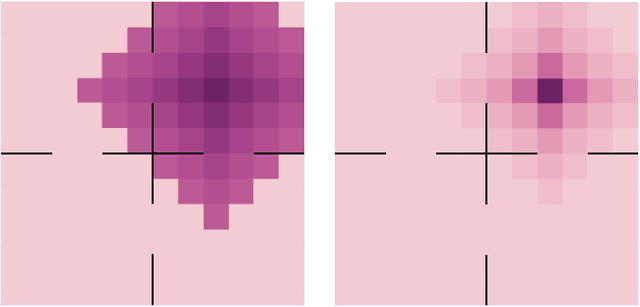
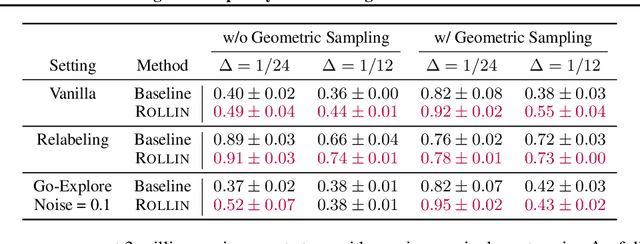
Reinforcement learning (RL) problems can be challenging without well-shaped rewards. Prior work on provably efficient RL methods generally proposes to address this issue with dedicated exploration strategies. However, another way to tackle this challenge is to reformulate it as a multi-task RL problem, where the task space contains not only the challenging task of interest but also easier tasks that implicitly function as a curriculum. Such a reformulation opens up the possibility of running existing multi-task RL methods as a more efficient alternative to solving a single challenging task from scratch. In this work, we provide a theoretical framework that reformulates a single-task RL problem as a multi-task RL problem defined by a curriculum. Under mild regularity conditions on the curriculum, we show that sequentially solving each task in the multi-task RL problem is more computationally efficient than solving the original single-task problem, without any explicit exploration bonuses or other exploration strategies. We also show that our theoretical insights can be translated into an effective practical learning algorithm that can accelerate curriculum learning on simulated robotic tasks.
Imitation Is Not Enough: Robustifying Imitation with Reinforcement Learning for Challenging Driving Scenarios
Dec 21, 2022
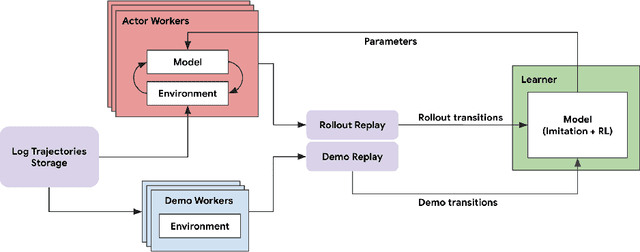
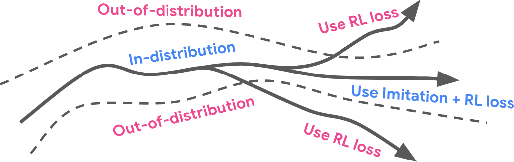
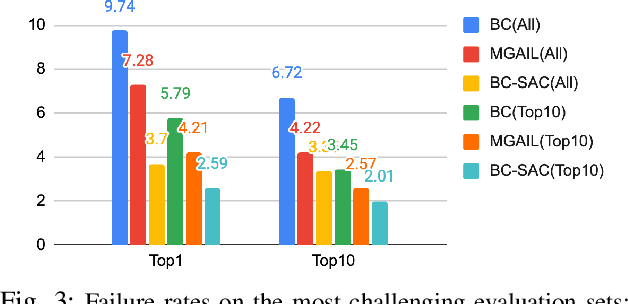
Imitation learning (IL) is a simple and powerful way to use high-quality human driving data, which can be collected at scale, to identify driving preferences and produce human-like behavior. However, policies based on imitation learning alone often fail to sufficiently account for safety and reliability concerns. In this paper, we show how imitation learning combined with reinforcement learning using simple rewards can substantially improve the safety and reliability of driving policies over those learned from imitation alone. In particular, we use a combination of imitation and reinforcement learning to train a policy on over 100k miles of urban driving data, and measure its effectiveness in test scenarios grouped by different levels of collision risk. To our knowledge, this is the first application of a combined imitation and reinforcement learning approach in autonomous driving that utilizes large amounts of real-world human driving data.
Dexterous Manipulation from Images: Autonomous Real-World RL via Substep Guidance
Dec 19, 2022


Complex and contact-rich robotic manipulation tasks, particularly those that involve multi-fingered hands and underactuated object manipulation, present a significant challenge to any control method. Methods based on reinforcement learning offer an appealing choice for such settings, as they can enable robots to learn to delicately balance contact forces and dexterously reposition objects without strong modeling assumptions. However, running reinforcement learning on real-world dexterous manipulation systems often requires significant manual engineering. This negates the benefits of autonomous data collection and ease of use that reinforcement learning should in principle provide. In this paper, we describe a system for vision-based dexterous manipulation that provides a "programming-free" approach for users to define new tasks and enable robots with complex multi-fingered hands to learn to perform them through interaction. The core principle underlying our system is that, in a vision-based setting, users should be able to provide high-level intermediate supervision that circumvents challenges in teleoperation or kinesthetic teaching which allow a robot to not only learn a task efficiently but also to autonomously practice. Our system includes a framework for users to define a final task and intermediate sub-tasks with image examples, a reinforcement learning procedure that learns the task autonomously without interventions, and experimental results with a four-finger robotic hand learning multi-stage object manipulation tasks directly in the real world, without simulation, manual modeling, or reward engineering.
Offline Reinforcement Learning for Visual Navigation
Dec 16, 2022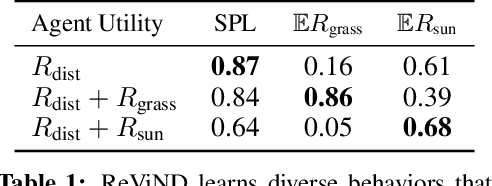
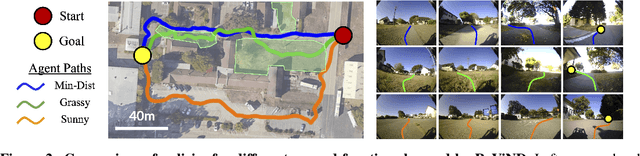
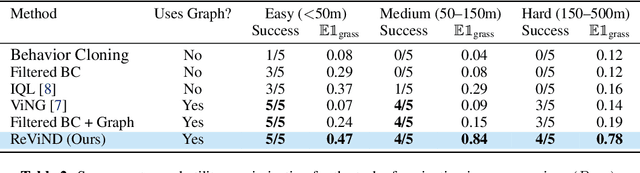
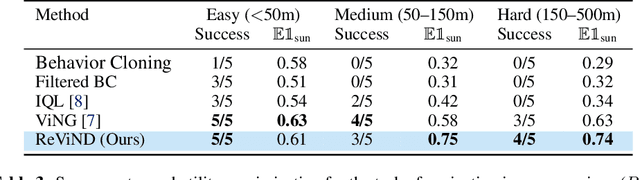
Reinforcement learning can enable robots to navigate to distant goals while optimizing user-specified reward functions, including preferences for following lanes, staying on paved paths, or avoiding freshly mowed grass. However, online learning from trial-and-error for real-world robots is logistically challenging, and methods that instead can utilize existing datasets of robotic navigation data could be significantly more scalable and enable broader generalization. In this paper, we present ReViND, the first offline RL system for robotic navigation that can leverage previously collected data to optimize user-specified reward functions in the real-world. We evaluate our system for off-road navigation without any additional data collection or fine-tuning, and show that it can navigate to distant goals using only offline training from this dataset, and exhibit behaviors that qualitatively differ based on the user-specified reward function.
Learning Robotic Navigation from Experience: Principles, Methods, and Recent Results
Dec 13, 2022Navigation is one of the most heavily studied problems in robotics, and is conventionally approached as a geometric mapping and planning problem. However, real-world navigation presents a complex set of physical challenges that defies simple geometric abstractions. Machine learning offers a promising way to go beyond geometry and conventional planning, allowing for navigational systems that make decisions based on actual prior experience. Such systems can reason about traversability in ways that go beyond geometry, accounting for the physical outcomes of their actions and exploiting patterns in real-world environments. They can also improve as more data is collected, potentially providing a powerful network effect. In this article, we present a general toolkit for experiential learning of robotic navigation skills that unifies several recent approaches, describe the underlying design principles, summarize experimental results from several of our recent papers, and discuss open problems and directions for future work.
* Final print version is here: https://royalsocietypublishing.org/doi/10.1098/rstb.2021.0447
RT-1: Robotics Transformer for Real-World Control at Scale
Dec 13, 2022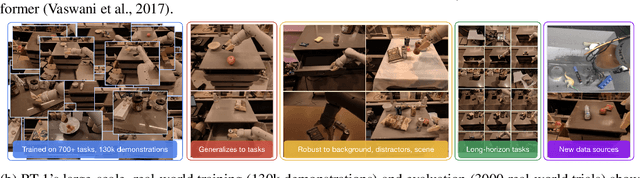
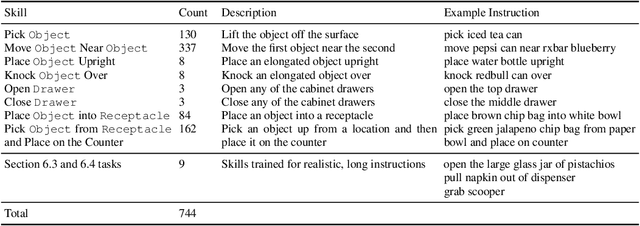
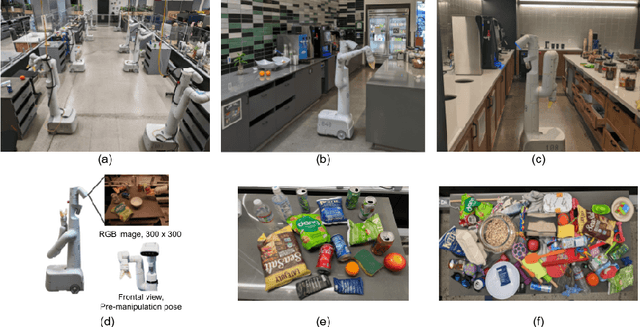
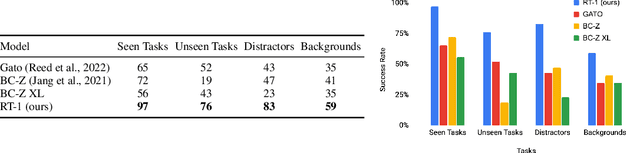
By transferring knowledge from large, diverse, task-agnostic datasets, modern machine learning models can solve specific downstream tasks either zero-shot or with small task-specific datasets to a high level of performance. While this capability has been demonstrated in other fields such as computer vision, natural language processing or speech recognition, it remains to be shown in robotics, where the generalization capabilities of the models are particularly critical due to the difficulty of collecting real-world robotic data. We argue that one of the keys to the success of such general robotic models lies with open-ended task-agnostic training, combined with high-capacity architectures that can absorb all of the diverse, robotic data. In this paper, we present a model class, dubbed Robotics Transformer, that exhibits promising scalable model properties. We verify our conclusions in a study of different model classes and their ability to generalize as a function of the data size, model size, and data diversity based on a large-scale data collection on real robots performing real-world tasks. The project's website and videos can be found at robotics-transformer.github.io
Confidence-Conditioned Value Functions for Offline Reinforcement Learning
Dec 08, 2022Offline reinforcement learning (RL) promises the ability to learn effective policies solely using existing, static datasets, without any costly online interaction. To do so, offline RL methods must handle distributional shift between the dataset and the learned policy. The most common approach is to learn conservative, or lower-bound, value functions, which underestimate the return of out-of-distribution (OOD) actions. However, such methods exhibit one notable drawback: policies optimized on such value functions can only behave according to a fixed, possibly suboptimal, degree of conservatism. However, this can be alleviated if we instead are able to learn policies for varying degrees of conservatism at training time and devise a method to dynamically choose one of them during evaluation. To do so, in this work, we propose learning value functions that additionally condition on the degree of conservatism, which we dub confidence-conditioned value functions. We derive a new form of a Bellman backup that simultaneously learns Q-values for any degree of confidence with high probability. By conditioning on confidence, our value functions enable adaptive strategies during online evaluation by controlling for confidence level using the history of observations thus far. This approach can be implemented in practice by conditioning the Q-function from existing conservative algorithms on the confidence. We theoretically show that our learned value functions produce conservative estimates of the true value at any desired confidence. Finally, we empirically show that our algorithm outperforms existing conservative offline RL algorithms on multiple discrete control domains.
Multi-Task Imitation Learning for Linear Dynamical Systems
Dec 01, 2022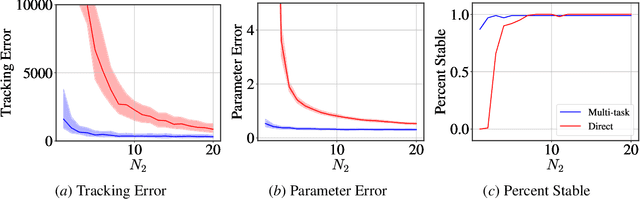
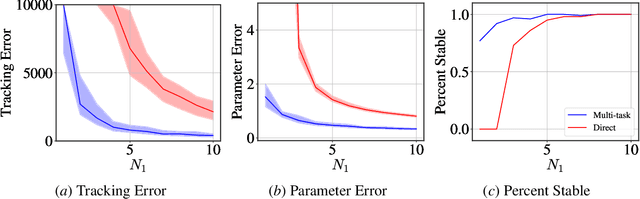
We study representation learning for efficient imitation learning over linear systems. In particular, we consider a setting where learning is split into two phases: (a) a pre-training step where a shared $k$-dimensional representation is learned from $H$ source policies, and (b) a target policy fine-tuning step where the learned representation is used to parameterize the policy class. We find that the imitation gap over trajectories generated by the learned target policy is bounded by $\tilde{O}\left( \frac{k n_x}{HN_{\mathrm{shared}}} + \frac{k n_u}{N_{\mathrm{target}}}\right)$, where $n_x > k$ is the state dimension, $n_u$ is the input dimension, $N_{\mathrm{shared}}$ denotes the total amount of data collected for each policy during representation learning, and $N_{\mathrm{target}}$ is the amount of target task data. This result formalizes the intuition that aggregating data across related tasks to learn a representation can significantly improve the sample efficiency of learning a target task. The trends suggested by this bound are corroborated in simulation.