 Add to Chrome
 Add to Firefox
 Add to Edge
CHORUS: Decentralized Multi-Embodiment Collaboration with One VLA Policy
Jun 10, 2026
Multi-robot collaboration allows robots to efficiently take on a wide range of tasks, from moving a couch through a doorway to assembling structures on a construction site. However, achieving such coordination in mobile multi-robot settings remains challenging: centralized methods conditioned on the combined observations of a team scale poorly with team size, and decentralized methods that train one policy per robot often require explicit alignment procedures or information sharing at inference time to overcome partial observability. Our key insight is that the visuomotor priors of pretrained vision-language-action (VLA) models should enable reactive, decentralized collaboration from each robot's local observations alone, without these inference-time assumptions. We propose CHORUS, a framework that adapts a single VLA backbone to control diverse, multi-robot teams. At inference time, each robot runs an independent copy of CHORUS, conditioned only on its own observations and a robot-identifying prompt. In real-world experiments including mobile tape measurement, library book handovers, and laundry basket lifting, CHORUS achieves a 64% point improvement over decentralized, from-scratch models, improves reactivity to teammate behavior by 40% points, and outperforms centralized baselines. Together, these results show that a shared VLA backbone is capable of achieving decentralized multi-robot collaboration, without per-robot policies or inter-robot communication at inference.

Steerable Vision-Language-Action Policies for Embodied Reasoning and Hierarchical Control
Feb 13, 2026Pretrained vision-language models (VLMs) can make semantic and visual inferences across diverse settings, providing valuable common-sense priors for robotic control. However, effectively grounding this knowledge in robot behaviors remains an open challenge. Prior methods often employ a hierarchical approach where VLMs reason over high-level commands to be executed by separate low-level policies, e.g., vision-language-action models (VLAs). The interface between VLMs and VLAs is usually natural language task instructions, which fundamentally limits how much VLM reasoning can steer low-level behavior. We thus introduce Steerable Policies: VLAs trained on rich synthetic commands at various levels of abstraction, like subtasks, motions, and grounded pixel coordinates. By improving low-level controllability, Steerable Policies can unlock pretrained knowledge in VLMs, enabling improved task generalization. We demonstrate this benefit by controlling our Steerable Policies with both a learned high-level embodied reasoner and an off-the-shelf VLM prompted to reason over command abstractions via in-context learning. Across extensive real-world manipulation experiments, these two novel methods outperform prior embodied reasoning VLAs and VLM-based hierarchical baselines, including on challenging generalization and long-horizon tasks. Website: steerable-policies.github.io
Scaling Cross-Embodied Learning: One Policy for Manipulation, Navigation, Locomotion and Aviation
Aug 21, 2024
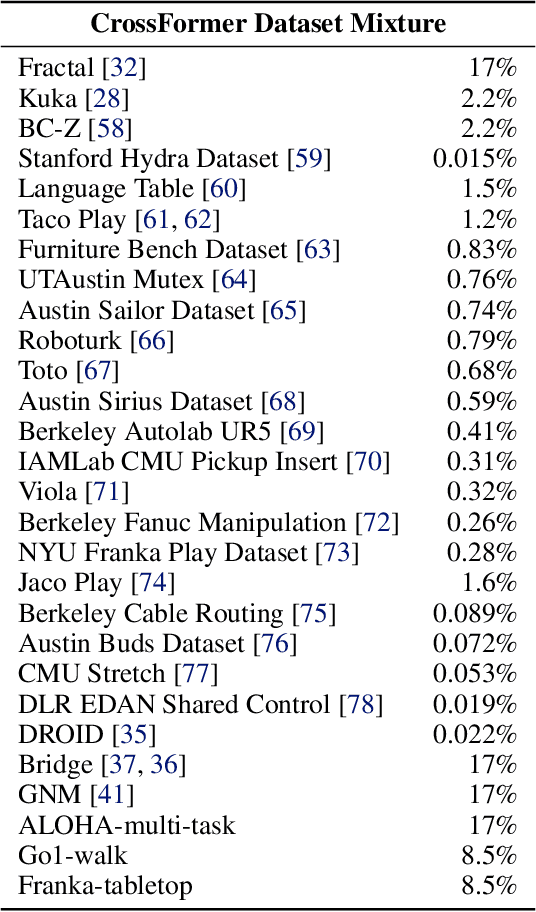
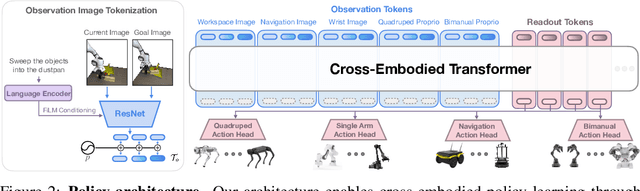
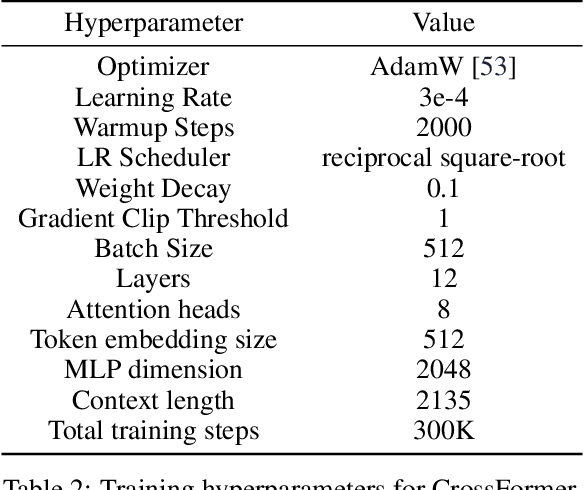
Modern machine learning systems rely on large datasets to attain broad generalization, and this often poses a challenge in robot learning, where each robotic platform and task might have only a small dataset. By training a single policy across many different kinds of robots, a robot learning method can leverage much broader and more diverse datasets, which in turn can lead to better generalization and robustness. However, training a single policy on multi-robot data is challenging because robots can have widely varying sensors, actuators, and control frequencies. We propose CrossFormer, a scalable and flexible transformer-based policy that can consume data from any embodiment. We train CrossFormer on the largest and most diverse dataset to date, 900K trajectories across 20 different robot embodiments. We demonstrate that the same network weights can control vastly different robots, including single and dual arm manipulation systems, wheeled robots, quadcopters, and quadrupeds. Unlike prior work, our model does not require manual alignment of the observation or action spaces. Extensive experiments in the real world show that our method matches the performance of specialist policies tailored for each embodiment, while also significantly outperforming the prior state of the art in cross-embodiment learning.
Polynomial Regression as a Task for Understanding In-context Learning Through Finetuning and Alignment
Jul 27, 2024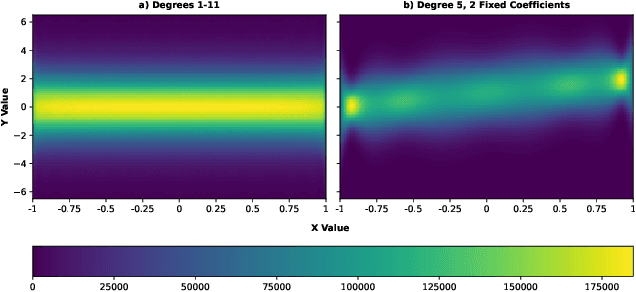
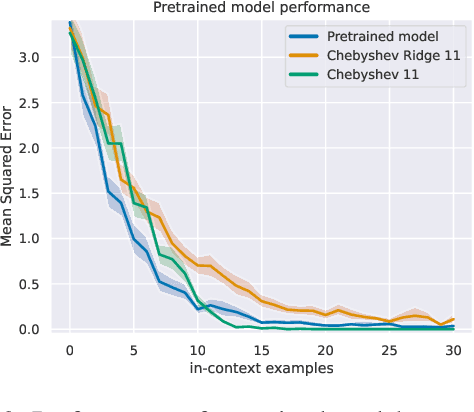
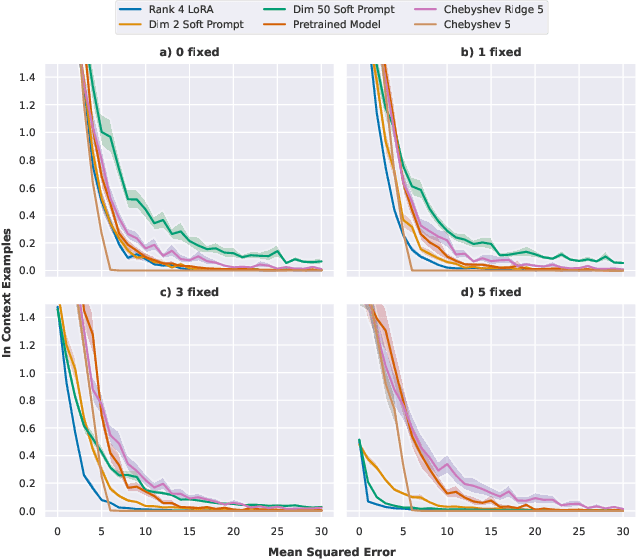
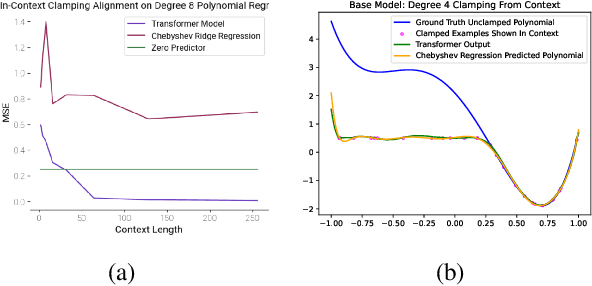
Simple function classes have emerged as toy problems to better understand in-context-learning in transformer-based architectures used for large language models. But previously proposed simple function classes like linear regression or multi-layer-perceptrons lack the structure required to explore things like prompting and alignment within models capable of in-context-learning. We propose univariate polynomial regression as a function class that is just rich enough to study prompting and alignment, while allowing us to visualize and understand what is going on clearly.
Open X-Embodiment: Robotic Learning Datasets and RT-X Models
Oct 17, 2023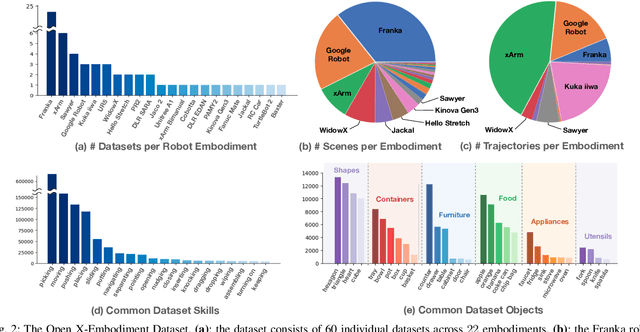
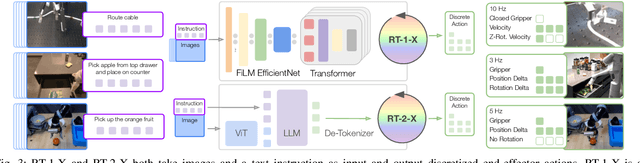


Large, high-capacity models trained on diverse datasets have shown remarkable successes on efficiently tackling downstream applications. In domains from NLP to Computer Vision, this has led to a consolidation of pretrained models, with general pretrained backbones serving as a starting point for many applications. Can such a consolidation happen in robotics? Conventionally, robotic learning methods train a separate model for every application, every robot, and even every environment. Can we instead train generalist X-robot policy that can be adapted efficiently to new robots, tasks, and environments? In this paper, we provide datasets in standardized data formats and models to make it possible to explore this possibility in the context of robotic manipulation, alongside experimental results that provide an example of effective X-robot policies. We assemble a dataset from 22 different robots collected through a collaboration between 21 institutions, demonstrating 527 skills (160266 tasks). We show that a high-capacity model trained on this data, which we call RT-X, exhibits positive transfer and improves the capabilities of multiple robots by leveraging experience from other platforms. More details can be found on the project website $\href{https://robotics-transformer-x.github.io}{\text{robotics-transformer-x.github.io}}$.
Dexterous Manipulation from Images: Autonomous Real-World RL via Substep Guidance
Dec 19, 2022


Complex and contact-rich robotic manipulation tasks, particularly those that involve multi-fingered hands and underactuated object manipulation, present a significant challenge to any control method. Methods based on reinforcement learning offer an appealing choice for such settings, as they can enable robots to learn to delicately balance contact forces and dexterously reposition objects without strong modeling assumptions. However, running reinforcement learning on real-world dexterous manipulation systems often requires significant manual engineering. This negates the benefits of autonomous data collection and ease of use that reinforcement learning should in principle provide. In this paper, we describe a system for vision-based dexterous manipulation that provides a "programming-free" approach for users to define new tasks and enable robots with complex multi-fingered hands to learn to perform them through interaction. The core principle underlying our system is that, in a vision-based setting, users should be able to provide high-level intermediate supervision that circumvents challenges in teleoperation or kinesthetic teaching which allow a robot to not only learn a task efficiently but also to autonomously practice. Our system includes a framework for users to define a final task and intermediate sub-tasks with image examples, a reinforcement learning procedure that learns the task autonomously without interventions, and experimental results with a four-finger robotic hand learning multi-stage object manipulation tasks directly in the real world, without simulation, manual modeling, or reward engineering.