 Add to Chrome
 Add to Firefox
 Add to Edge
Feedback Efficient Online Fine-Tuning of Diffusion Models
Feb 27, 2024
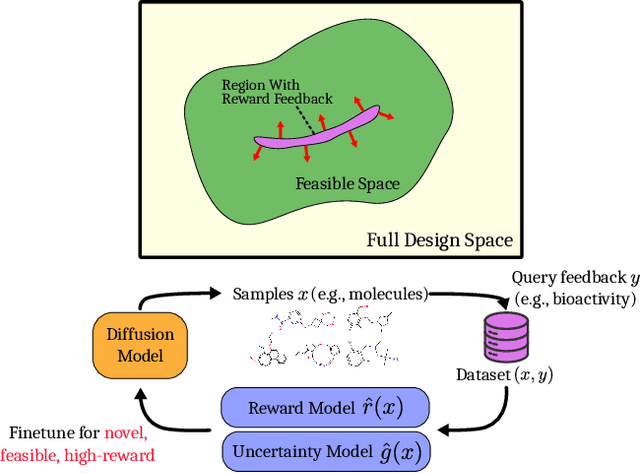

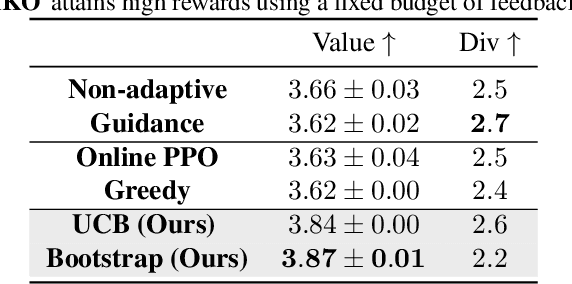
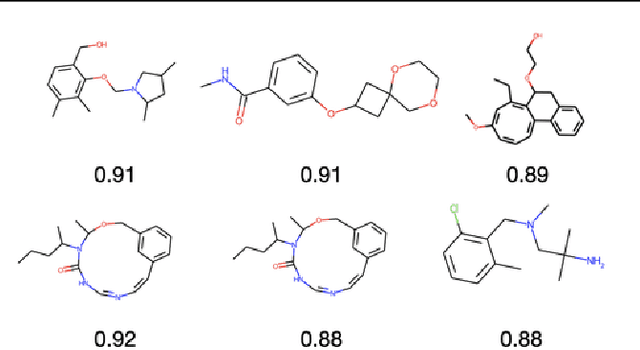
Diffusion models excel at modeling complex data distributions, including those of images, proteins, and small molecules. However, in many cases, our goal is to model parts of the distribution that maximize certain properties: for example, we may want to generate images with high aesthetic quality, or molecules with high bioactivity. It is natural to frame this as a reinforcement learning (RL) problem, in which the objective is to fine-tune a diffusion model to maximize a reward function that corresponds to some property. Even with access to online queries of the ground-truth reward function, efficiently discovering high-reward samples can be challenging: they might have a low probability in the initial distribution, and there might be many infeasible samples that do not even have a well-defined reward (e.g., unnatural images or physically impossible molecules). In this work, we propose a novel reinforcement learning procedure that efficiently explores on the manifold of feasible samples. We present a theoretical analysis providing a regret guarantee, as well as empirical validation across three domains: images, biological sequences, and molecules.

Unsupervised Zero-Shot Reinforcement Learning via Functional Reward Encodings
Feb 27, 2024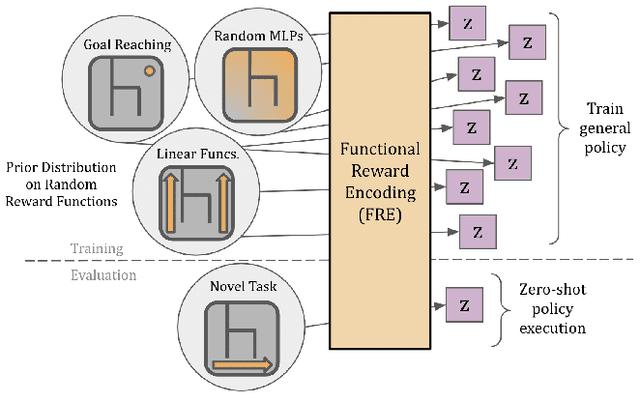
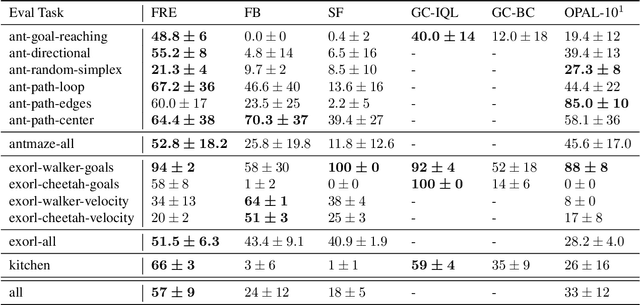
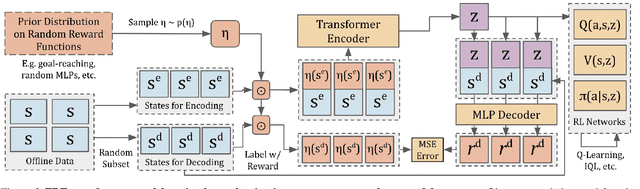
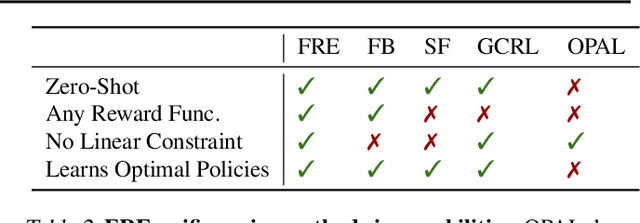
Can we pre-train a generalist agent from a large amount of unlabeled offline trajectories such that it can be immediately adapted to any new downstream tasks in a zero-shot manner? In this work, we present a functional reward encoding (FRE) as a general, scalable solution to this zero-shot RL problem. Our main idea is to learn functional representations of any arbitrary tasks by encoding their state-reward samples using a transformer-based variational auto-encoder. This functional encoding not only enables the pre-training of an agent from a wide diversity of general unsupervised reward functions, but also provides a way to solve any new downstream tasks in a zero-shot manner, given a small number of reward-annotated samples. We empirically show that FRE agents trained on diverse random unsupervised reward functions can generalize to solve novel tasks in a range of simulated robotic benchmarks, often outperforming previous zero-shot RL and offline RL methods. Code for this project is provided at: https://github.com/kvfrans/fre
Foundation Policies with Hilbert Representations
Feb 23, 2024Unsupervised and self-supervised objectives, such as next token prediction, have enabled pre-training generalist models from large amounts of unlabeled data. In reinforcement learning (RL), however, finding a truly general and scalable unsupervised pre-training objective for generalist policies from offline data remains a major open question. While a number of methods have been proposed to enable generic self-supervised RL, based on principles such as goal-conditioned RL, behavioral cloning, and unsupervised skill learning, such methods remain limited in terms of either the diversity of the discovered behaviors, the need for high-quality demonstration data, or the lack of a clear prompting or adaptation mechanism for downstream tasks. In this work, we propose a novel unsupervised framework to pre-train generalist policies that capture diverse, optimal, long-horizon behaviors from unlabeled offline data such that they can be quickly adapted to any arbitrary new tasks in a zero-shot manner. Our key insight is to learn a structured representation that preserves the temporal structure of the underlying environment, and then to span this learned latent space with directional movements, which enables various zero-shot policy "prompting" schemes for downstream tasks. Through our experiments on simulated robotic locomotion and manipulation benchmarks, we show that our unsupervised policies can solve goal-conditioned and general RL tasks in a zero-shot fashion, even often outperforming prior methods designed specifically for each setting. Our code and videos are available at https://seohong.me/projects/hilp/
Vision-Language Models Provide Promptable Representations for Reinforcement Learning
Feb 13, 2024Humans can quickly learn new behaviors by leveraging background world knowledge. In contrast, agents trained with reinforcement learning (RL) typically learn behaviors from scratch. We thus propose a novel approach that uses the vast amounts of general and indexable world knowledge encoded in vision-language models (VLMs) pre-trained on Internet-scale data for embodied RL. We initialize policies with VLMs by using them as promptable representations: embeddings that are grounded in visual observations and encode semantic features based on the VLM's internal knowledge, as elicited through prompts that provide task context and auxiliary information. We evaluate our approach on visually-complex, long horizon RL tasks in Minecraft and robot navigation in Habitat. We find that our policies trained on embeddings extracted from general-purpose VLMs outperform equivalent policies trained on generic, non-promptable image embeddings. We also find our approach outperforms instruction-following methods and performs comparably to domain-specific embeddings.
PIVOT: Iterative Visual Prompting Elicits Actionable Knowledge for VLMs
Feb 12, 2024



Vision language models (VLMs) have shown impressive capabilities across a variety of tasks, from logical reasoning to visual understanding. This opens the door to richer interaction with the world, for example robotic control. However, VLMs produce only textual outputs, while robotic control and other spatial tasks require outputting continuous coordinates, actions, or trajectories. How can we enable VLMs to handle such settings without fine-tuning on task-specific data? In this paper, we propose a novel visual prompting approach for VLMs that we call Prompting with Iterative Visual Optimization (PIVOT), which casts tasks as iterative visual question answering. In each iteration, the image is annotated with a visual representation of proposals that the VLM can refer to (e.g., candidate robot actions, localizations, or trajectories). The VLM then selects the best ones for the task. These proposals are iteratively refined, allowing the VLM to eventually zero in on the best available answer. We investigate PIVOT on real-world robotic navigation, real-world manipulation from images, instruction following in simulation, and additional spatial inference tasks such as localization. We find, perhaps surprisingly, that our approach enables zero-shot control of robotic systems without any robot training data, navigation in a variety of environments, and other capabilities. Although current performance is far from perfect, our work highlights potentials and limitations of this new regime and shows a promising approach for Internet-Scale VLMs in robotic and spatial reasoning domains. Website: pivot-prompt.github.io and HuggingFace: https://huggingface.co/spaces/pivot-prompt/pivot-prompt-demo.
SERL: A Software Suite for Sample-Efficient Robotic Reinforcement Learning
Feb 01, 2024In recent years, significant progress has been made in the field of robotic reinforcement learning (RL), enabling methods that handle complex image observations, train in the real world, and incorporate auxiliary data, such as demonstrations and prior experience. However, despite these advances, robotic RL remains hard to use. It is acknowledged among practitioners that the particular implementation details of these algorithms are often just as important (if not more so) for performance as the choice of algorithm. We posit that a significant challenge to widespread adoption of robotic RL, as well as further development of robotic RL methods, is the comparative inaccessibility of such methods. To address this challenge, we developed a carefully implemented library containing a sample efficient off-policy deep RL method, together with methods for computing rewards and resetting the environment, a high-quality controller for a widely-adopted robot, and a number of challenging example tasks. We provide this library as a resource for the community, describe its design choices, and present experimental results. Perhaps surprisingly, we find that our implementation can achieve very efficient learning, acquiring policies for PCB board assembly, cable routing, and object relocation between 25 to 50 minutes of training per policy on average, improving over state-of-the-art results reported for similar tasks in the literature. These policies achieve perfect or near-perfect success rates, extreme robustness even under perturbations, and exhibit emergent recovery and correction behaviors. We hope that these promising results and our high-quality open-source implementation will provide a tool for the robotics community to facilitate further developments in robotic RL. Our code, documentation, and videos can be found at https://serl-robot.github.io/
Reinforcement Learning for Versatile, Dynamic, and Robust Bipedal Locomotion Control
Jan 30, 2024This paper presents a comprehensive study on using deep reinforcement learning (RL) to create dynamic locomotion controllers for bipedal robots. Going beyond focusing on a single locomotion skill, we develop a general control solution that can be used for a range of dynamic bipedal skills, from periodic walking and running to aperiodic jumping and standing. Our RL-based controller incorporates a novel dual-history architecture, utilizing both a long-term and short-term input/output (I/O) history of the robot. This control architecture, when trained through the proposed end-to-end RL approach, consistently outperforms other methods across a diverse range of skills in both simulation and the real world.The study also delves into the adaptivity and robustness introduced by the proposed RL system in developing locomotion controllers. We demonstrate that the proposed architecture can adapt to both time-invariant dynamics shifts and time-variant changes, such as contact events, by effectively using the robot's I/O history. Additionally, we identify task randomization as another key source of robustness, fostering better task generalization and compliance to disturbances. The resulting control policies can be successfully deployed on Cassie, a torque-controlled human-sized bipedal robot. This work pushes the limits of agility for bipedal robots through extensive real-world experiments. We demonstrate a diverse range of locomotion skills, including: robust standing, versatile walking, fast running with a demonstration of a 400-meter dash, and a diverse set of jumping skills, such as standing long jumps and high jumps.
AutoRT: Embodied Foundation Models for Large Scale Orchestration of Robotic Agents
Jan 23, 2024Foundation models that incorporate language, vision, and more recently actions have revolutionized the ability to harness internet scale data to reason about useful tasks. However, one of the key challenges of training embodied foundation models is the lack of data grounded in the physical world. In this paper, we propose AutoRT, a system that leverages existing foundation models to scale up the deployment of operational robots in completely unseen scenarios with minimal human supervision. AutoRT leverages vision-language models (VLMs) for scene understanding and grounding, and further uses large language models (LLMs) for proposing diverse and novel instructions to be performed by a fleet of robots. Guiding data collection by tapping into the knowledge of foundation models enables AutoRT to effectively reason about autonomy tradeoffs and safety while significantly scaling up data collection for robot learning. We demonstrate AutoRT proposing instructions to over 20 robots across multiple buildings and collecting 77k real robot episodes via both teleoperation and autonomous robot policies. We experimentally show that such "in-the-wild" data collected by AutoRT is significantly more diverse, and that AutoRT's use of LLMs allows for instruction following data collection robots that can align to human preferences.
FMB: a Functional Manipulation Benchmark for Generalizable Robotic Learning
Jan 16, 2024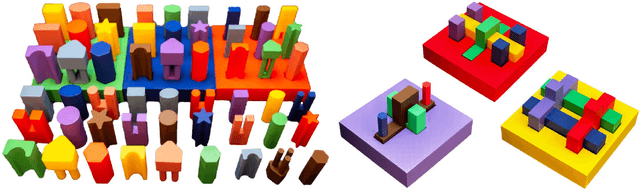

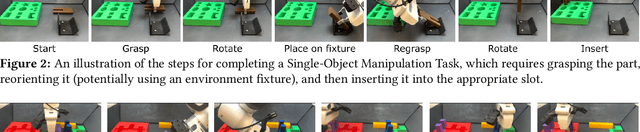
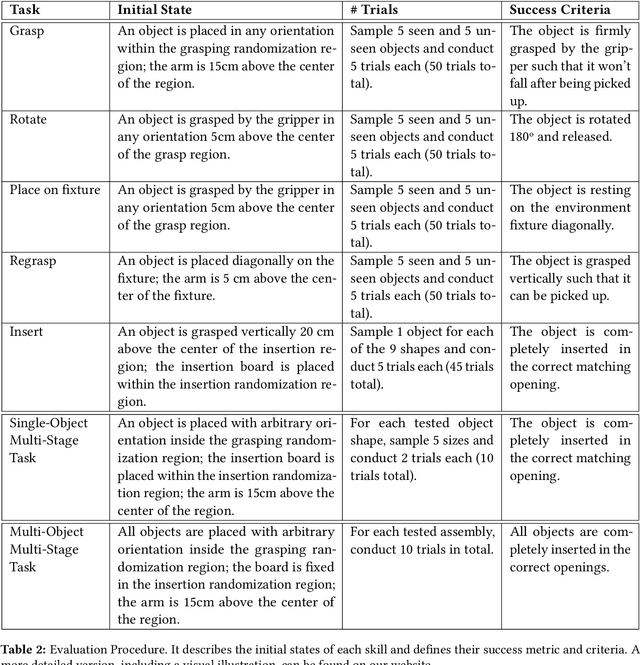
In this paper, we propose a real-world benchmark for studying robotic learning in the context of functional manipulation: a robot needs to accomplish complex long-horizon behaviors by composing individual manipulation skills in functionally relevant ways. The core design principles of our Functional Manipulation Benchmark (FMB) emphasize a harmonious balance between complexity and accessibility. Tasks are deliberately scoped to be narrow, ensuring that models and datasets of manageable scale can be utilized effectively to track progress. Simultaneously, they are diverse enough to pose a significant generalization challenge. Furthermore, the benchmark is designed to be easily replicable, encompassing all essential hardware and software components. To achieve this goal, FMB consists of a variety of 3D-printed objects designed for easy and accurate replication by other researchers. The objects are procedurally generated, providing a principled framework to study generalization in a controlled fashion. We focus on fundamental manipulation skills, including grasping, repositioning, and a range of assembly behaviors. The FMB can be used to evaluate methods for acquiring individual skills, as well as methods for combining and ordering such skills to solve complex, multi-stage manipulation tasks. We also offer an imitation learning framework that includes a suite of policies trained to solve the proposed tasks. This enables researchers to utilize our tasks as a versatile toolkit for examining various parts of the pipeline. For example, researchers could propose a better design for a grasping controller and evaluate it in combination with our baseline reorientation and assembly policies as part of a pipeline for solving multi-stage tasks. Our dataset, object CAD files, code, and evaluation videos can be found on our project website: https://functional-manipulation-benchmark.github.io
Functional Graphical Models: Structure Enables Offline Data-Driven Optimization
Jan 12, 2024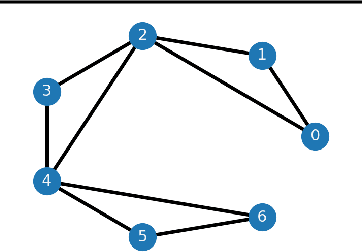
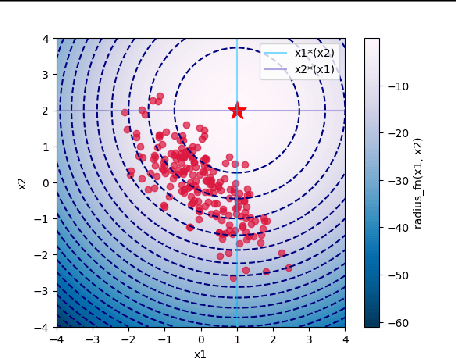
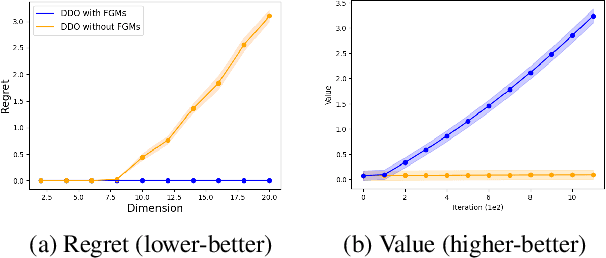
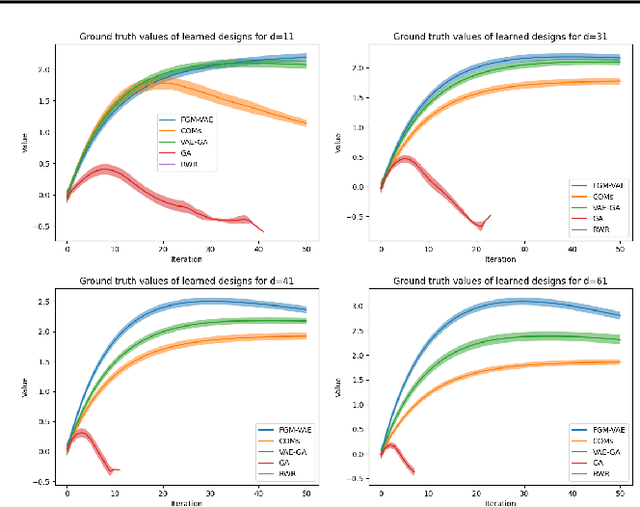
While machine learning models are typically trained to solve prediction problems, we might often want to use them for optimization problems. For example, given a dataset of proteins and their corresponding fluorescence levels, we might want to optimize for a new protein with the highest possible fluorescence. This kind of data-driven optimization (DDO) presents a range of challenges beyond those in standard prediction problems, since we need models that successfully predict the performance of new designs that are better than the best designs seen in the training set. It is not clear theoretically when existing approaches can even perform better than the naive approach that simply selects the best design in the dataset. In this paper, we study how structure can enable sample-efficient data-driven optimization. To formalize the notion of structure, we introduce functional graphical models (FGMs) and show theoretically how they can provide for principled data-driven optimization by decomposing the original high-dimensional optimization problem into smaller sub-problems. This allows us to derive much more practical regret bounds for DDO, and the result implies that DDO with FGMs can achieve nearly optimal designs in situations where naive approaches fail due to insufficient coverage of the offline data. We further present a data-driven optimization algorithm that inferes the FGM structure itself, either over the original input variables or a latent variable representation of the inputs.