 Add to Chrome
 Add to Firefox
 Add to Edge
LongCat Sparse Attention: Taming the Lightning via Streaming-aware Hierarchical Cross-Layer Indexing
Aug 03, 2026
DeepSeek Sparse Attention (DSA) enables efficient long-context modeling through its Lightning Indexer. However, practical deployment remains constrained by the indexer's expensive $O(L^2)$ scoring overhead and the hardware-inefficient, discontinuous memory-access patterns induced by its outputs. To address these system-level bottlenecks, we introduce LongCat Sparse Attention (LSA), a hardware-algorithm co-designed framework comprising three complementary and orthogonal strategies: (1) Streaming-Aware Indexing, which selectively converts scattered KV entries into hardware-aligned contiguous layouts to enable coalesced HBM access; (2) Cross-Layer Indexing, which amortizes indexing overhead by reusing the results produced by a single layer across consecutive layers, supported by cross-layer distillation; and (3) Hierarchical Indexing, which adopts a coarse-to-fine scoring scheme to progressively narrow the candidate set for each query, thereby substantially reducing indexing computation. Extensive scaling experiments, ranging from 69B-A3B to 560B-A27B models, demonstrate that LSA consistently achieves performance on par with full attention across both general-purpose and long-context benchmarks. Moreover, LSA supports native training with context lengths of up to one million tokens and underpins the development of LongCat-2.0 (1.6T-A48B). To facilitate further research, we also introduce and open-source LongCat-Flash-Lite-Sparse (69B-A3B), which integrates LSA into LongCat-Flash-Lite and incorporates an updated long-context training corpus.

Scaling Embeddings Outperforms Scaling Experts in Language Models
Jan 29, 2026While Mixture-of-Experts (MoE) architectures have become the standard for sparsity scaling in large language models, they increasingly face diminishing returns and system-level bottlenecks. In this work, we explore embedding scaling as a potent, orthogonal dimension for scaling sparsity. Through a comprehensive analysis and experiments, we identify specific regimes where embedding scaling achieves a superior Pareto frontier compared to expert scaling. We systematically characterize the critical architectural factors governing this efficacy -- ranging from parameter budgeting to the interplay with model width and depth. Moreover, by integrating tailored system optimizations and speculative decoding, we effectively convert this sparsity into tangible inference speedups. Guided by these insights, we introduce LongCat-Flash-Lite, a 68.5B parameter model with ~3B activated trained from scratch. Despite allocating over 30B parameters to embeddings, LongCat-Flash-Lite not only surpasses parameter-equivalent MoE baselines but also exhibits exceptional competitiveness against existing models of comparable scale, particularly in agentic and coding domains.
LongCat-Flash-Thinking-2601 Technical Report
Jan 23, 2026We introduce LongCat-Flash-Thinking-2601, a 560-billion-parameter open-source Mixture-of-Experts (MoE) reasoning model with superior agentic reasoning capability. LongCat-Flash-Thinking-2601 achieves state-of-the-art performance among open-source models on a wide range of agentic benchmarks, including agentic search, agentic tool use, and tool-integrated reasoning. Beyond benchmark performance, the model demonstrates strong generalization to complex tool interactions and robust behavior under noisy real-world environments. Its advanced capability stems from a unified training framework that combines domain-parallel expert training with subsequent fusion, together with an end-to-end co-design of data construction, environments, algorithms, and infrastructure spanning from pre-training to post-training. In particular, the model's strong generalization capability in complex tool-use are driven by our in-depth exploration of environment scaling and principled task construction. To optimize long-tailed, skewed generation and multi-turn agentic interactions, and to enable stable training across over 10,000 environments spanning more than 20 domains, we systematically extend our asynchronous reinforcement learning framework, DORA, for stable and efficient large-scale multi-environment training. Furthermore, recognizing that real-world tasks are inherently noisy, we conduct a systematic analysis and decomposition of real-world noise patterns, and design targeted training procedures to explicitly incorporate such imperfections into the training process, resulting in improved robustness for real-world applications. To further enhance performance on complex reasoning tasks, we introduce a Heavy Thinking mode that enables effective test-time scaling by jointly expanding reasoning depth and width through intensive parallel thinking.
Efficient Context Scaling with LongCat ZigZag Attention
Dec 30, 2025We introduce LongCat ZigZag Attention (LoZA), which is a sparse attention scheme designed to transform any existing full-attention models into sparse versions with rather limited compute budget. In long-context scenarios, LoZA can achieve significant speed-ups both for prefill-intensive (e.g., retrieval-augmented generation) and decode-intensive (e.g., tool-integrated reasoning) cases. Specifically, by applying LoZA to LongCat-Flash during mid-training, we serve LongCat-Flash-Exp as a long-context foundation model that can swiftly process up to 1 million tokens, enabling efficient long-term reasoning and long-horizon agentic capabilities.
EPS-MoE: Expert Pipeline Scheduler for Cost-Efficient MoE Inference
Oct 16, 2024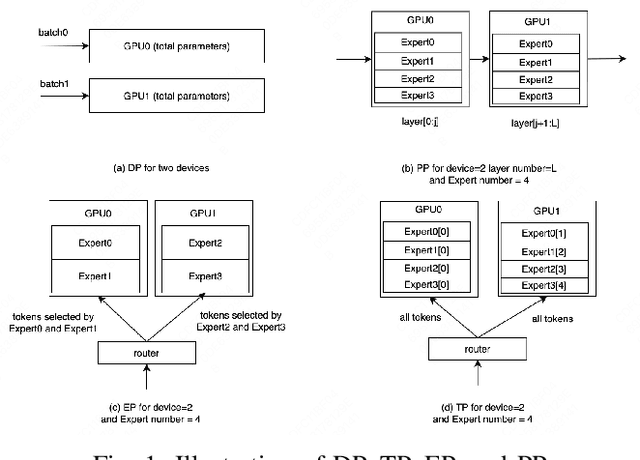
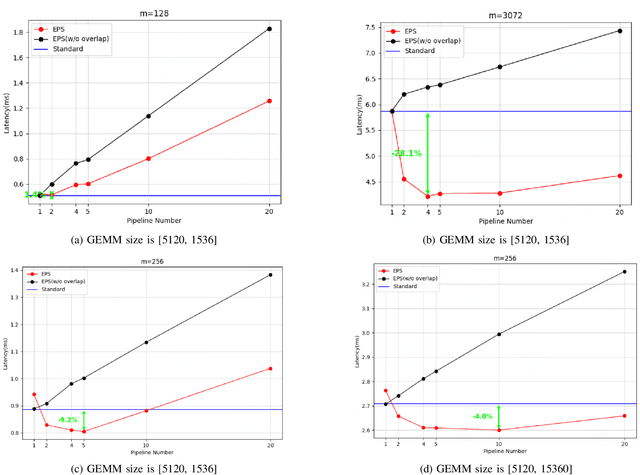
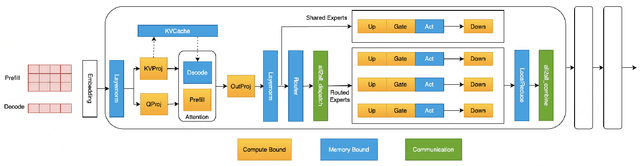
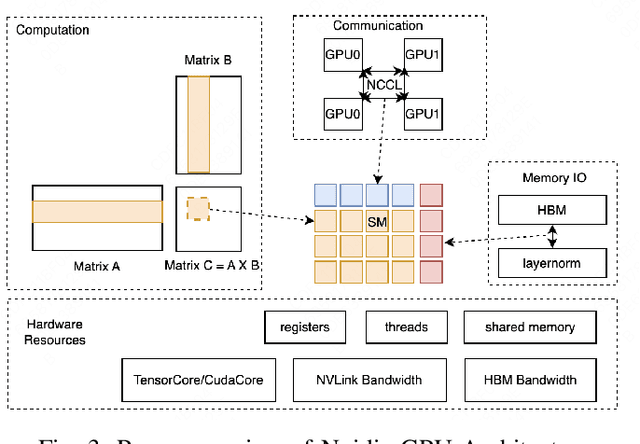
Large Language Model (LLM) has revolutionized the field of artificial intelligence, with their capabilities expanding rapidly due to advances in deep learning and increased computational resources. The mixture-of-experts (MoE) model has emerged as a prominent architecture in the field of LLM, better balancing the model performance and computational efficiency. MoE architecture allows for effective scaling and efficient parallel processing, but the GEMM (General Matrix Multiply) of MoE and the large parameters introduce challenges in terms of computation efficiency and communication overhead, which becomes the throughput bottleneck during inference. Applying a single parallelism strategy like EP, DP, PP, etc. to MoE architecture usually achieves sub-optimal inference throughput, the straightforward combinations of existing different parallelisms on MoE can not obtain optimal inference throughput yet. This paper introduces EPS-MoE, a novel expert pipeline scheduler for MoE that goes beyond the existing inference parallelism schemes. Our approach focuses on optimizing the computation of MoE FFN (FeedForward Network) modules by dynamically selecting the best kernel implementation of GroupGemm and DenseGemm for different loads and adaptively overlapping these computations with \textit{all2all} communication, leading to a substantial increase in throughput. Our experimental results demonstrate an average 21% improvement in prefill throughput over existing parallel inference methods. Specifically, we validated our method on DeepSeekV2, a highly optimized model claimed to achieve a prefill throughput of 100K tokens per second. By applying EPS-MoE, we further accelerated it to at least 120K tokens per second.