 Add to Chrome
 Add to Firefox
 Add to Edge
Coverage-based Fairness in Multi-document Summarization
Dec 11, 2024
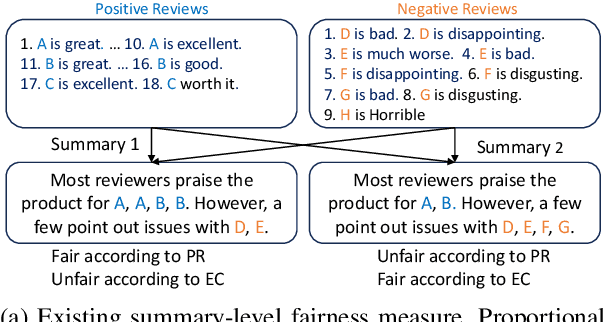

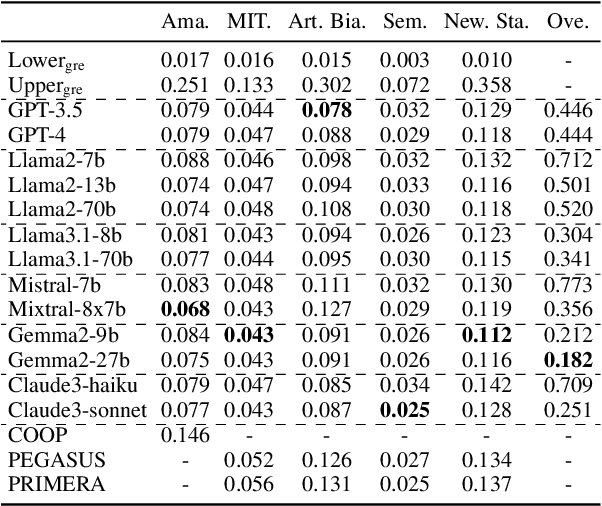
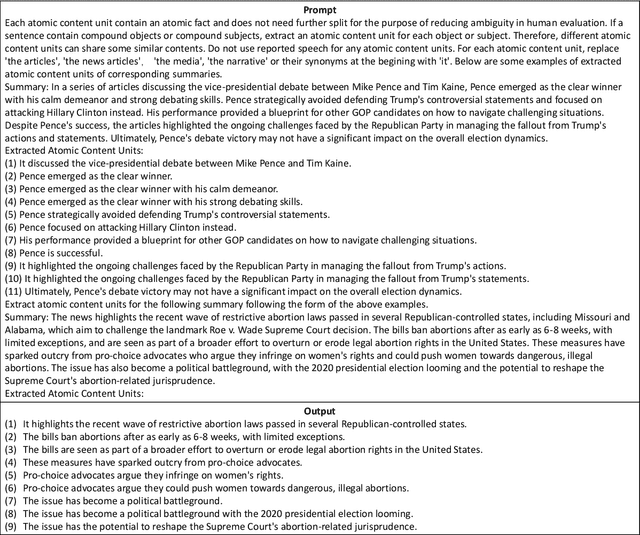
Fairness in multi-document summarization (MDS) measures whether a system can generate a summary fairly representing information from documents with different social attribute values. Fairness in MDS is crucial since a fair summary can offer readers a comprehensive view. Previous works focus on quantifying summary-level fairness using Proportional Representation, a fairness measure based on Statistical Parity. However, Proportional Representation does not consider redundancy in input documents and overlooks corpus-level unfairness. In this work, we propose a new summary-level fairness measure, Equal Coverage, which is based on coverage of documents with different social attribute values and considers the redundancy within documents. To detect the corpus-level unfairness, we propose a new corpus-level measure, Coverage Parity. Our human evaluations show that our measures align more with our definition of fairness. Using our measures, we evaluate the fairness of thirteen different LLMs. We find that Claude3-sonnet is the fairest among all evaluated LLMs. We also find that almost all LLMs overrepresent different social attribute values.

OmniDocBench: Benchmarking Diverse PDF Document Parsing with Comprehensive Annotations
Dec 10, 2024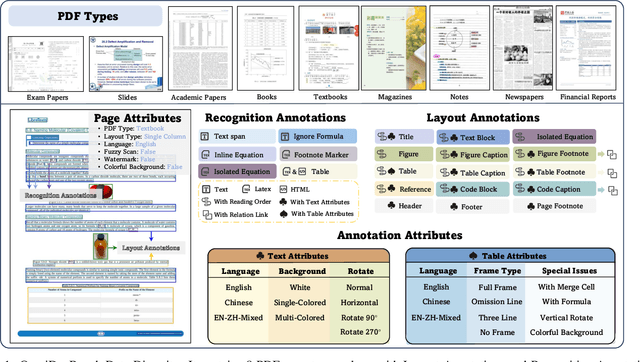

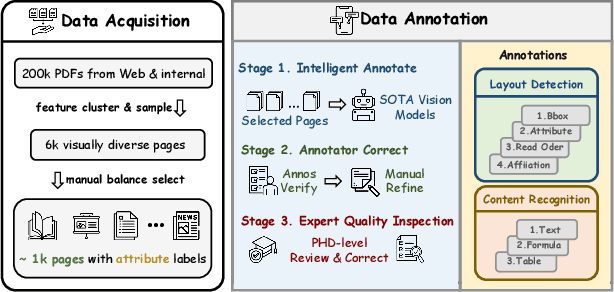
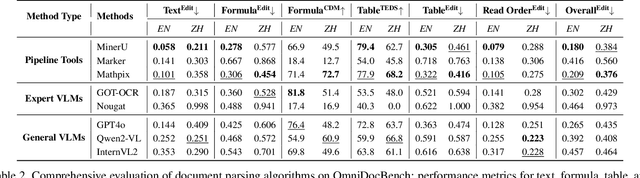
Document content extraction is crucial in computer vision, especially for meeting the high-quality data needs of large language models (LLMs) and retrieval-augmented generation (RAG) technologies. However, current document parsing methods suffer from significant limitations in terms of diversity and comprehensive evaluation. To address these challenges, we introduce OmniDocBench, a novel multi-source benchmark designed to advance automated document content extraction. OmniDocBench includes a meticulously curated and annotated high-quality evaluation dataset comprising nine diverse document types, such as academic papers, textbooks, slides, among others. Our benchmark provides a flexible and comprehensive evaluation framework with 19 layout category labels and 14 attribute labels, enabling multi-level assessments across entire datasets, individual modules, or specific data types. Using OmniDocBench, we perform an exhaustive comparative analysis of existing modular pipelines and multimodal end-to-end methods, highlighting their limitations in handling document diversity and ensuring fair evaluation. OmniDocBench establishes a robust, diverse, and fair evaluation standard for the document content extraction field, offering crucial insights for future advancements and fostering the development of document parsing technologies. The codes and dataset is available in https://github.com/opendatalab/OmniDocBench.
World-Consistent Data Generation for Vision-and-Language Navigation
Dec 09, 2024Vision-and-Language Navigation (VLN) is a challenging task that requires an agent to navigate through photorealistic environments following natural-language instructions. One main obstacle existing in VLN is data scarcity, leading to poor generalization performance over unseen environments. Tough data argumentation is a promising way for scaling up the dataset, how to generate VLN data both diverse and world-consistent remains problematic. To cope with this issue, we propose the world-consistent data generation (WCGEN), an efficacious data-augmentation framework satisfying both diversity and world-consistency, targeting at enhancing the generalizations of agents to novel environments. Roughly, our framework consists of two stages, the trajectory stage which leverages a point-cloud based technique to ensure spatial coherency among viewpoints, and the viewpoint stage which adopts a novel angle synthesis method to guarantee spatial and wraparound consistency within the entire observation. By accurately predicting viewpoint changes with 3D knowledge, our approach maintains the world-consistency during the generation procedure. Experiments on a wide range of datasets verify the effectiveness of our method, demonstrating that our data augmentation strategy enables agents to achieve new state-of-the-art results on all navigation tasks, and is capable of enhancing the VLN agents' generalization ability to unseen environments.
SiReRAG: Indexing Similar and Related Information for Multihop Reasoning
Dec 09, 2024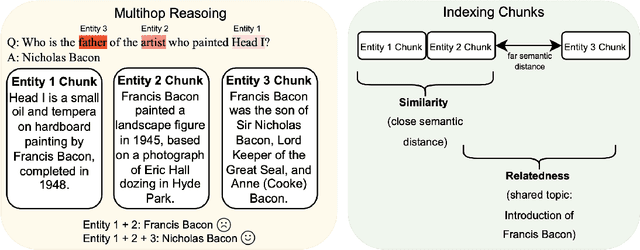

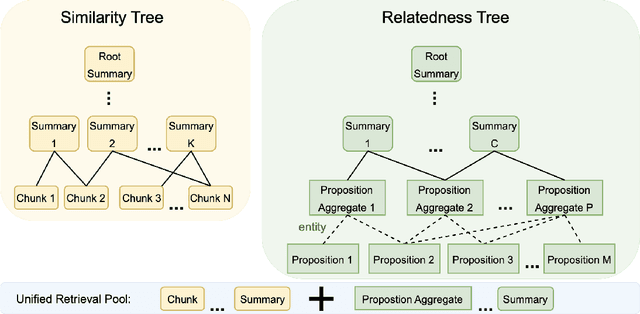

Indexing is an important step towards strong performance in retrieval-augmented generation (RAG) systems. However, existing methods organize data based on either semantic similarity (similarity) or related information (relatedness), but do not cover both perspectives comprehensively. Our analysis reveals that modeling only one perspective results in insufficient knowledge synthesis, leading to suboptimal performance on complex tasks requiring multihop reasoning. In this paper, we propose SiReRAG, a novel RAG indexing approach that explicitly considers both similar and related information. On the similarity side, we follow existing work and explore some variances to construct a similarity tree based on recursive summarization. On the relatedness side, SiReRAG extracts propositions and entities from texts, groups propositions via shared entities, and generates recursive summaries to construct a relatedness tree. We index and flatten both similarity and relatedness trees into a unified retrieval pool. Our experiments demonstrate that SiReRAG consistently outperforms state-of-the-art indexing methods on three multihop datasets (MuSiQue, 2WikiMultiHopQA, and HotpotQA), with an average 1.9% improvement in F1 scores. As a reasonably efficient solution, SiReRAG enhances existing reranking methods significantly, with up to 7.8% improvement in average F1 scores.
Passive Six-Dimensional Movable Antenna (6DMA)-Assisted Multiuser Communication
Dec 06, 2024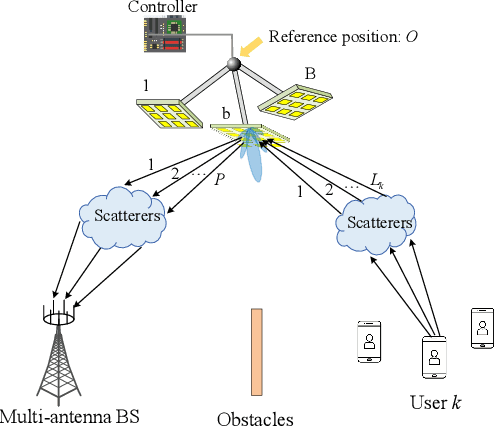
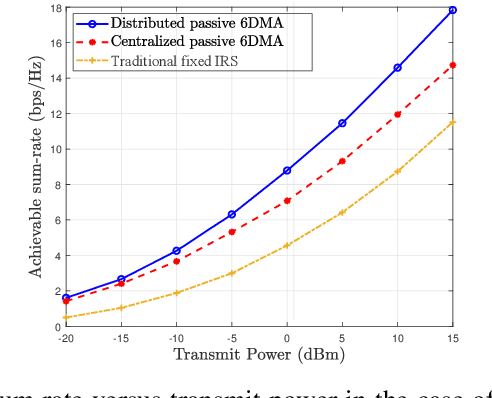
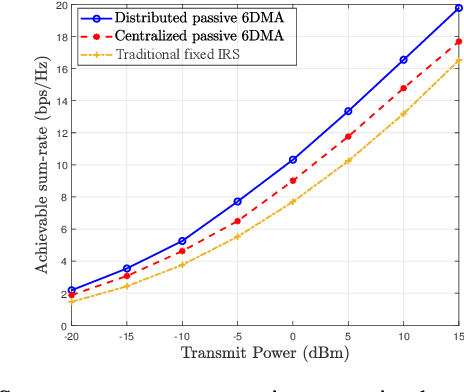
Six-dimensional movable antenna (6DMA) is a promising solution for enhancing wireless network capacity through the adjustment of both three-dimensional (3D) positions and 3D rotations of distributed antenna surfaces. Previous works mainly consider 6DMA surfaces composed of active antenna elements, thus termed as active 6DMA. In this letter, we propose a new passive 6DMA system consisting of distributed passive intelligent reflecting surfaces (IRSs) that can be adjusted in terms of 3D position and 3D rotation. Specifically, we study a passive 6DMA-aided multiuser uplink system and aim to maximize the users' achievable sum rate by jointly optimizing the 3D positions, 3D rotations, and reflection coefficients of all passive 6DMA surfaces, as well as the receive beamforming matrix at the base station (BS). To solve this challenging non-convex optimization problem, we propose an alternating optimization (AO) algorithm that decomposes it into three subproblems and solves them alternately in an iterative manner. Numerical results are presented to investigate the performance of the proposed passive 6DMA system under different configurations and demonstrate its superior performance over the traditional fixed-IRS counterpart for both directive and isotropic radiation patterns of passive reflecting elements.
6DMA-Aided Cell-Free Massive MIMO Communication
Dec 02, 2024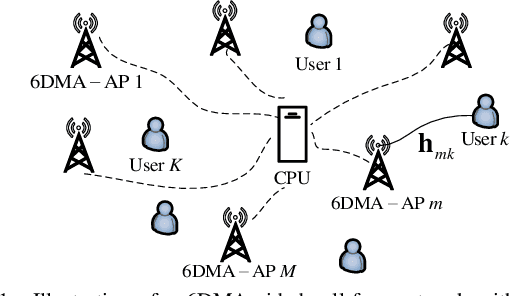
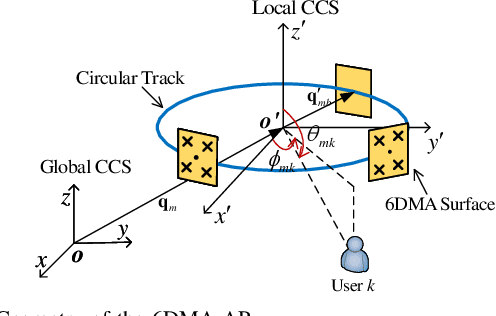
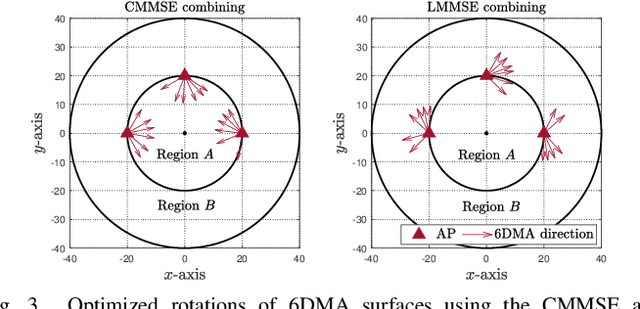
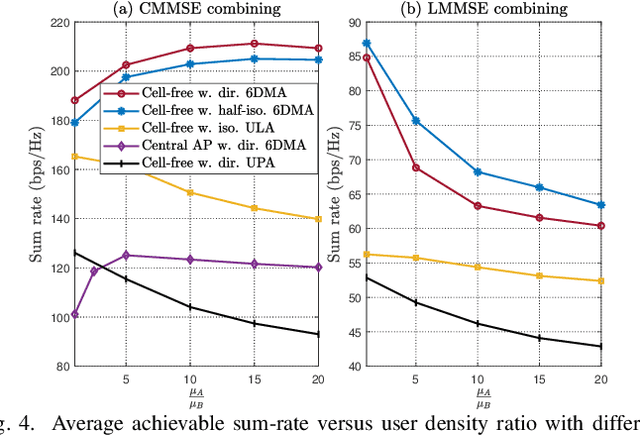
In this letter, we propose a six-dimensional movable antenna (6DMA)-aided cell-free massive multiple-input multiple-output (MIMO) system to fully exploit its macro spatial diversity, where a set of distributed access points (APs), each equipped with multiple 6DMA surfaces, cooperatively serve all users in a given area. Connected to a central processing unit (CPU) via fronthaul links, 6DMA-APs can optimize their combining vectors for decoding the users' information based on either local channel state information (CSI) or global CSI shared among them. We aim to maximize the average achievable sum-rate via jointly optimizing the rotation angles of all 6DMA surfaces at all APs, based on the users' spatial distribution. Since the formulated problem is non-convex and highly non-linear, we propose a Bayesian optimization-based algorithm to solve it efficiently. Simulation results show that, by enhancing signal power and mitigating interference through reduced channel cross-correlation among users, 6DMA-APs with optimized rotations can significantly improve the average sum-rate, as compared to the conventional cell-free network with fixed-position antennas and that with only a single centralized AP with optimally rotated 6DMAs, especially when the user distribution is more spatially diverse.
VisOnlyQA: Large Vision Language Models Still Struggle with Visual Perception of Geometric Information
Dec 01, 2024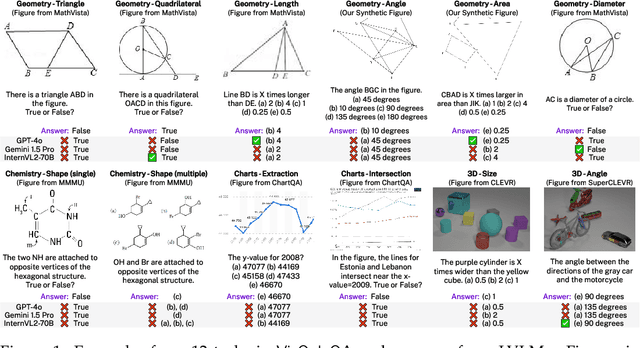
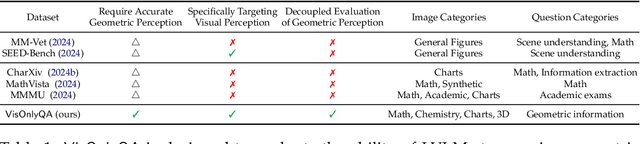
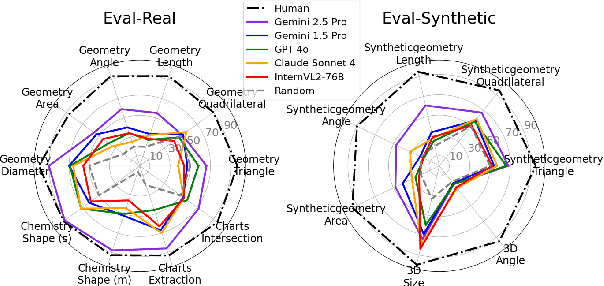
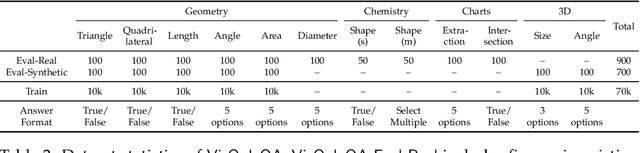
Errors in understanding visual information in images (i.e., visual perception errors) remain a major source of mistakes in Large Vision Language Models (LVLMs). While further analysis is essential, there is a deficiency in datasets for evaluating the visual perception of LVLMs. In this work, we introduce VisOnlyQA, a new dataset designed to directly evaluate the visual perception capabilities of LVLMs on questions about geometric and numerical information in scientific figures. Our dataset enables us to analyze the visual perception of LVLMs for fine-grained visual information, independent of other capabilities such as reasoning. The evaluation set of VisOnlyQA includes 1,200 multiple-choice questions in 12 tasks on four categories of figures. We also provide synthetic training data consisting of 70k instances. Our experiments on VisOnlyQA highlight the following findings: (i) 20 LVLMs we evaluate, including GPT-4o and Gemini 1.5 Pro, work poorly on the visual perception tasks in VisOnlyQA, while human performance is nearly perfect. (ii) Fine-tuning on synthetic training data demonstrates the potential for enhancing the visual perception of LVLMs, but observed improvements are limited to certain tasks and specific models. (iii) Stronger language models improve the visual perception of LVLMs. In summary, our experiments suggest that both training data and model architectures should be improved to enhance the visual perception capabilities of LVLMs. The datasets, code, and model responses are provided at https://github.com/psunlpgroup/VisOnlyQA.
Vision Mamba Distillation for Low-resolution Fine-grained Image Classification
Nov 27, 2024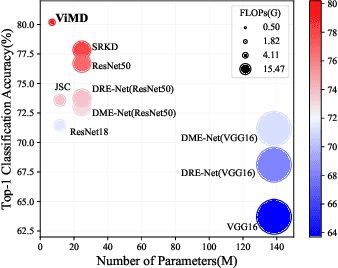

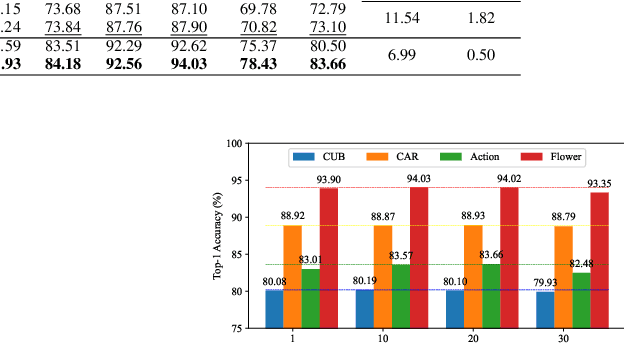

Low-resolution fine-grained image classification has recently made significant progress, largely thanks to the super-resolution techniques and knowledge distillation methods. However, these approaches lead to an exponential increase in the number of parameters and computational complexity of models. In order to solve this problem, in this letter, we propose a Vision Mamba Distillation (ViMD) approach to enhance the effectiveness and efficiency of low-resolution fine-grained image classification. Concretely, a lightweight super-resolution vision Mamba classification network (SRVM-Net) is proposed to improve its capability for extracting visual features by redesigning the classification sub-network with Mamba modeling. Moreover, we design a novel multi-level Mamba knowledge distillation loss boosting the performance, which can transfer prior knowledge obtained from a High-resolution Vision Mamba classification Network (HRVM-Net) as a teacher into the proposed SRVM-Net as a student. Extensive experiments on seven public fine-grained classification datasets related to benchmarks confirm our ViMD achieves a new state-of-the-art performance. While having higher accuracy, ViMD outperforms similar methods with fewer parameters and FLOPs, which is more suitable for embedded device applications. Code is available at https://github.com/boa2004plaust/ViMD.
Towards Cross-device and Training-free Robotic Grasping in 3D Open World
Nov 27, 2024Robotic grasping in the open world is a critical component of manufacturing and automation processes. While numerous existing approaches depend on 2D segmentation output to facilitate the grasping procedure, accurately determining depth from 2D imagery remains a challenge, often leading to limited performance in complex stacking scenarios. In contrast, techniques utilizing 3D point cloud data inherently capture depth information, thus enabling adeptly navigating and manipulating a diverse range of complex stacking scenes. However, such efforts are considerably hindered by the variance in data capture devices and the unstructured nature of the data, which limits their generalizability. Consequently, much research is narrowly concentrated on managing designated objects within specific settings, which confines their real-world applicability. This paper presents a novel pipeline capable of executing object grasping tasks in open-world scenarios even on previously unseen objects without the necessity for training. Additionally, our pipeline supports the flexible use of different 3D point cloud segmentation models across a variety of scenes. Leveraging the segmentation results, we propose to engage a training-free binary clustering algorithm that not only improves segmentation precision but also possesses the capability to cluster and localize unseen objects for executing grasping operations. In our experiments, we investigate a range of open-world scenarios, and the outcomes underscore the remarkable robustness and generalizability of our pipeline, consistent across various environments, robots, cameras, and objects. The code will be made available upon acceptance of the paper.
RAMIE: Retrieval-Augmented Multi-task Information Extraction with Large Language Models on Dietary Supplements
Nov 24, 2024\textbf{Objective:} We aimed to develop an advanced multi-task large language model (LLM) framework to extract multiple types of information about dietary supplements (DS) from clinical records. \textbf{Methods:} We used four core DS information extraction tasks - namely, named entity recognition (NER: 2,949 clinical sentences), relation extraction (RE: 4,892 sentences), triple extraction (TE: 2,949 sentences), and usage classification (UC: 2,460 sentences) as our multitasks. We introduced a novel Retrieval-Augmented Multi-task Information Extraction (RAMIE) Framework, including: 1) employed instruction fine-tuning techniques with task-specific prompts, 2) trained LLMs for multiple tasks with improved storage efficiency and lower training costs, and 3) incorporated retrieval augmentation generation (RAG) techniques by retrieving similar examples from the training set. We compared RAMIE's performance to LLMs with instruction fine-tuning alone and conducted an ablation study to assess the contributions of multi-task learning and RAG to improved multitasking performance. \textbf{Results:} With the aid of the RAMIE framework, Llama2-13B achieved an F1 score of 87.39 (3.51\% improvement) on the NER task and demonstrated outstanding performance on the RE task with an F1 score of 93.74 (1.15\% improvement). For the TE task, Llama2-7B scored 79.45 (14.26\% improvement), and MedAlpaca-7B achieved the highest F1 score of 93.45 (0.94\% improvement) on the UC task. The ablation study revealed that while MTL increased efficiency with a slight trade-off in performance, RAG significantly boosted overall accuracy. \textbf{Conclusion:} This study presents a novel RAMIE framework that demonstrates substantial improvements in multi-task information extraction for DS-related data from clinical records. Our framework can potentially be applied to other domains.