 Add to Chrome
 Add to Firefox
 Add to Edge
Causality-inspired Federated Learning for Dynamic Spatio-Temporal Graphs
Mar 31, 2026
Federated Graph Learning (FGL) has emerged as a powerful paradigm for decentralized training of graph neural networks while preserving data privacy. However, existing FGL methods are predominantly designed for static graphs and rely on parameter averaging or distribution alignment, which implicitly assume that all features are equally transferable across clients, overlooking both the spatial and temporal heterogeneity and the presence of client-specific knowledge in real-world graphs. In this work, we identify that such assumptions create a vicious cycle of spurious representation entanglement, client-specific interference, and negative transfer, degrading generalization performance in Federated Learning over Dynamic Spatio-Temporal Graphs (FSTG). To address this issue, we propose a novel causality-inspired framework named SC-FSGL, which explicitly decouples transferable causal knowledge from client-specific noise through representation-level interventions. Specifically, we introduce a Conditional Separation Module that simulates soft interventions through client conditioned masks, enabling the disentanglement of invariant spatio-temporal causal factors from spurious signals and mitigating representation entanglement caused by client heterogeneity. In addition, we propose a Causal Codebook that clusters causal prototypes and aligns local representations via contrastive learning, promoting cross-client consistency and facilitating knowledge sharing across diverse spatio-temporal patterns. Experiments on five diverse heterogeneity Spatio-Temporal Graph (STG) datasets show that SC-FSGL outperforms state-of-the-art methods.

Vision Mamba Distillation for Low-resolution Fine-grained Image Classification
Nov 27, 2024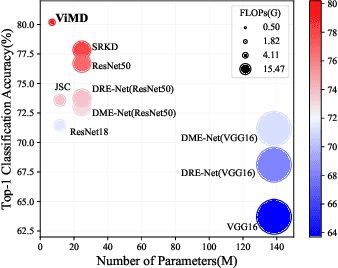

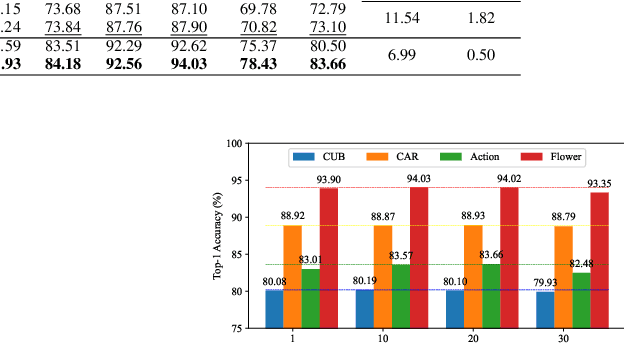

Low-resolution fine-grained image classification has recently made significant progress, largely thanks to the super-resolution techniques and knowledge distillation methods. However, these approaches lead to an exponential increase in the number of parameters and computational complexity of models. In order to solve this problem, in this letter, we propose a Vision Mamba Distillation (ViMD) approach to enhance the effectiveness and efficiency of low-resolution fine-grained image classification. Concretely, a lightweight super-resolution vision Mamba classification network (SRVM-Net) is proposed to improve its capability for extracting visual features by redesigning the classification sub-network with Mamba modeling. Moreover, we design a novel multi-level Mamba knowledge distillation loss boosting the performance, which can transfer prior knowledge obtained from a High-resolution Vision Mamba classification Network (HRVM-Net) as a teacher into the proposed SRVM-Net as a student. Extensive experiments on seven public fine-grained classification datasets related to benchmarks confirm our ViMD achieves a new state-of-the-art performance. While having higher accuracy, ViMD outperforms similar methods with fewer parameters and FLOPs, which is more suitable for embedded device applications. Code is available at https://github.com/boa2004plaust/ViMD.
Paying more attention to local contrast: improving infrared small target detection performance via prior knowledge
Nov 20, 2024The data-driven method for infrared small target detection (IRSTD) has achieved promising results. However, due to the small scale of infrared small target datasets and the limited number of pixels occupied by the targets themselves, it is a challenging task for deep learning methods to directly learn from these samples. Utilizing human expert knowledge to assist deep learning methods in better learning is worthy of exploration. To effectively guide the model to focus on targets' spatial features, this paper proposes the Local Contrast Attention Enhanced infrared small target detection Network (LCAE-Net), combining prior knowledge with data-driven deep learning methods. LCAE-Net is a U-shaped neural network model which consists of two developed modules: a Local Contrast Enhancement (LCE) module and a Channel Attention Enhancement (CAE) module. The LCE module takes advantages of prior knowledge, leveraging handcrafted convolution operator to acquire Local Contrast Attention (LCA), which could realize background suppression while enhance the potential target region, thus guiding the neural network to pay more attention to potential infrared small targets' location information. To effectively utilize the response information throughout downsampling progresses, the CAE module is proposed to achieve the information fusion among feature maps' different channels. Experimental results indicate that our LCAE-Net outperforms existing state-of-the-art methods on the three public datasets NUDT-SIRST, NUAA-SIRST, and IRSTD-1K, and its detection speed could reach up to 70 fps. Meanwhile, our model has a parameter count and Floating-Point Operations (FLOPs) of 1.945M and 4.862G respectively, which is suitable for deployment on edge devices.