 Add to Chrome
 Add to Firefox
 Add to Edge
Rotatable Antenna Enabled Multi-Cell Mixed Near-Field and Far-Field Communications
Apr 07, 2026
Prior studies on mixed near-field and far-field communications have focused exclusively on single-cell scenarios, where both near-field and far-field users are served by the same base station (BS), leading to intra-cell mixed-field interference. In this paper, we consider a more general and practical multi-cell mixed-field scenario consisting of multiple cells, each serving multiple users, thus resulting in more complex inter-cell mixed-field interference. To address this new challenge, we propose leveraging rotatable antenna (RA) technology to enhance multi-cell mixed-field communication performance by exploiting the additional spatial degree-of-freedom introduced by RA rotation to mitigate interference in an efficient way. Specifically, we study an RA-enabled multi-cell mixed-field communication system in which each BS is equipped with an RA array to serve its associated users. We formulate a network-wide sum-rate maximization problem that jointly optimizes the transmit beamforming and the rotation angles of the RA arrays, subject to per-BS power constraints and admissible array rotation limits. To gain useful insights into the role of RAs in multi-cell mixed-field communications, we first analyze a special case with a single user per cell. For this case, we obtain a closed-form expression for the rotation-aware inter-cell mixed-field interference using the Fresnel integrals and analytically show that RA rotation can effectively mitigate such interference, thereby substantially improving system performance. For the general case with multiple users per cell, we develop an efficient double-layer algorithm: the inner layer optimizes the transmit beamforming at each BS via semidefinite relaxation and successive convex approximation; while the outer layer determines the rotation angles of the RA arrays using particle swarm optimization.

Rotatable Antenna-Empowered Wireless Networks: A Tutorial
Mar 26, 2026Non-fixed flexible antenna architectures, such as fluid antenna system (FAS), movable antenna (MA), and pinching antenna, have garnered significant interest in recent years. Among them, rotatable antenna (RA) has emerged as a promising technology for enhancing wireless communication and sensing performance through flexible antenna orientation/boresight rotation. By enabling mechanical or electronic boresight adjustment without altering physical antenna positions, RA introduces additional spatial degrees of freedom (DoFs) beyond conventional beamforming. In this paper, we provide a comprehensive tutorial on the fundamentals, architectures, and applications of RA-empowered wireless networks. Specifically, we begin by reviewing the historical evolution of RA-related technologies and clarifying the distinctive role of RA among flexible antenna architectures. Then, we establish a unified mathematical framework for RA-enabled systems, including general antenna/array rotation models, as well as channel models that cover near- and far-field propagation characteristics, wideband frequency selectivity, and polarization effects. Building upon this foundation, we investigate antenna/array rotation optimization in representative communication and sensing scenarios. Furthermore, we examine RA channel estimation/acquisition strategies encompassing orientation scheduling mechanisms and signal processing methods that exploit multi-view channel observations. Beyond theoretical modeling and algorithmic design, we discuss practical RA configurations and deployment strategies. We also present recent RA prototypes and experimental results that validate the practical performance gains enabled by antenna rotation. Finally, we highlight promising extensions of RA to emerging wireless paradigms and outline open challenges to inspire future research.
Rotatable Antenna Array-Enhanced Null Steering: Performance Analysis and Optimization
Dec 13, 2025Conventional fixed-orientation antenna (FOA) arrays offer limited degrees of freedom (DoF) for flexible beamforming such as null steering. To address this limitation, we propose a new rotatable antenna array (RAA) architecture in this paper, which enables three-dimensional (3D) rotational control of an antenna array to provide enhanced spatial flexibility for null steering. To characterize its performance, we aim to jointly optimize the 3D rotational angles of the RAA, to maximize the beam gain over a given desired direction, while nulling those over multiple interference directions under zero-forcing (ZF) beamforming. However, this problem is non-convex and challenging to tackle due to the highly nonlinear expression of the beam gain in terms of the rotational angles. To gain insights, we first examine several special cases including both isotropic and directional antenna radiation patterns, deriving the conditions under which full beam gain can be achieved over the desired direction while meeting the nulling constraints for interference directions. These conditions clearly indicate that compared with FOA arrays, RAAs can significantly relax the angular separation requirement for achieving effective null steering. For other general cases, we propose a sequential update algorithm, that iteratively refines the 3D rotational angles by discretizing the 3D angular search space. To avoid undesired local optimum, a Gibbs sampling (GS) procedure is also employed between two consecutive rounds of sequential update for solution exploration. Simulation results verify our analytical results and show superior null-steering performance of RAAs to FOA arrays.
Position Optimization for Two-layer Movable Antenna Systems
Nov 19, 2025Movable antenna (MA) is a promising technology for improving the performance of wireless communication systems by providing new degrees-of-freedom (DoFs) in antenna position optimization. However, existing works on MA systems have mostly considered element-wise single-layer MA (SL-MA) arrays, where all the MAs move within the given movable region, hence inevitably incurring high control complexity and hardware cost in practice. To address this issue, we propose in this letter a new two-layer MA array (TL-MA), where the positions of MAs are jointly determined by the large-scale movement of multiple subarrays and the small-scale fine-tuning of per-subarray MAs. In particular, an optimization problem is formulated to maximize the sum-rate of the TL-MA-aided communication system by jointly optimizing the subarray-positions, per-subarray (relative) MA positions, and receive beamforming. To solve this non-convex problem, we propose an alternating optimization (AO)-based particle swarm optimization (PSO) algorithm, which alternately optimizes the positions of subarrays and per-subarray MAs, given the optimal receive beamforming. Numerical results verify that the proposed TL-MA significantly reduces the sum-displacement of MA motors (i.e., the total moving distances of all motors) of element-wise SL-MA, while achieving comparable rate performance.
Rotatable Antenna-Enabled Secure Wireless Communication
Apr 15, 2025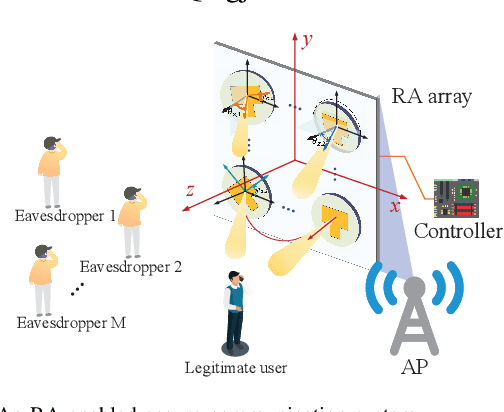
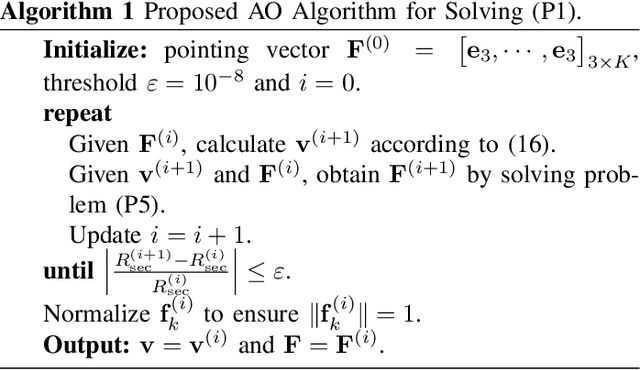
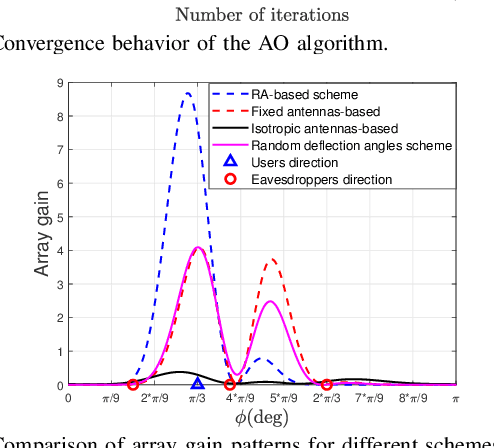
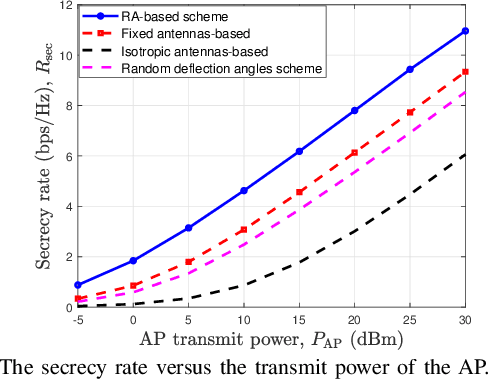
Rotatable antenna (RA) is a promising technology that exploits new spatial degrees of freedom (DoFs) to improve wireless communication and sensing performance. In this letter, we investigate an RA-enabled secure communication system where confidential information is transmitted from an RA-based access point (AP) to a single-antenna legitimate user in the presence of multiple eavesdroppers. We aim to maximize the achievable secrecy rate by jointly optimizing the transmit beamforming and the deflection angles of all RAs. Accordingly, we propose an efficient alternating optimization (AO) algorithm to obtain a high-quality suboptimal solution in an iterative manner, where the generalized Rayleigh quotient-based beamforming is applied and the RAs' deflection angles are optimized by the successive convex approximation (SCA). Simulation results show that the proposed RA-enabled secure communication system achieves significant improvement in achievable secrecy rate as compared to various benchmark schemes.
Rotatable Antennas for Integrated Sensing and Communications
Mar 13, 2025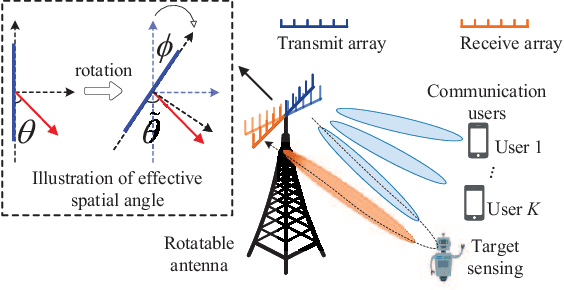
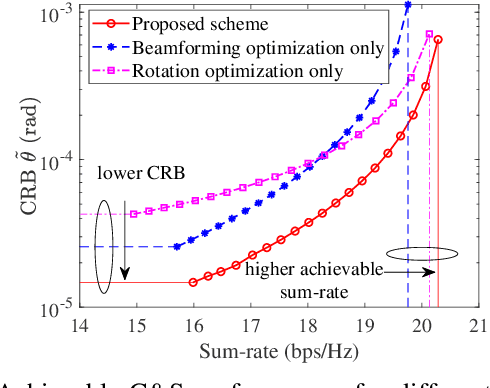
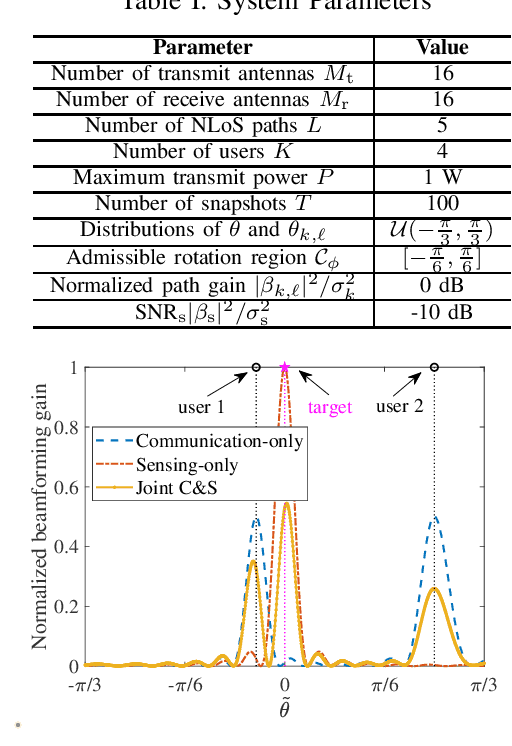
In this letter, we propose to deploy rotatable antennas (RAs) at the base station (BS) to enhance both communication and sensing (C&S) performances, by exploiting a new spatial degree-of-freedom (DoF) offered by array rotation. Specifically, we formulate a multi-objective optimization problem to simultaneously maximize the sum-rate of multiple communication users and minimize the Cram\'er-Rao bound (CRB) for target angle estimation, by jointly optimizing the transmit beamforming vectors and the array rotation angle at the BS. To solve this problem, we first equivalently decompose it into two subproblems, corresponding to an inner problem for beamforming optimization and an outer problem for array rotation optimization. Although these two subproblems are non-convex, we obtain their high-quality solutions by applying the block coordinate descent (BCD) technique and one-dimensional exhaustive search, respectively. Moreover, we show that for the communication-only case, RAs provide an additional rotation gain to improve communication performance; while for the sensing-only case, the equivalent spatial aperture can be enlarged by RAs for achieving higher sensing accuracy. Finally, numerical results are presented to showcase the performance gains of RAs over fixed-rotation antennas in integrated sensing and communications (ISAC).
Linear Model of RIS-Aided High-Mobility Communication System
Feb 28, 2025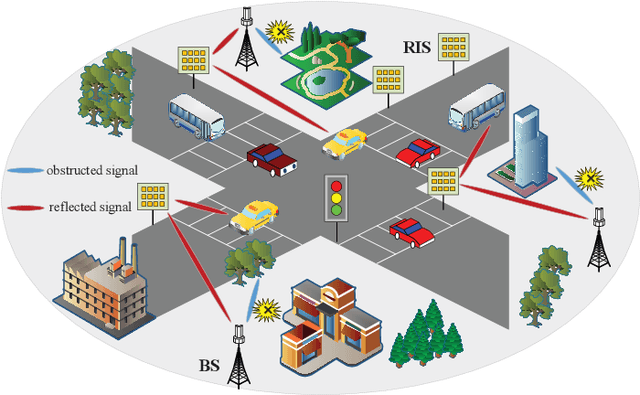
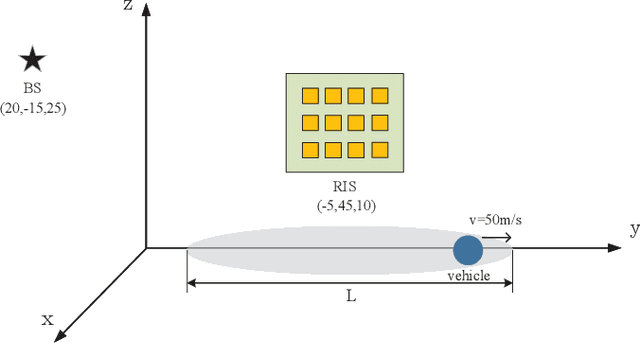
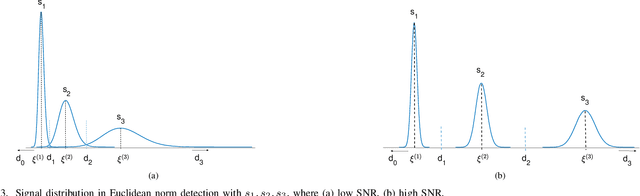
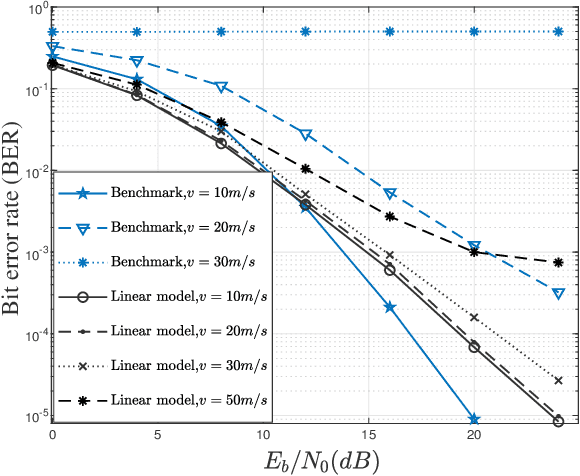
Reconfigurable intelligent surface (RIS)-aided vehicle-to-everything (V2X) communication has emerged as a crucial solution for providing reliable data services to vehicles on the road. However, in delay-sensitive or high-mobility communications, the rapid movement of vehicles can lead to random scattering in the environment and time-selective fading in the channel. In view of this, we investigate in this paper an innovative linear model with low-complexity transmitter signal design and receiver detection methods, which boost stability in fast-fading environments and reduce channel training overhead. Specifically, considering the differences in hardware design and signal processing at the receiving end between uplink and downlink communication systems, distinct solutions are proposed. Accordingly, we first integrate the Rician channel introduced by the RIS with the corresponding signal processing algorithms to model the RIS-aided downlink communication system as a Doppler-robust linear model. Inspired by this property, we design a precoding scheme based on the linear model to reduce the complexity of precoding. Then, by leveraging the linear model and the large-scale antenna array at the base station (BS) side, we improve the linear model for the uplink communication system and derive its asymptotic performance in closed-form. Simulation results demonstrate the performance advantages of the proposed RIS-aided high-mobility communication system compared to other benchmark schemes.
* accepted in IEEE Transactions on Vehicular Technology( Early Access )
Joint Size and Placement Optimization for IRS-Aided Communications with Active and Passive Elements
Feb 24, 2025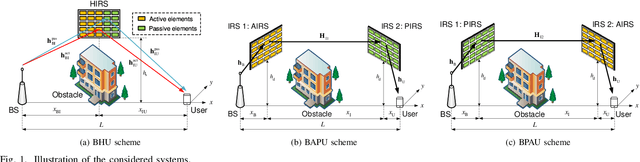
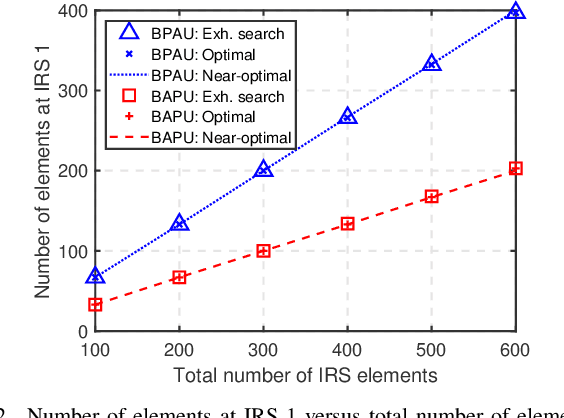
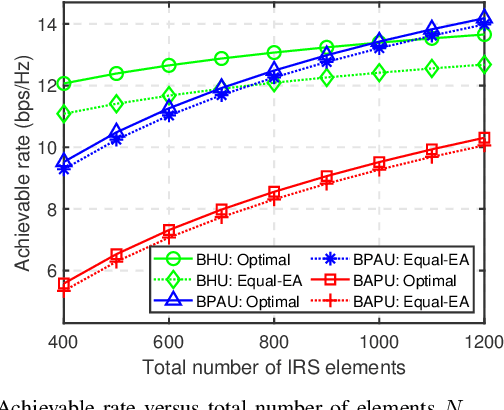
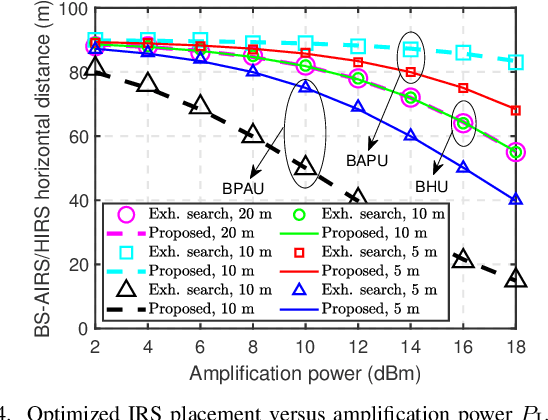
Different types of intelligent reflecting surfaces (IRS) are exploited for assisting wireless communications. The joint use of passive IRS (PIRS) and active IRS (AIRS) emerges as a promising solution owing to their complementary advantages. They can be integrated into a single hybrid active-passive IRS (HIRS) or deployed in a distributed manner, which poses challenges in determining the IRS element allocation and placement for rate maximization. In this paper, we investigate the capacity of an IRS-aided wireless communication system with both active and passive elements. Specifically, we consider three deployment schemes: 1) base station (BS)-HIRS-user (BHU); 2) BS-AIRS-PIRS-user (BAPU); 3) BS-PIRS-AIRS-user (BPAU). Under the line-of-sight channel model, we formulate a rate maximization problem via a joint optimization of the IRS element allocation and placement. We first derive the optimized number of active and passive elements for BHU, BAPU, and BPAU schemes, respectively. Then, low-complexity HIRS/AIRS placement strategies are provided. To obtain more insights, we characterize the system capacity scaling orders for the three schemes with respect to the large total number of IRS elements, amplification power budget, and BS transmit power. Finally, simulation results are presented to validate our theoretical findings and show the performance difference among the BHU, BAPU, and BPAU schemes with the proposed joint design under various system setups.
Rotatable Antenna Enabled Wireless Communication: Modeling and Optimization
Jan 07, 2025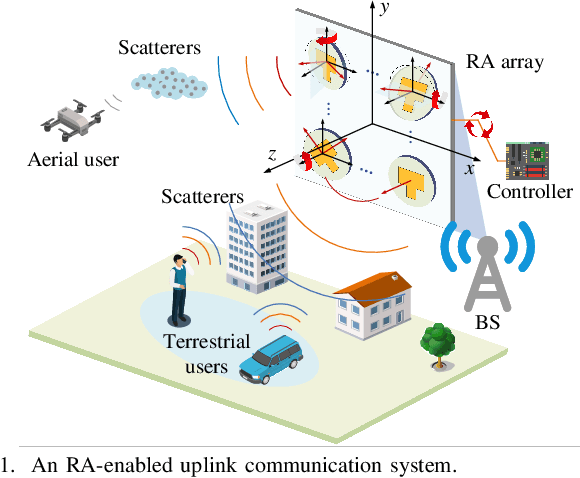
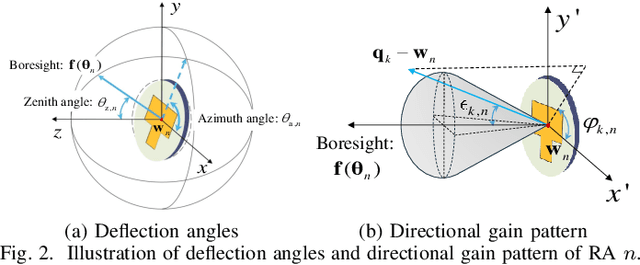
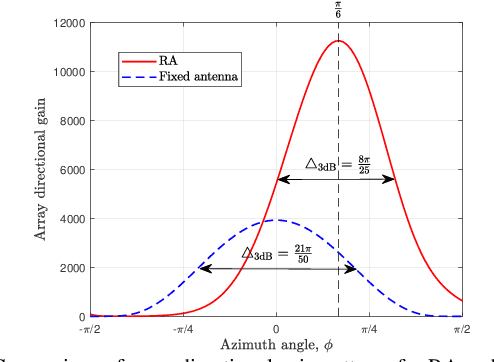
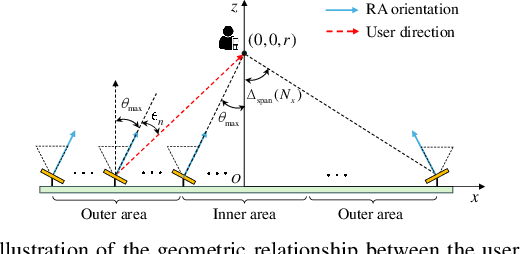
Fluid antenna system (FAS) and movable antenna (MA) have recently emerged as promising technologies to exploit new spatial degrees of freedom (DoFs), which have attracted growing attention in wireless communication. In this paper, we propose a new rotatable antenna (RA) model to improve the performance of wireless communication systems. Different from conventional fixed antennas, the proposed RA system can flexibly alter the three-dimensional (3D) boresight direction of each antenna independently by adjusting its deflection angles to achieve a desired array directional gain pattern. Specifically, we investigate an RA-enabled uplink communication system, where the receive beamforming and the deflection angles of all RAs at the base station (BS) are jointly optimized to maximize the minimum signal-to-interference-plus-noise ratio (SINR) among all the users. In the special single-user and free-space propagation setup, the optimal deflection angles of RAs are derived in closed form with the maximum-ratio combining (MRC) beamformer applied at the BS. Moreover, we analyze the asymptotic performance with an infinite number of antennas based on this solution, which theoretically proves that the RA system can achieve a higher array gain as compared to the fixed-antenna system. In the general multi-user and multi-path channel setup, we first propose an alternating optimization (AO) algorithm to alternately optimize the receive beamforming and the deflection angles of RAs in an iterative manner. Then, a two-stage algorithm that solves the formulated problem without the need for iteration is further proposed to reduce computational complexity. Simulation results are provided to validate our analytical results and demonstrate that the proposed RA system can significantly outperform other benchmark schemes.
Passive Six-Dimensional Movable Antenna (6DMA)-Assisted Multiuser Communication
Dec 06, 2024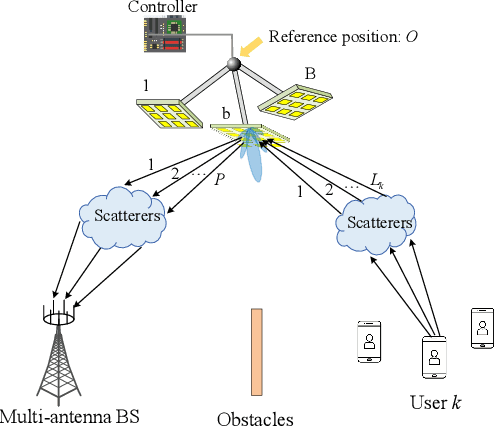
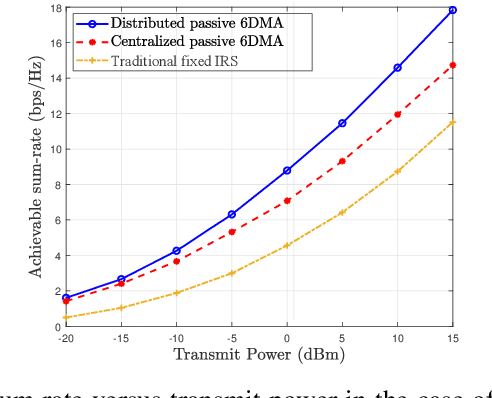
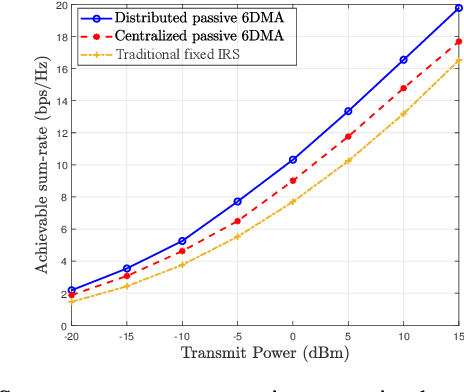
Six-dimensional movable antenna (6DMA) is a promising solution for enhancing wireless network capacity through the adjustment of both three-dimensional (3D) positions and 3D rotations of distributed antenna surfaces. Previous works mainly consider 6DMA surfaces composed of active antenna elements, thus termed as active 6DMA. In this letter, we propose a new passive 6DMA system consisting of distributed passive intelligent reflecting surfaces (IRSs) that can be adjusted in terms of 3D position and 3D rotation. Specifically, we study a passive 6DMA-aided multiuser uplink system and aim to maximize the users' achievable sum rate by jointly optimizing the 3D positions, 3D rotations, and reflection coefficients of all passive 6DMA surfaces, as well as the receive beamforming matrix at the base station (BS). To solve this challenging non-convex optimization problem, we propose an alternating optimization (AO) algorithm that decomposes it into three subproblems and solves them alternately in an iterative manner. Numerical results are presented to investigate the performance of the proposed passive 6DMA system under different configurations and demonstrate its superior performance over the traditional fixed-IRS counterpart for both directive and isotropic radiation patterns of passive reflecting elements.