 Add to Chrome
 Add to Firefox
 Add to Edge
Speculate with Memory: Lossless Acceleration for LLM Agents
Jul 14, 2026
Speculative execution accelerates LLM agents by using a smaller, cheaper model to predict and pre-launch the next step while the environment is idle. However, existing speculators are stateless and discard all information between tasks, preventing prediction quality from improving with experience. We equip the speculator with three online memory systems that learn from past agent trajectories: a contrastive transition table tracking action-sequence statistics, an episodic memory retrieving contextually similar segments, and a confusion tracker suppressing recurring errors. We evaluate this approach on six benchmarks spanning three speculation types: action prediction, observation prediction, and chained prediction. Memory-augmented speculation yields a 19--39\% relative accuracy improvement on action prediction and up to a $2.5\times$ increase on observation prediction tasks with repetitive action spaces. These gains grow continuously as memory accumulates and generalize across speculator models of varying cost. All speculation is lossless because it runs during idle time at zero added wall-clock cost, and the actor's trajectory is identical to non-speculative execution.

GTA: Generating Long-Horizon Tasks for Web Agents at Scale
May 28, 2026Web agents, which couple language models with browsing and tool-use capabilities, show promise as open web assistants. Yet progress is increasingly limited by the lack of scalable, process-level supervision. Existing benchmarks are largely manually constructed, providing only coarse start-goal annotations without intermediate trajectories, while recent automatic generation efforts remain expensive, biased, and shallow. These limitations prevent reliable training and evaluation of agents that must generalize to realistic, multi-hop, cross-page tasks. We introduce a scalable framework, GTA, that integrates crawling, retrieval-based seeding, in-context generation, and automated quality control to produce realistic tasks paired with executable trajectories. This design decouples crawling from generation for greater efficiency, grounds tasks in the site graph to enforce compositionality, and ensures dense supervision through deterministic replays and systematic validation. We instantiate the pipeline on over 50 websites covering e-commerce, government, forums, and news, with multilingual and multi-hop coverage. The resulting benchmark reveals a significant human-agent performance gap and enables detailed diagnostics. Our contributions are three-fold: (i) formalizing multi-hop web-agent task generation, (ii) proposing an efficient and validated pipeline for automatic data creation, and (iii) releasing a dynamic benchmark with reproducible evaluation.
Dont Stop Early: Scalable Enterprise Deep Research with Controlled Information Flow and Evidence-Aware Termination
Apr 27, 2026Enterprise deep research often fails to produce decision-ready reports due to uneven information coverage, context explosion, and premature stopping. We propose a scalable Enterprise Deep Research (EDR) architecture to address these failures. Our system (i) decomposes requests into coverage-driven objectives via outline generation with reflection, (ii) localizes context with dependency-guided execution and explicit information sharing, and (iii) enforces evidence-based completion criteria so agents iteratively collect information until sufficiency conditions are met. We evaluate on an internal sales enablement task and the public DeepResearch Bench benchmark, where our proposed system design achieves the strongest overall performance compared with competitive deep-research baselines. The results show that dependency-controlled context and explicit evidence sufficiency criteria reduce premature stopping and improve the consistency and depth of enterprise research outputs.
Agentic Uncertainty Quantification
Jan 22, 2026Although AI agents have demonstrated impressive capabilities in long-horizon reasoning, their reliability is severely hampered by the ``Spiral of Hallucination,'' where early epistemic errors propagate irreversibly. Existing methods face a dilemma: uncertainty quantification (UQ) methods typically act as passive sensors, only diagnosing risks without addressing them, while self-reflection mechanisms suffer from continuous or aimless corrections. To bridge this gap, we propose a unified Dual-Process Agentic UQ (AUQ) framework that transforms verbalized uncertainty into active, bi-directional control signals. Our architecture comprises two complementary mechanisms: System 1 (Uncertainty-Aware Memory, UAM), which implicitly propagates verbalized confidence and semantic explanations to prevent blind decision-making; and System 2 (Uncertainty-Aware Reflection, UAR), which utilizes these explanations as rational cues to trigger targeted inference-time resolution only when necessary. This enables the agent to balance efficient execution and deep deliberation dynamically. Extensive experiments on closed-loop benchmarks and open-ended deep research tasks demonstrate that our training-free approach achieves superior performance and trajectory-level calibration. We believe this principled framework AUQ represents a significant step towards reliable agents.
CRMArena-Pro: Holistic Assessment of LLM Agents Across Diverse Business Scenarios and Interactions
May 24, 2025While AI agents hold transformative potential in business, effective performance benchmarking is hindered by the scarcity of public, realistic business data on widely used platforms. Existing benchmarks often lack fidelity in their environments, data, and agent-user interactions, with limited coverage of diverse business scenarios and industries. To address these gaps, we introduce CRMArena-Pro, a novel benchmark for holistic, realistic assessment of LLM agents in diverse professional settings. CRMArena-Pro expands on CRMArena with nineteen expert-validated tasks across sales, service, and 'configure, price, and quote' processes, for both Business-to-Business and Business-to-Customer scenarios. It distinctively incorporates multi-turn interactions guided by diverse personas and robust confidentiality awareness assessments. Experiments reveal leading LLM agents achieve only around 58% single-turn success on CRMArena-Pro, with performance dropping significantly to approximately 35% in multi-turn settings. While Workflow Execution proves more tractable for top agents (over 83% single-turn success), other evaluated business skills present greater challenges. Furthermore, agents exhibit near-zero inherent confidentiality awareness; though targeted prompting can improve this, it often compromises task performance. These findings highlight a substantial gap between current LLM capabilities and enterprise demands, underscoring the need for advancements in multi-turn reasoning, confidentiality adherence, and versatile skill acquisition.
Turning Conversations into Workflows: A Framework to Extract and Evaluate Dialog Workflows for Service AI Agents
Feb 24, 2025Automated service agents require well-structured workflows to provide consistent and accurate responses to customer queries. However, these workflows are often undocumented, and their automatic extraction from conversations remains unexplored. In this work, we present a novel framework for extracting and evaluating dialog workflows from historical interactions. Our extraction process consists of two key stages: (1) a retrieval step to select relevant conversations based on key procedural elements, and (2) a structured workflow generation process using a question-answer-based chain-of-thought (QA-CoT) prompting. To comprehensively assess the quality of extracted workflows, we introduce an automated agent and customer bots simulation framework that measures their effectiveness in resolving customer issues. Extensive experiments on the ABCD and SynthABCD datasets demonstrate that our QA-CoT technique improves workflow extraction by 12.16\% in average macro accuracy over the baseline. Moreover, our evaluation method closely aligns with human assessments, providing a reliable and scalable framework for future research.
Unanswerability Evaluation for Retreival Augmented Generation
Dec 16, 2024Existing evaluation frameworks for retrieval-augmented generation (RAG) systems focus on answerable queries, but they overlook the importance of appropriately rejecting unanswerable requests. In this paper, we introduce UAEval4RAG, a framework designed to evaluate whether RAG systems can handle unanswerable queries effectively. We define a taxonomy with six unanswerable categories, and UAEval4RAG automatically synthesizes diverse and challenging queries for any given knowledge base with unanswered ratio and acceptable ratio metrics. We conduct experiments with various RAG components, including retrieval models, rewriting methods, rerankers, language models, and prompting strategies, and reveal hidden trade-offs in performance of RAG systems. Our findings highlight the critical role of component selection and prompt design in optimizing RAG systems to balance the accuracy of answerable queries with high rejection rates of unanswerable ones. UAEval4RAG provides valuable insights and tools for developing more robust and reliable RAG systems.
SiReRAG: Indexing Similar and Related Information for Multihop Reasoning
Dec 09, 2024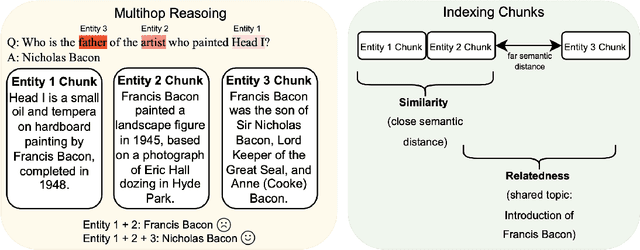

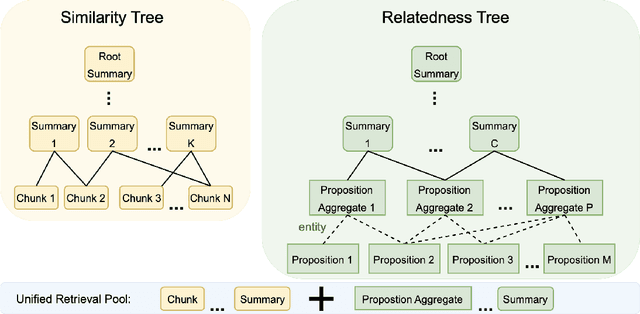

Indexing is an important step towards strong performance in retrieval-augmented generation (RAG) systems. However, existing methods organize data based on either semantic similarity (similarity) or related information (relatedness), but do not cover both perspectives comprehensively. Our analysis reveals that modeling only one perspective results in insufficient knowledge synthesis, leading to suboptimal performance on complex tasks requiring multihop reasoning. In this paper, we propose SiReRAG, a novel RAG indexing approach that explicitly considers both similar and related information. On the similarity side, we follow existing work and explore some variances to construct a similarity tree based on recursive summarization. On the relatedness side, SiReRAG extracts propositions and entities from texts, groups propositions via shared entities, and generates recursive summaries to construct a relatedness tree. We index and flatten both similarity and relatedness trees into a unified retrieval pool. Our experiments demonstrate that SiReRAG consistently outperforms state-of-the-art indexing methods on three multihop datasets (MuSiQue, 2WikiMultiHopQA, and HotpotQA), with an average 1.9% improvement in F1 scores. As a reasonably efficient solution, SiReRAG enhances existing reranking methods significantly, with up to 7.8% improvement in average F1 scores.
Distill-SynthKG: Distilling Knowledge Graph Synthesis Workflow for Improved Coverage and Efficiency
Oct 22, 2024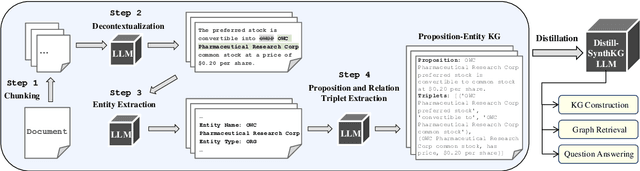
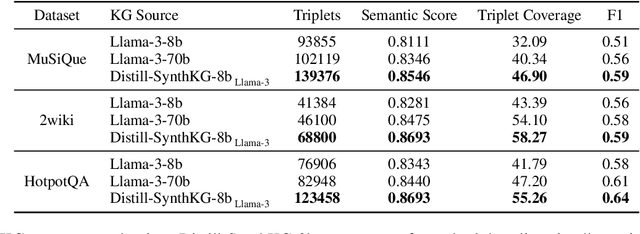
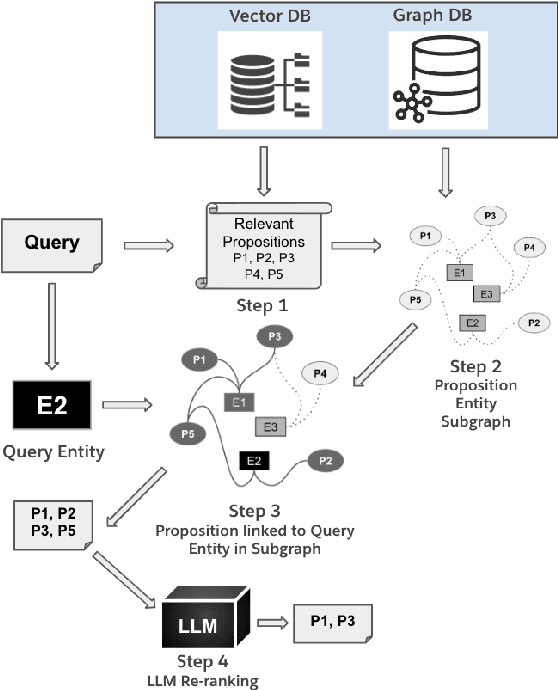
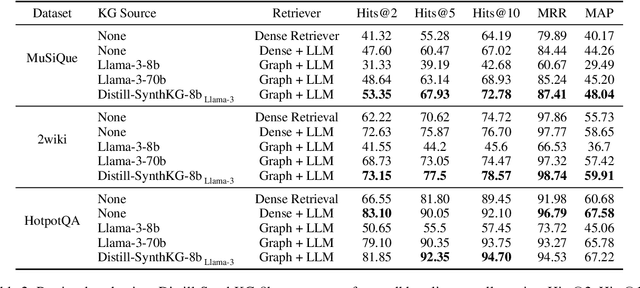
Knowledge graphs (KGs) generated by large language models (LLMs) are becoming increasingly valuable for Retrieval-Augmented Generation (RAG) applications that require knowledge-intensive reasoning. However, existing KG extraction methods predominantly rely on prompt-based approaches, which are inefficient for processing large-scale corpora. These approaches often suffer from information loss, particularly with long documents, due to the lack of specialized design for KG construction. Additionally, there is a gap in evaluation datasets and methodologies for ontology-free KG construction. To overcome these limitations, we propose SynthKG, a multi-step, document-level ontology-free KG synthesis workflow based on LLMs. By fine-tuning a smaller LLM on the synthesized document-KG pairs, we streamline the multi-step process into a single-step KG generation approach called Distill-SynthKG, substantially reducing the number of LLM inference calls. Furthermore, we re-purpose existing question-answering datasets to establish KG evaluation datasets and introduce new evaluation metrics. Using KGs produced by Distill-SynthKG, we also design a novel graph-based retrieval framework for RAG. Experimental results demonstrate that Distill-SynthKG not only surpasses all baseline models in KG quality -- including models up to eight times larger -- but also consistently excels in retrieval and question-answering tasks. Our proposed graph retrieval framework also outperforms all KG-retrieval methods across multiple benchmark datasets. We release the SynthKG dataset and Distill-SynthKG model publicly to support further research and development.
Do RAG Systems Cover What Matters? Evaluating and Optimizing Responses with Sub-Question Coverage
Oct 20, 2024

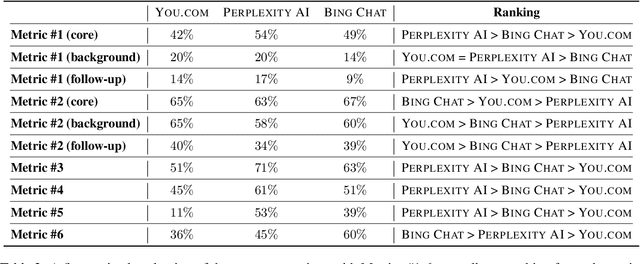
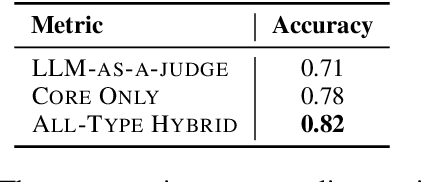
Evaluating retrieval-augmented generation (RAG) systems remains challenging, particularly for open-ended questions that lack definitive answers and require coverage of multiple sub-topics. In this paper, we introduce a novel evaluation framework based on sub-question coverage, which measures how well a RAG system addresses different facets of a question. We propose decomposing questions into sub-questions and classifying them into three types -- core, background, and follow-up -- to reflect their roles and importance. Using this categorization, we introduce a fine-grained evaluation protocol that provides insights into the retrieval and generation characteristics of RAG systems, including three commercial generative answer engines: You.com, Perplexity AI, and Bing Chat. Interestingly, we find that while all answer engines cover core sub-questions more often than background or follow-up ones, they still miss around 50% of core sub-questions, revealing clear opportunities for improvement. Further, sub-question coverage metrics prove effective for ranking responses, achieving 82% accuracy compared to human preference annotations. Lastly, we also demonstrate that leveraging core sub-questions enhances both retrieval and answer generation in a RAG system, resulting in a 74% win rate over the baseline that lacks sub-questions.