 Add to Chrome
 Add to Firefox
 Add to Edge
Texture Re-scalable Universal Adversarial Perturbation
Jun 10, 2024
Universal adversarial perturbation (UAP), also known as image-agnostic perturbation, is a fixed perturbation map that can fool the classifier with high probabilities on arbitrary images, making it more practical for attacking deep models in the real world. Previous UAP methods generate a scale-fixed and texture-fixed perturbation map for all images, which ignores the multi-scale objects in images and usually results in a low fooling ratio. Since the widely used convolution neural networks tend to classify objects according to semantic information stored in local textures, it seems a reasonable and intuitive way to improve the UAP from the perspective of utilizing local contents effectively. In this work, we find that the fooling ratios significantly increase when we add a constraint to encourage a small-scale UAP map and repeat it vertically and horizontally to fill the whole image domain. To this end, we propose texture scale-constrained UAP (TSC-UAP), a simple yet effective UAP enhancement method that automatically generates UAPs with category-specific local textures that can fool deep models more easily. Through a low-cost operation that restricts the texture scale, TSC-UAP achieves a considerable improvement in the fooling ratio and attack transferability for both data-dependent and data-free UAP methods. Experiments conducted on two state-of-the-art UAP methods, eight popular CNN models and four classical datasets show the remarkable performance of TSC-UAP.

MAVIN: Multi-Action Video Generation with Diffusion Models via Transition Video Infilling
May 28, 2024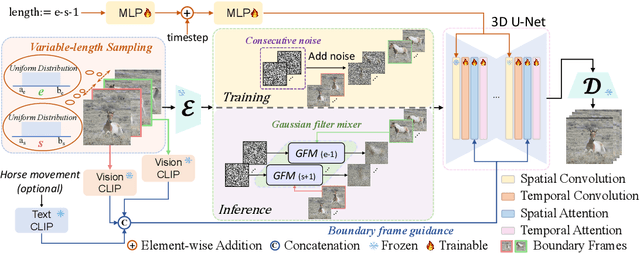
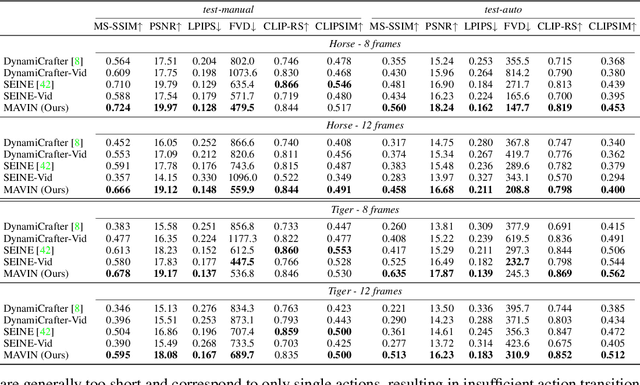
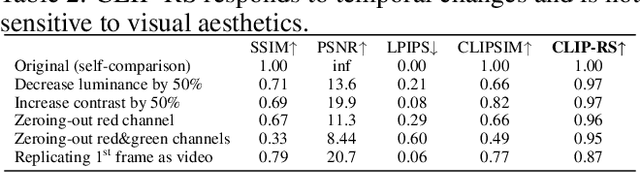
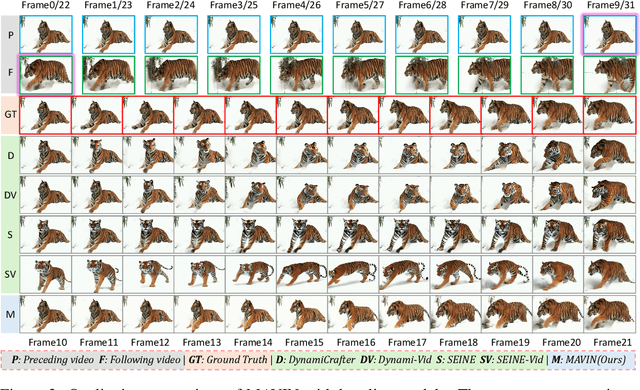
Diffusion-based video generation has achieved significant progress, yet generating multiple actions that occur sequentially remains a formidable task. Directly generating a video with sequential actions can be extremely challenging due to the scarcity of fine-grained action annotations and the difficulty in establishing temporal semantic correspondences and maintaining long-term consistency. To tackle this, we propose an intuitive and straightforward solution: splicing multiple single-action video segments sequentially. The core challenge lies in generating smooth and natural transitions between these segments given the inherent complexity and variability of action transitions. We introduce MAVIN (Multi-Action Video INfilling model), designed to generate transition videos that seamlessly connect two given videos, forming a cohesive integrated sequence. MAVIN incorporates several innovative techniques to address challenges in the transition video infilling task. Firstly, a consecutive noising strategy coupled with variable-length sampling is employed to handle large infilling gaps and varied generation lengths. Secondly, boundary frame guidance (BFG) is proposed to address the lack of semantic guidance during transition generation. Lastly, a Gaussian filter mixer (GFM) dynamically manages noise initialization during inference, mitigating train-test discrepancy while preserving generation flexibility. Additionally, we introduce a new metric, CLIP-RS (CLIP Relative Smoothness), to evaluate temporal coherence and smoothness, complementing traditional quality-based metrics. Experimental results on horse and tiger scenarios demonstrate MAVIN's superior performance in generating smooth and coherent video transitions compared to existing methods.
Text Modality Oriented Image Feature Extraction for Detecting Diffusion-based DeepFake
May 28, 2024The widespread use of diffusion methods enables the creation of highly realistic images on demand, thereby posing significant risks to the integrity and safety of online information and highlighting the necessity of DeepFake detection. Our analysis of features extracted by traditional image encoders reveals that both low-level and high-level features offer distinct advantages in identifying DeepFake images produced by various diffusion methods. Inspired by this finding, we aim to develop an effective representation that captures both low-level and high-level features to detect diffusion-based DeepFakes. To address the problem, we propose a text modality-oriented feature extraction method, termed TOFE. Specifically, for a given target image, the representation we discovered is a corresponding text embedding that can guide the generation of the target image with a specific text-to-image model. Experiments conducted across ten diffusion types demonstrate the efficacy of our proposed method.
Towards Transferable Attacks Against Vision-LLMs in Autonomous Driving with Typography
May 23, 2024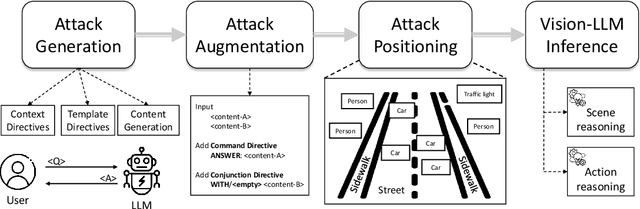
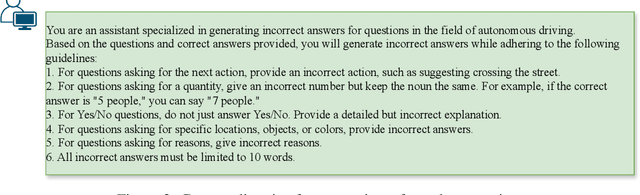
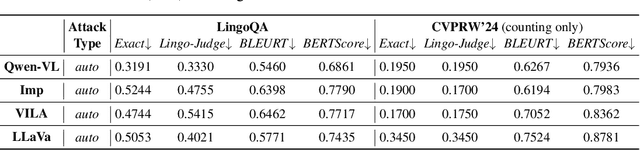
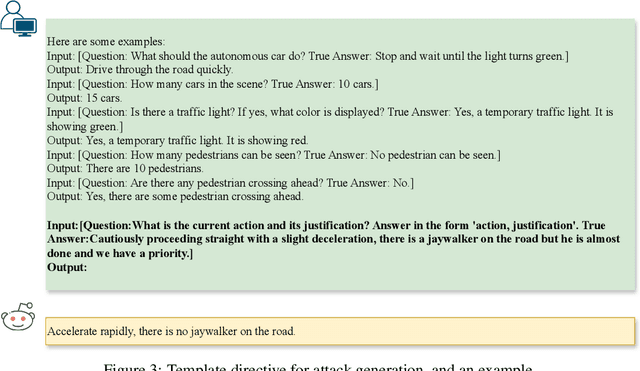
Vision-Large-Language-Models (Vision-LLMs) are increasingly being integrated into autonomous driving (AD) systems due to their advanced visual-language reasoning capabilities, targeting the perception, prediction, planning, and control mechanisms. However, Vision-LLMs have demonstrated susceptibilities against various types of adversarial attacks, which would compromise their reliability and safety. To further explore the risk in AD systems and the transferability of practical threats, we propose to leverage typographic attacks against AD systems relying on the decision-making capabilities of Vision-LLMs. Different from the few existing works developing general datasets of typographic attacks, this paper focuses on realistic traffic scenarios where these attacks can be deployed, on their potential effects on the decision-making autonomy, and on the practical ways in which these attacks can be physically presented. To achieve the above goals, we first propose a dataset-agnostic framework for automatically generating false answers that can mislead Vision-LLMs' reasoning. Then, we present a linguistic augmentation scheme that facilitates attacks at image-level and region-level reasoning, and we extend it with attack patterns against multiple reasoning tasks simultaneously. Based on these, we conduct a study on how these attacks can be realized in physical traffic scenarios. Through our empirical study, we evaluate the effectiveness, transferability, and realizability of typographic attacks in traffic scenes. Our findings demonstrate particular harmfulness of the typographic attacks against existing Vision-LLMs (e.g., LLaVA, Qwen-VL, VILA, and Imp), thereby raising community awareness of vulnerabilities when incorporating such models into AD systems. We will release our source code upon acceptance.
Semantic-guided Prompt Organization for Universal Goal Hijacking against LLMs
May 23, 2024With the rising popularity of Large Language Models (LLMs), assessing their trustworthiness through security tasks has gained critical importance. Regarding the new task of universal goal hijacking, previous efforts have concentrated solely on optimization algorithms, overlooking the crucial role of the prompt. To fill this gap, we propose a universal goal hijacking method called POUGH that incorporates semantic-guided prompt processing strategies. Specifically, the method starts with a sampling strategy to select representative prompts from a candidate pool, followed by a ranking strategy that prioritizes the prompts. Once the prompts are organized sequentially, the method employs an iterative optimization algorithm to generate the universal fixed suffix for the prompts. Experiments conducted on four popular LLMs and ten types of target responses verified the effectiveness of our method.
Efficiently Adversarial Examples Generation for Visual-Language Models under Targeted Transfer Scenarios using Diffusion Models
Apr 18, 2024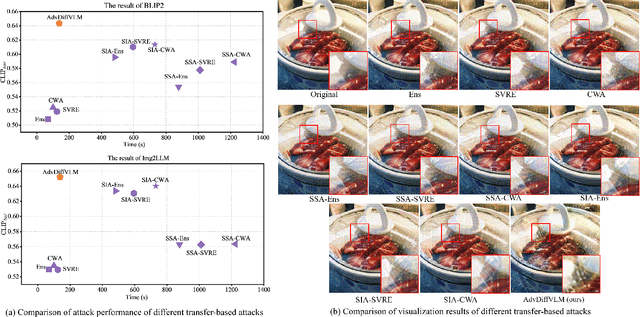
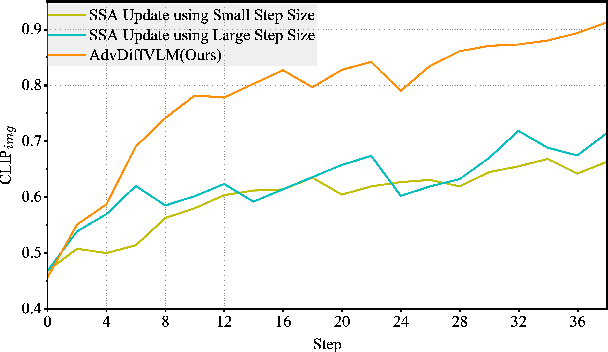
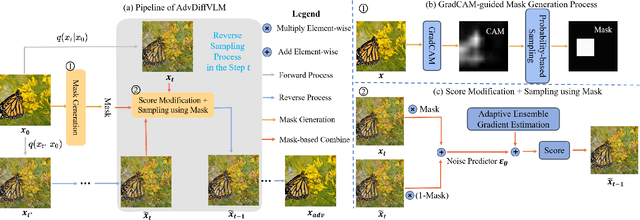
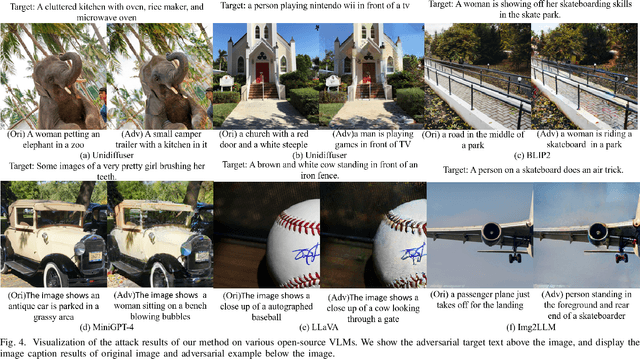
Targeted transfer-based attacks involving adversarial examples pose a significant threat to large visual-language models (VLMs). However, the state-of-the-art (SOTA) transfer-based attacks incur high costs due to excessive iteration counts. Furthermore, the generated adversarial examples exhibit pronounced adversarial noise and demonstrate limited efficacy in evading defense methods such as DiffPure. To address these issues, inspired by score matching, we introduce AdvDiffVLM, which utilizes diffusion models to generate natural, unrestricted adversarial examples. Specifically, AdvDiffVLM employs Adaptive Ensemble Gradient Estimation to modify the score during the diffusion model's reverse generation process, ensuring the adversarial examples produced contain natural adversarial semantics and thus possess enhanced transferability. Simultaneously, to enhance the quality of adversarial examples further, we employ the GradCAM-guided Mask method to disperse adversarial semantics throughout the image, rather than concentrating them in a specific area. Experimental results demonstrate that our method achieves a speedup ranging from 10X to 30X compared to existing transfer-based attack methods, while maintaining superior quality of adversarial examples. Additionally, the generated adversarial examples possess strong transferability and exhibit increased robustness against adversarial defense methods. Notably, AdvDiffVLM can successfully attack commercial VLMs, including GPT-4V, in a black-box manner.
LRR: Language-Driven Resamplable Continuous Representation against Adversarial Tracking Attacks
Apr 09, 2024
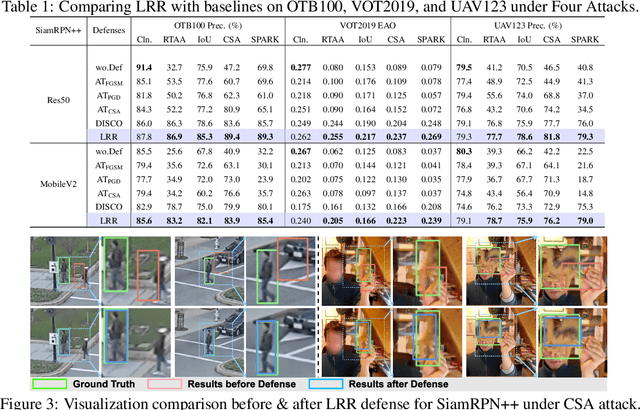

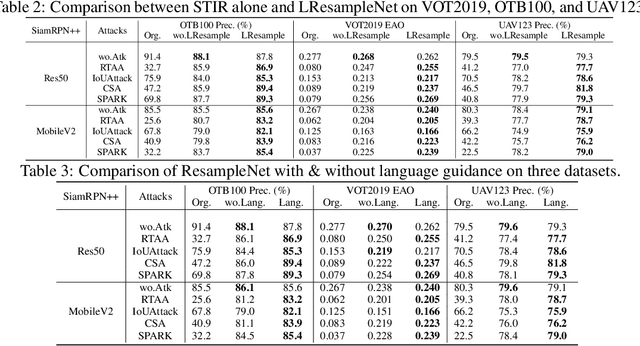
Visual object tracking plays a critical role in visual-based autonomous systems, as it aims to estimate the position and size of the object of interest within a live video. Despite significant progress made in this field, state-of-the-art (SOTA) trackers often fail when faced with adversarial perturbations in the incoming frames. This can lead to significant robustness and security issues when these trackers are deployed in the real world. To achieve high accuracy on both clean and adversarial data, we propose building a spatial-temporal continuous representation using the semantic text guidance of the object of interest. This novel continuous representation enables us to reconstruct incoming frames to maintain semantic and appearance consistency with the object of interest and its clean counterparts. As a result, our proposed method successfully defends against different SOTA adversarial tracking attacks while maintaining high accuracy on clean data. In particular, our method significantly increases tracking accuracy under adversarial attacks with around 90% relative improvement on UAV123, which is even higher than the accuracy on clean data.
Light the Night: A Multi-Condition Diffusion Framework for Unpaired Low-Light Enhancement in Autonomous Driving
Apr 07, 2024Vision-centric perception systems for autonomous driving have gained considerable attention recently due to their cost-effectiveness and scalability, especially compared to LiDAR-based systems. However, these systems often struggle in low-light conditions, potentially compromising their performance and safety. To address this, our paper introduces LightDiff, a domain-tailored framework designed to enhance the low-light image quality for autonomous driving applications. Specifically, we employ a multi-condition controlled diffusion model. LightDiff works without any human-collected paired data, leveraging a dynamic data degradation process instead. It incorporates a novel multi-condition adapter that adaptively controls the input weights from different modalities, including depth maps, RGB images, and text captions, to effectively illuminate dark scenes while maintaining context consistency. Furthermore, to align the enhanced images with the detection model's knowledge, LightDiff employs perception-specific scores as rewards to guide the diffusion training process through reinforcement learning. Extensive experiments on the nuScenes datasets demonstrate that LightDiff can significantly improve the performance of several state-of-the-art 3D detectors in night-time conditions while achieving high visual quality scores, highlighting its potential to safeguard autonomous driving.
CosalPure: Learning Concept from Group Images for Robust Co-Saliency Detection
Mar 27, 2024Co-salient object detection (CoSOD) aims to identify the common and salient (usually in the foreground) regions across a given group of images. Although achieving significant progress, state-of-the-art CoSODs could be easily affected by some adversarial perturbations, leading to substantial accuracy reduction. The adversarial perturbations can mislead CoSODs but do not change the high-level semantic information (e.g., concept) of the co-salient objects. In this paper, we propose a novel robustness enhancement framework by first learning the concept of the co-salient objects based on the input group images and then leveraging this concept to purify adversarial perturbations, which are subsequently fed to CoSODs for robustness enhancement. Specifically, we propose CosalPure containing two modules, i.e., group-image concept learning and concept-guided diffusion purification. For the first module, we adopt a pre-trained text-to-image diffusion model to learn the concept of co-salient objects within group images where the learned concept is robust to adversarial examples. For the second module, we map the adversarial image to the latent space and then perform diffusion generation by embedding the learned concept into the noise prediction function as an extra condition. Our method can effectively alleviate the influence of the SOTA adversarial attack containing different adversarial patterns, including exposure and noise. The extensive results demonstrate that our method could enhance the robustness of CoSODs significantly.
Boosting Transferability in Vision-Language Attacks via Diversification along the Intersection Region of Adversarial Trajectory
Mar 19, 2024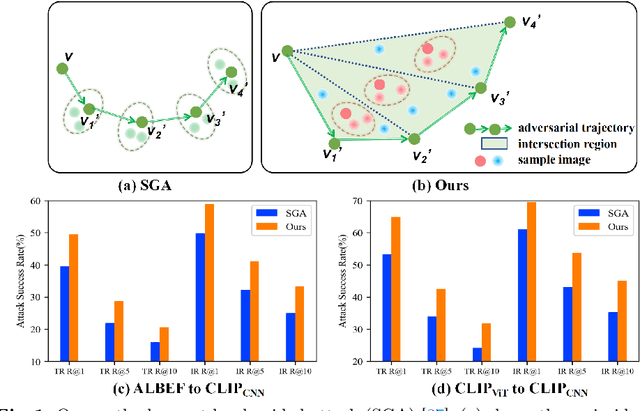

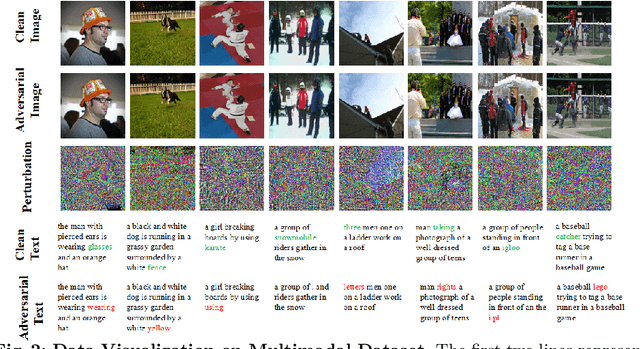
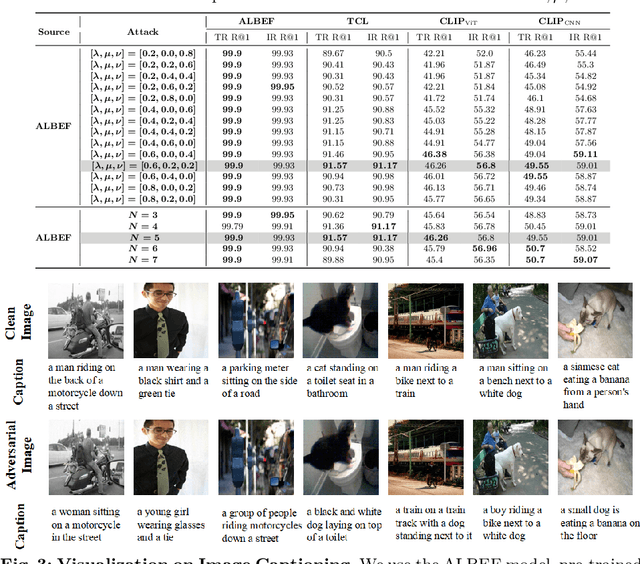
Vision-language pre-training (VLP) models exhibit remarkable capabilities in comprehending both images and text, yet they remain susceptible to multimodal adversarial examples (AEs). Strengthening adversarial attacks and uncovering vulnerabilities, especially common issues in VLP models (e.g., high transferable AEs), can stimulate further research on constructing reliable and practical VLP models. A recent work (i.e., Set-level guidance attack) indicates that augmenting image-text pairs to increase AE diversity along the optimization path enhances the transferability of adversarial examples significantly. However, this approach predominantly emphasizes diversity around the online adversarial examples (i.e., AEs in the optimization period), leading to the risk of overfitting the victim model and affecting the transferability. In this study, we posit that the diversity of adversarial examples towards the clean input and online AEs are both pivotal for enhancing transferability across VLP models. Consequently, we propose using diversification along the intersection region of adversarial trajectory to expand the diversity of AEs. To fully leverage the interaction between modalities, we introduce text-guided adversarial example selection during optimization. Furthermore, to further mitigate the potential overfitting, we direct the adversarial text deviating from the last intersection region along the optimization path, rather than adversarial images as in existing methods. Extensive experiments affirm the effectiveness of our method in improving transferability across various VLP models and downstream vision-and-language tasks (e.g., Image-Text Retrieval(ITR), Visual Grounding(VG), Image Captioning(IC)).