 Add to Chrome
 Add to Firefox
 Add to Edge
Avatar-Forever: Decoupled Parallel Training for High-Quality Real-Time Infinite Avatars
Aug 12, 2026
Existing streaming video systems often rely on sequential, distillation-centered training pipelines to enable few-step long-video generation. However, this paradigm suffers from two limitations. First, failures or distribution shifts introduced in earlier stages affect later optimization, complicating the training process to converge. Second, the distillation-centric objective favours short-term generation but is prone to quality degradation when autoregressive errors accumulate over long rollouts. We propose Avatar-Forever, a decoupled parallel training framework for high-quality real-time infinite interactive avatars. Instead of coupling generation efficiency and long-horizon robustness under a sequential distillation pipeline, we treat them as two independent capabilities that can be trained in parallel. One branch performs full-parameter distillation to train an efficient generator with high visual quality, while another trains a lightweight long-horizon adapter via Recovery-oriented Rollout Training (RRT), which improves generation robustness under long-horizon inference conditions. Our decoupled parallel training design simplifies the overall training process and avoids unnecessary objective conflicts between few-step generation and long-horizon adaptation. We further introduce ForeverCache, a chunk-wise feature caching mechanism to substantially reduce redundant history computation during streaming inference. Built upon a 22B video foundation model, Avatar-Forever supports unbounded audio-driven avatar generation while maintaining identity consistency, motion coherence, and visual fidelity, enabling an end-to-end throughput of high-resolution 768x512 videos at 27.2 FPS on a single H100 GPU and providing a practical path toward stable digital humans.

Long-Horizon Streaming Video Generation via Hybrid Attention with Decoupled Distillation
Apr 11, 2026Streaming video generation (SVG) distills a pretrained bidirectional video diffusion model into an autoregressive model equipped with sliding window attention (SWA). However, SWA inevitably loses distant history during long video generation, and its computational overhead remains a critical challenge to real-time deployment. In this work, we propose Hybrid Forcing, which jointly optimizes temporal information retention and computational efficiency through a hybrid attention design. First, we introduce lightweight linear temporal attention to preserve long-range dependencies beyond the sliding window. In particular, we maintain a compact key-value state to incrementally absorb evicted tokens, retaining temporal context with negligible memory and computational overhead. Second, we incorporate block-sparse attention into the local sliding window to reduce redundant computation within short-range modeling, reallocating computational capacity toward more critical dependencies. Finally, we introduce a decoupled distillation strategy tailored to the hybrid attention design. A few-step initial distillation is performed under dense attention, then the distillation of our proposed linear temporal and block-sparse attention is activated for streaming modeling, ensuring stable optimization. Extensive experiments on both short- and long-form video generation benchmarks demonstrate that Hybrid Forcing consistently achieves state-of-the-art performance. Notably, our model achieves real-time, unbounded 832x480 video generation at 29.5 FPS on a single NVIDIA H100 GPU without quantization or model compression. The source code and trained models are available at https://github.com/leeruibin/hybrid-forcing.
CoCoEdit: Content-Consistent Image Editing via Region Regularized Reinforcement Learning
Feb 15, 2026Image editing has achieved impressive results with the development of large-scale generative models. However, existing models mainly focus on the editing effects of intended objects and regions, often leading to unwanted changes in unintended regions. We present a post-training framework for Content-Consistent Editing (CoCoEdit) via region regularized reinforcement learning. We first augment existing editing datasets with refined instructions and masks, from which 40K diverse and high quality samples are curated as training set. We then introduce a pixel-level similarity reward to complement MLLM-based rewards, enabling models to ensure both editing quality and content consistency during the editing process. To overcome the spatial-agnostic nature of the rewards, we propose a region-based regularizer, aiming to preserve non-edited regions for high-reward samples while encouraging editing effects for low-reward samples. For evaluation, we annotate editing masks for GEdit-Bench and ImgEdit-Bench, introducing pixel-level similarity metrics to measure content consistency and editing quality. Applying CoCoEdit to Qwen-Image-Edit and FLUX-Kontext, we achieve not only competitive editing scores with state-of-the-art models, but also significantly better content consistency, measured by PSNR/SSIM metrics and human subjective ratings.
Diversity-Preserved Distribution Matching Distillation for Fast Visual Synthesis
Feb 03, 2026Distribution matching distillation (DMD) aligns a multi-step generator with its few-step counterpart to enable high-quality generation under low inference cost. However, DMD tends to suffer from mode collapse, as its reverse-KL formulation inherently encourages mode-seeking behavior, for which existing remedies typically rely on perceptual or adversarial regularization, thereby incurring substantial computational overhead and training instability. In this work, we propose a role-separated distillation framework that explicitly disentangles the roles of distilled steps: the first step is dedicated to preserving sample diversity via a target-prediction (e.g., v-prediction) objective, while subsequent steps focus on quality refinement under the standard DMD loss, with gradients from the DMD objective blocked at the first step. We term this approach Diversity-Preserved DMD (DP-DMD), which, despite its simplicity -- no perceptual backbone, no discriminator, no auxiliary networks, and no additional ground-truth images -- preserves sample diversity while maintaining visual quality on par with state-of-the-art methods in extensive text-to-image experiments.
Beyond External Guidance: Unleashing the Semantic Richness Inside Diffusion Transformers for Improved Training
Jan 12, 2026Recent works such as REPA have shown that guiding diffusion models with external semantic features (e.g., DINO) can significantly accelerate the training of diffusion transformers (DiTs). However, this requires the use of pretrained external networks, introducing additional dependencies and reducing flexibility. In this work, we argue that DiTs actually have the power to guide the training of themselves, and propose \textbf{Self-Transcendence}, a simple yet effective method that achieves fast convergence using internal feature supervision only. It is found that the slow convergence in DiT training primarily stems from the difficulty of representation learning in shallow layers. To address this, we initially train the DiT model by aligning its shallow features with the latent representations from the pretrained VAE for a short phase (e.g., 40 epochs), then apply classifier-free guidance to the intermediate features, enhancing their discriminative capability and semantic expressiveness. These enriched internal features, learned entirely within the model, are used as supervision signals to guide a new DiT training. Compared to existing self-contained methods, our approach brings a significant performance boost. It can even surpass REPA in terms of generation quality and convergence speed, but without the need for any external pretrained models. Our method is not only more flexible for different backbones but also has the potential to be adopted for a wider range of diffusion-based generative tasks. The source code of our method can be found at https://github.com/csslc/Self-Transcendence.
Visual Perturbation and Adaptive Hard Negative Contrastive Learning for Compositional Reasoning in Vision-Language Models
May 21, 2025Vision-Language Models (VLMs) are essential for multimodal tasks, especially compositional reasoning (CR) tasks, which require distinguishing fine-grained semantic differences between visual and textual embeddings. However, existing methods primarily fine-tune the model by generating text-based hard negative samples, neglecting the importance of image-based negative samples, which results in insufficient training of the visual encoder and ultimately impacts the overall performance of the model. Moreover, negative samples are typically treated uniformly, without considering their difficulty levels, and the alignment of positive samples is insufficient, which leads to challenges in aligning difficult sample pairs. To address these issues, we propose Adaptive Hard Negative Perturbation Learning (AHNPL). AHNPL translates text-based hard negatives into the visual domain to generate semantically disturbed image-based negatives for training the model, thereby enhancing its overall performance. AHNPL also introduces a contrastive learning approach using a multimodal hard negative loss to improve the model's discrimination of hard negatives within each modality and a dynamic margin loss that adjusts the contrastive margin according to sample difficulty to enhance the distinction of challenging sample pairs. Experiments on three public datasets demonstrate that our method effectively boosts VLMs' performance on complex CR tasks. The source code is available at https://github.com/nynu-BDAI/AHNPL.
InsViE-1M: Effective Instruction-based Video Editing with Elaborate Dataset Construction
Mar 26, 2025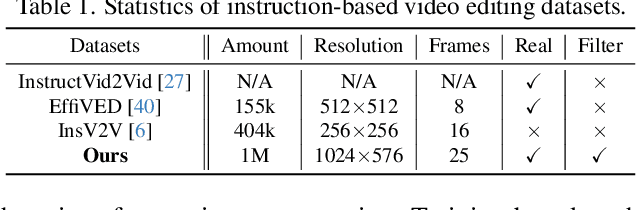
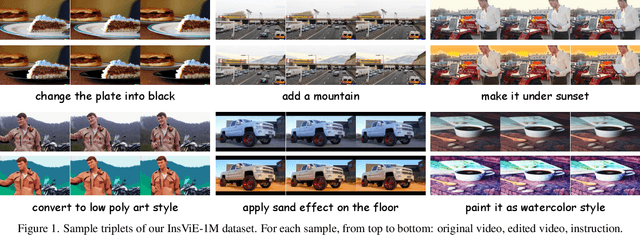
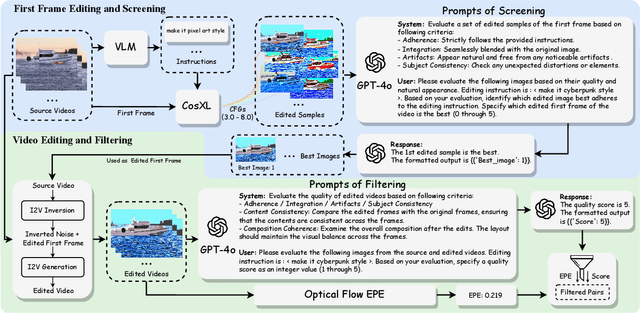
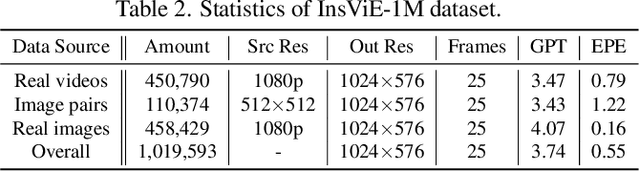
Instruction-based video editing allows effective and interactive editing of videos using only instructions without extra inputs such as masks or attributes. However, collecting high-quality training triplets (source video, edited video, instruction) is a challenging task. Existing datasets mostly consist of low-resolution, short duration, and limited amount of source videos with unsatisfactory editing quality, limiting the performance of trained editing models. In this work, we present a high-quality Instruction-based Video Editing dataset with 1M triplets, namely InsViE-1M. We first curate high-resolution and high-quality source videos and images, then design an effective editing-filtering pipeline to construct high-quality editing triplets for model training. For a source video, we generate multiple edited samples of its first frame with different intensities of classifier-free guidance, which are automatically filtered by GPT-4o with carefully crafted guidelines. The edited first frame is propagated to subsequent frames to produce the edited video, followed by another round of filtering for frame quality and motion evaluation. We also generate and filter a variety of video editing triplets from high-quality images. With the InsViE-1M dataset, we propose a multi-stage learning strategy to train our InsViE model, progressively enhancing its instruction following and editing ability. Extensive experiments demonstrate the advantages of our InsViE-1M dataset and the trained model over state-of-the-art works. Codes are available at InsViE.
Constrained Gaussian Wasserstein Optimal Transport with Commutative Covariance Matrices
Mar 05, 2025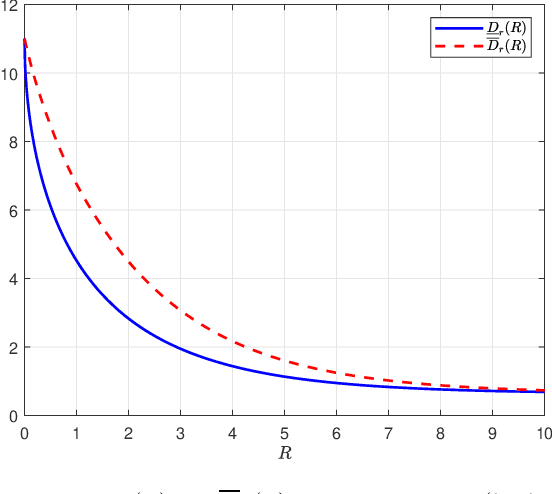
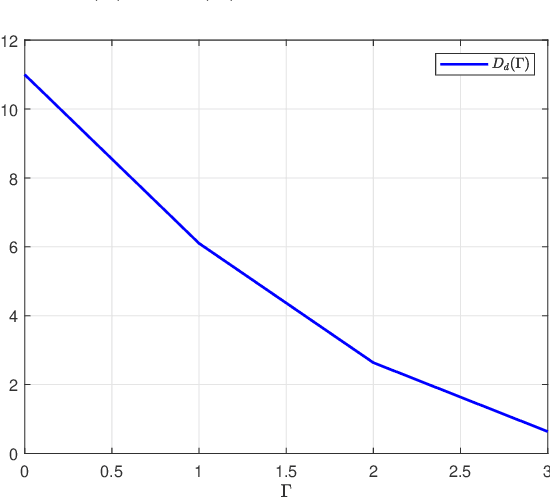
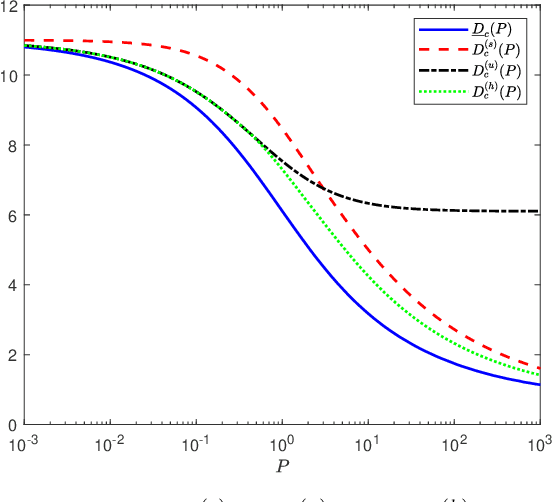
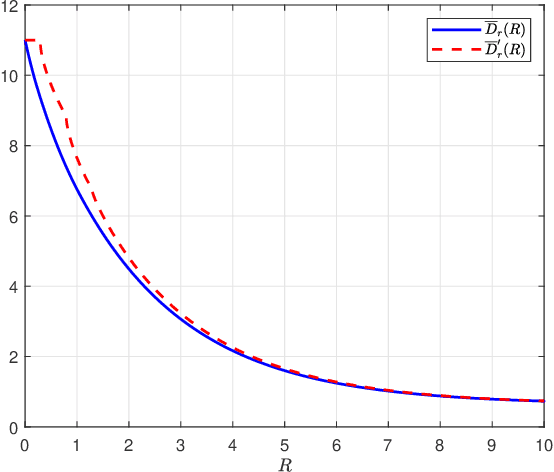
Optimal transport has found widespread applications in signal processing and machine learning. Among its many equivalent formulations, optimal transport seeks to reconstruct a random variable/vector with a prescribed distribution at the destination while minimizing the expected distortion relative to a given random variable/vector at the source. However, in practice, certain constraints may render the optimal transport plan infeasible. In this work, we consider three types of constraints: rate constraints, dimension constraints, and channel constraints, motivated by perception-aware lossy compression, generative principal component analysis, and deep joint source-channel coding, respectively. Special attenion is given to the setting termed Gaussian Wasserstein optimal transport, where both the source and reconstruction variables are multivariate Gaussian, and the end-to-end distortion is measured by the mean squared error. We derive explicit results for the minimum achievable mean squared error under the three aforementioned constraints when the covariance matrices of the source and reconstruction variables commute.
RORem: Training a Robust Object Remover with Human-in-the-Loop
Jan 01, 2025Despite the significant advancements, existing object removal methods struggle with incomplete removal, incorrect content synthesis and blurry synthesized regions, resulting in low success rates. Such issues are mainly caused by the lack of high-quality paired training data, as well as the self-supervised training paradigm adopted in these methods, which forces the model to in-paint the masked regions, leading to ambiguity between synthesizing the masked objects and restoring the background. To address these issues, we propose a semi-supervised learning strategy with human-in-the-loop to create high-quality paired training data, aiming to train a Robust Object Remover (RORem). We first collect 60K training pairs from open-source datasets to train an initial object removal model for generating removal samples, and then utilize human feedback to select a set of high-quality object removal pairs, with which we train a discriminator to automate the following training data generation process. By iterating this process for several rounds, we finally obtain a substantial object removal dataset with over 200K pairs. Fine-tuning the pre-trained stable diffusion model with this dataset, we obtain our RORem, which demonstrates state-of-the-art object removal performance in terms of both reliability and image quality. Particularly, RORem improves the object removal success rate over previous methods by more than 18\%. The dataset, source code and trained model are available at https://github.com/leeruibin/RORem.
Gradient Diffusion: A Perturbation-Resilient Gradient Leakage Attack
Jul 07, 2024Recent years have witnessed the vulnerability of Federated Learning (FL) against gradient leakage attacks, where the private training data can be recovered from the exchanged gradients, making gradient protection a critical issue for the FL training process. Existing solutions often resort to perturbation-based mechanisms, such as differential privacy, where each participating client injects a specific amount of noise into local gradients before aggregating to the server, and the global distribution variation finally conceals the gradient privacy. However, perturbation is not always the panacea for gradient protection since the robustness heavily relies on the injected noise. This intuition raises an interesting question: \textit{is it possible to deactivate existing protection mechanisms by removing the perturbation inside the gradients?} In this paper, we present the answer: \textit{yes} and propose the Perturbation-resilient Gradient Leakage Attack (PGLA), the first attempt to recover the perturbed gradients, without additional access to the original model structure or third-party data. Specifically, we leverage the inherent diffusion property of gradient perturbation protection and construct a novel diffusion-based denoising model to implement PGLA. Our insight is that capturing the disturbance level of perturbation during the diffusion reverse process can release the gradient denoising capability, which promotes the diffusion model to generate approximate gradients as the original clean version through adaptive sampling steps. Extensive experiments demonstrate that PGLA effectively recovers the protected gradients and exposes the FL training process to the threat of gradient leakage, achieving the best quality in gradient denoising and data recovery compared to existing models. We hope to arouse public attention on PGLA and its defense.