 Add to Chrome
 Add to Firefox
 Add to Edge
L2CEval: Evaluating Language-to-Code Generation Capabilities of Large Language Models
Oct 02, 2023
Recently, large language models (LLMs), especially those that are pretrained on code, have demonstrated strong capabilities in generating programs from natural language inputs in a few-shot or even zero-shot manner. Despite promising results, there is a notable lack of a comprehensive evaluation of these models language-to-code generation capabilities. Existing studies often focus on specific tasks, model architectures, or learning paradigms, leading to a fragmented understanding of the overall landscape. In this work, we present L2CEval, a systematic evaluation of the language-to-code generation capabilities of LLMs on 7 tasks across the domain spectrum of semantic parsing, math reasoning and Python programming, analyzing the factors that potentially affect their performance, such as model size, pretraining data, instruction tuning, and different prompting methods. In addition to assessing model performance, we measure confidence calibration for the models and conduct human evaluations of the output programs. This enables us to identify and analyze the typical failure modes across various tasks and models. L2CEval offers a comprehensive understanding of the capabilities and limitations of LLMs in language-to-code generation. We also release the evaluation framework and all model outputs, hoping to lay the groundwork for further future research in this domain.

ExeDec: Execution Decomposition for Compositional Generalization in Neural Program Synthesis
Jul 26, 2023When writing programs, people have the ability to tackle a new complex task by decomposing it into smaller and more familiar subtasks. While it is difficult to measure whether neural program synthesis methods have similar capabilities, we can measure whether they compositionally generalize, that is, whether a model that has been trained on the simpler subtasks is subsequently able to solve more complex tasks. In this paper, we characterize several different forms of compositional generalization that are desirable in program synthesis, forming a meta-benchmark which we use to create generalization tasks for two popular datasets, RobustFill and DeepCoder. We then propose ExeDec, a novel decomposition-based synthesis strategy that predicts execution subgoals to solve problems step-by-step informed by program execution at each step. ExeDec has better synthesis performance and greatly improved compositional generalization ability compared to baselines.
SQL-PaLM: Improved Large Language Model Adaptation for Text-to-SQL
Jun 07, 2023


One impressive emergent capability of large language models (LLMs) is generation of code, including Structured Query Language (SQL) for databases. For the task of converting natural language text to SQL queries, Text-to-SQL, adaptation of LLMs is of paramount importance, both in in-context learning and fine-tuning settings, depending on the amount of adaptation data used. In this paper, we propose an LLM-based Text-to-SQL model SQL-PaLM, leveraging on PaLM-2, that pushes the state-of-the-art in both settings. Few-shot SQL-PaLM is based on an execution-based self-consistency prompting approach designed for Text-to-SQL, and achieves 77.3% in test-suite accuracy on Spider, which to our best knowledge is the first to outperform previous state-of-the-art with fine-tuning by a significant margin, 4%. Furthermore, we demonstrate that the fine-tuned SQL-PALM outperforms it further by another 1%. Towards applying SQL-PaLM to real-world scenarios we further evaluate its robustness on other challenging variants of Spider and demonstrate the superior generalization capability of SQL-PaLM. In addition, via extensive case studies, we demonstrate the impressive intelligent capabilities and various success enablers of LLM-based Text-to-SQL.
PaLM 2 Technical Report
May 17, 2023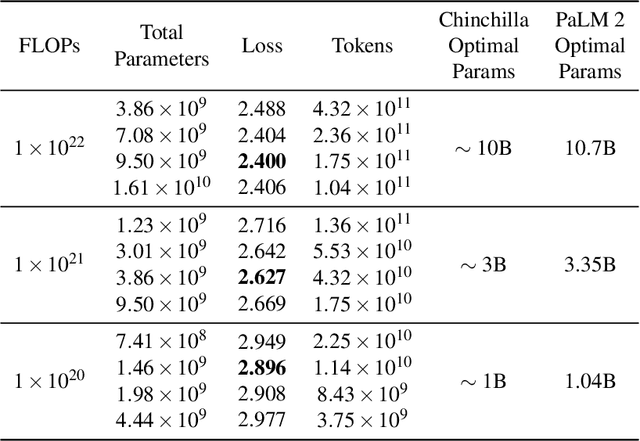
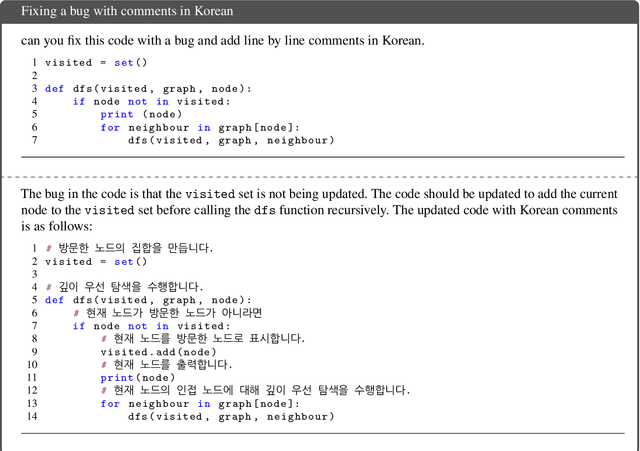
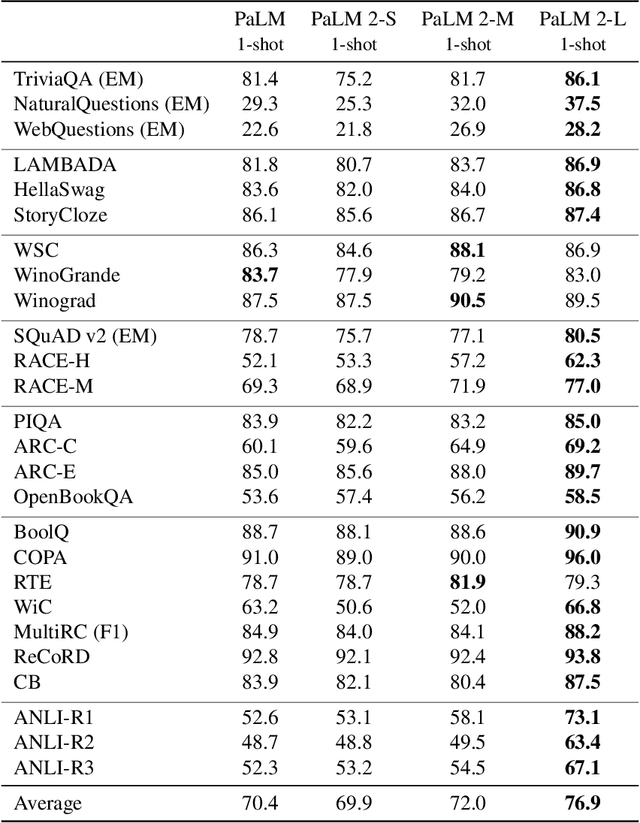
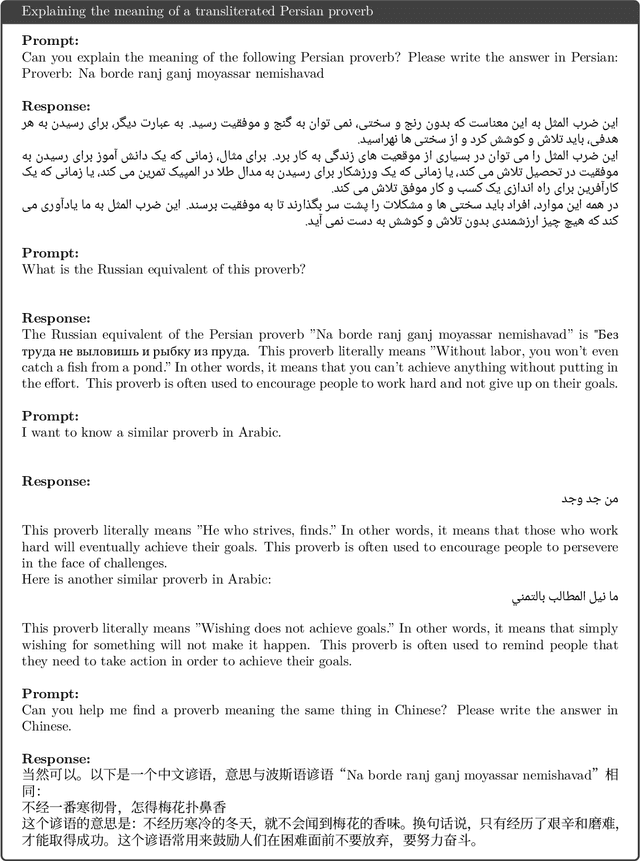
We introduce PaLM 2, a new state-of-the-art language model that has better multilingual and reasoning capabilities and is more compute-efficient than its predecessor PaLM. PaLM 2 is a Transformer-based model trained using a mixture of objectives. Through extensive evaluations on English and multilingual language, and reasoning tasks, we demonstrate that PaLM 2 has significantly improved quality on downstream tasks across different model sizes, while simultaneously exhibiting faster and more efficient inference compared to PaLM. This improved efficiency enables broader deployment while also allowing the model to respond faster, for a more natural pace of interaction. PaLM 2 demonstrates robust reasoning capabilities exemplified by large improvements over PaLM on BIG-Bench and other reasoning tasks. PaLM 2 exhibits stable performance on a suite of responsible AI evaluations, and enables inference-time control over toxicity without additional overhead or impact on other capabilities. Overall, PaLM 2 achieves state-of-the-art performance across a diverse set of tasks and capabilities. When discussing the PaLM 2 family, it is important to distinguish between pre-trained models (of various sizes), fine-tuned variants of these models, and the user-facing products that use these models. In particular, user-facing products typically include additional pre- and post-processing steps. Additionally, the underlying models may evolve over time. Therefore, one should not expect the performance of user-facing products to exactly match the results reported in this report.
Natural Language to Code Generation in Interactive Data Science Notebooks
Dec 19, 2022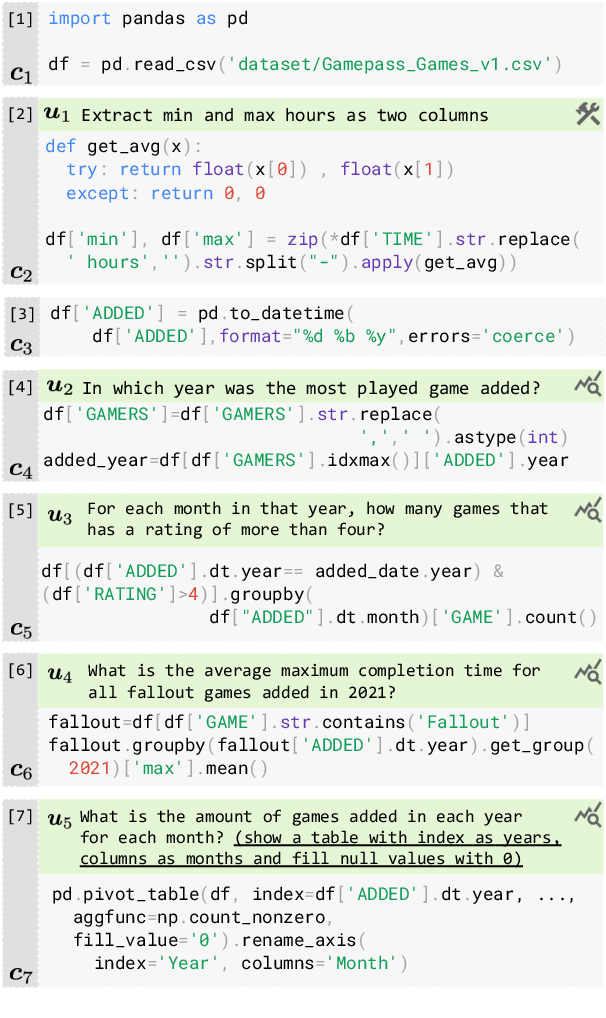


Computational notebooks, such as Jupyter notebooks, are interactive computing environments that are ubiquitous among data scientists to perform data wrangling and analytic tasks. To measure the performance of AI pair programmers that automatically synthesize programs for those tasks given natural language (NL) intents from users, we build ARCADE, a benchmark of 1082 code generation problems using the pandas data analysis framework in data science notebooks. ARCADE features multiple rounds of NL-to-code problems from the same notebook. It requires a model to understand rich multi-modal contexts, such as existing notebook cells and their execution states as well as previous turns of interaction. To establish a strong baseline on this challenging task, we develop PaChiNCo, a 62B code language model (LM) for Python computational notebooks, which significantly outperforms public code LMs. Finally, we explore few-shot prompting strategies to elicit better code with step-by-step decomposition and NL explanation, showing the potential to improve the diversity and explainability of model predictions.
SCARA: Scalable Graph Neural Networks with Feature-Oriented Optimization
Jul 19, 2022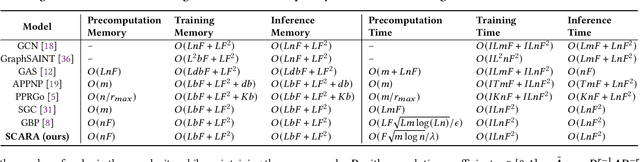
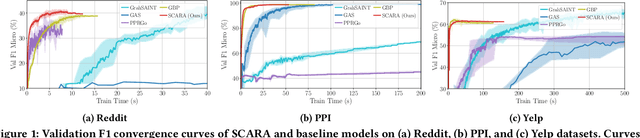

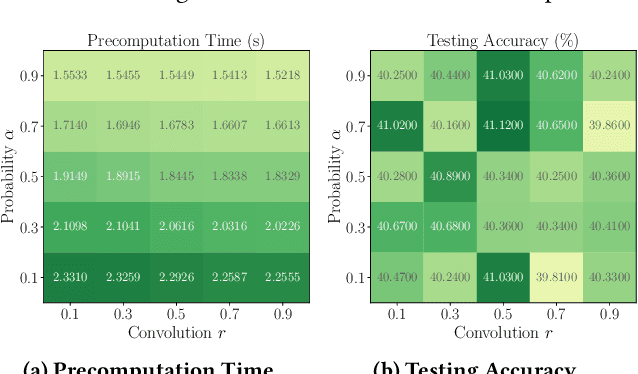
Recent advances in data processing have stimulated the demand for learning graphs of very large scales. Graph Neural Networks (GNNs), being an emerging and powerful approach in solving graph learning tasks, are known to be difficult to scale up. Most scalable models apply node-based techniques in simplifying the expensive graph message-passing propagation procedure of GNN. However, we find such acceleration insufficient when applied to million- or even billion-scale graphs. In this work, we propose SCARA, a scalable GNN with feature-oriented optimization for graph computation. SCARA efficiently computes graph embedding from node features, and further selects and reuses feature computation results to reduce overhead. Theoretical analysis indicates that our model achieves sub-linear time complexity with a guaranteed precision in propagation process as well as GNN training and inference. We conduct extensive experiments on various datasets to evaluate the efficacy and efficiency of SCARA. Performance comparison with baselines shows that SCARA can reach up to 100x graph propagation acceleration than current state-of-the-art methods with fast convergence and comparable accuracy. Most notably, it is efficient to process precomputation on the largest available billion-scale GNN dataset Papers100M (111M nodes, 1.6B edges) in 100 seconds.
PaLM: Scaling Language Modeling with Pathways
Apr 19, 2022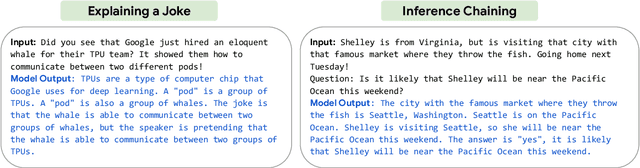

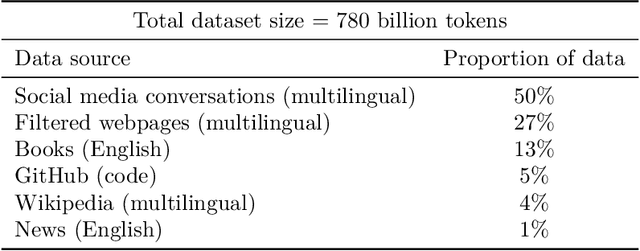
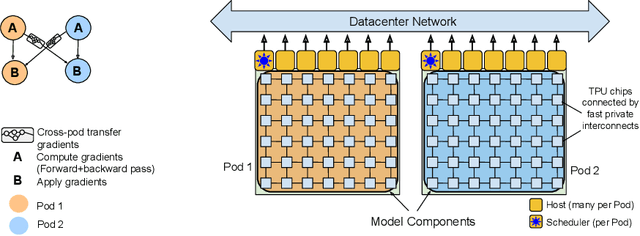
Large language models have been shown to achieve remarkable performance across a variety of natural language tasks using few-shot learning, which drastically reduces the number of task-specific training examples needed to adapt the model to a particular application. To further our understanding of the impact of scale on few-shot learning, we trained a 540-billion parameter, densely activated, Transformer language model, which we call Pathways Language Model PaLM. We trained PaLM on 6144 TPU v4 chips using Pathways, a new ML system which enables highly efficient training across multiple TPU Pods. We demonstrate continued benefits of scaling by achieving state-of-the-art few-shot learning results on hundreds of language understanding and generation benchmarks. On a number of these tasks, PaLM 540B achieves breakthrough performance, outperforming the finetuned state-of-the-art on a suite of multi-step reasoning tasks, and outperforming average human performance on the recently released BIG-bench benchmark. A significant number of BIG-bench tasks showed discontinuous improvements from model scale, meaning that performance steeply increased as we scaled to our largest model. PaLM also has strong capabilities in multilingual tasks and source code generation, which we demonstrate on a wide array of benchmarks. We additionally provide a comprehensive analysis on bias and toxicity, and study the extent of training data memorization with respect to model scale. Finally, we discuss the ethical considerations related to large language models and discuss potential mitigation strategies.
Compositional Generalization and Decomposition in Neural Program Synthesis
Apr 07, 2022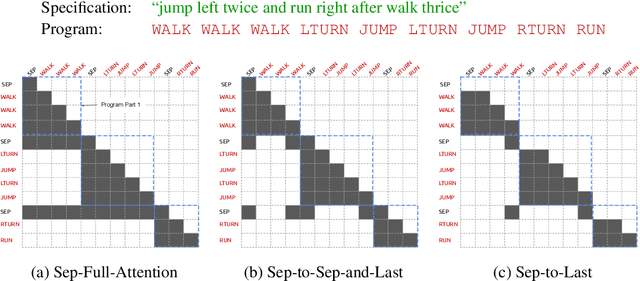
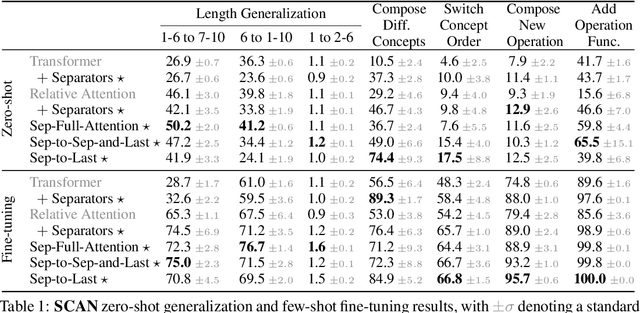
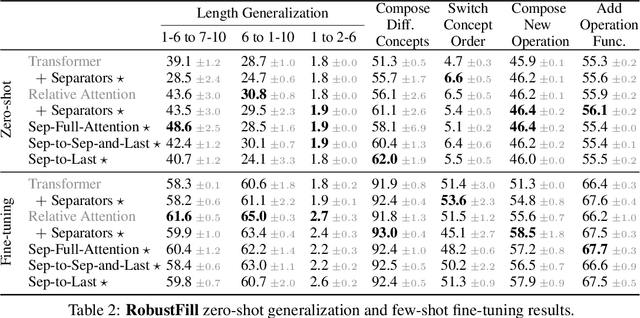
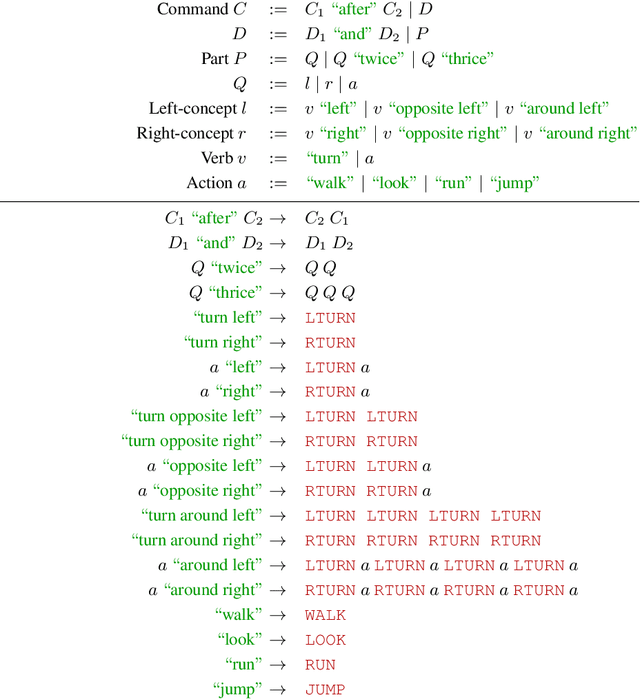
When writing programs, people have the ability to tackle a new complex task by decomposing it into smaller and more familiar subtasks. While it is difficult to measure whether neural program synthesis methods have similar capabilities, what we can measure is whether they compositionally generalize, that is, whether a model that has been trained on the simpler subtasks is subsequently able to solve more complex tasks. In this paper, we focus on measuring the ability of learned program synthesizers to compositionally generalize. We first characterize several different axes along which program synthesis methods would be desired to generalize, e.g., length generalization, or the ability to combine known subroutines in new ways that do not occur in the training data. Based on this characterization, we introduce a benchmark suite of tasks to assess these abilities based on two popular existing datasets, SCAN and RobustFill. Finally, we make first attempts to improve the compositional generalization ability of Transformer models along these axes through novel attention mechanisms that draw inspiration from a human-like decomposition strategy. Empirically, we find our modified Transformer models generally perform better than natural baselines, but the tasks remain challenging.
Show Me More Details: Discovering Hierarchies of Procedures from Semi-structured Web Data
Mar 17, 2022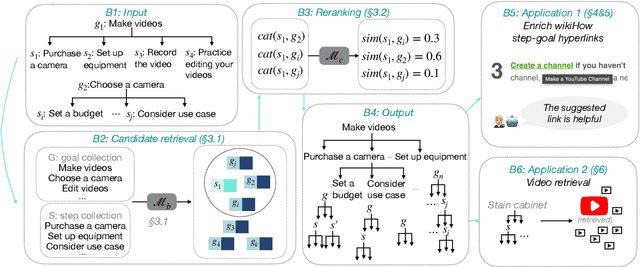
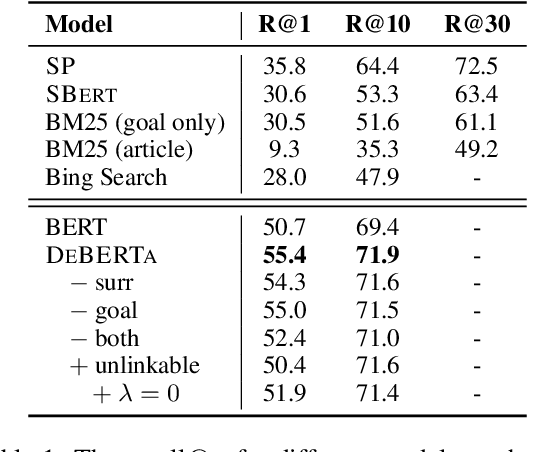
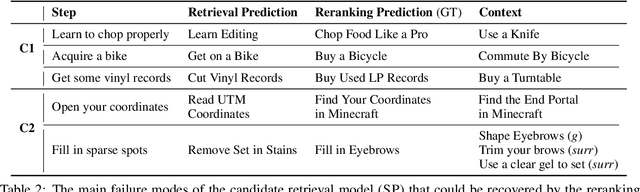
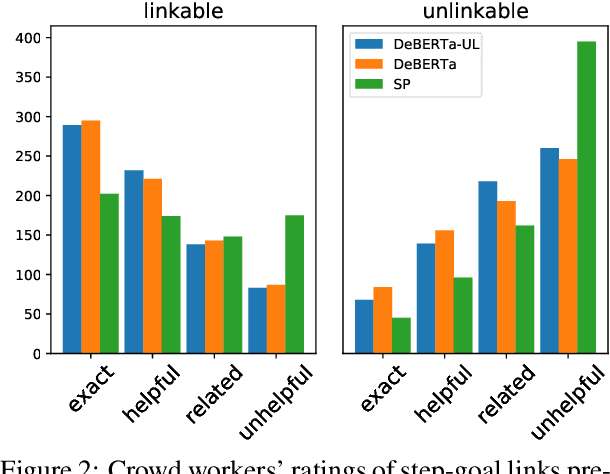
Procedures are inherently hierarchical. To "make videos", one may need to "purchase a camera", which in turn may require one to "set a budget". While such hierarchical knowledge is critical for reasoning about complex procedures, most existing work has treated procedures as shallow structures without modeling the parent-child relation. In this work, we attempt to construct an open-domain hierarchical knowledge-base (KB) of procedures based on wikiHow, a website containing more than 110k instructional articles, each documenting the steps to carry out a complex procedure. To this end, we develop a simple and efficient method that links steps (e.g., "purchase a camera") in an article to other articles with similar goals (e.g., "how to choose a camera"), recursively constructing the KB. Our method significantly outperforms several strong baselines according to automatic evaluation, human judgment, and application to downstream tasks such as instructional video retrieval. A demo with partial data can be found at https://wikihow-hierarchy.github.io. The code and the data are at https://github.com/shuyanzhou/wikihow_hierarchy.
UnifiedSKG: Unifying and Multi-Tasking Structured Knowledge Grounding with Text-to-Text Language Models
Jan 20, 2022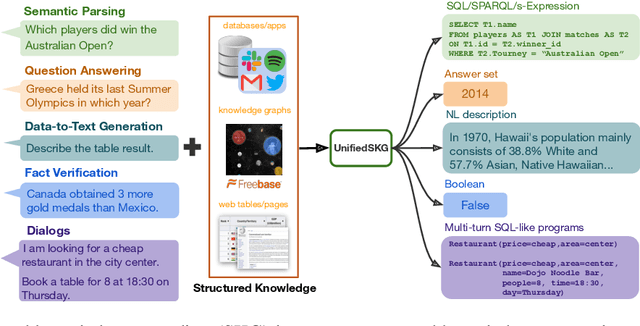
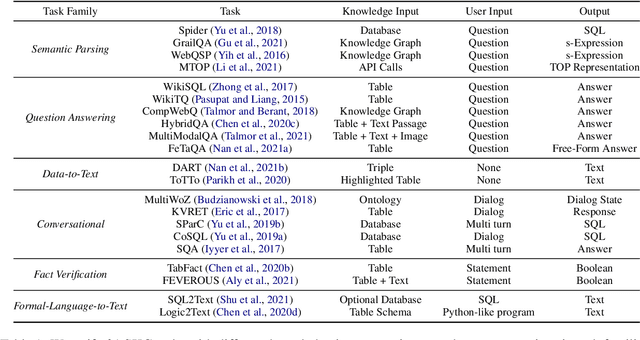
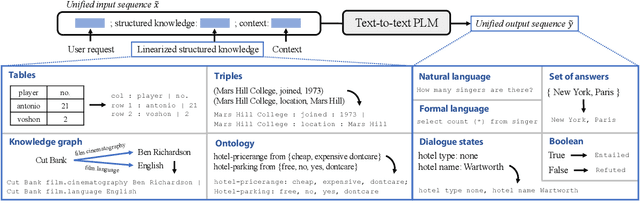
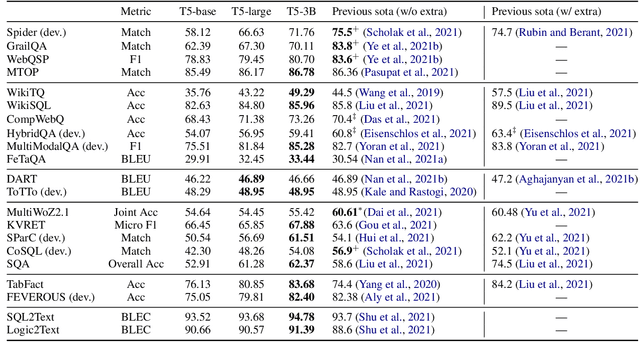
Structured knowledge grounding (SKG) leverages structured knowledge to complete user requests, such as semantic parsing over databases and question answering over knowledge bases. Since the inputs and outputs of SKG tasks are heterogeneous, they have been studied separately by different communities, which limits systematic and compatible research on SKG. In this paper, we overcome this limitation by proposing the SKG framework, which unifies 21 SKG tasks into a text-to-text format, aiming to promote systematic SKG research, instead of being exclusive to a single task, domain, or dataset. We use UnifiedSKG to benchmark T5 with different sizes and show that T5, with simple modifications when necessary, achieves state-of-the-art performance on almost all of the 21 tasks. We further demonstrate that multi-task prefix-tuning improves the performance on most tasks, largely improving the overall performance. UnifiedSKG also facilitates the investigation of zero-shot and few-shot learning, and we show that T0, GPT-3, and Codex struggle in zero-shot and few-shot learning for SKG. We also use UnifiedSKG to conduct a series of controlled experiments on structured knowledge encoding variants across SKG tasks. UnifiedSKG is easily extensible to more tasks, and it is open-sourced at https://github.com/hkunlp/unifiedskg Latest collections at https://unifiedskg.com.