 Add to Chrome
 Add to Firefox
 Add to Edge
What Makes a Desired Graph for Relational Deep Learning?
Jun 07, 2026
Relational deep learning (RDL) converts relational databases (RDBs) into heterogeneous graphs, but graphs derived directly from database schemas are often not well suited for how graph neural networks (GNNs) perform relational reasoning. We study what makes a relational graph suitable for deep learning and show that schema-derived graphs suffer from two systematic failures: information overload and semantic fragmentation. Our empirical analysis reveals that the desired graph is not the raw schema, but a result of controlled structural adaptation. Performance depends on balancing two operations: mitigating information overload via filtering, and repairing semantic fragmentation via injection. Specifically, filtering serves as a bias-variance knob with non-monotonic effects, while injection improves performance only when it explicitly restores the relational dependencies missing from the original schema. Based on these findings, we develop an end-to-end structural optimizer that applies both operations to adapt relational graphs automatically. Across 26 tasks spanning classification, regression, and recommendation, the optimized graphs consistently improve accuracy while often reducing inference cost.

HMAF: A Hierarchical Multi-Slot GD-RTB Allocation Framework
Jun 04, 2026In modern online advertising platforms, Guaranteed Delivery (GD) contracts coexist and bid with Real-Time Bidding (RTB) auctions. Recent approaches either decouple GD and RTB optimization or rely on heuristic priority rules, and thus fail to effectively balance short-term revenue maximization with long-term contract delivery under complex multi-slot delivery and impression constraints. To address these challenges, we propose HMAF (Hierarchical Multi-Slot Allocation Framework), a unified framework designed to optimize impression allocation in GD--RTB advertising platforms. HMAF employs the Plan--Calibrate--Execute paradigm as its core structure, and integrates offline constraint optimization with online decision-making, balancing offline GD resource planning, dynamically calibrating GD--RTB competitiveness, and making real-time listwise rank decisions across multi-slot environments. HMAF has been implemented in multiple marketing scenarios at Meituan, one of the world's largest online food delivery platforms, leading to a 3.72% increase in GD delivery rate and a 1.59% increase in total advertisement revenue.
CausalPOI: Spatio-Temporal Graph-Based Causal Modeling for Cold-Start POI Check-in Forecasting
Jun 03, 2026As urban environments continue to evolve rapidly, accurately modeling the dynamic behaviour of Points of Interest is essential for supporting data-driven urban planning and commercial decision-making. While recent advancements in spatio-temporal graph learning have improved POI forecasting, most methods rely on proximity-based graphs and correlation-driven modeling, which overlook the functional dependencies between POIs and fail to capture the causal effects of urban interventions. In this paper, we introduce a novel research problem -- cold-start POI check-in forecasting, which aims to predict the future check-in pattern of a newly introduced POI, by modeling its temporal evolution and functional interactions with nearby POIs in a structured urban spatial context. To address these challenges, we propose CausalPOI, a spatio-temporal graph-based causal representation learning framework. CausalPOI leverages Spatio-Temporal Functional Interaction Graph to model semantic and spatial relationships between POIs, and constructs structurally aligned treatment and control graphs to simulate factual and counterfactual scenarios. Extensive experiments on real-world SafeGraph datasets demonstrate that CausalPOI significantly outperforms state-of-the-art baselines across the board, validating its effectiveness in spatio-temporal forecasting, semantic interaction modeling, and causal effect estimation, providing a more interpretable and actionable foundation for urban intervention analysis. Source code is available at Github.
Beyond Single Slot: Joint Optimization for Multi-Slot Guaranteed Display Advertising
May 20, 2026Guaranteed display advertising is crucial for platform monetization, yet existing methods often operate under a single-slot assumption, limiting their ability to optimize allocation across multi-slot page views. In this paper, we propose a novel joint optimization framework for multi-slot GD allocation, addressing key challenges such as slot-level redundancy, contract imbalance, and exposure concentration. Our approach formulates the allocation as an offline bipartite matching problem with a contract roulette mechanism for slot exclusivity and Page View constraints for impression control, and incorporates a scalable allocation optimization algorithm for efficient large-scale deployment. Extensive online tests on the Meituan advertising platform demonstrate that our method significantly improves merchant ROI, platform revenue efficiency, and contract fulfillment robustness. Specifically, online A/B tests show a 28.99% increase in Average Revenue Per User under 70% traffic, and DID analysis further indicates improved contract stability, demonstrating the strong applicability and effectiveness of our framework in real-world advertising deployments.
Modality-free Graph In-context Alignment
Mar 13, 2026In-context learning (ICL) converts static encoders into task-conditioned reasoners, enabling adaptation to new data from just a few examples without updating pretrained parameters. This capability is essential for graph foundation models (GFMs) to approach LLM-level generality. Yet current GFMs struggle with cross-domain alignment, typically relying on modality-specific encoders that fail when graphs are pre-vectorized or raw data is inaccessible. In this paper, we introduce Modality-Free Graph In-context Alignment (MF-GIA), a framework that makes a pretrained graph encoder promptable for few-shot prediction across heterogeneous domains without modality assumptions. MF-GIA captures domain characteristics through gradient fingerprints, which parameterize lightweight transformations that align pre-encoded features and indexed labels into unified semantic spaces. During pretraining, a dual prompt-aware attention mechanism with episodic objective learns to match queries against aligned support examples to establish prompt-based reasoning capabilities. At inference, MF-GIA performs parameter-update-free adaptation using only a few-shot support set to trigger cross-domain alignment and enable immediate prediction on unseen domains. Experiments demonstrate that MF-GIA achieves superior few-shot performance across diverse graph domains and strong generalization to unseen domains.
Coden: Efficient Temporal Graph Neural Networks for Continuous Prediction
Feb 13, 2026Temporal Graph Neural Networks (TGNNs) are pivotal in processing dynamic graphs. However, existing TGNNs primarily target one-time predictions for a given temporal span, whereas many practical applications require continuous predictions, that predictions are issued frequently over time. Directly adapting existing TGNNs to continuous-prediction scenarios introduces either significant computational overhead or prediction quality issues especially for large graphs. This paper revisits the challenge of { continuous predictions} in TGNNs, and introduces {\sc Coden}, a TGNN model designed for efficient and effective learning on dynamic graphs. {\sc Coden} innovatively overcomes the key complexity bottleneck in existing TGNNs while preserving comparable predictive accuracy. Moreover, we further provide theoretical analyses that substantiate the effectiveness and efficiency of {\sc Coden}, and clarify its duality relationship with both RNN-based and attention-based models. Our evaluations across five dynamic datasets show that {\sc Coden} surpasses existing performance benchmarks in both efficiency and effectiveness, establishing it as a superior solution for continuous prediction in evolving graph environments.
MoSE: Unveiling Structural Patterns in Graphs via Mixture of Subgraph Experts
Sep 11, 2025While graph neural networks (GNNs) have achieved great success in learning from graph-structured data, their reliance on local, pairwise message passing restricts their ability to capture complex, high-order subgraph patterns. leading to insufficient structural expressiveness. Recent efforts have attempted to enhance structural expressiveness by integrating random walk kernels into GNNs. However, these methods are inherently designed for graph-level tasks, which limits their applicability to other downstream tasks such as node classification. Moreover, their fixed kernel configurations hinder the model's flexibility in capturing diverse subgraph structures. To address these limitations, this paper proposes a novel Mixture of Subgraph Experts (MoSE) framework for flexible and expressive subgraph-based representation learning across diverse graph tasks. Specifically, MoSE extracts informative subgraphs via anonymous walks and dynamically routes them to specialized experts based on structural semantics, enabling the model to capture diverse subgraph patterns with improved flexibility and interpretability. We further provide a theoretical analysis of MoSE's expressivity within the Subgraph Weisfeiler-Lehman (SWL) Test, proving that it is more powerful than SWL. Extensive experiments, together with visualizations of learned subgraph experts, demonstrate that MoSE not only outperforms competitive baselines but also provides interpretable insights into structural patterns learned by the model.
When Deepfake Detection Meets Graph Neural Network:a Unified and Lightweight Learning Framework
Aug 07, 2025The proliferation of generative video models has made detecting AI-generated and manipulated videos an urgent challenge. Existing detection approaches often fail to generalize across diverse manipulation types due to their reliance on isolated spatial, temporal, or spectral information, and typically require large models to perform well. This paper introduces SSTGNN, a lightweight Spatial-Spectral-Temporal Graph Neural Network framework that represents videos as structured graphs, enabling joint reasoning over spatial inconsistencies, temporal artifacts, and spectral distortions. SSTGNN incorporates learnable spectral filters and temporal differential modeling into a graph-based architecture, capturing subtle manipulation traces more effectively. Extensive experiments on diverse benchmark datasets demonstrate that SSTGNN not only achieves superior performance in both in-domain and cross-domain settings, but also offers strong robustness against unseen manipulations. Remarkably, SSTGNN accomplishes these results with up to 42.4$\times$ fewer parameters than state-of-the-art models, making it highly lightweight and scalable for real-world deployment.
DHIL-GT: Scalable Graph Transformer with Decoupled Hierarchy Labeling
Dec 06, 2024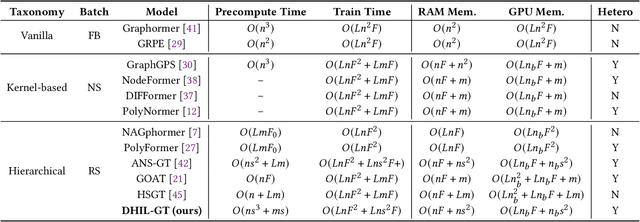
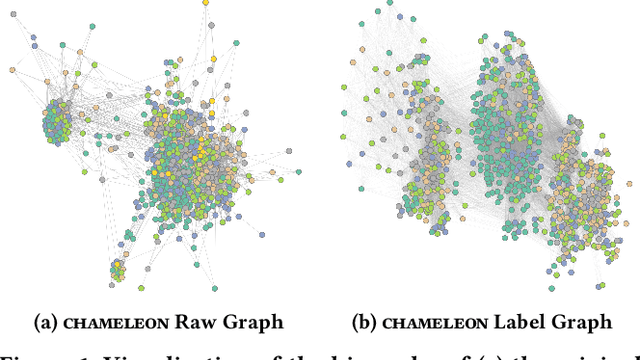
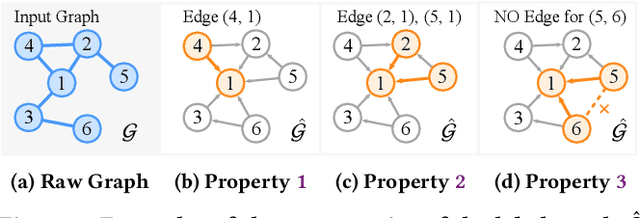
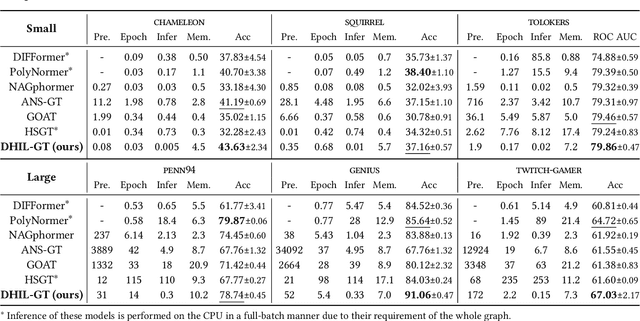
Graph Transformer (GT) has recently emerged as a promising neural network architecture for learning graph-structured data. However, its global attention mechanism with quadratic complexity concerning the graph scale prevents wider application to large graphs. While current methods attempt to enhance GT scalability by altering model architecture or encoding hierarchical graph data, our analysis reveals that these models still suffer from the computational bottleneck related to graph-scale operations. In this work, we target the GT scalability issue and propose DHIL-GT, a scalable Graph Transformer that simplifies network learning by fully decoupling the graph computation to a separate stage in advance. DHIL-GT effectively retrieves hierarchical information by exploiting the graph labeling technique, as we show that the graph label hierarchy is more informative than plain adjacency by offering global connections while promoting locality, and is particularly suitable for handling complex graph patterns such as heterophily. We further design subgraph sampling and positional encoding schemes for precomputing model input on top of graph labels in an end-to-end manner. The training stage thus favorably removes graph-related computations, leading to ideal mini-batch capability and GPU utilization. Notably, the precomputation and training processes of DHIL-GT achieve complexities linear to the number of graph edges and nodes, respectively. Extensive experiments demonstrate that DHIL-GT is efficient in terms of computational boost and mini-batch capability over existing scalable Graph Transformer designs on large-scale benchmarks, while achieving top-tier effectiveness on both homophilous and heterophilous graphs.
Towards Graph Foundation Models: The Perspective of Zero-shot Reasoning on Knowledge Graphs
Oct 16, 2024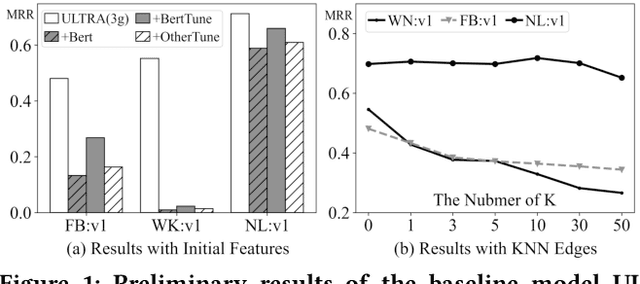
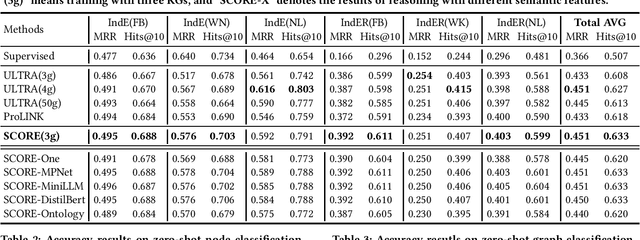
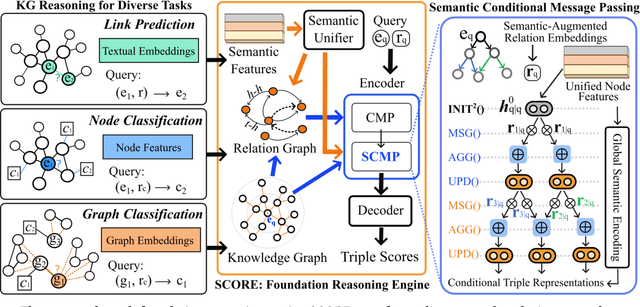
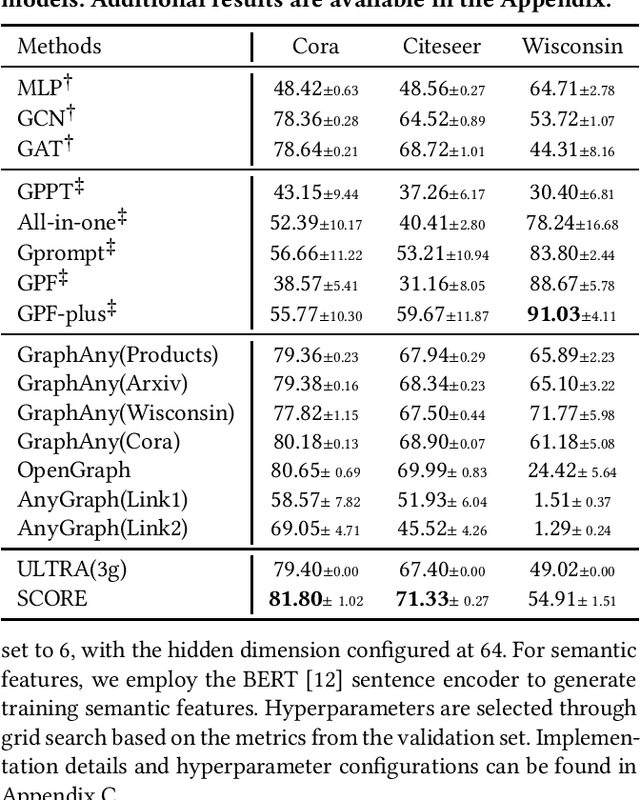
Inspired by the success of artificial general intelligence, there is a trend towards developing Graph Foundation Models that excel in generalization across various graph tasks and domains. However, current models often require extensive training or fine-tuning to capture structural and semantic insights on new graphs, which limits their versatility. In this work, we explore graph foundation models from the perspective of zero-shot reasoning on Knowledge Graphs (KGs). Our focus is on utilizing KGs as a unified topological structure to tackle diverse tasks, while addressing semantic isolation challenges in KG reasoning to effectively integrate diverse semantic and structural features. This brings us new methodological insights into KG reasoning, as well as high generalizability towards foundation models in practice. Methodologically, we introduce SCORE, a unified graph reasoning framework that effectively generalizes diverse graph tasks using zero-shot learning. At the core of SCORE is semantic conditional message passing, a technique designed to capture both structural and semantic invariances in graphs, with theoretical backing for its expressive power. Practically, we evaluate the zero-shot reasoning capability of SCORE using 38 diverse graph datasets, covering node-level, link-level, and graph-level tasks across multiple domains. Our experiments reveal a substantial performance improvement over prior foundation models and supervised baselines, highlighting the efficacy and adaptability of our approach.