 Add to Chrome
 Add to Firefox
 Add to Edge
Mixture-of-Parallelisms: Towards Memory-Efficient Training Stack for Mixture-of-Experts Models
Jul 02, 2026
This paper showcases a memory-efficient training stack for Mixture-of-Experts (MoE) models. It is a training paradigm that combines and specializes various existing and novel parallelism techniques at different layers and stages of the Mixture-of-Experts (MoE) model training pipeline. It leverages these techniques to achieve maximal efficiency given the physical constraints of CPU, CPU memory, GPU HBM memory, and the CPU-GPU, GPU-GPU, and node-node communication bandwidth of the GPU cluster. It also contains a novel strategy for the optimizer step to achieve high throughput and memory efficiency, enabling practitioners to conduct lossless pre-training/fine-tuning of trillion-parameter scale models, at a million context length, with just under 12 8x H200 GPU nodes, with state-of-the-art throughput and memory efficiency. In our experiments, MoP delivers 4.7x--8.2x higher per-GPU throughput than a strongly-tuned FSDP2 baseline (with the gap widening at larger scale) and sustains training at context lengths up to 1M tokens, where the baseline runs out of memory beyond 64--128K.

Procedural Memory Distillation: Online Reflection for Self-Improving Language Models
Jul 01, 2026Reinforcement learning with verifiable rewards (RLVR), along with recent selfdistillation variants such as SDPO, evaluates each rollout against a verifier and updates the policy from that episode-level signal. However, the richer procedural information in the rollout is rarely retained or reused. Across episodes and epochs, the model repeatedly encounters related problems under a changing policy, producing cross-episode signals that episode-local updates cannot capture: which strategies consistently pass verification, which failure modes persist, which patterns recur. We propose Procedural Memory Distillation (PMD), which converts these crossepisode signals into reusable procedural memory and distills it into the policy's weights during training. This memory functions as a training scaffold, absorbed into the policy itself, yielding a memory-free model at inference. PMD organizes the memory at three levels of abstraction: raw trajectories, self-reflected strategies and lessons, and higher-level behavioral patterns that recur across problems, all extracted online from the model's own trajectories. A memory-conditioned self-teacher draws on the accumulated experience to supervise the student on its own rollouts, enabling student to progressively internalize procedural knowledge within its parameters. The central design principle is co-evolution: the policy generates rollouts that update the memory, and memory shapes the supervision that updates the policy. Empirically, across Qwen3-8B and OLMo3-Instruct-7B, PMD improves over SDPO by 3.8-5.5% on SCIKNOWEVAL and 7.9-13.6% on LIVECODEBENCH. Co-evolution powers these gains: freezing either the memory or the policy trails PMD by more than 10% across SCIKNOWEVAL domains.
Reward Modeling for Multi-Agent Orchestration
Jun 11, 2026Multi-Agent Systems (MAS) built on Large Language Models (LLMs) require effective orchestration to coordinate specialized agents, yet training such orchestrators is hindered by limited supervision and high computational cost. We propose Orchestration Reward Modeling (OrchRM), a self-supervised framework for evaluating orchestration quality without human annotations. OrchRM leverages intermediate artifacts from multi-agent executions to construct win-lose pairs for Bradley-Terry reward model training. Unlike existing MAS test-time scaling and orchestrator training frameworks that rely on costly sub-agent rollouts, OrchRM operates directly at the orchestration level, enabling efficient and high-performing reward-guided orchestrator training and MAS test-time scaling. OrchRM improves training efficiency by up to 10x in token usage while improving MAS test-time scaling performance by up to 8% in accuracy. These gains consistently transfer across multiple domains, including mathematical reasoning, web-based question answering, and multi-hop reasoning, demonstrating orchestration-level reward modeling as a scalable direction for robust multi-agent orchestration. Code will be available at https://github.com/Wang-ML-Lab/OrchRM.
Learning from Language Feedback via Variational Policy Distillation
May 14, 2026Reinforcement learning from verifiable rewards (RLVR) suffers from sparse outcome signals, creating severe exploration bottlenecks on complex reasoning tasks. Recent on-policy self-distillation methods attempt to address this by utilizing language feedback to generate dense, token-level supervision. However, these approaches rely on a fixed, passive teacher to interpret the feedback. As the student policy improves, the teacher's zero-shot assessment capabilities plateau, ultimately halting further learning. To overcome this, we propose Variational Policy Distillation (VPD), a framework that formalizes learning from language feedback as a Variational Expectation-Maximization (EM) problem. VPD co-evolves both policies: in the E-step, the teacher is actively refined on trajectory outcomes via an adaptive trust-region update, translating textual feedback into a dynamically improved target token distribution. In the M-step, the student internalizes this dense distributional guidance on its own on-policy rollouts. By continuously improving the teacher's ability to extract actionable signals from textual critique, VPD overcomes the limitations of passive distillation. Evaluated across diverse sources of diagnostic feedback on scientific reasoning and code generation tasks, VPD consistently outperforms both standard RLVR and existing self-distillation baselines. Finally, by stress-testing our framework on rigid mathematical reasoning and cold-start regimes, we illuminate the fundamental bounds of feedback-driven self-distillation compared to pure environment-driven RL.
VIBEPASS: Can Vibe Coders Really Pass the Vibe Check?
Mar 16, 2026As Large Language Models shift the programming toward human-guided ''vibe coding'', agentic coding tools increasingly rely on models to self-diagnose and repair their own subtle faults -- a capability central to autonomous software engineering yet never systematically evaluated. We present \name{}, the first empirical decomposition that jointly evaluates two coupled tasks: \emph{Fault-Triggering Test Generation (FT-Test)} constructing a discriminative witness that exposes a latent bug, and \emph{Fault-targeted Program Repair (FPR)}, repairing it under varying diagnostic conditions. \name{} pairs competitive programming problems with LLM-generated solutions that pass partial test suites but fail on semantic edge cases, enabling controlled identification of where the diagnostic chain breaks down. Evaluating 12 frontier LLMs, we find that fault-targeted reasoning does not scale with general coding ability. Models produce syntactically valid test inputs at near-ceiling rates yet collapse on discriminative generation, with fault hypothesis generation -- not output validation -- as the dominant bottleneck. Test-guided repair reveals a complementary insight: when self-generated tests successfully witness a fault, the resulting repair matches or outperforms repair guided by externally provided tests, but tests that fail to witness the fault actively degrade repair below unguided baselines. Together, these results reframe the challenge of autonomous debugging: the binding bottleneck is not code synthesis or test validity but fault-target reasoning, a capability that remains deficient across all frontier models. As Large Language Models shift the programming toward human-guided ''vibe coding'', agentic coding tools increasingly rely on models to self-diagnose and repair their own subtle faults -- a capability central to autonomous software engineering yet never systematically evaluated.
MAS-ProVe: Understanding the Process Verification of Multi-Agent Systems
Feb 03, 2026Multi-Agent Systems (MAS) built on Large Language Models (LLMs) often exhibit high variance in their reasoning trajectories. Process verification, which evaluates intermediate steps in trajectories, has shown promise in general reasoning settings, and has been suggested as a potential tool for guiding coordination of MAS; however, its actual effectiveness in MAS remains unclear. To fill this gap, we present MAS-ProVe, a systematic empirical study of process verification for multi-agent systems (MAS). Our study spans three verification paradigms (LLM-as-a-Judge, reward models, and process reward models), evaluated across two levels of verification granularity (agent-level and iteration-level). We further examine five representative verifiers and four context management strategies, and conduct experiments over six diverse MAS frameworks on multiple reasoning benchmarks. We find that process-level verification does not consistently improve performance and frequently exhibits high variance, highlighting the difficulty of reliably evaluating partial multi-agent trajectories. Among the methods studied, LLM-as-a-Judge generally outperforms reward-based approaches, with trained judges surpassing general-purpose LLMs. We further observe a small performance gap between LLMs acting as judges and as single agents, and identify a context-length-performance trade-off in verification. Overall, our results suggest that effective and robust process verification for MAS remains an open challenge, requiring further advances beyond current paradigms. Code is available at https://github.com/Wang-ML-Lab/MAS-ProVe.
MAS-Orchestra: Understanding and Improving Multi-Agent Reasoning Through Holistic Orchestration and Controlled Benchmarks
Jan 21, 2026While multi-agent systems (MAS) promise elevated intelligence through coordination of agents, current approaches to automatic MAS design under-deliver. Such shortcomings stem from two key factors: (1) methodological complexity - agent orchestration is performed using sequential, code-level execution that limits global system-level holistic reasoning and scales poorly with agent complexity - and (2) efficacy uncertainty - MAS are deployed without understanding if there are tangible benefits compared to single-agent systems (SAS). We propose MAS-Orchestra, a training-time framework that formulates MAS orchestration as a function-calling reinforcement learning problem with holistic orchestration, generating an entire MAS at once. In MAS-Orchestra, complex, goal-oriented sub-agents are abstracted as callable functions, enabling global reasoning over system structure while hiding internal execution details. To rigorously study when and why MAS are beneficial, we introduce MASBENCH, a controlled benchmark that characterizes tasks along five axes: Depth, Horizon, Breadth, Parallel, and Robustness. Our analysis reveals that MAS gains depend critically on task structure, verification protocols, and the capabilities of both orchestrator and sub-agents, rather than holding universally. Guided by these insights, MAS-Orchestra achieves consistent improvements on public benchmarks including mathematical reasoning, multi-hop QA, and search-based QA. Together, MAS-Orchestra and MASBENCH enable better training and understanding of MAS in the pursuit of multi-agent intelligence.
SweRank+: Multilingual, Multi-Turn Code Ranking for Software Issue Localization
Dec 23, 2025Maintaining large-scale, multilingual codebases hinges on accurately localizing issues, which requires mapping natural-language error descriptions to the relevant functions that need to be modified. However, existing ranking approaches are often Python-centric and perform a single-pass search over the codebase. This work introduces SweRank+, a framework that couples SweRankMulti, a cross-lingual code ranking tool, with SweRankAgent, an agentic search setup, for iterative, multi-turn reasoning over the code repository. SweRankMulti comprises a code embedding retriever and a listwise LLM reranker, and is trained using a carefully curated large-scale issue localization dataset spanning multiple popular programming languages. SweRankAgent adopts an agentic search loop that moves beyond single-shot localization with a memory buffer to reason and accumulate relevant localization candidates over multiple turns. Our experiments on issue localization benchmarks spanning various languages demonstrate new state-of-the-art performance with SweRankMulti, while SweRankAgent further improves localization over single-pass ranking.
SSR: Socratic Self-Refine for Large Language Model Reasoning
Nov 13, 2025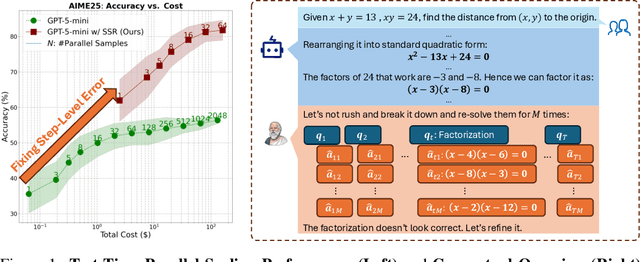
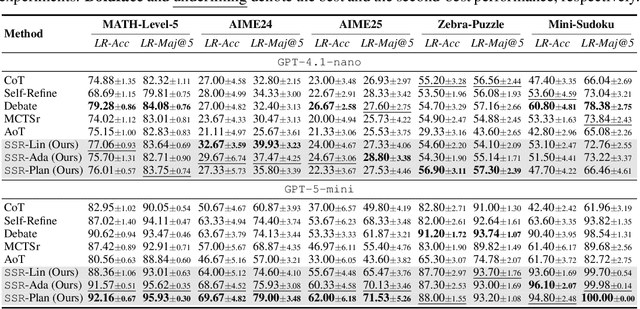
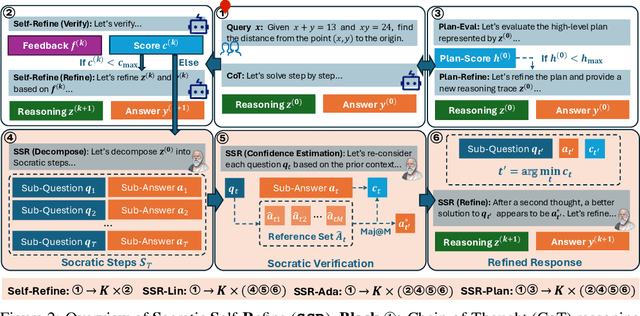
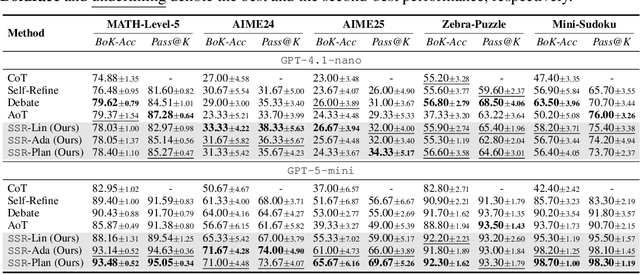
Large Language Models (LLMs) have demonstrated remarkable reasoning abilities, yet existing test-time frameworks often rely on coarse self-verification and self-correction, limiting their effectiveness on complex tasks. In this paper, we propose Socratic Self-Refine (SSR), a novel framework for fine-grained evaluation and precise refinement of LLM reasoning. Our proposed SSR decomposes model responses into verifiable (sub-question, sub-answer) pairs, enabling step-level confidence estimation through controlled re-solving and self-consistency checks. By pinpointing unreliable steps and iteratively refining them, SSR produces more accurate and interpretable reasoning chains. Empirical results across five reasoning benchmarks and three LLMs show that SSR consistently outperforms state-of-the-art iterative self-refinement baselines. Beyond performance gains, SSR provides a principled black-box approach for evaluating and understanding the internal reasoning processes of LLMs. Code is available at https://github.com/SalesforceAIResearch/socratic-self-refine-reasoning.
Self-Abstraction from Grounded Experience for Plan-Guided Policy Refinement
Nov 08, 2025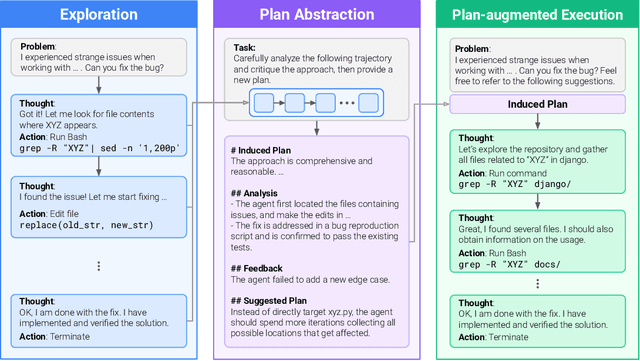
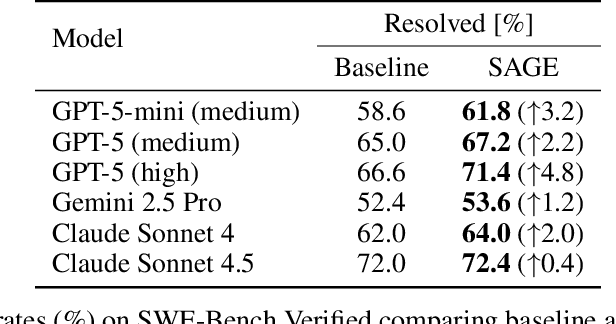
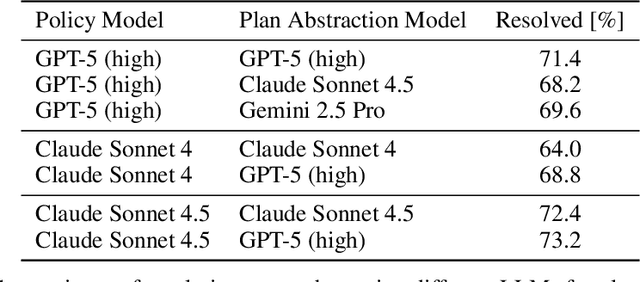
Large language model (LLM) based agents are increasingly used to tackle software engineering tasks that require multi-step reasoning and code modification, demonstrating promising yet limited performance. However, most existing LLM agents typically operate within static execution frameworks, lacking a principled mechanism to learn and self-improve from their own experience and past rollouts. As a result, their performance remains bounded by the initial framework design and the underlying LLM's capabilities. We propose Self-Abstraction from Grounded Experience (SAGE), a framework that enables agents to learn from their own task executions and refine their behavior through self-abstraction. After an initial rollout, the agent induces a concise plan abstraction from its grounded experience, distilling key steps, dependencies, and constraints. This learned abstraction is then fed back as contextual guidance, refining the agent's policy and supporting more structured, informed subsequent executions. Empirically, SAGE delivers consistent performance gains across diverse LLM backbones and agent architectures. Notably, it yields a 7.2% relative performance improvement over the strong Mini-SWE-Agent baseline when paired with the GPT-5 (high) backbone. SAGE further achieves strong overall performance on SWE-Bench Verified benchmark, reaching 73.2% and 74% Pass@1 resolve rates with the Mini-SWE-Agent and OpenHands CodeAct agent framework, respectively.