 Add to Chrome
 Add to Firefox
 Add to Edge
2023 Low-Power Computer Vision Challenge (LPCVC) Summary
Mar 11, 2024
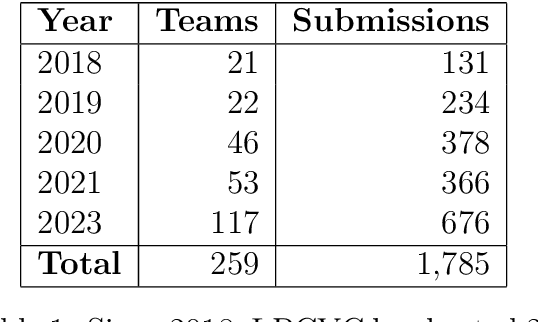
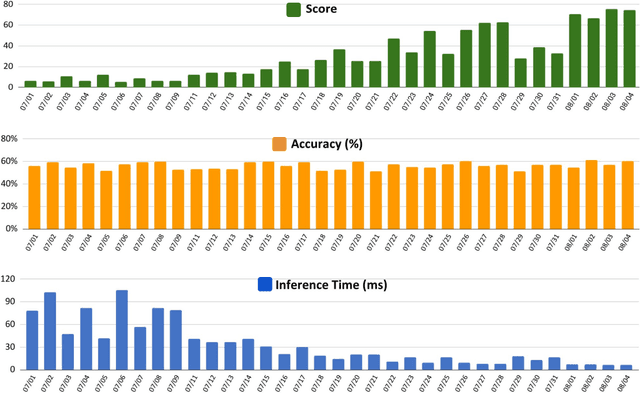


This article describes the 2023 IEEE Low-Power Computer Vision Challenge (LPCVC). Since 2015, LPCVC has been an international competition devoted to tackling the challenge of computer vision (CV) on edge devices. Most CV researchers focus on improving accuracy, at the expense of ever-growing sizes of machine models. LPCVC balances accuracy with resource requirements. Winners must achieve high accuracy with short execution time when their CV solutions run on an embedded device, such as Raspberry PI or Nvidia Jetson Nano. The vision problem for 2023 LPCVC is segmentation of images acquired by Unmanned Aerial Vehicles (UAVs, also called drones) after disasters. The 2023 LPCVC attracted 60 international teams that submitted 676 solutions during the submission window of one month. This article explains the setup of the competition and highlights the winners' methods that improve accuracy and shorten execution time.

LLMs Can Defend Themselves Against Jailbreaking in a Practical Manner: A Vision Paper
Mar 04, 2024Jailbreaking is an emerging adversarial attack that bypasses the safety alignment deployed in off-the-shelf large language models (LLMs). A considerable amount of research exists proposing more effective jailbreak attacks, including the recent Greedy Coordinate Gradient (GCG) attack, jailbreak template-based attacks such as using "Do-Anything-Now" (DAN), and multilingual jailbreak. In contrast, the defensive side has been relatively less explored. This paper proposes a lightweight yet practical defense called SELFDEFEND, which can defend against all existing jailbreak attacks with minimal delay for jailbreak prompts and negligible delay for normal user prompts. Our key insight is that regardless of the kind of jailbreak strategies employed, they eventually need to include a harmful prompt (e.g., "how to make a bomb") in the prompt sent to LLMs, and we found that existing LLMs can effectively recognize such harmful prompts that violate their safety policies. Based on this insight, we design a shadow stack that concurrently checks whether a harmful prompt exists in the user prompt and triggers a checkpoint in the normal stack once a token of "No" or a harmful prompt is output. The latter could also generate an explainable LLM response to adversarial prompts. We demonstrate our idea of SELFDEFEND works in various jailbreak scenarios through manual analysis in GPT-3.5/4. We also list three future directions to further enhance SELFDEFEND.
A Survey on Robotics with Foundation Models: toward Embodied AI
Feb 04, 2024While the exploration for embodied AI has spanned multiple decades, it remains a persistent challenge to endow agents with human-level intelligence, including perception, learning, reasoning, decision-making, control, and generalization capabilities, so that they can perform general-purpose tasks in open, unstructured, and dynamic environments. Recent advances in computer vision, natural language processing, and multi-modality learning have shown that the foundation models have superhuman capabilities for specific tasks. They not only provide a solid cornerstone for integrating basic modules into embodied AI systems but also shed light on how to scale up robot learning from a methodological perspective. This survey aims to provide a comprehensive and up-to-date overview of foundation models in robotics, focusing on autonomous manipulation and encompassing high-level planning and low-level control. Moreover, we showcase their commonly used datasets, simulators, and benchmarks. Importantly, we emphasize the critical challenges intrinsic to this field and delineate potential avenues for future research, contributing to advancing the frontier of academic and industrial discourse.
EPSD: Early Pruning with Self-Distillation for Efficient Model Compression
Jan 31, 2024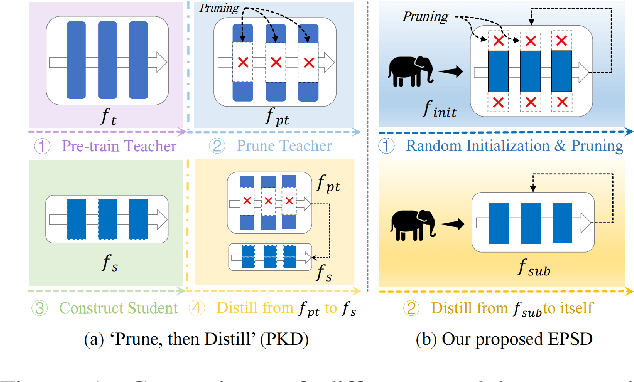
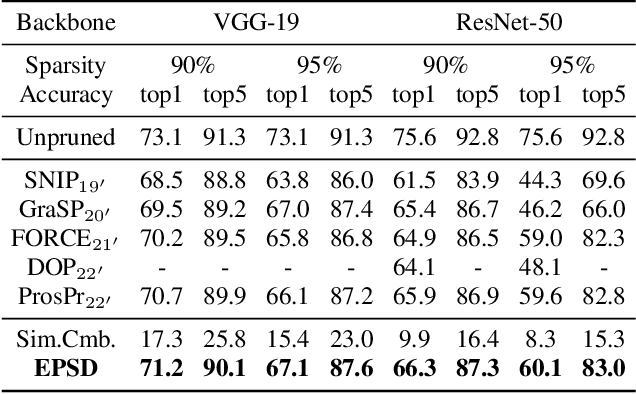
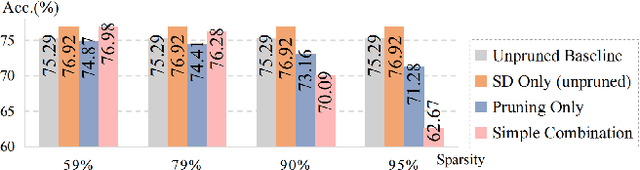
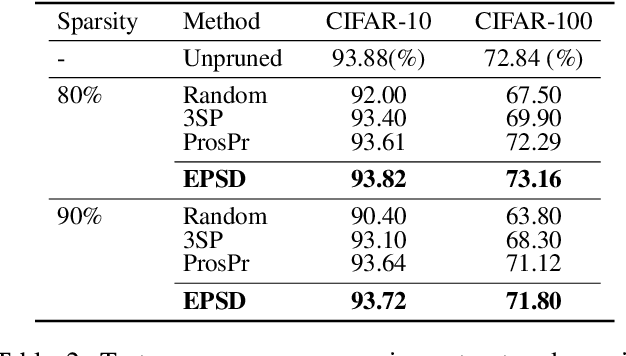
Neural network compression techniques, such as knowledge distillation (KD) and network pruning, have received increasing attention. Recent work `Prune, then Distill' reveals that a pruned student-friendly teacher network can benefit the performance of KD. However, the conventional teacher-student pipeline, which entails cumbersome pre-training of the teacher and complicated compression steps, makes pruning with KD less efficient. In addition to compressing models, recent compression techniques also emphasize the aspect of efficiency. Early pruning demands significantly less computational cost in comparison to the conventional pruning methods as it does not require a large pre-trained model. Likewise, a special case of KD, known as self-distillation (SD), is more efficient since it requires no pre-training or student-teacher pair selection. This inspires us to collaborate early pruning with SD for efficient model compression. In this work, we propose the framework named Early Pruning with Self-Distillation (EPSD), which identifies and preserves distillable weights in early pruning for a given SD task. EPSD efficiently combines early pruning and self-distillation in a two-step process, maintaining the pruned network's trainability for compression. Instead of a simple combination of pruning and SD, EPSD enables the pruned network to favor SD by keeping more distillable weights before training to ensure better distillation of the pruned network. We demonstrated that EPSD improves the training of pruned networks, supported by visual and quantitative analyses. Our evaluation covered diverse benchmarks (CIFAR-10/100, Tiny-ImageNet, full ImageNet, CUB-200-2011, and Pascal VOC), with EPSD outperforming advanced pruning and SD techniques.
SWBT: Similarity Weighted Behavior Transformer with the Imperfect Demonstration for Robotic Manipulation
Jan 17, 2024Imitation learning (IL), aiming to learn optimal control policies from expert demonstrations, has been an effective method for robot manipulation tasks. However, previous IL methods either only use expensive expert demonstrations and omit imperfect demonstrations or rely on interacting with the environment and learning from online experiences. In the context of robotic manipulation, we aim to conquer the above two challenges and propose a novel framework named Similarity Weighted Behavior Transformer (SWBT). SWBT effectively learn from both expert and imperfect demonstrations without interaction with environments. We reveal that the easy-to-get imperfect demonstrations, such as forward and inverse dynamics, significantly enhance the network by learning fruitful information. To the best of our knowledge, we are the first to attempt to integrate imperfect demonstrations into the offline imitation learning setting for robot manipulation tasks. Extensive experiments on the ManiSkill2 benchmark built on the high-fidelity Sapien simulator and real-world robotic manipulation tasks demonstrated that the proposed method can extract better features and improve the success rates for all tasks. Our code will be released upon acceptance of the paper.
LLaVA-Phi: Efficient Multi-Modal Assistant with Small Language Model
Jan 15, 2024In this paper, we introduce LLaVA-$\phi$ (LLaVA-Phi), an efficient multi-modal assistant that harnesses the power of the recently advanced small language model, Phi-2, to facilitate multi-modal dialogues. LLaVA-Phi marks a notable advancement in the realm of compact multi-modal models. It demonstrates that even smaller language models, with as few as 2.7B parameters, can effectively engage in intricate dialogues that integrate both textual and visual elements, provided they are trained with high-quality corpora. Our model delivers commendable performance on publicly available benchmarks that encompass visual comprehension, reasoning, and knowledge-based perception. Beyond its remarkable performance in multi-modal dialogue tasks, our model opens new avenues for applications in time-sensitive environments and systems that require real-time interaction, such as embodied agents. It highlights the potential of smaller language models to achieve sophisticated levels of understanding and interaction, while maintaining greater resource efficiency.The project is available at {https://github.com/zhuyiche/llava-phi}.
Assessing Large Language Models in Mechanical Engineering Education: A Study on Mechanics-Focused Conceptual Understanding
Jan 13, 2024This study is a pioneering endeavor to investigate the capabilities of Large Language Models (LLMs) in addressing conceptual questions within the domain of mechanical engineering with a focus on mechanics. Our examination involves a manually crafted exam encompassing 126 multiple-choice questions, spanning various aspects of mechanics courses, including Fluid Mechanics, Mechanical Vibration, Engineering Statics and Dynamics, Mechanics of Materials, Theory of Elasticity, and Continuum Mechanics. Three LLMs, including ChatGPT (GPT-3.5), ChatGPT (GPT-4), and Claude (Claude-2.1), were subjected to evaluation against engineering faculties and students with or without mechanical engineering background. The findings reveal GPT-4's superior performance over the other two LLMs and human cohorts in answering questions across various mechanics topics, except for Continuum Mechanics. This signals the potential future improvements for GPT models in handling symbolic calculations and tensor analyses. The performances of LLMs were all significantly improved with explanations prompted prior to direct responses, underscoring the crucial role of prompt engineering. Interestingly, GPT-3.5 demonstrates improved performance with prompts covering a broader domain, while GPT-4 excels with prompts focusing on specific subjects. Finally, GPT-4 exhibits notable advancements in mitigating input bias, as evidenced by guessing preferences for humans. This study unveils the substantial potential of LLMs as highly knowledgeable assistants in both mechanical pedagogy and scientific research.
Peridynamic Neural Operators: A Data-Driven Nonlocal Constitutive Model for Complex Material Responses
Jan 11, 2024Neural operators, which can act as implicit solution operators of hidden governing equations, have recently become popular tools for learning the responses of complex real-world physical systems. Nevertheless, most neural operator applications have thus far been data-driven and neglect the intrinsic preservation of fundamental physical laws in data. In this work, we introduce a novel integral neural operator architecture called the Peridynamic Neural Operator (PNO) that learns a nonlocal constitutive law from data. This neural operator provides a forward model in the form of state-based peridynamics, with objectivity and momentum balance laws automatically guaranteed. As applications, we demonstrate the expressivity and efficacy of our model in learning complex material behaviors from both synthetic and experimental data sets. We show that, owing to its ability to capture complex responses, our learned neural operator achieves improved accuracy and efficiency compared to baseline models that use predefined constitutive laws. Moreover, by preserving the essential physical laws within the neural network architecture, the PNO is robust in treating noisy data. The method shows generalizability to different domain configurations, external loadings, and discretizations.
FCDNet: Frequency-Guided Complementary Dependency Modeling for Multivariate Time-Series Forecasting
Dec 27, 2023
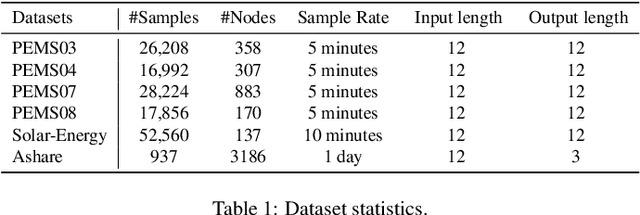
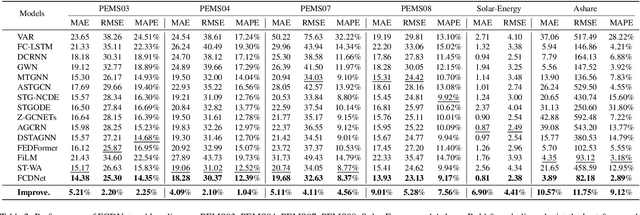

Multivariate time-series (MTS) forecasting is a challenging task in many real-world non-stationary dynamic scenarios. In addition to intra-series temporal signals, the inter-series dependency also plays a crucial role in shaping future trends. How to enable the model's awareness of dependency information has raised substantial research attention. Previous approaches have either presupposed dependency constraints based on domain knowledge or imposed them using real-time feature similarity. However, MTS data often exhibit both enduring long-term static relationships and transient short-term interactions, which mutually influence their evolving states. It is necessary to recognize and incorporate the complementary dependencies for more accurate MTS prediction. The frequency information in time series reflects the evolutionary rules behind complex temporal dynamics, and different frequency components can be used to well construct long-term and short-term interactive dependency structures between variables. To this end, we propose FCDNet, a concise yet effective framework for multivariate time-series forecasting. Specifically, FCDNet overcomes the above limitations by applying two light-weight dependency constructors to help extract long- and short-term dependency information adaptively from multi-level frequency patterns. With the growth of input variables, the number of trainable parameters in FCDNet only increases linearly, which is conducive to the model's scalability and avoids over-fitting. Additionally, adopting a frequency-based perspective can effectively mitigate the influence of noise within MTS data, which helps capture more genuine dependencies. The experimental results on six real-world datasets from multiple fields show that FCDNet significantly exceeds strong baselines, with an average improvement of 6.82% on MAE, 4.98% on RMSE, and 4.91% on MAPE.
Harnessing the Power of Neural Operators with Automatically Encoded Conservation Laws
Dec 26, 2023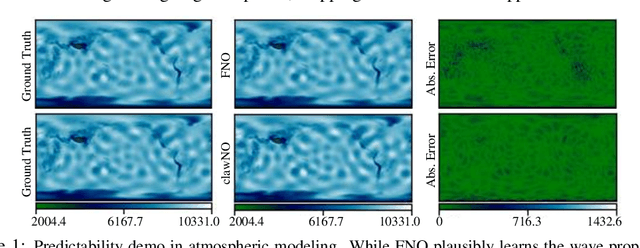
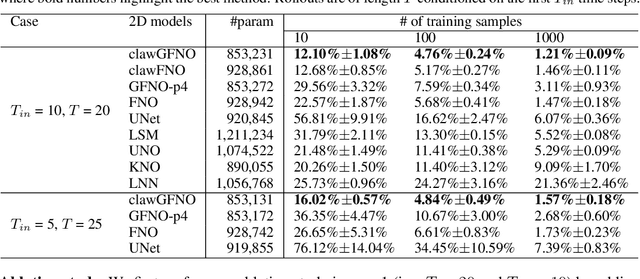

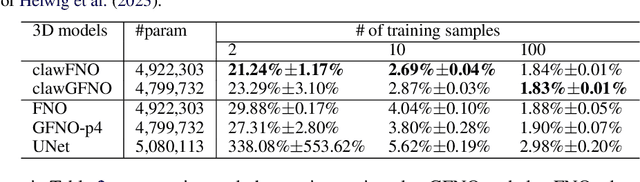
Neural operators (NOs) have emerged as effective tools for modeling complex physical systems in scientific machine learning. In NOs, a central characteristic is to learn the governing physical laws directly from data. In contrast to other machine learning applications, partial knowledge is often known a priori about the physical system at hand whereby quantities such as mass, energy and momentum are exactly conserved. Currently, NOs have to learn these conservation laws from data and can only approximately satisfy them due to finite training data and random noise. In this work, we introduce conservation law-encoded neural operators (clawNOs), a suite of NOs that endow inference with automatic satisfaction of such conservation laws. ClawNOs are built with a divergence-free prediction of the solution field, with which the continuity equation is automatically guaranteed. As a consequence, clawNOs are compliant with the most fundamental and ubiquitous conservation laws essential for correct physical consistency. As demonstrations, we consider a wide variety of scientific applications ranging from constitutive modeling of material deformation, incompressible fluid dynamics, to atmospheric simulation. ClawNOs significantly outperform the state-of-the-art NOs in learning efficacy, especially in small-data regimes.