 Add to Chrome
 Add to Firefox
 Add to Edge
ChainFlow-VLA: Causal Flow Planning with Vision-Language Models
May 22, 2026
Current end-to-end autonomous driving systems are fundamentally limited by a mismatch between temporal causal reasoning and global trajectory consistency. Autoregressive (AR) models capture interaction-aware temporal dependencies via causal factorization, but their step-wise decoding leads to error accumulation and suboptimal global structure. In contrast, diffusion models optimize trajectories globally but lack explicit causal constraints, making them unreliable in interactive and safety-critical scenarios. This dichotomy reveals a deeper issue: existing methods treat causal modeling and global optimization as separate paradigms, without a principled way to unify them within a single trajectory distribution. To address this, we propose ChainFlow-VLA, which unifies causal generation and global refinement within a unified probabilistic framework. We formulate planning as a mixture over AR-induced modes and learn Vision-Language Model (VLM)-conditioned residual distributions over these modes. An autoregressive generator (Chain) produces a discrete set of causal trajectory modes, followed by a diffusion-based refiner (Flow) that leverages VLM hidden states as semantic priors to perform mode-conditioned correction in residual space while preserving causal structure. This straightforward conditioning seamlessly injects high-level scene understanding into fine-grained trajectory adjustments. Experiments demonstrate that ChainFlow-VLA achieves robust planning in ambiguous and long-tail scenarios, achieving a state-of-the-art score of 94.85 on the NAVSIM v1 leaderboard, matching human-level performance (94.8). Code will be available at https://github.com/AFARI-Research/ChainFlow-VLA.

CoWorld-VLA: Thinking in a Multi-Expert World Model for Autonomous Driving
May 11, 2026Vision-Language-Action (VLA) models have emerged as a promising paradigm for end-to-end autonomous driving. However, existing reasoning mechanisms still struggle to provide planning-oriented intermediate representations: textual Chain-of-Thought (CoT) fails to preserve continuous spatiotemporal structure, while latent world reasoning remains difficult to use as a direct condition for action generation. In this paper, we propose CoWorld-VLA, a multi-expert world reasoning framework for autonomous driving, where world representations serve as explicit conditions to guide action planning. CoWorld-VLA extracts complementary world information through multi-source supervision and encodes it into expert tokens within the VLA, thereby providing planner-accessible conditioning signals. Specifically, we construct four types of tokens: semantic interaction, geometric structure, dynamic evolution, and ego trajectory tokens, which respectively model interaction intent, spatial structure, future temporal dynamics, and behavioral goals. During action generation, CoWorld-VLA employs a diffusion-based hierarchical multi-expert fusion planner, which is coupled with scene context throughout the joint denoising process to generate continuous ego trajectories. Experiments show that CoWorld-VLA achieves competitive results in both future scene generation and planning on the NAVSIM v1 benchmark, demonstrating strong performance in collision avoidance and trajectory accuracy. Ablation studies further validate the complementarity of expert tokens and their effectiveness as planning conditions for action generation. Code will be available at https://github.com/potatochip1211/CoWorld-VLA.
Any 3D Scene is Worth 1K Tokens: 3D-Grounded Representation for Scene Generation at Scale
Apr 13, 20263D scene generation has long been dominated by 2D multi-view or video diffusion models. This is due not only to the lack of scene-level 3D latent representation, but also to the fact that most scene-level 3D visual data exists in the form of multi-view images or videos, which are naturally compatible with 2D diffusion architectures. Typically, these 2D-based approaches degrade 3D spatial extrapolation to 2D temporal extension, which introduces two fundamental issues: (i) representing 3D scenes via 2D views leads to significant representation redundancy, and (ii) latent space rooted in 2D inherently limits the spatial consistency of the generated 3D scenes. In this paper, we propose, for the first time, to perform 3D scene generation directly within an implicit 3D latent space to address these limitations. First, we repurpose frozen 2D representation encoders to construct our 3D Representation Autoencoder (3DRAE), which grounds view-coupled 2D semantic representations into a view-decoupled 3D latent representation. This enables representing 3D scenes observed from arbitrary numbers of views--at any resolution and aspect ratio--with fixed complexity and rich semantics. Then we introduce 3D Diffusion Transformer (3DDiT), which performs diffusion modeling in this 3D latent space, achieving remarkably efficient and spatially consistent 3D scene generation while supporting diverse conditioning configurations. Moreover, since our approach directly generates a 3D scene representation, it can be decoded to images and optional point maps along arbitrary camera trajectories without requiring per-trajectory diffusion sampling pass, which is common in 2D-based approaches.
Emotion-Aware Prefix: Towards Explicit Emotion Control in Voice Conversion Models
Mar 10, 2026Recent advances in zero-shot voice conversion have exhibited potential in emotion control, yet the performance is suboptimal or inconsistent due to their limited expressive capacity. We propose Emotion-Aware Prefix for explicit emotion control in a two-stage voice conversion backbone. We significantly improve emotion conversion performance, doubling the baseline Emotion Conversion Accuracy (ECA) from 42.40% to 85.50% while maintaining linguistic integrity and speech quality, without compromising speaker identity. Our ablation study suggests that a joint control of both sequence modulation and acoustic realization is essential to synthesize distinct emotions. Furthermore, comparative analysis verifies the generalizability of proposed method, while it provides insights on the role of acoustic decoupling in maintaining speaker identity.
Bridging the Modality Gap: Softly Discretizing Audio Representation for LLM-based Automatic Speech Recognition
Jun 06, 2025One challenge of integrating speech input with large language models (LLMs) stems from the discrepancy between the continuous nature of audio data and the discrete token-based paradigm of LLMs. To mitigate this gap, we propose a method for integrating vector quantization (VQ) into LLM-based automatic speech recognition (ASR). Using the LLM embedding table as the VQ codebook, the VQ module aligns the continuous representations from the audio encoder with the discrete LLM inputs, enabling the LLM to operate on a discretized audio representation that better reflects the linguistic structure. We further create a soft "discretization" of the audio representation by updating the codebook and performing a weighted sum over the codebook embeddings. Empirical results demonstrate that our proposed method significantly improves upon the LLM-based ASR baseline, particularly in out-of-domain conditions. This work highlights the potential of soft discretization as a modality bridge in LLM-based ASR.
Autoregressive Meta-Actions for Unified Controllable Trajectory Generation
May 29, 2025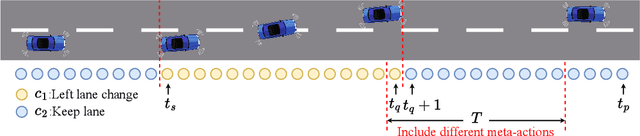
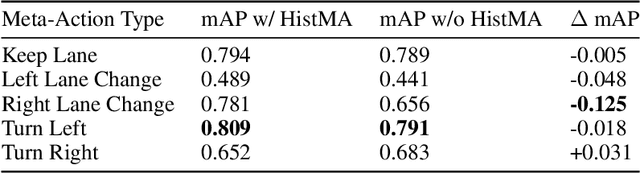
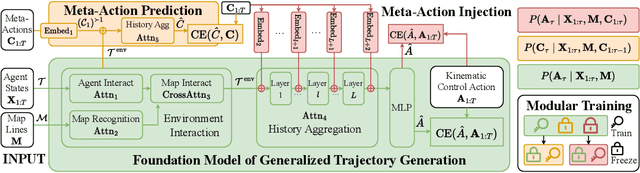
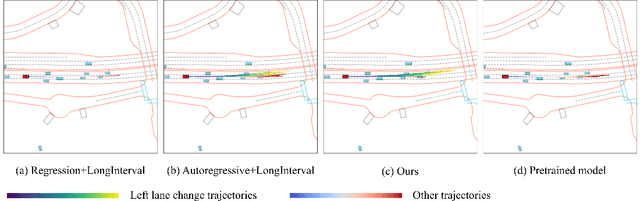
Controllable trajectory generation guided by high-level semantic decisions, termed meta-actions, is crucial for autonomous driving systems. A significant limitation of existing frameworks is their reliance on invariant meta-actions assigned over fixed future time intervals, causing temporal misalignment with the actual behavior trajectories. This misalignment leads to irrelevant associations between the prescribed meta-actions and the resulting trajectories, disrupting task coherence and limiting model performance. To address this challenge, we introduce Autoregressive Meta-Actions, an approach integrated into autoregressive trajectory generation frameworks that provides a unified and precise definition for meta-action-conditioned trajectory prediction. Specifically, We decompose traditional long-interval meta-actions into frame-level meta-actions, enabling a sequential interplay between autoregressive meta-action prediction and meta-action-conditioned trajectory generation. This decomposition ensures strict alignment between each trajectory segment and its corresponding meta-action, achieving a consistent and unified task formulation across the entire trajectory span and significantly reducing complexity. Moreover, we propose a staged pre-training process to decouple the learning of basic motion dynamics from the integration of high-level decision control, which offers flexibility, stability, and modularity. Experimental results validate our framework's effectiveness, demonstrating improved trajectory adaptivity and responsiveness to dynamic decision-making scenarios. We provide the video document and dataset, which are available at https://arma-traj.github.io/.
DRoPE: Directional Rotary Position Embedding for Efficient Agent Interaction Modeling
Mar 19, 2025Accurate and efficient modeling of agent interactions is essential for trajectory generation, the core of autonomous driving systems. Existing methods, scene-centric, agent-centric, and query-centric frameworks, each present distinct advantages and drawbacks, creating an impossible triangle among accuracy, computational time, and memory efficiency. To break this limitation, we propose Directional Rotary Position Embedding (DRoPE), a novel adaptation of Rotary Position Embedding (RoPE), originally developed in natural language processing. Unlike traditional relative position embedding (RPE), which introduces significant space complexity, RoPE efficiently encodes relative positions without explicitly increasing complexity but faces inherent limitations in handling angular information due to periodicity. DRoPE overcomes this limitation by introducing a uniform identity scalar into RoPE's 2D rotary transformation, aligning rotation angles with realistic agent headings to naturally encode relative angular information. We theoretically analyze DRoPE's correctness and efficiency, demonstrating its capability to simultaneously optimize trajectory generation accuracy, time complexity, and space complexity. Empirical evaluations compared with various state-of-the-art trajectory generation models, confirm DRoPE's good performance and significantly reduced space complexity, indicating both theoretical soundness and practical effectiveness. The video documentation is available at https://drope-traj.github.io/.
UniScene: Unified Occupancy-centric Driving Scene Generation
Dec 06, 2024Generating high-fidelity, controllable, and annotated training data is critical for autonomous driving. Existing methods typically generate a single data form directly from a coarse scene layout, which not only fails to output rich data forms required for diverse downstream tasks but also struggles to model the direct layout-to-data distribution. In this paper, we introduce UniScene, the first unified framework for generating three key data forms - semantic occupancy, video, and LiDAR - in driving scenes. UniScene employs a progressive generation process that decomposes the complex task of scene generation into two hierarchical steps: (a) first generating semantic occupancy from a customized scene layout as a meta scene representation rich in both semantic and geometric information, and then (b) conditioned on occupancy, generating video and LiDAR data, respectively, with two novel transfer strategies of Gaussian-based Joint Rendering and Prior-guided Sparse Modeling. This occupancy-centric approach reduces the generation burden, especially for intricate scenes, while providing detailed intermediate representations for the subsequent generation stages. Extensive experiments demonstrate that UniScene outperforms previous SOTAs in the occupancy, video, and LiDAR generation, which also indeed benefits downstream driving tasks.
Audiobox TTA-RAG: Improving Zero-Shot and Few-Shot Text-To-Audio with Retrieval-Augmented Generation
Nov 07, 2024Current leading Text-To-Audio (TTA) generation models suffer from degraded performance on zero-shot and few-shot settings. It is often challenging to generate high-quality audio for audio events that are unseen or uncommon in the training set. Inspired by the success of Retrieval-Augmented Generation (RAG) in Large Language Model (LLM)-based knowledge-intensive tasks, we extend the TTA process with additional conditioning contexts. We propose Audiobox TTA-RAG, a novel retrieval-augmented TTA approach based on Audiobox, a conditional flow-matching audio generation model. Unlike the vanilla Audiobox TTA solution which generates audio conditioned on text, we augmented the conditioning input with retrieved audio samples that provide additional acoustic information to generate the target audio. Our retrieval method does not require the external database to have labeled audio, offering more practical use cases. To evaluate our proposed method, we curated test sets in zero-shot and few-shot settings. Our empirical results show that the proposed model can effectively leverage the retrieved audio samples and significantly improve zero-shot and few-shot TTA performance, with large margins on multiple evaluation metrics, while maintaining the ability to generate semantically aligned audio for the in-domain setting. In addition, we investigate the effect of different retrieval methods and data sources.
DiariST: Streaming Speech Translation with Speaker Diarization
Sep 14, 2023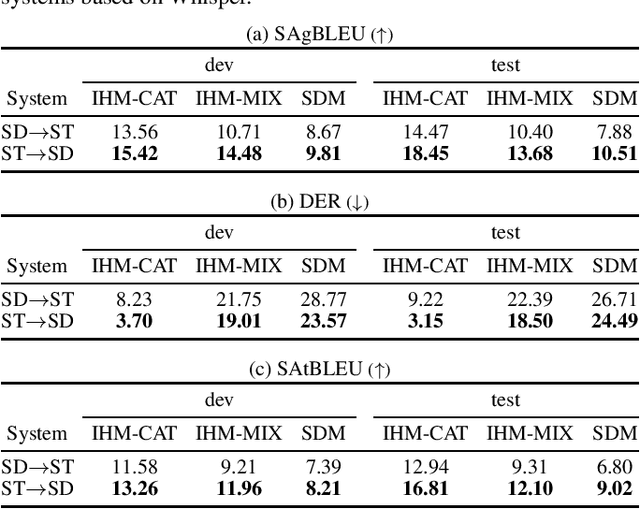
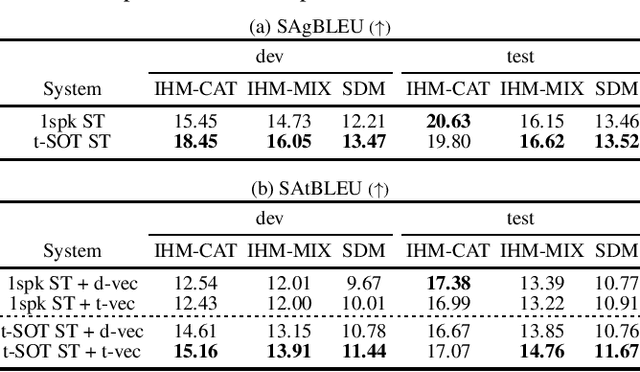
End-to-end speech translation (ST) for conversation recordings involves several under-explored challenges such as speaker diarization (SD) without accurate word time stamps and handling of overlapping speech in a streaming fashion. In this work, we propose DiariST, the first streaming ST and SD solution. It is built upon a neural transducer-based streaming ST system and integrates token-level serialized output training and t-vector, which were originally developed for multi-talker speech recognition. Due to the absence of evaluation benchmarks in this area, we develop a new evaluation dataset, DiariST-AliMeeting, by translating the reference Chinese transcriptions of the AliMeeting corpus into English. We also propose new metrics, called speaker-agnostic BLEU and speaker-attributed BLEU, to measure the ST quality while taking SD accuracy into account. Our system achieves a strong ST and SD capability compared to offline systems based on Whisper, while performing streaming inference for overlapping speech. To facilitate the research in this new direction, we release the evaluation data, the offline baseline systems, and the evaluation code.