 Add to Chrome
 Add to Firefox
 Add to Edge
ChainFlow-VLA: Causal Flow Planning with Vision-Language Models
May 22, 2026
Current end-to-end autonomous driving systems are fundamentally limited by a mismatch between temporal causal reasoning and global trajectory consistency. Autoregressive (AR) models capture interaction-aware temporal dependencies via causal factorization, but their step-wise decoding leads to error accumulation and suboptimal global structure. In contrast, diffusion models optimize trajectories globally but lack explicit causal constraints, making them unreliable in interactive and safety-critical scenarios. This dichotomy reveals a deeper issue: existing methods treat causal modeling and global optimization as separate paradigms, without a principled way to unify them within a single trajectory distribution. To address this, we propose ChainFlow-VLA, which unifies causal generation and global refinement within a unified probabilistic framework. We formulate planning as a mixture over AR-induced modes and learn Vision-Language Model (VLM)-conditioned residual distributions over these modes. An autoregressive generator (Chain) produces a discrete set of causal trajectory modes, followed by a diffusion-based refiner (Flow) that leverages VLM hidden states as semantic priors to perform mode-conditioned correction in residual space while preserving causal structure. This straightforward conditioning seamlessly injects high-level scene understanding into fine-grained trajectory adjustments. Experiments demonstrate that ChainFlow-VLA achieves robust planning in ambiguous and long-tail scenarios, achieving a state-of-the-art score of 94.85 on the NAVSIM v1 leaderboard, matching human-level performance (94.8). Code will be available at https://github.com/AFARI-Research/ChainFlow-VLA.

Rethinking Scale: Deployment Trade-offs of Small Language Models under Agent Paradigms
Apr 21, 2026Despite the impressive capabilities of large language models, their substantial computational costs, latency, and privacy risks hinder their widespread deployment in real-world applications. Small Language Models (SLMs) with fewer than 10 billion parameters present a promising alternative; however, their inherent limitations in knowledge and reasoning curtail their effectiveness. Existing research primarily focuses on enhancing SLMs through scaling laws or fine-tuning strategies while overlooking the potential of using agent paradigms, such as tool use and multi-agent collaboration, to systematically compensate for the inherent weaknesses of small models. To address this gap, this paper presents the first large-scale, comprehensive study of <10B open-source models under three paradigms: (1) the base model, (2) a single agent equipped with tools, and (3) a multi-agent system with collaborative capabilities. Our results show that single-agent systems achieve the best balance between performance and cost, while multi-agent setups add overhead with limited gains. Our findings highlight the importance of agent-centric design for efficient and trustworthy deployment in resource-constrained settings.
Low-Complexity Algorithm for Stackelberg Prediction Games with Global Optimality
Apr 03, 2026Stackelberg prediction games (SPGs) model strategic data manipulation in adversarial learning via a leader--follower interaction between a learner and a self-interested data provider, leading to challenging bilevel optimization problems. Focusing on the least-squares setting (SPG-LS), recent work shows that the bilevel program admits an equivalent spherically constrained least-squares (SCLS) reformulation, which avoids costly conic programming and enables scalable algorithms. In this paper, we develop a simple and efficient alternating direction method of multiplier (ADMM) based solver for the SCLS problem. By introducing a consensus splitting that separates the quadratic objective from the spherical constraint, we obtain an augmented Lagrangian formulation with closed-form updates: the primal quadratic step reduces to solving a fixed shifted linear system, the constraint step is a projection onto the unit sphere, and the dual step is a lightweight scaled ascent. The resulting method has low per-iteration complexity and allows pre-factorization of the constant system matrix for substantial speedups. Experiments demonstrate that the proposed ADMM approach achieves competitive solution quality with significantly improved computational efficiency compared with existing global solvers for SCLS, particularly in sparse and high-dimensional regimes.
Which Company Adjustment Matter? Insights from Uplift Modeling on Financial Health
Jun 23, 2025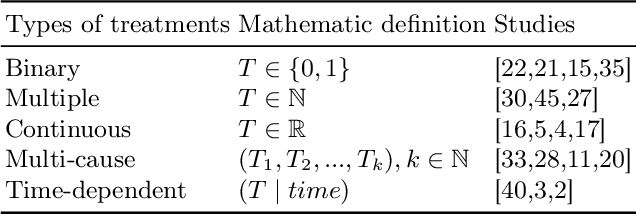
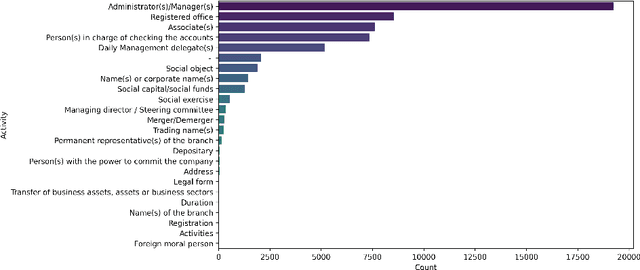
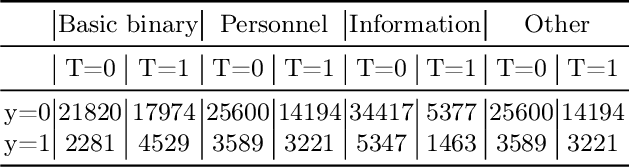
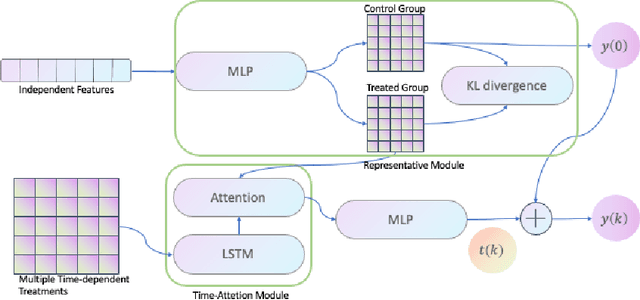
Uplift modeling has achieved significant success in various fields, particularly in online marketing. It is a method that primarily utilizes machine learning and deep learning to estimate individual treatment effects. This paper we apply uplift modeling to analyze the effect of company adjustment on their financial status, and we treat these adjustment as treatments or interventions in this study. Although there have been extensive studies and application regarding binary treatments, multiple treatments, and continuous treatments, company adjustment are often more complex than these scenarios, as they constitute a series of multiple time-dependent actions. The effect estimation of company adjustment needs to take into account not only individual treatment traits but also the temporal order of this series of treatments. This study collects a real-world data set about company financial statements and reported behavior in Luxembourg for the experiments. First, we use two meta-learners and three other well-known uplift models to analyze different company adjustment by simplifying the adjustment as binary treatments. Furthermore, we propose a new uplift modeling framework (MTDnet) to address the time-dependent nature of these adjustment, and the experimental result shows the necessity of considering the timing of these adjustment.
Complex Scene Classification of PolSAR Imagery based on a Self-paced Learning Approach
Mar 18, 2019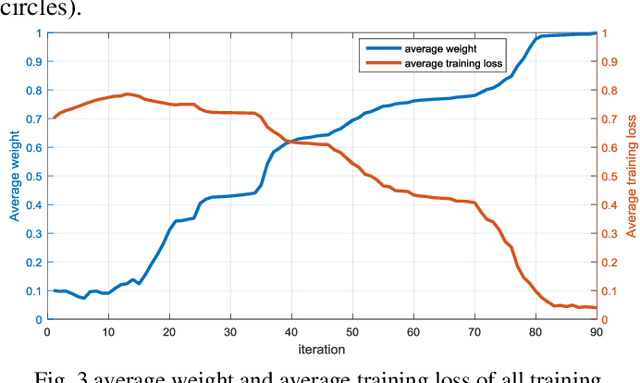
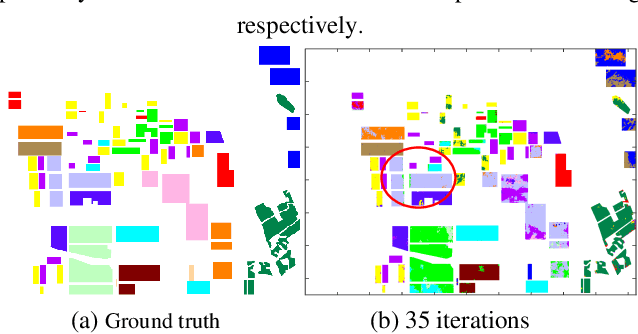
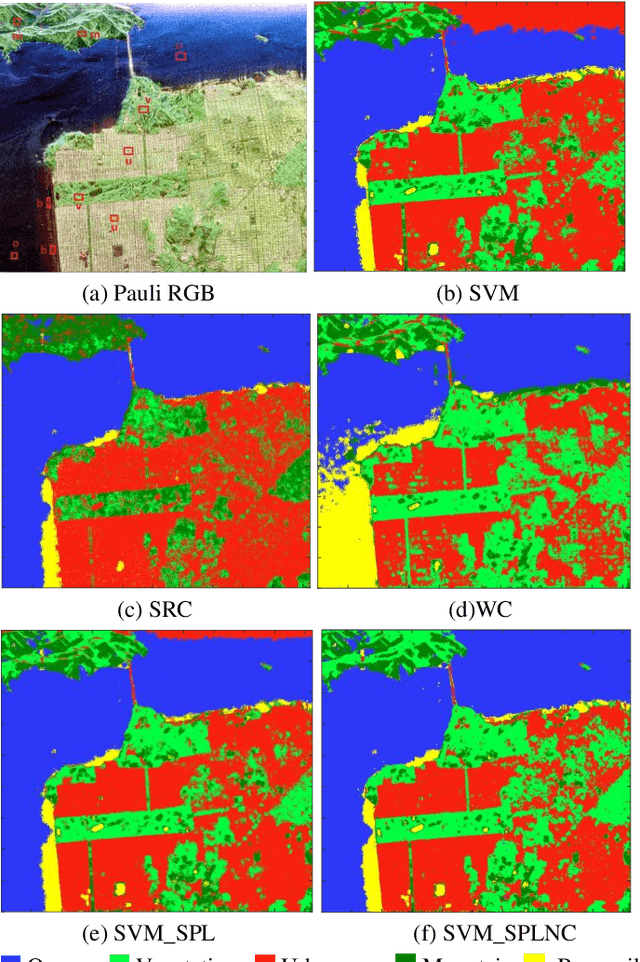
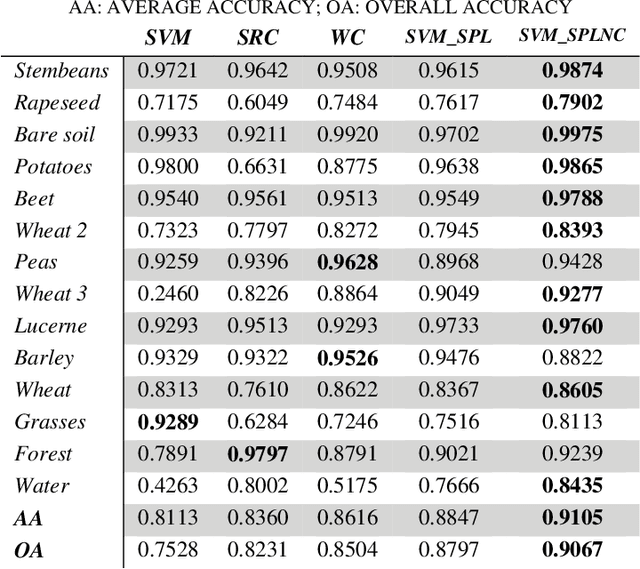
Existing polarimetric synthetic aperture radar (PolSAR) image classification methods cannot achieve satisfactory performance on complex scenes characterized by several types of land cover with significant levels of noise or similar scattering properties across land cover types. Hence, we propose a supervised classification method aimed at constructing a classifier based on self-paced learning (SPL). SPL has been demonstrated to be effective at dealing with complex data while providing classifier. In this paper, a novel Support Vector Machine (SVM) algorithm based on SPL with neighborhood constraints (SVM_SPLNC) is proposed. The proposed method leverages the easiest samples first to obtain an initial parameter vector. Then, more complex samples are gradually incorporated to update the parameter vector iteratively. Moreover, neighborhood constraints are introduced during the training process to further improve performance. Experimental results on three real PolSAR images show that the proposed method performs well on complex scenes.