 Add to Chrome
 Add to Firefox
 Add to Edge
Navigating Speech Enhancement for Real-Time MRI: A Systematic Assessment of Signal Quality, Source Preservation, and Downstream Tasks
Aug 17, 2026
Audio recorded during real-time magnetic resonance imaging (rtMRI) is heavily contaminated by scanner noise, but it remains unclear whether general-purpose speech enhancement improves the signal for speech research and downstream processing. Three off-the-shelf systems---Denoiser, PASE, and RE-USE---are evaluated across five rtMRI corpora using naturally recorded inputs, a clean-input probe, and an archived paired additive-noise probe. The multi-task evaluation spans learned quality predictors, speaker and phone representations, reference-based intelligibility and quality measures, acoustic--phonetic probes, automatic speech recognition (ASR), and paralinguistic tasks. The central result is that enhancement effects are endpoint dependent: higher predicted-quality scores do not reliably imply better ASR performance or greater source fidelity. Across 15 corpus--recognizer comparisons using corpus-provided processed inputs, RE-USE yielded lower word-error-rate point estimates in 11, whereas Denoiser yielded higher estimates in 13. In the paired additive-noise probe, PASE and RE-USE improved recognized-phone agreement, intelligibility, and perceptual-quality point estimates. Denoiser improved recognized-phone agreement and short-time objective intelligibility (STOI) but reduced speaker-embedding similarity. No system was uniformly best across corpora, recognizers, and endpoints. Enhanced rtMRI audio should therefore be treated as a task-specific transformed derivative rather than a universally improved replacement for the original or DSP-processed waveform.

Learning from Annotation Uncertainty: Entropy-Aware Curriculum for Speech Emotion Recognition
Jun 25, 2026Speech emotion recognition (SER) often relies on hard consensus labels that collapse annotator disagreement. We study distribution-based supervision for 9-class SER on MSP-Podcast 2.0 using a WavLM-Base multitask model for categorical emotion and dimensional VAD. Hard-label training is compared with targets from primary and merged primary--secondary annotator vote distributions. Distributional objectives improve alignment with human vote distributions, reducing JSD/KLD relative to hard-label training. Analysis shows that hard supervision partly benefits from assigning ambiguous utterances to the residual Other class, whereas distributional supervision redistributes uncertainty across emotion categories. Entropy-stratified evaluation shows that high-ambiguity utterances remain challenging, but distribution-based supervision better captures perceptual uncertainty. These findings support moving beyond hard labels toward targets that reflect listener disagreement.
Advancing Speaker-Based Vocal Effort Classification with WavLM and Data Augmentation in Naturalistic Non-Calibrated Speech Recordings
Jun 25, 2026The variations in vocal effort range (e.g. whisper, soft, neutral, loud, shout) alter production and speech acoustics, reducing intelligibility and limiting the robustness of any subsequent speech technology. Classification is challenging since effort lies on a continuum, adjacent categories are easily confused, and labeled data remain scarce. Prior SSL approaches with wav2vec2, HuBERT, and AST improve performance on the AVID corpus but still suffer from boundary errors. In this study, we introduce WavLM for the first time in vocal effort classification and benchmark it against wav2vec2 and HuBERT. To address data scarcity, we conduct a systematic study of augmentation strategies, covering RIR convolution, additive noise, time masking, speed perturbation, band-limiting, MixUp, and CutMix. Augmentation consistently improves WavLM, with gains ranging from +0.6% to +1.8% absolute. We further propose Gaussian-neighbor soft labels, which further reduce near-boundary confusions by modeling the vocal effort continuum. Our best system, WavLM-BASE with gradual unfreezing, augmentation, and Gaussian-neighbor soft labels, achieves 78.2% mean accuracy, establishing a new state-of-the-art on AVID.
Advancing automatic speech recognition using feature fusion with self-supervised learning features: A case study on Fearless Steps Apollo corpus
Apr 24, 2026Using self-supervised learning (SSL) models has significantly improved performance for downstream speech tasks, surpassing the capabilities of traditional hand-crafted features. This study investigates the amalgamation of SSL models, with the aim to leverage both their individual strengths and refine extracted features to achieve improved speech recognition models for naturalistic scenarios. Our research investigates the massive naturalistic Fearless Steps (FS) APOLLO resource, with particular focus on the FS Challenge (FSC) Phase-4 corpus, providing the inaugural analysis of this dataset. Additionally, we incorporate the CHiME-6 dataset to evaluate performance across diverse naturalistic speech scenarios. While exploring previously proposed Feature Refinement Loss and fusion methods, we found these methods to be less effective on the FSC Phase-4 corpus. To address this, we introduce a novel deep cross-attention (DCA) fusion method, designed to elevate performance, especially for the FSC Phase-4 corpus. Our objective is to foster creation of superior FS APOLLO community resources, catering to the diverse needs of researchers across various disciplines. The proposed solution achieves an absolute +1.1% improvement in WER, providing effective meta-data creation for the massive FS APOLLO community resource.
* Accepted to Speech Communication 2026
TokenSE: a Mamba-based discrete token speech enhancement framework for cochlear implants
Apr 14, 2026Speech enhancement (SE) is critical for improving speech intelligibility and quality in real-world environments, particularly for cochlear implant (CI) users who experience severe degradations in speech understanding under noisy and reverberant conditions. In this study, we propose TokenSE, a discrete token-based SE framework operating in the neural audio codec space, which predicts clean codec token indices from degraded speech using a Mamba-based model. Unlike the earlier Transformer architecture, whose self-attention mechanism has a computational complexity that grows quadratically with sequence length, the input-dependent selection mechanism of Mamba achieves linear complexity, making it a compelling alternative to Transformers, especially for CI and hearing-aid (HA) applications. Objective evaluations show that TokenSE consistently outperforms baseline methods on both in-domain and out-of-domain datasets. Moreover, subjective listening experiments with CI users indicate clear benefit in speech intelligibility under adverse noisy and reverberant environments.
DAT-CFTNet: Speech Enhancement for Cochlear Implant Recipients using Attention-based Dual-Path Recurrent Neural Network
Apr 08, 2026The human auditory system has the ability to selectively focus on key speech elements in an audio stream while giving secondary attention to less relevant areas such as noise or distortion within the background, dynamically adjusting its attention over time. Inspired by the recent success of attention models, this study introduces a dual-path attention module in the bottleneck layer of a concurrent speech enhancement network. Our study proposes an attention-based dual-path RNN (DAT-RNN), which, when combined with the modified complex-valued frequency transformation network (CFTNet), forms the DAT-CFTNet. This attention mechanism allows for precise differentiation between speech and noise in time-frequency (T-F) regions of spectrograms, optimizing both local and global context information processing in the CFTNet. Our experiments suggest that the DAT-CFTNet leads to consistently improved performance over the existing models, including CFTNet and DCCRN, in terms of speech intelligibility and quality. Moreover, the proposed model exhibits superior performance in enhancing speech intelligibility for cochlear implant (CI) recipients, who are known to have severely limited T-F hearing restoration (e.g., >10%) in CI listener studies in noisy settings show the proposed solution is capable of suppressing non-stationary noise, avoiding the musical artifacts often seen in traditional speech enhancement methods. The implementation of the proposed model will be publicly available.
* 5 pages
Emotion-Aware Prefix: Towards Explicit Emotion Control in Voice Conversion Models
Mar 10, 2026Recent advances in zero-shot voice conversion have exhibited potential in emotion control, yet the performance is suboptimal or inconsistent due to their limited expressive capacity. We propose Emotion-Aware Prefix for explicit emotion control in a two-stage voice conversion backbone. We significantly improve emotion conversion performance, doubling the baseline Emotion Conversion Accuracy (ECA) from 42.40% to 85.50% while maintaining linguistic integrity and speech quality, without compromising speaker identity. Our ablation study suggests that a joint control of both sequence modulation and acoustic realization is essential to synthesize distinct emotions. Furthermore, comparative analysis verifies the generalizability of proposed method, while it provides insights on the role of acoustic decoupling in maintaining speaker identity.
DeepTraverse: A Depth-First Search Inspired Network for Algorithmic Visual Understanding
Jun 11, 2025Conventional vision backbones, despite their success, often construct features through a largely uniform cascade of operations, offering limited explicit pathways for adaptive, iterative refinement. This raises a compelling question: can principles from classical search algorithms instill a more algorithmic, structured, and logical processing flow within these networks, leading to representations built through more interpretable, perhaps reasoning-like decision processes? We introduce DeepTraverse, a novel vision architecture directly inspired by algorithmic search strategies, enabling it to learn features through a process of systematic elucidation and adaptive refinement distinct from conventional approaches. DeepTraverse operationalizes this via two key synergistic components: recursive exploration modules that methodically deepen feature analysis along promising representational paths with parameter sharing for efficiency, and adaptive calibration modules that dynamically adjust feature salience based on evolving global context. The resulting algorithmic interplay allows DeepTraverse to intelligently construct and refine feature patterns. Comprehensive evaluations across a diverse suite of image classification benchmarks show that DeepTraverse achieves highly competitive classification accuracy and robust feature discrimination, often outperforming conventional models with similar or larger parameter counts. Our work demonstrates that integrating such algorithmic priors provides a principled and effective strategy for building more efficient, performant, and structured vision backbones.
UniPET-SPK: A Unified Framework for Parameter-Efficient Tuning of Pre-trained Speech Models for Robust Speaker Verification
Jan 27, 2025With excellent generalization ability, SSL speech models have shown impressive performance on various downstream tasks in the pre-training and fine-tuning paradigm. However, as the size of pre-trained models grows, fine-tuning becomes practically unfeasible due to expanding computation and storage requirements and the risk of overfitting. This study explores parameter-efficient tuning (PET) methods for adapting large-scale pre-trained SSL speech models to speaker verification task. Correspondingly, we propose three PET methods: (i)an adapter-tuning method, (ii)a prompt-tuning method, and (iii)a unified framework that effectively incorporates adapter-tuning and prompt-tuning with a dynamically learnable gating mechanism. First, we propose the Inner+Inter Adapter framework, which inserts two types of adapters into pre-trained models, allowing for adaptation of latent features within the intermediate Transformer layers and output embeddings from all Transformer layers, through a parallel adapter design. Second, we propose the Deep Speaker Prompting method that concatenates trainable prompt tokens into the input space of pre-trained models to guide adaptation. Lastly, we propose the UniPET-SPK, a unified framework that effectively incorporates these two alternate PET methods into a single framework with a dynamic trainable gating mechanism. The proposed UniPET-SPK learns to find the optimal mixture of PET methods to match different datasets and scenarios. We conduct a comprehensive set of experiments on several datasets to validate the effectiveness of the proposed PET methods. Experimental results on VoxCeleb, CN-Celeb, and 1st 48-UTD forensic datasets demonstrate that the proposed UniPET-SPK consistently outperforms the two PET methods, fine-tuning, and other parameter-efficient tuning methods, achieving superior performance while updating only 5.4% of the parameters.
DiffAttack: Diffusion-based Timbre-reserved Adversarial Attack in Speaker Identification
Jan 09, 2025

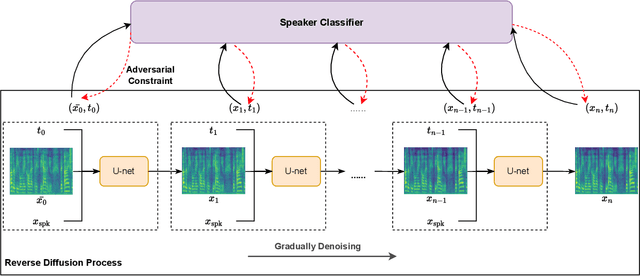
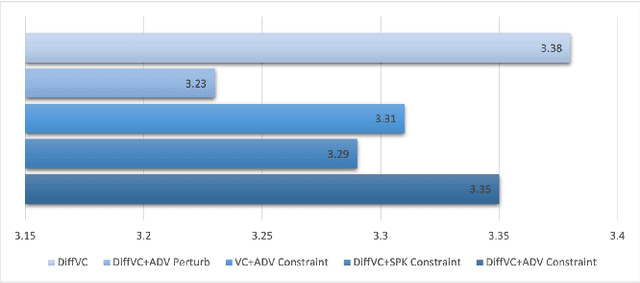
Being a form of biometric identification, the security of the speaker identification (SID) system is of utmost importance. To better understand the robustness of SID systems, we aim to perform more realistic attacks in SID, which are challenging for both humans and machines to detect. In this study, we propose DiffAttack, a novel timbre-reserved adversarial attack approach that exploits the capability of a diffusion-based voice conversion (DiffVC) model to generate adversarial fake audio with distinct target speaker attribution. By introducing adversarial constraints into the generative process of the diffusion-based voice conversion model, we craft fake samples that effectively mislead target models while preserving speaker-wise characteristics. Specifically, inspired by the use of randomly sampled Gaussian noise in conventional adversarial attacks and diffusion processes, we incorporate adversarial constraints into the reverse diffusion process. These constraints subtly guide the reverse diffusion process toward aligning with the target speaker distribution. Our experiments on the LibriTTS dataset indicate that DiffAttack significantly improves the attack success rate compared to vanilla DiffVC and other methods. Moreover, objective and subjective evaluations demonstrate that introducing adversarial constraints does not compromise the speech quality generated by the DiffVC model.