 Add to Chrome
 Add to Firefox
 Add to Edge
Embodied3DBench: Benchmarking Low-Level Embodied Spatial Intelligence of Vision Language Models
May 27, 2026
Are current Vision Language Models (VLMs) ready to comprehend and reason about complex embodied interactions in 3D environments? We introduce Embodied3DBench, a robot-centric benchmark targeting low-level spatial intelligence in embodied 3D environments. To systematically evaluate these foundational perceptual capabilities, the benchmark includes 6 task categories divided into two core groups: Spatial Structural Understanding (Grounding, Spatial Relation Prediction, and Multi-view Correspondence) and Interaction-Oriented Perception (Affordance Prediction, Grasp Point Prediction, and Trajectory Prediction). The benchmark spans 12 subcategories and contains over 21k high-quality question-answer pairs. We evaluate 13 state-of-the-art models, and the results show that while current models exhibit relatively strong high-level spatial reasoning, such as understanding object-to-object positional relations, they remain fragile in interaction-oriented perception, highlighting a significant lack of robust 3D-aware interaction priors. To actively bridge this capability gap revealed by our benchmark, we further synthesize a large-scale training dataset comprising 1.3M QA pairs. Notably, fine-tuning on this dataset yields significant improvements in low-level spatial intelligence. Ultimately, Embodied3DBench fills a critical gap by providing both a systematic evaluation framework and a scalable data solution, setting a clear target for the development of interaction-aware multimodal systems.

Smart Word Suggestions for Writing Assistance
May 17, 2023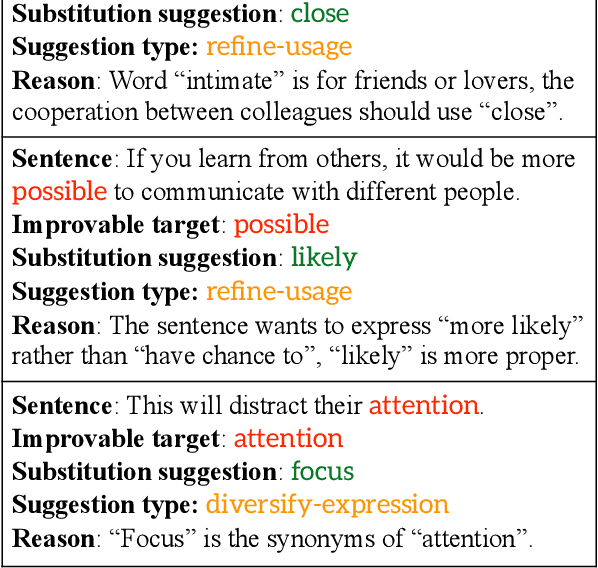
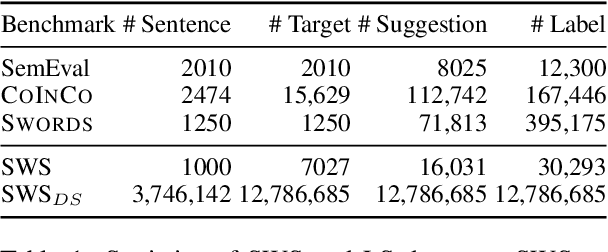
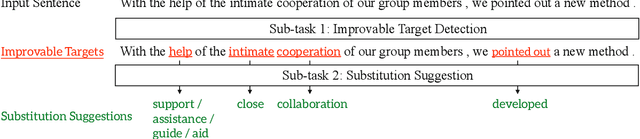
Enhancing word usage is a desired feature for writing assistance. To further advance research in this area, this paper introduces "Smart Word Suggestions" (SWS) task and benchmark. Unlike other works, SWS emphasizes end-to-end evaluation and presents a more realistic writing assistance scenario. This task involves identifying words or phrases that require improvement and providing substitution suggestions. The benchmark includes human-labeled data for testing, a large distantly supervised dataset for training, and the framework for evaluation. The test data includes 1,000 sentences written by English learners, accompanied by over 16,000 substitution suggestions annotated by 10 native speakers. The training dataset comprises over 3.7 million sentences and 12.7 million suggestions generated through rules. Our experiments with seven baselines demonstrate that SWS is a challenging task. Based on experimental analysis, we suggest potential directions for future research on SWS. The dataset and related codes is available at https://github.com/microsoft/SmartWordSuggestions.