 Add to Chrome
 Add to Firefox
 Add to Edge
LatentGym: A Testbed For Cross-Task Experiential Learning With Controllable Latent Structure
Jun 13, 2026
We envision continually learning agentic systems that become more useful over time: as they encounter sequences of related tasks, they should infer the hidden structure shared across those tasks and use it to improve future decisions. This cross-task experiential learning capability is pivotal in domains such as personalization and interactive assistance, but existing training/evaluation frameworks do not provide shared, controllable latent structures and cannot measure whether or why agents improve. We introduce LatentGym: a controllable suite in which each environment is organized around a ground-truth latent variable governing the structure across tasks. Our construction yields metrics that separate exploration (whether the agent's actions gather information about the latent) from exploitation (whether the agent uses what it has gathered). We demonstrate our suite on empirical studies addressing three questions: how and why frontier models fail to adapt across related tasks; whether post-training on related task sequences improves general cross-task adaptation, and where those gains come from; and how design choices such as inter-task feedback shape training dynamics and generalization. Together, these results establish a controlled foundation for studying how LLM agents learn from experience across tasks, and for designing agents that adapt more reliably in sequential, personalized, and interactive settings.

Wan-Image: Pushing the Boundaries of Generative Visual Intelligence
Apr 21, 2026We present Wan-Image, a unified visual generation system explicitly engineered to paradigm-shift image generation models from casual synthesizers into professional-grade productivity tools. While contemporary diffusion models excel at aesthetic generation, they frequently encounter critical bottlenecks in rigorous design workflows that demand absolute controllability, complex typography rendering, and strict identity preservation. To address these challenges, Wan-Image features a natively unified multi-modal architecture by synergizing the cognitive capabilities of large language models with the high-fidelity pixel synthesis of diffusion transformers, which seamlessly translates highly nuanced user intents into precise visual outputs. It is fundamentally powered by large-scale multi-modal data scaling, a systematic fine-grained annotation engine, and curated reinforcement learning data to surpass basic instruction following and unlock expert-level professional capabilities. These include ultra-long complex text rendering, hyper-diverse portrait generation, palette-guided generation, multi-subject identity preservation, coherent sequential visual generation, precise multi-modal interactive editing, native alpha-channel generation, and high-efficiency 4K synthesis. Across diverse human evaluations, Wan-Image exceeds Seedream 5.0 Lite and GPT Image 1.5 in overall performance, reaching parity with Nano Banana Pro in challenging tasks. Ultimately, Wan-Image revolutionizes visual content creation across e-commerce, entertainment, education, and personal productivity, redefining the boundaries of professional visual synthesis.
HY-World 2.0: A Multi-Modal World Model for Reconstructing, Generating, and Simulating 3D Worlds
Apr 15, 2026We introduce HY-World 2.0, a multi-modal world model framework that advances our prior project HY-World 1.0. HY-World 2.0 accommodates diverse input modalities, including text prompts, single-view images, multi-view images, and videos, and produces 3D world representations. With text or single-view image inputs, the model performs world generation, synthesizing high-fidelity, navigable 3D Gaussian Splatting (3DGS) scenes. This is achieved through a four-stage method: a) Panorama Generation with HY-Pano 2.0, b) Trajectory Planning with WorldNav, c) World Expansion with WorldStereo 2.0, and d) World Composition with WorldMirror 2.0. Specifically, we introduce key innovations to enhance panorama fidelity, enable 3D scene understanding and planning, and upgrade WorldStereo, our keyframe-based view generation model with consistent memory. We also upgrade WorldMirror, a feed-forward model for universal 3D prediction, by refining model architecture and learning strategy, enabling world reconstruction from multi-view images or videos. Also, we introduce WorldLens, a high-performance 3DGS rendering platform featuring a flexible engine-agnostic architecture, automatic IBL lighting, efficient collision detection, and training-rendering co-design, enabling interactive exploration of 3D worlds with character support. Extensive experiments demonstrate that HY-World 2.0 achieves state-of-the-art performance on several benchmarks among open-source approaches, delivering results comparable to the closed-source model Marble. We release all model weights, code, and technical details to facilitate reproducibility and support further research on 3D world models.
Self-Distilled RLVR
Apr 03, 2026On-policy distillation (OPD) has become a popular training paradigm in the LLM community. This paradigm selects a larger model as the teacher to provide dense, fine-grained signals for each sampled trajectory, in contrast to reinforcement learning with verifiable rewards (RLVR), which only obtains sparse signals from verifiable outcomes in the environment. Recently, the community has explored on-policy self-distillation (OPSD), where the same model serves as both teacher and student, with the teacher receiving additional privileged information such as reference answers to enable self-evolution. This paper demonstrates that learning signals solely derived from the privileged teacher result in severe information leakage and unstable long-term training. Accordingly, we identify the optimal niche for self-distillation and propose \textbf{RLSD} (\textbf{RL}VR with \textbf{S}elf-\textbf{D}istillation). Specifically, we leverage self-distillation to obtain token-level policy differences for determining fine-grained update magnitudes, while continuing to use RLVR to derive reliable update directions from environmental feedback (e.g., response correctness). This enables RLSD to simultaneously harness the strengths of both RLVR and OPSD, achieving a higher convergence ceiling and superior training stability.
Textual Equilibrium Propagation for Deep Compound AI Systems
Jan 28, 2026Large language models (LLMs) are increasingly deployed as part of compound AI systems that coordinate multiple modules (e.g., retrievers, tools, verifiers) over long-horizon workflows. Recent approaches that propagate textual feedback globally (e.g., TextGrad) make it feasible to optimize such pipelines, but we find that performance degrades as system depth grows. In particular, long-horizon agentic workflows exhibit two depth-scaling failure modes: 1) exploding textual gradient, where textual feedback grows exponentially with depth, leading to prohibitively long message and amplifies evaluation biases; and 2) vanishing textual gradient, where limited long-context ability causes models overemphasize partial feedback and compression of lengthy feedback causes downstream messages to lose specificity gradually as they propagate many hops upstream. To mitigate these issues, we introduce Textual Equilibrium Propagation (TEP), a local learning principle inspired by Equilibrium Propagation in energy-based models. TEP includes two phases: 1) a free phase where a local LLM critics iteratively refine prompts until reaching equilibrium (no further improvements are suggested); and 2) a nudged phase which applies proximal prompt edits with bounded modification intensity, using task-level objectives that propagate via forward signaling rather than backward feedback chains. This design supports local prompt optimization followed by controlled adaptation toward global goals without the computational burden and signal degradation of global textual backpropagation. Across long-horizon QA benchmarks and multi-agent tool-use dataset, TEP consistently improves accuracy and efficiency over global propagation methods such as TextGrad. The gains grows with depth, while preserving the practicality of black-box LLM components in deep compound AI system.
A Closer Look at Personalized Fine-Tuning in Heterogeneous Federated Learning
Nov 16, 2025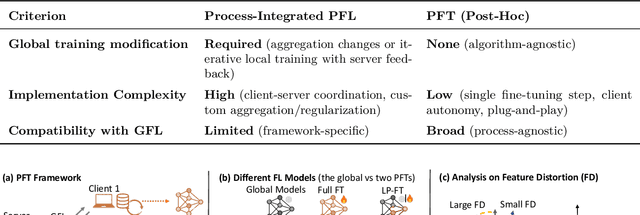
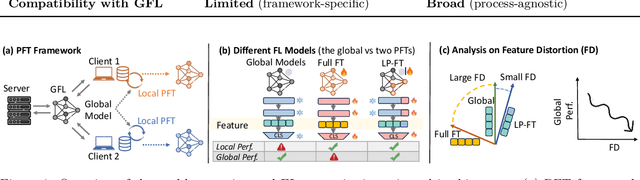
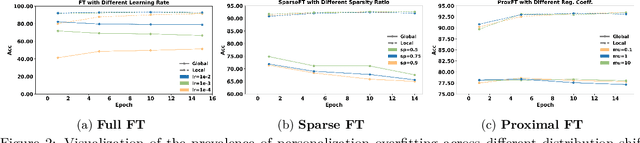
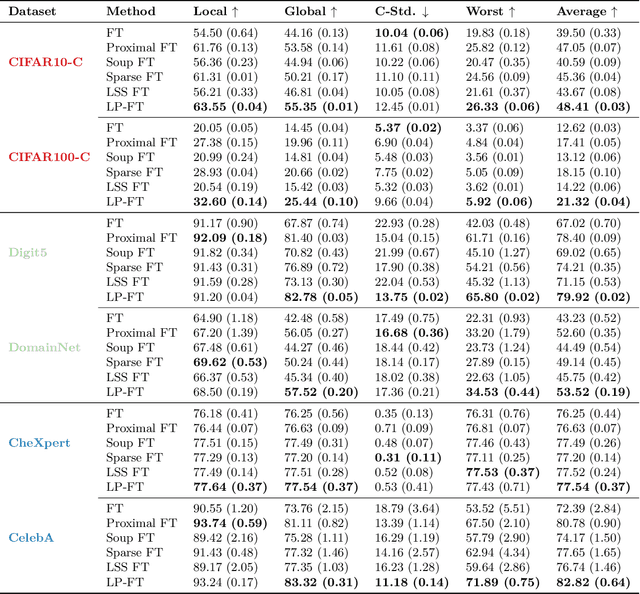
Federated Learning (FL) enables decentralized, privacy-preserving model training but struggles to balance global generalization and local personalization due to non-identical data distributions across clients. Personalized Fine-Tuning (PFT), a popular post-hoc solution, fine-tunes the final global model locally but often overfits to skewed client distributions or fails under domain shifts. We propose adapting Linear Probing followed by full Fine-Tuning (LP-FT), a principled centralized strategy for alleviating feature distortion (Kumar et al., 2022), to the FL setting. Through systematic evaluation across seven datasets and six PFT variants, we demonstrate LP-FT's superiority in balancing personalization and generalization. Our analysis uncovers federated feature distortion, a phenomenon where local fine-tuning destabilizes globally learned features, and theoretically characterizes how LP-FT mitigates this via phased parameter updates. We further establish conditions (e.g., partial feature overlap, covariate-concept shift) under which LP-FT outperforms standard fine-tuning, offering actionable guidelines for deploying robust personalization in FL.
HunyuanWorld 1.0: Generating Immersive, Explorable, and Interactive 3D Worlds from Words or Pixels
Jul 29, 2025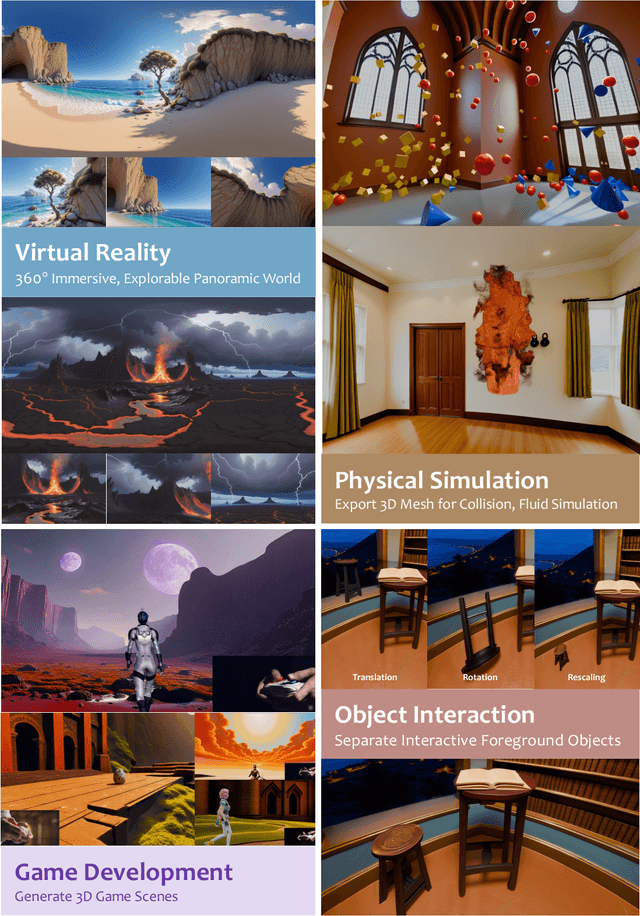

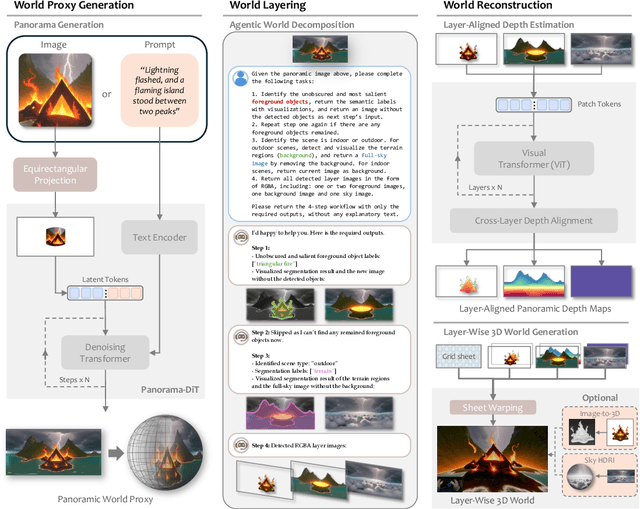
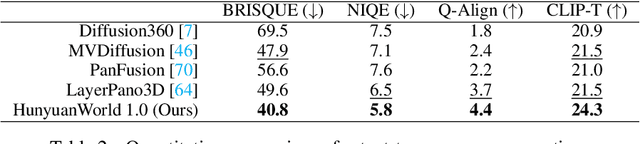
Creating immersive and playable 3D worlds from texts or images remains a fundamental challenge in computer vision and graphics. Existing world generation approaches typically fall into two categories: video-based methods that offer rich diversity but lack 3D consistency and rendering efficiency, and 3D-based methods that provide geometric consistency but struggle with limited training data and memory-inefficient representations. To address these limitations, we present HunyuanWorld 1.0, a novel framework that combines the best of both worlds for generating immersive, explorable, and interactive 3D scenes from text and image conditions. Our approach features three key advantages: 1) 360{\deg} immersive experiences via panoramic world proxies; 2) mesh export capabilities for seamless compatibility with existing computer graphics pipelines; 3) disentangled object representations for augmented interactivity. The core of our framework is a semantically layered 3D mesh representation that leverages panoramic images as 360{\deg} world proxies for semantic-aware world decomposition and reconstruction, enabling the generation of diverse 3D worlds. Extensive experiments demonstrate that our method achieves state-of-the-art performance in generating coherent, explorable, and interactive 3D worlds while enabling versatile applications in virtual reality, physical simulation, game development, and interactive content creation.
Can Textual Gradient Work in Federated Learning?
Feb 27, 2025Recent studies highlight the promise of LLM-based prompt optimization, especially with TextGrad, which automates differentiation'' via texts and backpropagates textual feedback. This approach facilitates training in various real-world applications that do not support numerical gradient propagation or loss calculation. In this paper, we systematically explore the potential and challenges of incorporating textual gradient into Federated Learning (FL). Our contributions are fourfold. Firstly, we introduce a novel FL paradigm, Federated Textual Gradient (FedTextGrad), that allows clients to upload locally optimized prompts derived from textual gradients, while the server aggregates the received prompts. Unlike traditional FL frameworks, which are designed for numerical aggregation, FedTextGrad is specifically tailored for handling textual data, expanding the applicability of FL to a broader range of problems that lack well-defined numerical loss functions. Secondly, building on this design, we conduct extensive experiments to explore the feasibility of FedTextGrad. Our findings highlight the importance of properly tuning key factors (e.g., local steps) in FL training. Thirdly, we highlight a major challenge in FedTextGrad aggregation: retaining essential information from distributed prompt updates. Last but not least, in response to this issue, we improve the vanilla variant of FedTextGrad by providing actionable guidance to the LLM when summarizing client prompts by leveraging the Uniform Information Density principle. Through this principled study, we enable the adoption of textual gradients in FL for optimizing LLMs, identify important issues, and pinpoint future directions, thereby opening up a new research area that warrants further investigation.
Hunyuan3D 2.0: Scaling Diffusion Models for High Resolution Textured 3D Assets Generation
Jan 21, 2025


We present Hunyuan3D 2.0, an advanced large-scale 3D synthesis system for generating high-resolution textured 3D assets. This system includes two foundation components: a large-scale shape generation model -- Hunyuan3D-DiT, and a large-scale texture synthesis model -- Hunyuan3D-Paint. The shape generative model, built on a scalable flow-based diffusion transformer, aims to create geometry that properly aligns with a given condition image, laying a solid foundation for downstream applications. The texture synthesis model, benefiting from strong geometric and diffusion priors, produces high-resolution and vibrant texture maps for either generated or hand-crafted meshes. Furthermore, we build Hunyuan3D-Studio -- a versatile, user-friendly production platform that simplifies the re-creation process of 3D assets. It allows both professional and amateur users to manipulate or even animate their meshes efficiently. We systematically evaluate our models, showing that Hunyuan3D 2.0 outperforms previous state-of-the-art models, including the open-source models and closed-source models in geometry details, condition alignment, texture quality, and etc. Hunyuan3D 2.0 is publicly released in order to fill the gaps in the open-source 3D community for large-scale foundation generative models. The code and pre-trained weights of our models are available at: https://github.com/Tencent/Hunyuan3D-2
Local Superior Soups: A Catalyst for Model Merging in Cross-Silo Federated Learning
Oct 31, 2024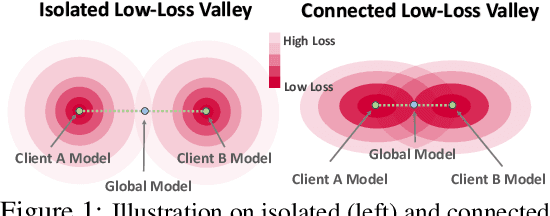
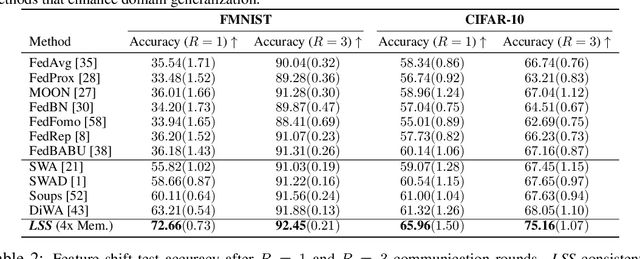
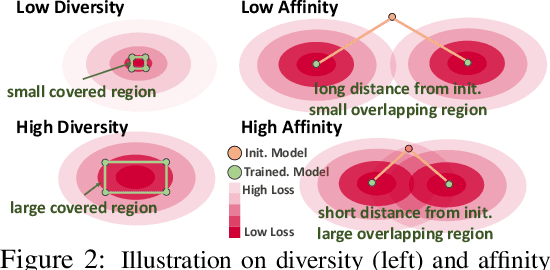
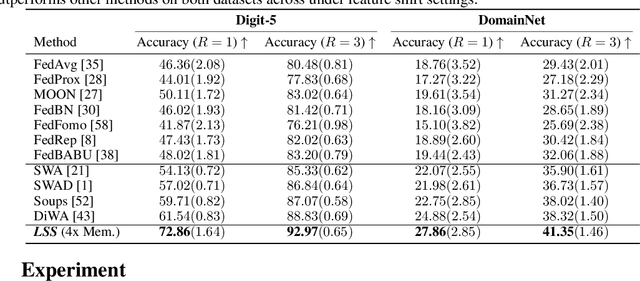
Federated learning (FL) is a learning paradigm that enables collaborative training of models using decentralized data. Recently, the utilization of pre-trained weight initialization in FL has been demonstrated to effectively improve model performance. However, the evolving complexity of current pre-trained models, characterized by a substantial increase in parameters, markedly intensifies the challenges associated with communication rounds required for their adaptation to FL. To address these communication cost issues and increase the performance of pre-trained model adaptation in FL, we propose an innovative model interpolation-based local training technique called ``Local Superior Soups.'' Our method enhances local training across different clients, encouraging the exploration of a connected low-loss basin within a few communication rounds through regularized model interpolation. This approach acts as a catalyst for the seamless adaptation of pre-trained models in in FL. We demonstrated its effectiveness and efficiency across diverse widely-used FL datasets. Our code is available at \href{https://github.com/ubc-tea/Local-Superior-Soups}{https://github.com/ubc-tea/Local-Superior-Soups}.