 Add to Chrome
 Add to Firefox
 Add to Edge
JoyAI-VL-Interaction: Real-Time Vision-Language Interaction Intelligence
Jun 10, 2026
Many moments in the real world do not wait for a user to ask. A fire starts on a security monitor, an expression flickers across a video call, or a product a viewer wants flashes by in a livestream. Yet today's large models remain mostly turn-based by design: they answer only when addressed, and even video-call apps that appear interactive still operate as question-answer systems, reacting only when polled or prompted. We argue for a different paradigm: a model that is present in the world like a person. It continuously watches what is happening now, decides on its own whether to speak or stay silent, interacts in real time, and delegates to a background model when the problem is hard. To advance interaction models and their adoption across domains, we make two fully open-sourced contributions. First, we release JoyAI-VL-Interaction, an 8B-scale, vision-first VL-interaction model. The model makes the response decision internally, choosing each second to stay silent, respond, or delegate to a background model, and it excels at vision-triggered responsiveness and time awareness. We pair it with a transferable training recipe, from which capabilities we never trained for emerge, such as guiding a shopper through changing app screens or improvising a lecture from a slide deck. Second, we release a complete, deployable system built around that model. The system streams any ongoing video into the model, making it genuinely present in the world. All other components are pluggable, including ASR/TTS modules, memory, visualization UI, and a background brain that can connect to any API or agent. Across six real-world scenarios, human raters prefer JoyAI-VL-Interaction over the in-app video-call assistants of Doubao and Gemini by a wide margin. To our knowledge, this is the first open, vision-driven interaction model released together with its training recipe, data, and complete deployable system.

Harnessing Streaming Video in the Wild
Jun 07, 2026Vision-Language Models (VLMs) are increasingly required to process unbounded video streams in applications such as video-call assistants, live commentary, and embodied robots. An ideal streaming system should support proactive interaction, long-horizon memory, and real-time processing, while resting on a VLM backbone capable of handling diverse in-the-wild streaming tasks. However, existing VLMs excel at offline video understanding but fall short in streaming capabilities and lack dedicated infrastructure for streaming deployment. We address this gap on three fronts. (i) For backbone capability, we construct \textbf{Streaming-Train-248K}, a streaming dataset paired with a novel training objective for adapting VLMs to streaming interaction and understanding. (ii) For real-world deployment, we introduce \textbf{Streaming Harness}, a plug-and-play system that endows any VLM with three core abilities: proactive interaction (per-second response decisions), long-term memory (12-hour context retention), and real-time processing (sub-second latency). (iii) To drive continued community progress on streaming capabilities, we design \textbf{Streaming-Eval}, a benchmark that reflects models' capabilities across diverse in-the-wild scenarios. Extensive experiments demonstrate consistent gains from our approach across all core capabilities required for streaming video understanding. We will open-source our data, code, and benchmark to advance the community's shift from offline video understanding to deployable streaming intelligence.
Near-Future Policy Optimization
Apr 22, 2026Reinforcement learning with verifiable rewards (RLVR) has become a core post-training recipe. Introducing suitable off-policy trajectories into on-policy exploration accelerates RLVR convergence and raises the performance ceiling, yet finding a source of such trajectories remains the key challenge. Existing mixed-policy methods either import trajectories from external teachers (high-quality but distributionally far) or replay past training trajectories (close but capped in quality), and neither simultaneously satisfies the strong enough (higher $Q$ , more new knowledge to learn) and close enough (lower $V$ , more readily absorbed) conditions required to maximize the effective learning signal $\mathcal{S} = Q/V$. We propose \textbf{N}ear-Future \textbf{P}olicy \textbf{O}ptimization (\textbf{NPO}), a simple mixed-policy scheme that learns from a policy's own near-future self: a later checkpoint from the same training run is a natural source of auxiliary trajectories that is both stronger than the current policy and closer than any external source, directly balancing trajectory quality against variance cost. We validate NPO through two manual interventions, early-stage bootstrapping and late-stage plateau breakthrough, and further propose \textbf{AutoNPO},an adaptive variant that automatically triggers interventions from online training signals and selects the guide checkpoint that maximizes $S$. On Qwen3-VL-8B-Instruct with GRPO, NPO improves average performance from 57.88 to 62.84, and AutoNPO pushes it to 63.15, raising the final performance ceiling while accelerating convergence.
Self-Distilled RLVR
Apr 03, 2026On-policy distillation (OPD) has become a popular training paradigm in the LLM community. This paradigm selects a larger model as the teacher to provide dense, fine-grained signals for each sampled trajectory, in contrast to reinforcement learning with verifiable rewards (RLVR), which only obtains sparse signals from verifiable outcomes in the environment. Recently, the community has explored on-policy self-distillation (OPSD), where the same model serves as both teacher and student, with the teacher receiving additional privileged information such as reference answers to enable self-evolution. This paper demonstrates that learning signals solely derived from the privileged teacher result in severe information leakage and unstable long-term training. Accordingly, we identify the optimal niche for self-distillation and propose \textbf{RLSD} (\textbf{RL}VR with \textbf{S}elf-\textbf{D}istillation). Specifically, we leverage self-distillation to obtain token-level policy differences for determining fine-grained update magnitudes, while continuing to use RLVR to derive reliable update directions from environmental feedback (e.g., response correctness). This enables RLSD to simultaneously harness the strengths of both RLVR and OPSD, achieving a higher convergence ceiling and superior training stability.
System 1&2 Synergy via Dynamic Model Interpolation
Jan 29, 2026Training a unified language model that adapts between intuitive System 1 and deliberative System 2 remains challenging due to interference between their cognitive modes. Recent studies have thus pursued making System 2 models more efficient. However, these approaches focused on output control, limiting what models produce. We argue that this paradigm is misaligned: output length is merely a symptom of the model's cognitive configuration, not the root cause. In this work, we shift the focus to capability control, which modulates \textit{how models think} rather than \textit{what they produce}. To realize this, we leverage existing Instruct and Thinking checkpoints through dynamic parameter interpolation, without additional training. Our pilot study establishes that linear interpolation yields a convex, monotonic Pareto frontier, underpinned by representation continuity and structural connectivity. Building on this, we propose \textbf{DAMI} (\textbf{D}yn\textbf{A}mic \textbf{M}odel \textbf{I}nterpolation), a framework that estimates a query-specific Reasoning Intensity $λ(q)$ to configure cognitive depth. For training-based estimation, we develop a preference learning method encoding accuracy and efficiency criteria. For zero-shot deployment, we introduce a confidence-based method leveraging inter-model cognitive discrepancy. Experiments on five mathematical reasoning benchmarks demonstrate that DAMI achieves higher accuracy than the Thinking model while remaining efficient, effectively combining the efficiency of System 1 with the reasoning depth of System 2.
TailorKV: A Hybrid Framework for Long-Context Inference via Tailored KV Cache Optimization
May 26, 2025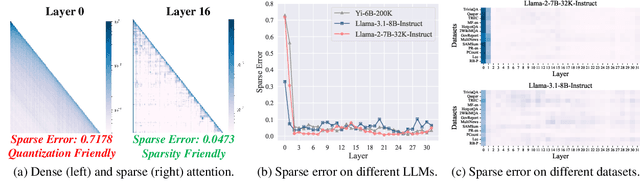

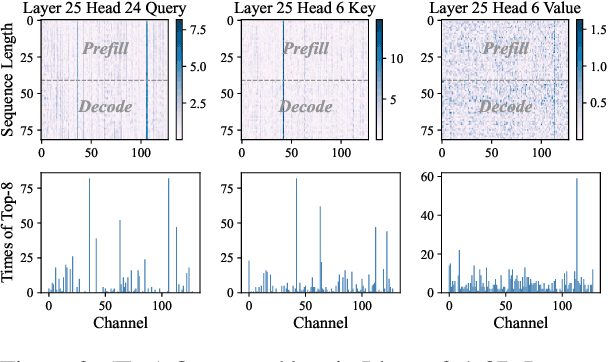
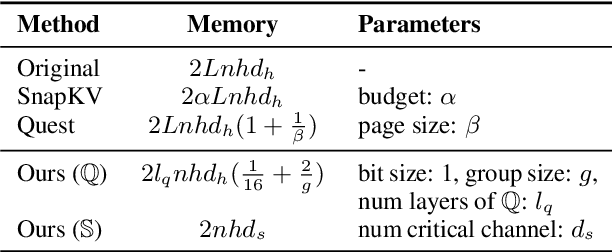
The Key-Value (KV) cache in generative large language models (LLMs) introduces substantial memory overhead. Existing works mitigate this burden by offloading or compressing the KV cache. However, loading the entire cache incurs significant latency due to PCIe bandwidth bottlenecks in CPU-GPU communication, while aggressive compression causes notable performance degradation. We identify that certain layers in the LLM need to maintain global information and are unsuitable for selective loading. In contrast, other layers primarily focus on a few tokens with dominant activations that potentially incur substantial quantization error. This observation leads to a key insight that loading dominant tokens and quantizing all tokens can complement each other. Building on this insight, we propose a hybrid compression method, TailorKV, which seamlessly integrates quantization and offloading. TailorKV develops an inference framework along with a hardware-friendly implementation that leverages these complementary characteristics. Extensive long-context evaluations exhibit that TailorKV achieves nearly lossless performance under aggressive compression settings, outperforming the state-of-the-art. Particularly, the Llama-3.1-8B with 128k context can be served within a single RTX 3090 GPU, reaching 82 ms per token during decoding.