 Add to Chrome
 Add to Firefox
 Add to Edge
Prototype-Based Test-Time Adaptation of Vision-Language Models
Apr 23, 2026
Test-time adaptation (TTA) has emerged as a promising paradigm for vision-language models (VLMs) to bridge the distribution gap between pre-training and test data. Recent works have focused on backpropagation-free TTA methods that rely on cache-based designs, but these introduce two key limitations. First, inference latency increases as the cache grows with the number of classes, leading to inefficiencies in large-scale settings. Second, suboptimal performance occurs when the cache contains insufficient or incorrect samples. In this paper, we present Prototype-Based Test-Time Adaptation (PTA), an efficient and effective TTA paradigm that uses a set of class-specific knowledge prototypes to accumulate knowledge from test samples. Particularly, knowledge prototypes are adaptively weighted based on the zero-shot class confidence of each test sample, incorporating the sample's visual features into the corresponding class-specific prototype. It is worth highlighting that the knowledge from past test samples is integrated and utilized solely in the prototypes, eliminating the overhead of cache population and retrieval that hinders the efficiency of existing TTA methods. This endows PTA with extremely high efficiency while achieving state-of-the-art performance on 15 image recognition benchmarks and 4 robust point cloud analysis benchmarks. For example, PTA improves CLIP's accuracy from 65.64% to 69.38% on 10 cross-domain benchmarks, while retaining 92% of CLIP's inference speed on large-scale ImageNet-1K. In contrast, the cache-based TDA achieves a lower accuracy of 67.97% and operates at only 50% of CLIP's inference speed.

ID-Selection: Importance-Diversity Based Visual Token Selection for Efficient LVLM Inference
Apr 07, 2026Recent advances have explored visual token pruning to accelerate the inference of large vision-language models (LVLMs). However, existing methods often struggle to balance token importance and diversity: importance-based methods tend to retain redundant tokens, whereas diversity-based methods may overlook informative ones. This trade-off becomes especially problematic under high reduction ratios, where preserving only a small subset of visual tokens is critical. To address this issue, we propose ID-Selection, a simple yet effective token selection strategy for efficient LVLM inference. The key idea is to couple importance estimation with diversity-aware iterative selection: each token is first assigned an importance score, after which high-scoring tokens are selected one by one while the scores of similar tokens are progressively suppressed. In this way, ID-Selection preserves informative tokens while reducing redundancy in a unified selection process. Extensive experiments across 5 LVLM backbones and 16 main benchmarks demonstrate that ID-Selection consistently achieves superior performance and efficiency, especially under extreme pruning ratios. For example, on LLaVA-1.5-7B, ID-Selection prunes 97.2% of visual tokens, retaining only 16 tokens, while reducing inference FLOPs by over 97% and preserving 91.8% of the original performance, all without additional training.
Beyond Static Artifacts: A Forensic Benchmark for Video Deepfake Reasoning in Vision Language Models
Feb 25, 2026Current Vision-Language Models (VLMs) for deepfake detection excel at identifying spatial artifacts but overlook a critical dimension: temporal inconsistencies in video forgeries. Adapting VLMs to reason about these dynamic cues remains a distinct challenge. To bridge this gap, we propose Forensic Answer-Questioning (FAQ), a large-scale benchmark that formulates temporal deepfake analysis as a multiple-choice task. FAQ introduces a three-level hierarchy to progressively evaluate and equip VLMs with forensic capabilities: (1) Facial Perception, testing the ability to identify static visual artifacts; (2) Temporal Deepfake Grounding, requiring the localization of dynamic forgery artifacts across frames; and (3) Forensic Reasoning, challenging models to synthesize evidence for final authenticity verdicts. We evaluate a range of VLMs on FAQ and generate a corresponding instruction-tuning set, FAQ-IT. Extensive experiments show that models fine-tuned on FAQ-IT achieve advanced performance on both in-domain and cross-dataset detection benchmarks. Ablation studies further validate the impact of our key design choices, confirming that FAQ is the driving force behind the temporal reasoning capabilities of these VLMs.
DS$^2$Net: Detail-Semantic Deep Supervision Network for Medical Image Segmentation
Aug 06, 2025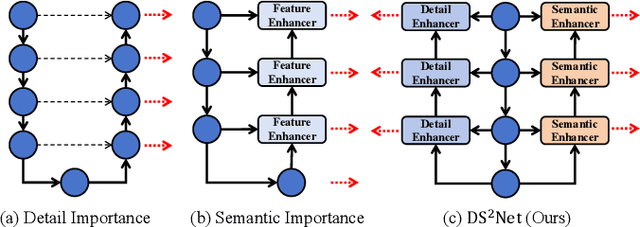
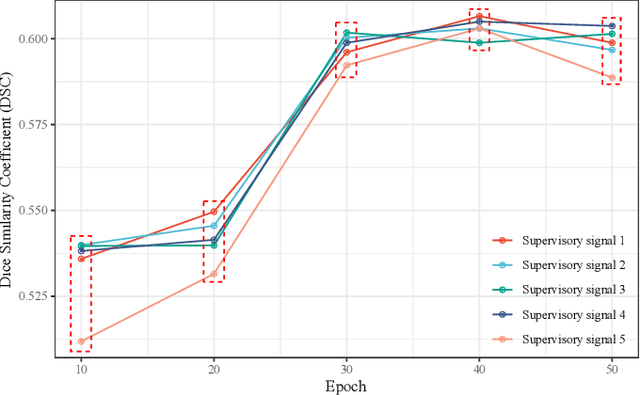
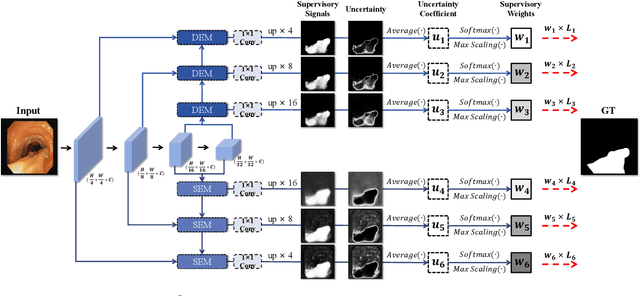
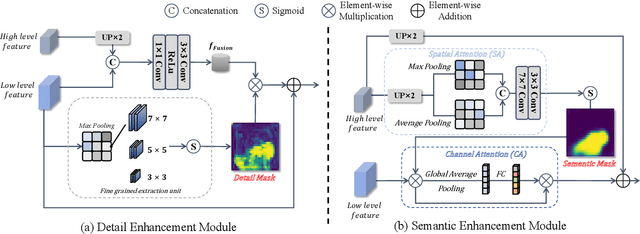
Deep Supervision Networks exhibit significant efficacy for the medical imaging community. Nevertheless, existing work merely supervises either the coarse-grained semantic features or fine-grained detailed features in isolation, which compromises the fact that these two types of features hold vital relationships in medical image analysis. We advocate the powers of complementary feature supervision for medical image segmentation, by proposing a Detail-Semantic Deep Supervision Network (DS$^2$Net). DS$^2$Net navigates both low-level detailed and high-level semantic feature supervision through Detail Enhance Module (DEM) and Semantic Enhance Module (SEM). DEM and SEM respectively harness low-level and high-level feature maps to create detail and semantic masks for enhancing feature supervision. This is a novel shift from single-view deep supervision to multi-view deep supervision. DS$^2$Net is also equipped with a novel uncertainty-based supervision loss that adaptively assigns the supervision strength of features within distinct scales based on their uncertainty, thus circumventing the sub-optimal heuristic design that typifies previous works. Through extensive experiments on six benchmarks captured under either colonoscopy, ultrasound and microscope, we demonstrate that DS$^2$Net consistently outperforms state-of-the-art methods for medical image analysis.
GS-Bias: Global-Spatial Bias Learner for Single-Image Test-Time Adaptation of Vision-Language Models
Jul 16, 2025Recent advances in test-time adaptation (TTA) for Vision-Language Models (VLMs) have garnered increasing attention, particularly through the use of multiple augmented views of a single image to boost zero-shot generalization. Unfortunately, existing methods fail to strike a satisfactory balance between performance and efficiency, either due to excessive overhead of tuning text prompts or unstable benefits from handcrafted, training-free visual feature enhancement. In this paper, we present Global-Spatial Bias Learner (GS-Bias), an efficient and effective TTA paradigm that incorporates two learnable biases during TTA, unfolded as the global bias and spatial bias. Particularly, the global bias captures the global semantic features of a test image by learning consistency across augmented views, while spatial bias learns the semantic coherence between regions in the image's spatial visual representation. It is worth highlighting that these two sets of biases are directly added to the logits outputed by the pretrained VLMs, which circumvent the full backpropagation through VLM that hinders the efficiency of existing TTA methods. This endows GS-Bias with extremely high efficiency while achieving state-of-the-art performance on 15 benchmark datasets. For example, it achieves a 2.23% improvement over TPT in cross-dataset generalization and a 2.72% improvement in domain generalization, while requiring only 6.5% of TPT's memory usage on ImageNet.
TextRefiner: Internal Visual Feature as Efficient Refiner for Vision-Language Models Prompt Tuning
Dec 11, 2024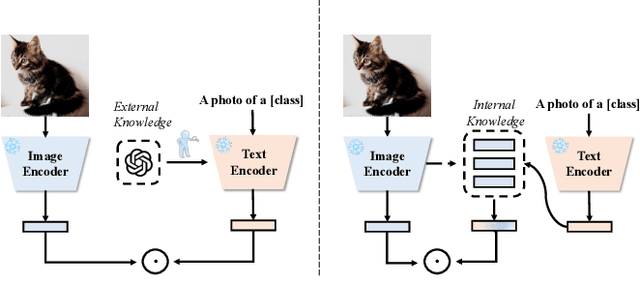


Despite the efficiency of prompt learning in transferring vision-language models (VLMs) to downstream tasks, existing methods mainly learn the prompts in a coarse-grained manner where the learned prompt vectors are shared across all categories. Consequently, the tailored prompts often fail to discern class-specific visual concepts, thereby hindering the transferred performance for classes that share similar or complex visual attributes. Recent advances mitigate this challenge by leveraging external knowledge from Large Language Models (LLMs) to furnish class descriptions, yet incurring notable inference costs. In this paper, we introduce TextRefiner, a plug-and-play method to refine the text prompts of existing methods by leveraging the internal knowledge of VLMs. Particularly, TextRefiner builds a novel local cache module to encapsulate fine-grained visual concepts derivedfrom local tokens within the image branch. By aggregating and aligning the cached visual descriptions with the original output of the text branch, TextRefiner can efficiently refine and enrich the learned prompts from existing methods without relying on any external expertise. For example, it improves the performance of CoOp from 71.66 % to 76.94 % on 11 benchmarks, surpassing CoCoOp which introduces instance-wise features for text prompts. Equipped with TextRefiner, PromptKD achieves state-of-the-art performance and is efficient in inference. Our code is relesed at https://github.com/xjjxmu/TextRefiner