 Add to Chrome
 Add to Firefox
 Add to Edge
InfraNet: Quality-Aware RGB Guidance for Efficient Infrared Object Detection
Jul 04, 2026
Robust object detection under adverse visual conditions remains a long-standing challenge for multi-modal perception systems. Existing fusion-based methods typically require both RGB and infrared (IR) inputs, and treat them equally during both training and inference, which compromises their robustness when the RGB modality becomes unreliable or unavailable. In this case, we propose \textbf{InfraNet}, an IR-centric quality-aware framework that regulates RGB guidance during training and supports flexible RGB--IR or IR-only deployment. InfraNet employs an asymmetric architecture where the primary IR pathway extracts multi-scale infrared features for predictions, while the auxiliary RGB pathway provides reliability-controlled supervisory signals. The core of InfraNet is \textbf{QualGate}, a quality-aware fusion module that learns a task-oriented control signal to suppress unreliable RGB guidance and compensate IR features during cross-modal training. Built upon InfraNet, we design two architectural variants: a lightweight IR-only architecture InfraNet-IR and an RGB--IR architecture InfraNet-RGB-IR. Our method is evaluated through extensive experiments on four benchmark datasets (LLVIP, FLIR-Aligned, M$^3$FD, and DroneVehicle), showing strong or competitive accuracy in challenging low-light and adverse weather conditions. Notably, InfraNet maintains high efficiency in IR-only inference, making it both accurate and computationally efficient.

Teaching Vision-Language-Action Models What to See and Where to Look
Jul 02, 2026Vision-Language-Action (VLA) models have emerged as a promising paradigm for end-to-end autonomous driving. However, existing VLAs' training relies heavily on text-centric visual question answering and chain-of-thought reasoning data, which emphasizes linguistic reasoning rather than action-grounded planning. As a result, the learned representations capture semantic knowledge but lack spatial dependencies crucial for reliable trajectory prediction. We propose DriveTeach-VLA, a framework that explicitly teaches VLAs what to see and where to look. Driving-aware Vision Distillation (DVD) injects driving-specific perceptual priors into the vision encoder, while 2D Trajectory-Guided Prompts (2D-TGP) provide spatial conditioning aligned with feasible driving trajectories. Together, they form a vision-guided learning pipeline: what to see (DVD pretraining) - where to look (TGP-guided SFT) - how to act (TGP-guided GRPO). DriveTeach-VLA achieves the state-of-the-art performance on NAVSIM and nuScenes. Our code is available at: https://github.com/ShivaTeam/DriveTeach-VLA.
Surf3R: Rapid Surface Reconstruction from Sparse RGB Views in Seconds
Aug 06, 2025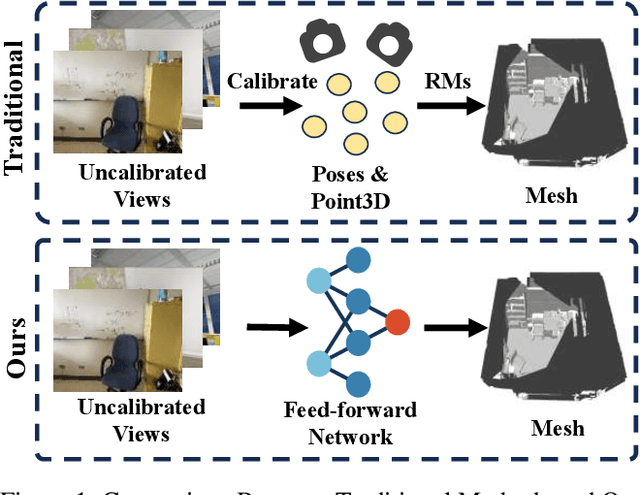
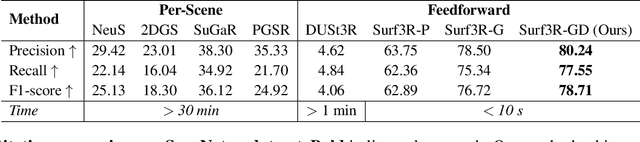
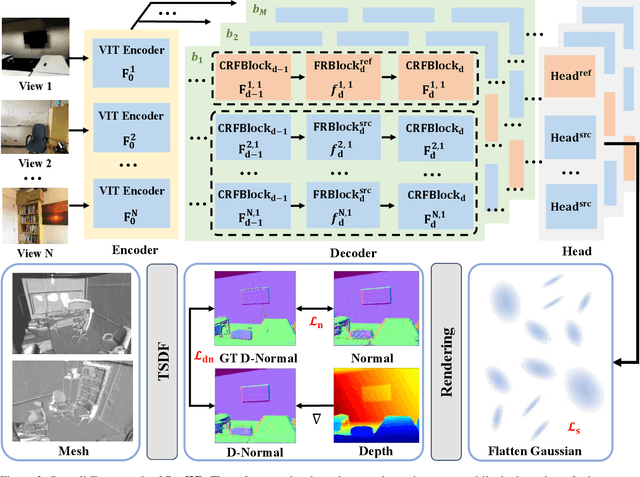

Current multi-view 3D reconstruction methods rely on accurate camera calibration and pose estimation, requiring complex and time-intensive pre-processing that hinders their practical deployment. To address this challenge, we introduce Surf3R, an end-to-end feedforward approach that reconstructs 3D surfaces from sparse views without estimating camera poses and completes an entire scene in under 10 seconds. Our method employs a multi-branch and multi-view decoding architecture in which multiple reference views jointly guide the reconstruction process. Through the proposed branch-wise processing, cross-view attention, and inter-branch fusion, the model effectively captures complementary geometric cues without requiring camera calibration. Moreover, we introduce a D-Normal regularizer based on an explicit 3D Gaussian representation for surface reconstruction. It couples surface normals with other geometric parameters to jointly optimize the 3D geometry, significantly improving 3D consistency and surface detail accuracy. Experimental results demonstrate that Surf3R achieves state-of-the-art performance on multiple surface reconstruction metrics on ScanNet++ and Replica datasets, exhibiting excellent generalization and efficiency.
Squeeze10-LLM: Squeezing LLMs' Weights by 10 Times via a Staged Mixed-Precision Quantization Method
Jul 24, 2025Deploying large language models (LLMs) is challenging due to their massive parameters and high computational costs. Ultra low-bit quantization can significantly reduce storage and accelerate inference, but extreme compression (i.e., mean bit-width <= 2) often leads to severe performance degradation. To address this, we propose Squeeze10-LLM, effectively "squeezing" 16-bit LLMs' weights by 10 times. Specifically, Squeeze10-LLM is a staged mixed-precision post-training quantization (PTQ) framework and achieves an average of 1.6 bits per weight by quantizing 80% of the weights to 1 bit and 20% to 4 bits. We introduce Squeeze10LLM with two key innovations: Post-Binarization Activation Robustness (PBAR) and Full Information Activation Supervision (FIAS). PBAR is a refined weight significance metric that accounts for the impact of quantization on activations, improving accuracy in low-bit settings. FIAS is a strategy that preserves full activation information during quantization to mitigate cumulative error propagation across layers. Experiments on LLaMA and LLaMA2 show that Squeeze10-LLM achieves state-of-the-art performance for sub-2bit weight-only quantization, improving average accuracy from 43% to 56% on six zero-shot classification tasks--a significant boost over existing PTQ methods. Our code will be released upon publication.